Sarvan Kumarhttp://sarvankumar.wordpress.comMy name is Sarvan Kumar, I am post graduate in chemistry (MSc). besides teaching chemistry at various schools and coaching centres I have been giving home tuitions to students for 10 years. I have helped students score good marks in chemistry not only in board examination but also JEE, NEET, SAT, IGCSE and IB examinations. Nearly 90% of my students have scored more than 95% in their CBSE board examination. Moreover they have also secured a seat in prestigious engineering and medical college.
Since every student is different hence my unique style of teach
Chemistry deals with matters and their transformations. Matters are of two types one is pure and another is impure.
Pure matters contain only one kind of particle but impure matters contain more than one kind of particle.
Elements are made by tiny particles called atoms, the particular elements contain only one kind of atoms hence elements are pure substances.
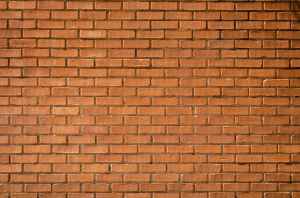
Consider a wall it contain bricks so bricks are building material of wall. We make wall from regular arrangements of bricks. So we can say that bricks are small particle of wall. This is very different things how we made the atoms.
Similarly atoms are building block of an elements. atoms are bricks and element is wall.
Wall Like Elements Each Bricks are like atoms Photo by MESSALA CIULLA on Pexels.com
Atoms are spherical in shape like ball, it has three dimensional structure, in the Centre of atom there is tiny dense nucleus. electrons revolve around the nucleus in 3d spaces. This space we can call electron cloud.
The nucleus contains positively charged protons and uncharged neutrons, thus nucleus is positively charged. In other hand electrons are negatively charged. The number off positively charged protons and negatively charged electrons are equal hence atoms are neutral.
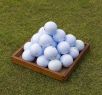
A ball like atoms
Balls are joined with strong force and form a regular arrangement called element
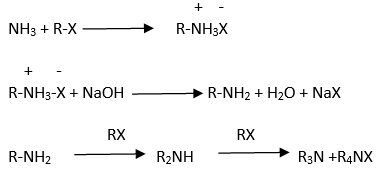
Q.1.Ammonolysis method is not suitable for preparation of primary amines why?
Ans . Ammonolysis gives a mixture of primary, secondary and tertiary amines and also a quaternary ammonium salt hence this method is not suitable for preparation of primary amines.
Q.2. Arrange the order of reactivity of halides with amines RI, RBr, RCl.
Ans.The order of reactivity of halides with amines is RI > RBr > RCl.
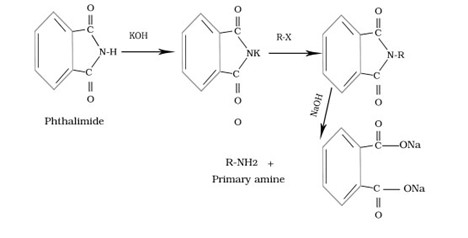
Q.3. Aromatic primary amines cannot be prepared by Gabriel phthalimide synthesis.
Ans. Since C-X bond of aryl halides has partial double bond character due to resonance hence they don’t undergo nucleophilic substitution with the anion formed by phthalimide.
Q.4. Gabriel phthalimide synthesis is used for the preparation of primary amines why?
Ans.This method gives primary amine without any contamination of secondary and tertiary amine.
Q.5. Lower aliphatic amines are soluble in water why?
Ans. Because they can form hydrogen bonds with water molecules. However, solubility decreases with increase in molar mass of amines due to increase in size of the hydrophobic alkyl part.
Q.6.Which is more soluble in alcohol and amine if they have comparable molecular mass?
Ans. Since electronegativity of oxygen is higher than nitrogen hence alcohols are more polar than amines and form stronger intermolecular hydrogen bonds than amines hence alcohols are more soluble than amines.
Q.7.The order of boiling point of isomeric amines is as follows Primary > Secondary > Tertiary why?
Ans. The intermolecular association is more in primary amines than in secondary amines as there are two hydrogen atoms available for hydrogen bond formation in it. Tertiary amines do not have intermolecular association due to the absence of hydrogen atom available for hydrogen bond formation.
Q.8. Amines are basic in nature why?
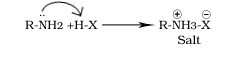
Ans. It is due to the presence of a lone pair on nitrogen, it can react with acid and forms salt.
Q.9 .Compare basic strength between aliphatic amines and ammonia.
Ans. Due to electron releasing nature of alkyl group, it (R) pushes electrons towards nitrogen and thus makes the unshared electron pair more available for sharing with the proton of the acid thus aliphatic amines are more basic than ammonia.
Q.10.The order of basicity of amines in the gaseous phase follows the expected order
Ans. Due to the electron releasing nature of alkyl group, it (R) pushes electrons towards nitrogen and thus makes the unshared electron pair more available for sharing with the proton of the acid. Since number of alkyl groups increases from primary amine to tertiary amine hence basic strength also increases in same order.
Q.11.The order of the basic strength in case of ethyl substituted amines in aqueous solution is as follows why?
(C2H5)2NH > (C2H5)3NH > (C2H5)3NH >NH3
Ans.The basic strength of amines depends on three factors.
Inductive effect
Solvation effect
Steric hinderance of the alkyl group
Since steric hindrance effect of ethyl groups in tertiary amine make the stability of substituted ammonium cation lesser than that of secondary amine hence basic strength of tertiary amine is lower than secondary amine.
Q.12.The order of the basic strength in case of methyl substituted amines in aqueous solution is as follows why?
(CH3)2NH > CH3NH2 > (CH3)3N > NH3
Ans.The basic strength of amines depends on three factors.
Inductive effect
solvation effect
Steric hinderance of the alkyl group
When the alkyl group is small, like –CH3 group, there is no steric hindrance to H-bonding hence the stability of substituted ammonium cation in case of tertiary amine is lesser than that of primary amine hence basic strength of tertiary amine is lower than the primary amine.
Q.13. Why is ammonia more basic than arylamines.
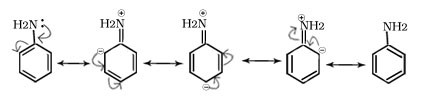
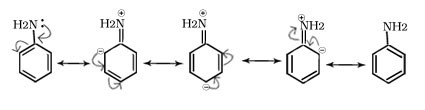
Ans. the -NH2 group is attached directly to the benzene ring. It results in the unshared electron pair on nitrogen atom to be in conjugation with the benzene ring and thus making it less available for protonation.
Q.14.What is the effect of electron releasing group and electron withdrawing group on basic strength of substituted aniline?
Ans. In case of substituted aniline, electron releasing groups like –OCH3, –CH3 increase the basic strength whereas electron withdrawing groups like –NO2, –SO3H, –COOH, –X decrease it.
Q.15.Arrange the following compounds in decreasing order of their basic strength:
C6H5NH2, C2H5NH2, (C2H5)2NH, NH3
Ans. The decreasing order of the basic strength of above amines and ammonia is in following order:
(C2H5)2NH > C2H5NH2 > NH3 > C6H5NH2
Above order is due to aromatic amine is less basic than aliphatic amine and ammonia due to resonance stabilization of lone pair of nitrogen of aniline with benzene ring.
Q.16. –NH2 group in aniline is ortho and para directing towards electrophilic substitution reaction and a powerful activating group why?
Ans.Ortho- and para-positions to the –NH2 group become canters of high electron density due to +R (resonance). Thus –NH2 group is ortho and para directing and a powerful activating group.
Q. 17.The activating effect of –NHCOCH3 group is less than that of amino group.
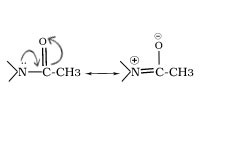
Ans. The lone pair of electrons on nitrogen of acetanilide interacts with oxygen atom through resonance. Thus it is less available for donation to benzene ring by resonance. Therefore, activating effect of –NHCOCH3 group is less than that of the amino group.
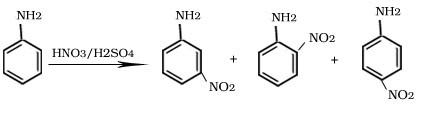
Q.18.Besides the ortho and para derivatives, significant amount of meta derivative is also formed during nitration of aniline why?
Ans. In the strongly acidic medium, aniline is protonated to form the anilinium ion which is meta directing.
Q.19.Aniline does not undergo Friedel-Crafts reaction (alkylation and acetylation) why?
Ans. Due to the salt formation with aluminum chloride, the Lewis acid, which is used as a catalyst, nitrogen of aniline acquires positive charge and hence acts as a strong deactivating group for further reaction.
Distinguish reactions
Distinguish between aliphatic primary amine/Aniline and secondary amine/tertiary amine. Aliphatic primary amine/Aniline gives the carbylamines test but secondary amine/tertiary amine does not give this test.
R-NH2 + CHCl3 + 3KOH → R-NC + 3KCl + 3H2O (RNC is phenyl isocyanide which is foul smelling substance.
Distinguish between aliphatic primary amine and aniline.
Nitrous acid test is used for this test. Both aliphatic primary amine and aniline give this test but in different way.
Benzene diazonium chlorides (C6H5N2Cl ) gives yellow color after coupling reaction with aniline.
Distinguish reaction between secondary amine and tertiary amine.
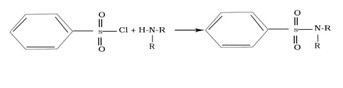
Hinsberg test is used for this reaction
Tertiary amines do not give this test. Secondary amines and primary amine react with Hinsberg reagent but product of primary amine and this reagent is soluble in KOH but that of secondary amine is insoluble.
Name Reactions
Ammonolysis
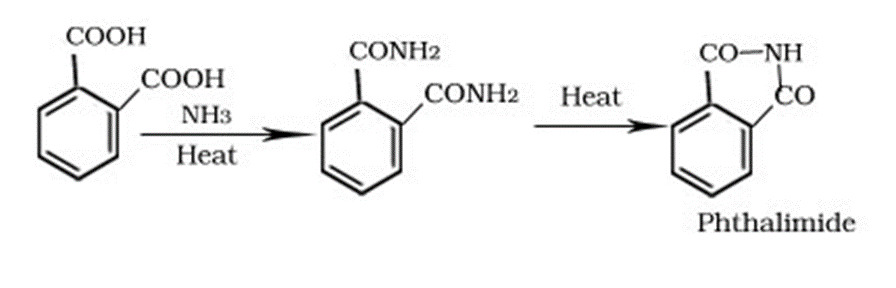
Gabriel phthalimide synthesis
Hoffmann bromamide degradation reaction
Coupling Reaction
Gattermann reaction
Other reactions
Acylation
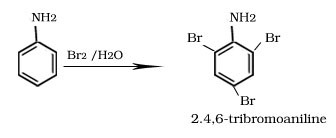
Bromination of aniline
Nitration of aniline
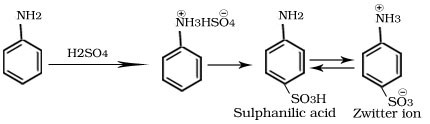
Sulphonation of aniline
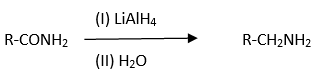
Formation of amines from nitro compound
Formation of amine from amide
Formation of amine from nitriles
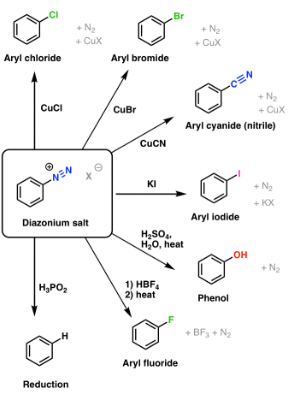
Reactions of Benzene diazonium chloride
Formation of nitrobenzene from benzene diazonium chloride
Q.1.The boiling point of aldehydes and ketones are higher than hydrocarbons having comparable molecular masses why?
Ans. Boiling point of aldehydes and ketones are higher than that of hydrocarbons because they are polar and hydrocarbons are non-polar therefore, the intermolecular dipole-dipole attraction in aldehydes and ketones is stronger than hydrocarbons.
Q.2.The boiling point of aldehydes and ketones are higher than ethers having comparable molecular masses why?
Ans. Boiling point of aldehydes and ketones are higher than that of ethers because they are more polar than ethers therefore, the intermolecular dipole-dipole attraction in aldehydes and ketones is stronger than ethers.
Q.3. Boiling point of aldehydes and ketones are lower than those of alcohols of similar molecular masses why?
Ans. It is due to absence of intermolecular hydrogen bonding in aldehydes and ketones.
Q.4. The lower members of aldehydes and ketones such as methanal, ethanal and propanone are miscible in water why ?
Ans. Lower members of aldehydes and ketones are able to form hydrogen bond with water. As molecular mass increases hydrophobic alkyl part also increases thus solubility decreases.
Q.5. Arrange the following compounds in increasing order of their boiling point.
Above order is due to alcohols have hydrogen bonding between their molecules. Aldehydes have dipole- dipole interaction and hydrocarbons are non polar.
Q.6. Aldehydes and ketones generally give nucleophilic addition reactions why?
Ans .It is due to electrophilic nature of carbon of carbonyl group.
Q.7. Aldehydes are generally more reactive than ketones in nucleophilic addition reactions why?
Ans. It is due to two reasons.
1.Steric hindrance effect of alkyl groups present at electrophilic carbon.
The presence of two relatively large substituents in ketones hinders the approach of nucleophile to carbonyl carbon.
2. +I effect of alkyl groups present at electrophilic carbon.
Two alkyl groups reduce the electrophilicity of the carbonyl carbon more effectively in ketones.
Q.8. Arrange the following compounds in increasing order of their reactivity in nucleophilic addition reactions.
(i) Ethanal, Propanal, Propanone, Butanone.
(ii) Benzaldehyde, p-Tolualdehyde, p-Nitrobenzaldehyde, Acetophenone.
Ans (i). Butanone < Propanone < Propanal < Ethanal.
Ethanal and Propanal are aldehyde hence they are more reactive than propanone and butanone. Electrophilic carbon of butanone has larger alkyl groups than propanone hence former is less reactive.
(ii) Acetophenone < p-Tolualdehyde < Benzaldehyde < p-Nitrobenzaldehyde
Above order is due to acetophenone is ketone. Pushing group (CH3) decreases the electrophilic nature of carbon of carbonyl group and that of pulling group (like NO2) increases.
Q.9. Carboxylic acids are higher boiling liquids than aldehydes, ketones and even alcohols having comparable molecular masses why ?
Ans. It is due to more extensive association of carboxylic acid molecules through intermolecular hydrogen bonding.
Q.10. Simple aliphatic carboxylic acids having upto four carbon atoms are miscible in water why?
Ans. It is due to the formation of hydrogen bonds with water. The solubility decreases with increasing number of carbon atoms. Higher carboxylic acids are insoluble in water due to the increased hydrophobic interaction of hydrocarbon part.
Q.11. Give the reactions which suggest carboxylic acids are acidic in nature.
Ans. CH3-COOH + Na → CH3COONa + H2
CH3COOH + NaHCO3 → CH3COONa + H2O + CO2
Q.12.What is Ka and PKa?
Ans. Ka is ionization constant of acid. Higher the value of Ka higher the acidic strength. PKa is –log Ka thus lower the PKa value higher the acidic strength.
Q.13.Carboxylic acids are more acidic than Phenol why?
Ans.
The carboxylate ion is more stabilized than phenoxide ion, so carboxylic acids are more acidic than phenols. The conjugate base of carboxylic acid, a carboxylate ion, is stabilised by two equivalent resonance structures in which the negative charge is at the more electronegative oxygen atom. The conjugate base of phenol, a phenoxide ion, has non-equivalent resonance structures in which the negative charge is at the less electronegative carbon atom.
Q.14.How does electron withdrawing group and electron releasing group affect the acidic strength of carboxylic acid?
Ans. Electron withdrawing groups increases the acidity of carboxylic acids by stabilising the conjugate base through delocalisation of the negative charge by inductive and/or resonance effects. Conversely, electron donating groups decrease the acidity by destabilising the conjugate base.
The effect of the following groups in increasing acidity order is
Ph < I < Br < Cl < F < CN < NO2 < CF3
Higher the carbon atoms in alkyl group higher the pushing effect.Thus, the following acids are arranged in order of increasing acidity
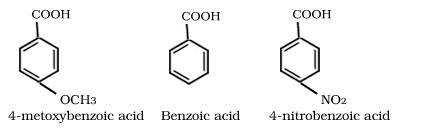
Q.15. Arrange the para-methoxybenzoic acid ,Benzoic acid and p-nitrobenzoic acid in decreasing order of acidic strength.
Electron withdrawing group increases while electron donating groups decrease the acidic strength of benzoic acid.
Q.16.Which is more acidic in prop-2-enoic acid and propanoic acid?
Ans. Conjugate –ve ion of prop-2-enoic acid is extra resonance stabilized hence it is more acidic than propanoic acid.
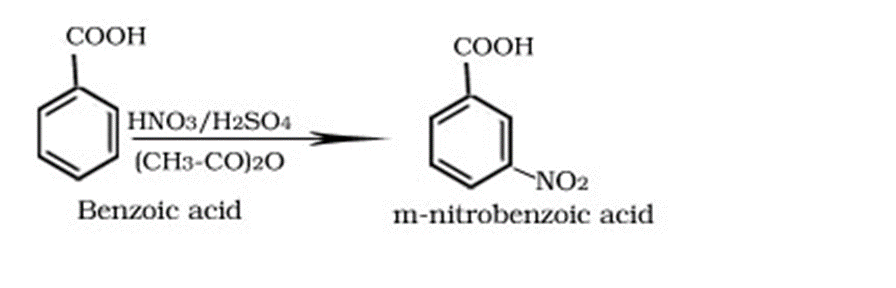
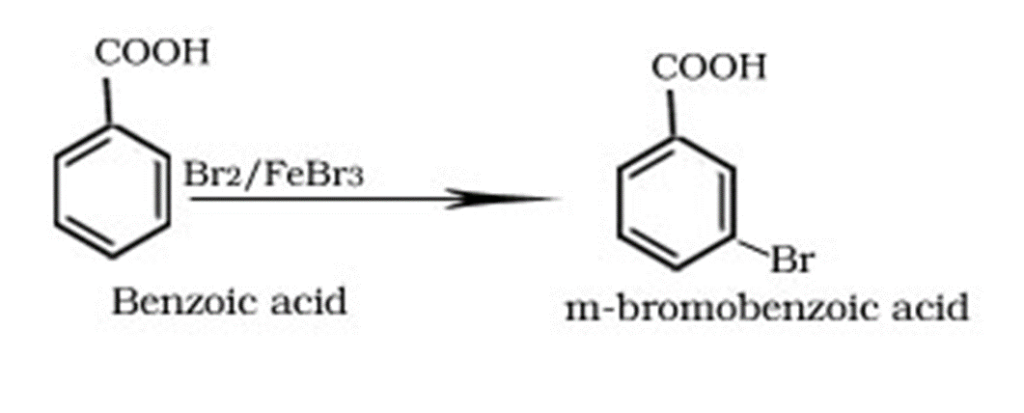
Q.17.Aromatic carboxylic acids undergo electrophilic substitution reactions in which the carboxyl group acts as a deactivating and meta-directing group why?
Ans.
Carboxyl group withdraw electrons from benzene ring by –R effect hence it is deactivating group since electron density is high at meta position hence it is meta directing.
Q.18.Benzoic acid do not undergo Friedel-Crafts reaction why?
Ans. Because the carboxyl group is deactivating and the catalyst aluminum chloride (Lewis acid) gets bonded to the carboxyl group).
Name Reactions in Aldehydes, Ketones and Carboxylic Acids
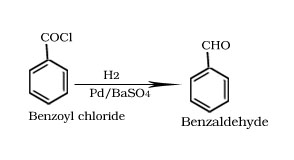
Rosenmund reduction
Rosenmund reduction
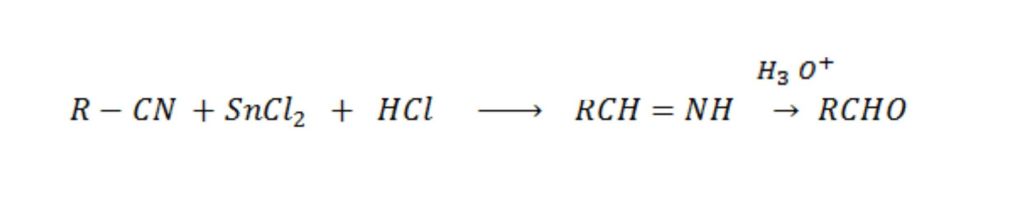
Stephen reaction
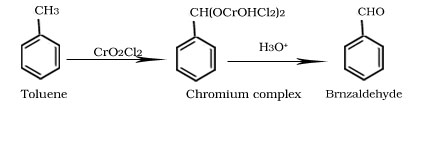
Etard reaction
Etard reaction
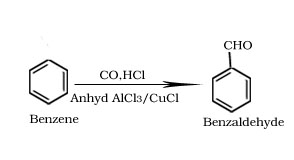
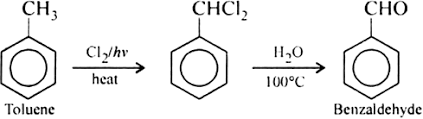
Gatterman-Koch reaction
Gatterman-Koch reaction
Clemmensen reduction
Clemmensen reduction
Wolff-Kishner reduction
Wolff-Kishner reduction
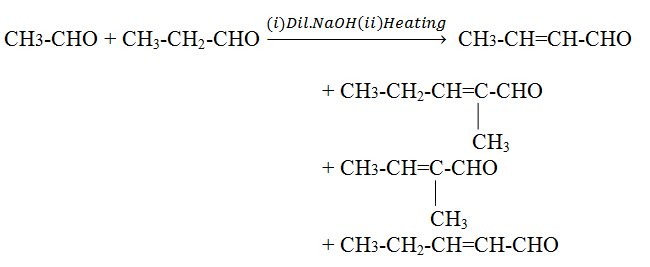
Aldol condensation
Aldol condensation
Cross aldol condensation
Cross aldol condensation
Cannizzaro reaction
Cannizzaro reaction
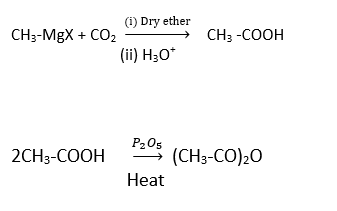
Decarboxylation reaction
Hell-Volhard-Zelinsky reaction
Hell-Volhard-Zelinsky reaction
Distinguish reaction
Tollen’s reagent test
Distinguish between aldehydes and ketones.
Aldehydes react with Tollen’s reagent and give silver mirror test. Ketones give no reaction with Tollen’s reagent
Fehling solution test
Distinguish between aldehydes and ketones.
Aldehydes react with Fehling reagent and give red brown ppt of Cu2O. Ketones give no reaction with Fehling reagent. Aromatic Aldehydes don’t give Fehling’s test.
Iodoform test
Distinguish between aldehydes and aldehydes and ‘ketones and ketones’.
Those aldehydes and ketones having CH3CO-give Iodoform test thus in aldehyde family only ethanal gives this test. In ketone family all methyl ketones give this test.
R-CO-CH3+ 3I2 + 4 NaOH → R-COONa +CHI3
Sodium hydrogencarbonate test
Distinguish between Carboxylic acid/Benzoic acid and alcohols/phenols
Carboxylic acids and benzoic acid react with sodium hydrogencarbonate give this test and release CO2. Alcohols and phenols don’t react with sodiumhydrogencarbonate.
Q.1.The boiling point of alcohols increases with increase in the number of carbon atoms why ?
Ans As mass increases van der Waals force between molecules increases hence boiling point increases.
Q.2.Boiling point of alcohols is higher than hydrocarbons, ethers, haloalkanes of comparable molecular masses why?
Ans.Higher boiling point of alcohols is due to the presence of intermolecular hydrogen bonding in them which is not present in ethers, haloalkanes, haloarenes and hydrocarbons.
Q.3.Alcohols are soluble in water why?
Ans.Solubility of alcohols in water is due to their ability to form hydrogen bond with water molecules.
Q.4.Solubility of alcohols decreases with increase in number of carbon atoms why?
Ans.It is due to increasing hydrophobic alkyl part in alcohols.
Q.5.Arrange the following sets of compounds in order of their increasing boiling points:
(b) n-Butane, ethoxyethane, pentanal and pentan-1-ol
n-butane has dispersion force ether, pentanal have dipole-dipole attraction and alcohol has H-bonding between their molecules.
Q.6.Give a reaction which proves alcohols are acidic in nature.
Ans. R-OH + Na → R-ONa + H2 . Evolution of H2 gas with metals proves that alcohols are acidic in nature.
Q.7.Give two reactions which prove phenol is acidic in nature.
Ans.
C6H5OH + Na → C6H5ONa + H2
C6H5OH + NaOH → C6H5ONa + H2O
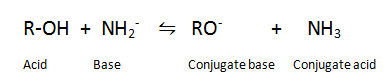
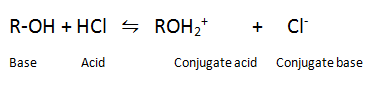
Q.8.Give a reaction which shows alcohols are Bronsted acid.
Ans.
Ans. Alcohols can donate a proton to a stronger base.
Q.9.Give a reaction which shows alcohols are weaker acid than water.
Ans.
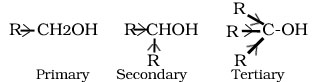
Q.10.Arrange primary ,secondary and tertiary alcohol in decreasing order of their acidic strength.
Ans.
An electron releasing alkyl group increases electron density on oxygen tending to decrease the polarity of O-H bond. This decreases the acid strength.
Q.11.Give a reaction which shows alcohols act as Bronsted bases.
Ans It is due to the presence of unshared electron pairs on oxygen, which makes them proton acceptors.
Q.12. Phenol is stronger acids than alcohols and water.
Ans
In alkoxide ion, the negative charge is localised on oxygen while in phenoxide ion, the charge is delocalized,hence phenoxide ion is more stable than alkoxide ion.Thus phenol is more acidic than alcohol.
Q.13.Arrange o- Nitrophenol p-Nitrophenol m-Nitrophenol o-cresol,m-cresol,p-cresol ,phenol and ethanol in decreasing order of acidic strength.
The presence of electron withdrawing groups such as nitro group, enhances the acidic strength of phenol and releasing groups, such as alkyl groups decreases the acidic strength.
Explanation:2
Phenoxide ion is more stable when withdrawing group is present on ortho and para positions It is due to the effective delocalisation of negative charge in phenoxide ion.
Explanation:3
Phenoxide ion is less stable when releasing group is present on ortho and para position.
Q.14.Arrange following compounds in the order of their acidic strength:
Ans. Propan-1-ol < 4-methylphenol < phenol < 3-nitrophenol <3,5-dinitrophenol <2,4,6-trinitrophenol
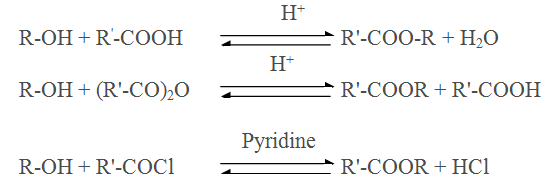
Q.15.During esterification between carboxylic acid and acid chloride pyridine is mixed with solution why ?
Ans Since esterification is reversible reaction hence the reaction with acid chloride is carried out in the presence of a base (pyridine) to neutralise HCl which is formed during the reaction.
Q.16.During esterification between carboxylic acid and alcohol water is removed as
soon as it is formed why?
Ans. Since esterification is reversible reaction hence water is removed as soon as it is formed.
Q.17.Arrange the reactivity of primary, secondary and tertiary alcohols towards dehydration in decreasing order.
Ans Tertiary > Secondary > Primary. it is due to decreasing order of intermediate carbocation in following order
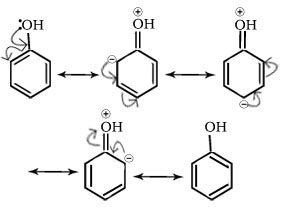
Q.18.–OH present at benzene ring in phenol is activating group and ortho and para directing why?
Ans. It is due to +R effect of –OH group electron density is high at ortho and para position.
Q.19 .Which is steam volatile in o-nitrophenol and p-nitrophenol .
Ans.O-nitrophenol is steam volatile due to intramolecular hydrogen bonding while p-nitrophenol is less volatile due to intermolecular hydrogen bonding which causes the association of molecules.
Q.20.Formation of ethers from dehydration of alcohol is suitable having primary alkyl groups only why?
Ans.The reaction follows SN1 pathway when the alcohol is secondary or tertiary and elimination competes over substitution and alkenes are easily formed.
Q.21. In the formation of ethers from Williamson synthesis better results are obtained if the alkyl halide is primary.
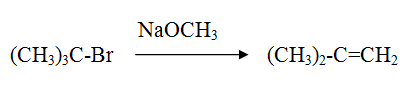
Ans.In case of secondary and tertiary alkyl halides, elimination competes over substitution. If a tertiary alkyl halide is used, an alkene is the only reaction product and no ether is formed.
Q.22.Compare boiling point between alcohols and ethers having comparable mass.
Ans Since alcohol molecules are joined with each other by H-bonding and ethers have weak dipole -dipole interactions hence alcohols have higher boiling point than ethers.
Q.23. Ethers are soluble in water why?
Ans Oxygen of ether can also form hydrogen bonds with water molecule.
Q.24.Arrange reactivity of different hydrogen halide with ether in decreasing order.
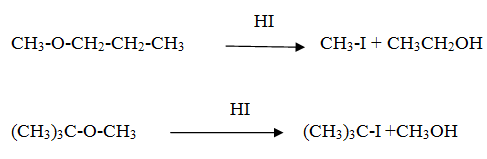
Ans The order of reactivity of hydrogen halides is HI > HBr > HCl
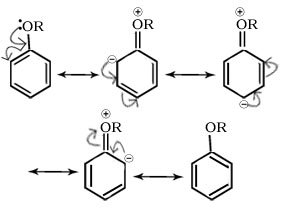
Q.26.The alkoxy group (-OR) is ortho ,para directing and activates the aromatic ring towards electrophilic substitution why.
Ans
Ans. It is due to +R effect of –OR group electron density is high at ortho and para positions.
Distinguish reactions
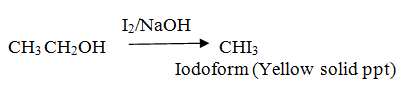
Distinguish between ethanol and phenol (Iodoform test)
Ethanol gives Iodoform test.
Phenol doesn’t give Iodoform test.
Distinguish reaction between ethanol and propanol(Iodoform test)
Ethanol gives Iodoform Test.
Propanol gives no Iodoform test.
Distinguish reaction between propanol and 2-methylpropan-2-ol(Lucas test)
Tertiary alcohol (2-methylpropan-2-ol) reacts with Lucas reagent (HCl+ZnCl2) immediately and produce haloalkane with turbidity. Primary alcohol (Propanol) does not produce turbidity at room temperature.
Name reactions
Kolbe’s reaction
Kolbe’s reaction
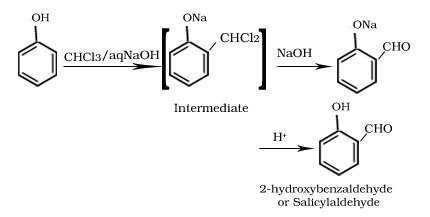
Reimer-Tiemann reaction
Reimer-Tiemann reaction
Williamson synthesis
R-X + R-ONa → R-O-R + NaX
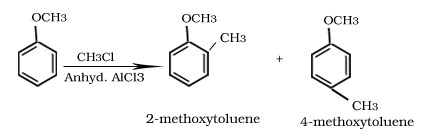
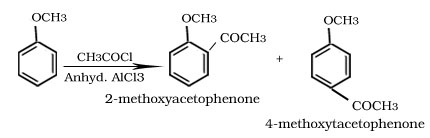
Friedel -Crafts alkylation and acylation reaction of anisole
Friedel -Crafts alkylation reaction of anisole
Friedel -Crafts acylation reaction of anisole
Nitration of anisole
Nitration of anisole
Halogenation of anisole
Halogenation of anisole
Mechanism
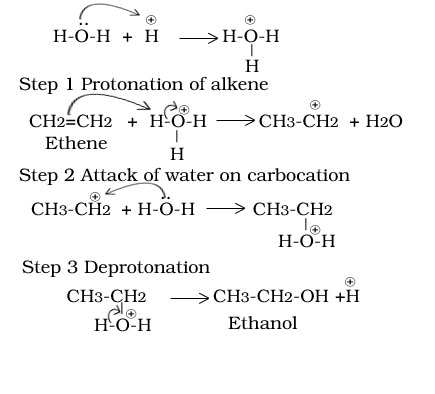
Ethene to ethanol
Mechanism of ethene to ethanol
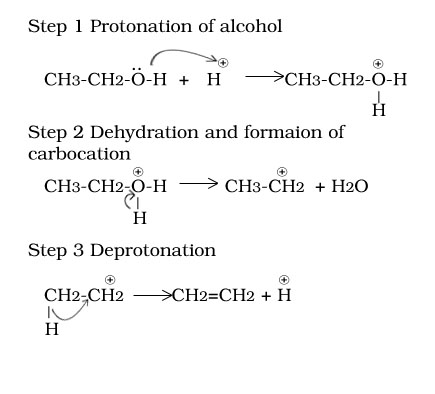
Ethanol to ethene
Mechanism of ethanol to ethene
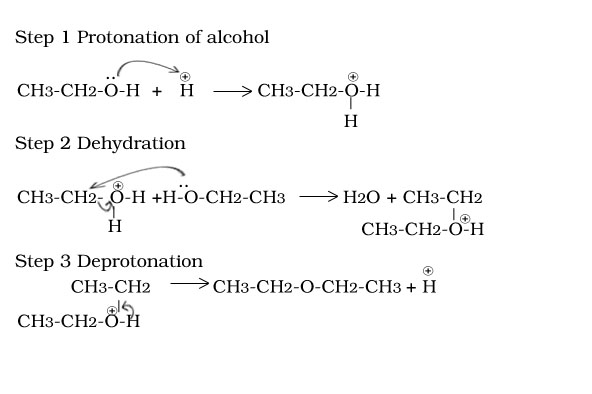
Ethanol to ether
Mechanism of Ethanol to ether
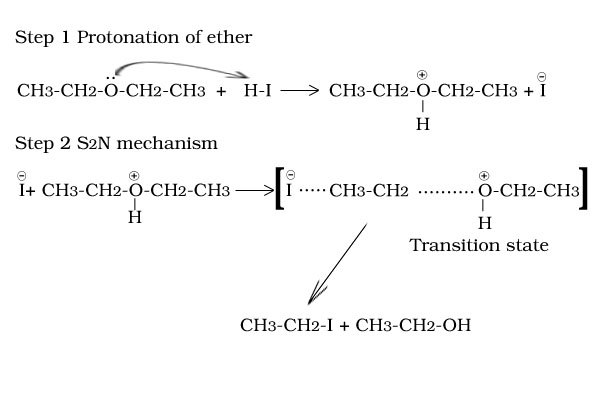
Reaction of ethoxy ethane with HI
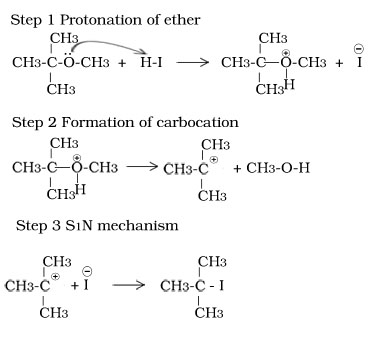
Reaction of tertiary butyl methyl ether with HI
Other reactions
Markonikov hydration of alkene
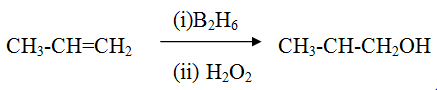
Hydroboration -oxidation reaction of alkene
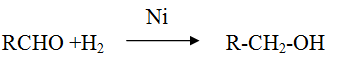
Reduction of aldehyde and ketone
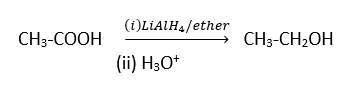
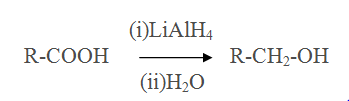
Reduction of Carboxylic acid
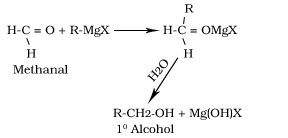
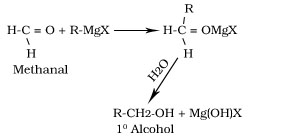
Reaction of Grignard reagent with methanal,other aldehydes and ketones
Formation of phenol from chlorobenzene
Formation of phenol from benzene and oleum
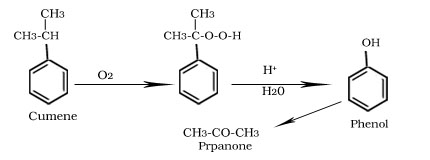
Formation of phenol from Cumene
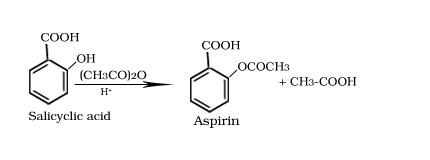
Formation of aspirin from salicyclic acid
Esterification of alcohol using carboxylic acid,anhydride,acid halide
Acid catalysed Dehydration of primary alcohol, Secondary alcohol,Tertiary alcohol
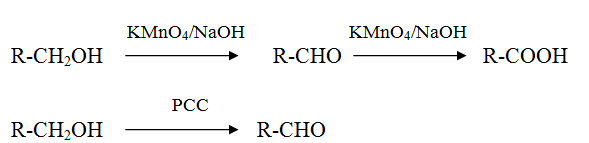
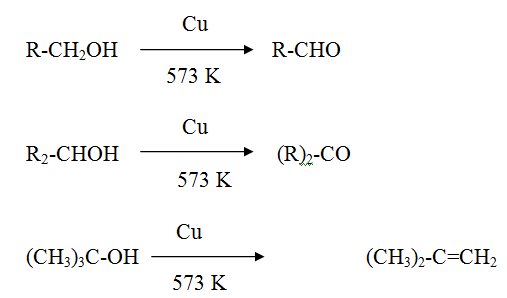
Oxidation of alcohol
Reaction of alcohol with hot copper
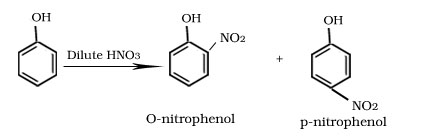
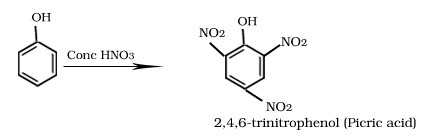
Nitration of phenol
Nitration of phenol with dilute nitric acid
Nitration of phenol with Conc. nitric acid
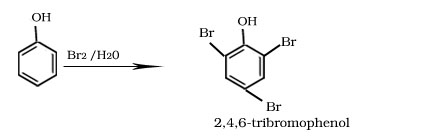
Bromination of phenol
Bromination of phenol in polar medium
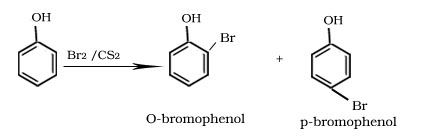
Bromination of phenol in non polar medium
Reaction of phenol with zinc dust
Reaction of phenol with Zn Dust
Oxidation of phenol
Oxidation of phenol
Reaction of tertiary alkyl halide with sodium alkoxide
Q.1.The reactions of primary and secondary alcohols with HCl require the presence of a catalyst, ZnCl2. With tertiary alcohols, the reaction is conducted by simply shaking with concentrated HCl at room temperature why?
Ans.It is due to order of reactivity of three classes of alcohols with HCl. Tertiary alcohols are most reactive hence do not need any catalyst. The order of reactivity of alcohols with a given haloacid is 3o>2o>1o
Q.2.The preparation of aryl halides is not possible from phenol and HX why?
Ans.Because the carbon-oxygen bond in phenol has a partial double bond character and is difficult to break being stronger than a single bond.
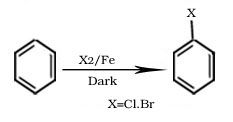
Q.3.Aryl chlorides and bromides can be easily prepared by electrophilic substitution of arenes with chlorine and bromine respectively in the presence of Lewis acid catalysts like iron or iron(III) chloride but aryl iodide and aryl fluoride is not possible by this method why?
Ans. Reactions with iodine are reversible in nature and require the presence of an oxidising agent (HNO3, HIO4) to oxidise the HI formed during iodination. Fluoro compounds are not prepared by this method due to high reactivity of fluorine.
Q.4.Boiling points of chlorides, bromides and iodides are considerably higher than those of the hydrocarbons of comparable molecular mass.
Ans.The chlorides, bromides and iodides are polar molecules and thus having dipole-dipole interaction between their molecules .On other hand hydrocarbons are non-polar molecules hence they contain weak dispersion forces .Thus boiling points of chlorides, bromides and iodides are considerably higher than those of the hydrocarbons of comparable molecular mass.
Q.5.The boiling points of alkyl halides decrease in the order: RI> RBr> RCl> RF why.
Ans. As the mass of the molecules increases size increases and thus, the magnitude of van der Waal forces increases hence boiling point increases.
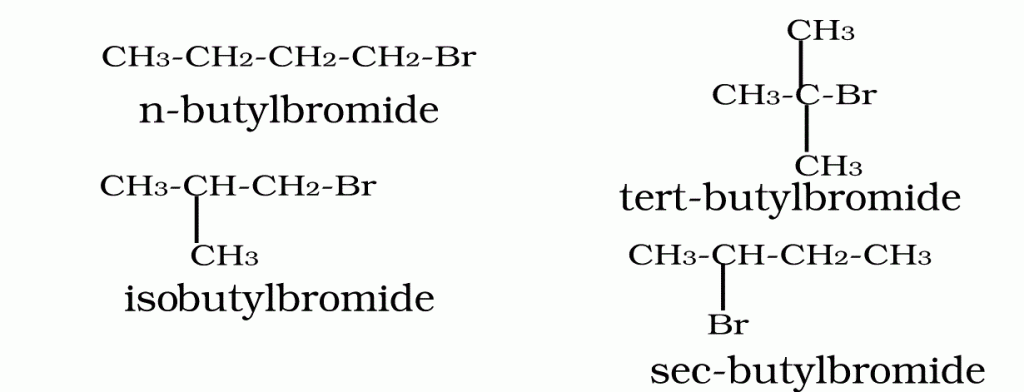
Q.6.Arrange n-butyl bromide,isobutyl bromide,sec-butyl bromide and tertiary butyl bromide in decreasing order of boiling point.
Ans.
As branching increases surface area decreases hence magnitude of intermolecular vander waal forces decreases thus boiling point decreases.The order is-
The p-isomer has higher melting as compared to their ortho and meta-isomers. It is due to symmetrical structure of para-isomers that fits in crystal lattice better as compared to ortho– and meta-isomers.
Q.8. The density of alkyl halide increases with increase in number of carbon atoms why?
Ans. As the number of carbon atoms increases, mass increases thus density increases.
Q.9.The haloalkanes are only very slightly soluble in water why?
Ans. Haloalkanes molecules have dipole-Dipole interaction between their molecules, but water molecules have hydrogen bonding .Since hydrogen bonding is stronger force hence very less energy is realesed when new attraction is setup between haloalkanes and water molecules.
Q.10. Arrange each set of compounds in order of increasing boiling points.
(ii) 1-Chloropropane, Isopropyl chloride, 1-Chlorobutane.
Ans. (i) Chloromethane < Bromomethane < Dibromomethane < Bromoform
Above order is due to atomic mass which increases in same order.
(ii) 1-Chloropropane < Isopropyl chloride < 1-Chlorobutane.
1-Chlorobutane has highest molecular mass thus it has highest boiling point. Since Isopropyl chloride has more branching than 1-chloropropane hence former has lesser boiling than latter.
Q.11. Haloalkanes react with KCN to form alkyl cyanides as main product while AgCN forms isocyanides as the chief product.
Ans. CN– is ambident nucleophile hence reaction can occur through C or N. Since KCN is ionic compound hence nucleophile CN– is available for bonding, since C-C bond is more stronger than C-N bond hence main product is cyanide. AgCN is covalent compound hence reaction occurs through N and main product is isocyanide.
Q.12.The order of reactivity towards S2N decreases in following order why?
Ans.As the alkyl groups increases around carbon having leaving group it is getting very difficult to approach that carbon by nucleophile hence reactivity decreases in following order Primary halide > Secondary halide > Tertiary halide.
Q.13.S1N reactions are generally carried out in polar protic solvents (like water, alcohol, acetic acid, etc.).
Ans. In S1N mechanism 1st step involves the C–X bond breaking for which the energy is obtained through solvation of halide ion with the proton of protic solvent.
Q.15.Why is S1N reation 1st order and unimolecular reaction ?
Ans. In S1N mechanism 1st step involves the C–X bond breaking which is slow process and thus rate of reaction depends only on concentration of alkyl halide thus reation is 1st order and unimolecular.
Q.17. The order of reactivity towards S1N decreases in following order why?
Ans.In S1N mechanism 1st step involves the C–X bond breaking and an intermediate carbocation forms. Since the stability of carbocation decreases in following order
3o˃2o˃1o (+I effect decreases)
Hence reactivity of alkyl halide decreases in following order Tertiary halide > Secondary halide > Primary halide.
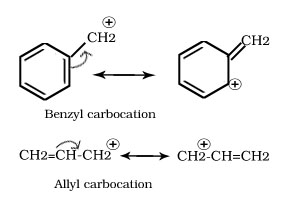
Q.18.Allylic and benzylic halides show high reactivity towards the S1N reaction.
Ans. The carbocation thus formed as intermediate gets stabilised through resonance.
Q.19.For a given alkyl group, the reactivity of the halide, R-X, follows the same order in both the mechanisms R–I> R–Br>R–Cl>>R–F why?
Ans.As the size of halogen increases bond dissociation energyof C-X decreases thus rate of releasing of leaving group decreases in following order I–˃Br–˃Cl–.Thus for a given alkyl group, the reactivity of the halide, R-X, follows the same order in both the mechanisms R–I> R–Br>R–Cl>>R–F.
Q.20.Grignard reagents should be prepared under anhydrous conditions?
R-MgX + H2O → R-H + MgOH(X). Grignard reagents are highly reactive in protic solvent like water , alcohol etc.
Q.21.Aryl halides are extremely less reactive towards nucleophilic substitution reactions why?
Ans.
Due to partial double bond character of C-Cl due to resonance , bond dissociation in haloarene is difficult than haloalkane and therefore, they are less reactive towards nucleophilic substitution reaction.
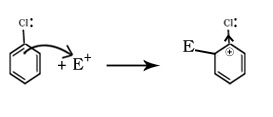
Q.22.Although chlorine is an electron withdrawing group, yet it is ortho,para directing in electrophilic aromatic substitution reactions why?
Ans
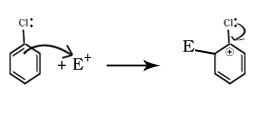
Cl on benzene ring produces two effects during electrophilic substitution one is inductive effect and other is resonance effect. By – I effect Cl decreases the stability of intermediate carbocation and by +R effect Cl increases the stability of intermediate carbocation. The inductive effect here is stronger than resonance and causes net electron deactivation and thus Cl is deactivating group.
Electron dcensity is high at ortho and para positions hence benzene ring donate electrons to the electrophile from these positions only hence Cl is ortho and para directing.
Q.23.Chloroform is stored in closed dark coloured bottles why?.
Ans,It is due to formation of poisonous gas phosgene.
2CHCl3 +O2 → 2COCl2 + 2HCl( COCl2 is phosgene)
Name reactions of Haloalkanes and Haloarenes
1.Wurtz reaction
R-X + 2Na + R-X → R-R + 2NaX
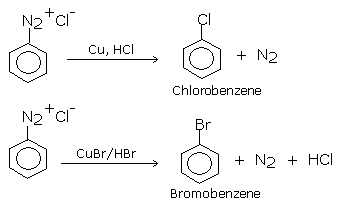
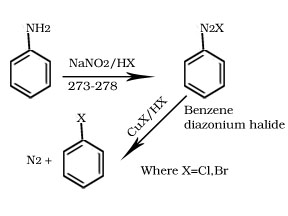
2.Sandmeyer’s reaction
Sandmeyer’s reaction
3. Finkelstein reaction
R-X + NaI → R-I + NaX X=Cl, Br
4.Swarts reaction
H3C-X +AgF → H3C-F + AgBr(X=Cl, Br)
5. Friedel-Crafts alkylation reaction
Friedel-Crafts alkylation reaction
6. Friedel -Craft acylation reaction
6. Friedel -Craft acylation reaction
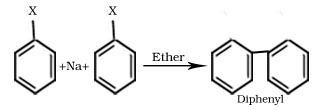
7 . Wurtz –Fittig reaction
Wurtz –Fittig reaction
8.Fittig reaction
Fittig reaction
Other reactions
Preparation of haloalakane from alcohol
R-OH + H-X → R-X + H2O (ZnCl2 is used as catalyst when 1o and 2o alcohols are reacted with HCl)
Addition takes place according to markonikov rule,But addition of HBr in presence of peroxide takes place antimarkonikov rule.
CH2=CH2 +HX → CH3-CH2X
3.Addition of halogen to alkene
CH2=CH2 +Br2 /CCl4 → CH2Br -CH2Br
4.Formation of Grignard reagent
CH3-CH2-Br + Mg → CH3-CH2MgBr (Grignard reagent)
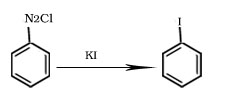
Formation of iodobenzene
Formation of haloarene from benzene
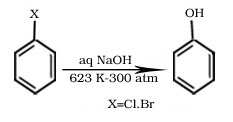
Formation of phenol from chlorobenzene
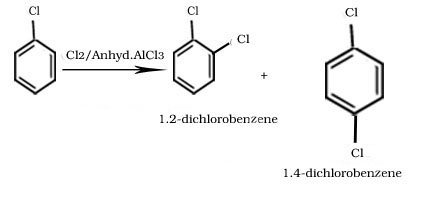
Halogenation Of Chlorobenzene
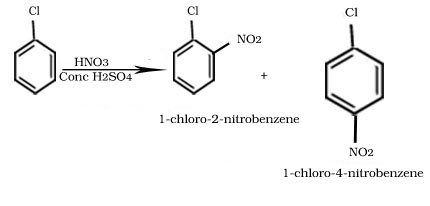
Nitration of Chlorobenzene
Sulphonation of Chlorobenzene
Mechanisms
SN1 Mechanism
1.SN1 mechanism completes in two steps.
2.In first step an intermediate carbocation forms and in second step nucleophile attacks the carbocation and formation of product can takes place.
3.Rate of reaction depends only on the first step and concentration of alkyl halide because it is slowest step thus SN1 is first order unimolecular reaction.
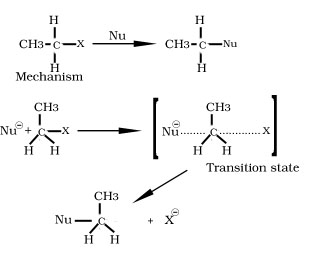
SN2 mechanism
1 SN2 mechanism completes in one step.
2.A transition state forms where there is simultaneous attack of the nucleophile and displacement of the leaving group.
3. Rate of reaction depends both on concentration of nucleophile and alkyl halide thus reaction is 2nd order bimolecular reaction.
Sterochemistry involves during SN2 and SN1 mechanism
Q.1.What do you mean by optical activity of a particular compound?
Ans.Compound which rotate plane polarized light in either a clockwise or anticlockwise direction is called optical active compound.
Q.2.Define enantiomers.
Ans.Enantiomers possess identical chemical structures (i.e. their atoms are the same and connected in the same order), but are mirror images and nonsuperimposable of one another.They are optically active compounds one is called dextro (+) and another is called laevo(-) compound. Dextro rotate the plane polarised light in clockwise(right) direction and laevo in anticlockwise(left) direction.
Q.3.Define racemic mixture.
Ans. Mixture of equal amounts of dextro and laevo isomers results in no rotation called racemic mixture.racemic mixture is optically inactive.
Q.4.What is the criteria for optical activity?
Ans.A chiral compound is must be an optically active compound.
Q.5.What do you mean by chiral compound?
Ans. A compound which contain at least a chiral carbon(asymmetric carbonn) that is the carbon atom which is attached to four different types of atoms or four different groups of atoms that cannot be superimposed on their own mirror image are said to be chiral compound.
Q.6.Define retention ,inversion and partial racemisation.
Ans. Retention :The configuration of the molecule is retained through the reaction, so the product molecule has the same configuration as the reactant that is dextro reactant forms dextro product and laevo forms laevo.
Inversion: When the product’s configuration is opposite that of the substrate the process is called inversion.
Partial racemisation:The phenomena in which retention and inversion both takes place simultaneously called partial racemisation.
Q.7.Explain the sterochemistry involves during SN2 and SN1 mechanism.
Ans Experimental observation shows that all SN2 reactions proceed with inversion of configuration; that is, the nucleophile will always attack from the backside in all SN2 reactions. SN1 involves both retention and inversion that is it undergo partial racemisation configuration.













































 Sarvan sir- Chemistry For All