Branches of chemistry

Chemistry is a broad field of science that encompasses various branches, each focusing on different aspects of matter, its properties, and interactions. Here are some major branches of chemistry:

  1. Organic Chemistry: Organic chemistry deals with the study of carbon-containing compounds, including their structure, properties, composition, reactions, and synthesis. It is crucial in understanding the chemistry of life, as organic compounds are the basis of living systems.
  2. Inorganic Chemistry: Inorganic chemistry focuses on the study of non-carbon-containing compounds, such as minerals, metals, and nonmetals. It involves the investigation of their properties, behavior, reactions, and their applications in different areas.
  3. Physical Chemistry: Physical chemistry combines principles of physics and chemistry to study the physical properties, behavior, and transformations of matter. It involves topics like thermodynamics, quantum mechanics, spectroscopy, kinetics, and computational chemistry.
  4. Analytical Chemistry: Analytical chemistry involves the development and application of techniques and methods to determine the composition, structure, and properties of matter. It includes qualitative and quantitative analysis, separations, spectroscopy, electrochemistry, and chromatography.
  5. Biochemistry: Biochemistry explores the chemical processes and substances that occur within living organisms. It focuses on the study of biological macromolecules, such as proteins, nucleic acids, carbohydrates, and lipids, as well as metabolic pathways, enzymology, and molecular biology.
  6. Environmental Chemistry: Environmental chemistry studies the chemical processes and phenomena occurring in the environment, including air, water, soil, and living organisms. It investigates the impact of human activities on the environment, pollution, and the development of sustainable practices.
  7. Theoretical Chemistry: Theoretical chemistry utilizes mathematical and computational methods to understand and predict the behavior of chemical systems. It involves developing models, simulations, and theories to explain chemical phenomena and aid in the interpretation of experimental results.
  8. Medicinal Chemistry: Medicinal chemistry focuses on the design, synthesis, and development of chemical compounds for use as pharmaceutical drugs. It combines principles of organic chemistry, biochemistry, and pharmacology to discover and optimize new drug candidates.
  9. Materials Chemistry: Materials chemistry explores the relationship between the structure, properties, and synthesis of materials. It involves the study of materials at the atomic and molecular levels, with applications in areas such as nanotechnology, polymers, ceramics, and metallurgy.
  10. Physical Organic Chemistry: Physical organic chemistry examines the relationship between the physical properties and reactivity of organic compounds. It investigates the mechanisms and rates of organic reactions, the effects of molecular structure on reactivity, and the use of spectroscopic techniques to study organic compounds.

These branches of chemistry are interconnected and often overlap, as they collectively contribute to a comprehensive understanding of the chemical world.

Aside

Importance of chemistry I Chemistry in everyday life


Chemistry is a fundamental science that plays a crucial role in our everyday lives and in advancing various fields of knowledge and technology. Here are some key reasons highlighting the importance of chemistry:

Importance of chemistry

Understanding Matter:

Chemistry helps us understand the composition, structure, properties, and behavior of matter at the atomic and molecular levels. This knowledge forms the basis for understanding the physical and chemical properties of substances, their transformations, and interactions.

Drug Discovery and Development:

Chemistry plays a vital role in the discovery, design, and development of new drugs. Chemists use their understanding of chemical reactions and molecular interactions to create new pharmaceutical compounds, analyze their efficacy, and optimize their properties.

Environmental Studies:

Chemistry is essential for studying and addressing environmental issues. Chemists contribute to pollution control, waste management, and the development of sustainable practices. They analyze pollutants, develop green technologies, and work towards mitigating the impact of human activities on the environment.

Energy Production and Storage:

Chemistry is critical for developing efficient and sustainable energy sources. It plays a key role in the design and improvement of batteries, fuel cells, solar panels, and other energy storage and conversion systems. Chemists are also involved in developing cleaner and more efficient methods of energy production, such as through catalysis and alternative fuel sources.

Materials Science and Engineering:

Chemistry is fundamental to the development and understanding of materials. Chemists contribute to the synthesis, characterization, and modification of materials with desired properties, such as strength, conductivity, and durability. This knowledge is vital in various industries, including electronics, aerospace, construction, and manufacturing.

Agriculture and Food Production:

Chemistry plays a significant role in agriculture and food production. It helps in the development and optimization of fertilizers, pesticides, and crop protection techniques. Analytical chemistry is crucial for ensuring food safety, quality control, and the detection of contaminants.

Health and Medicine:

Chemistry is essential in the field of medicine. It contributes to understanding the molecular basis of diseases, developing diagnostic tools, and designing therapeutic interventions. Chemistry is involved in the synthesis of drugs, the development of imaging techniques, and the study of biomolecules.

Consumer Products and Technology:

Chemistry is integral to the development and improvement of consumer products and technology. It is involved in the formulation of cosmetics, household products, and personal care items. Chemical processes and reactions are essential in various industries, such as manufacturing, electronics, and telecommunications.

These are just a few examples that highlight the importance of chemistry in various aspects of our lives. Chemistry provides the foundation for advancements in science, technology, and innovation, contributing to the betterment of society and the world we live in.

Atom meaning in Chemistry

Chemistry deals with matters and their transformations. Matters are of two types one is pure and another is impure.

Pure matters contain only one kind of particle but impure matters contain more than one kind of particle.

Elements are made by tiny particles called atoms, the particular elements contain only one kind of atoms hence elements are pure substances.

Consider a wall it contain bricks so bricks are building material of wall. We make wall from regular arrangements of bricks. So we can say that bricks are small particle of wall. This is very different things how we made the atoms.

Similarly atoms are building block of an elements. atoms are bricks and element is wall.

Wall Like Elements Each Bricks are like atoms
Photo by MESSALA CIULLA on Pexels.com

Atoms are spherical in shape like ball, it has three dimensional structure, in the Centre of atom there is tiny dense nucleus. electrons revolve around the nucleus in 3d spaces. This space we can call electron cloud.

The nucleus contains positively charged protons and uncharged neutrons, thus nucleus is positively charged. In other hand electrons are negatively charged. The number off positively charged protons and negatively charged electrons are equal hence atoms are neutral.

A ball like atoms
Balls are joined with
strong force and form a
regular arrangement
called element

Chemistry XI Test Papers & Assignment

Test Papers from different Schools

Amines Class 12 Chemistry Notes

Reasoning types question

Q.1.Ammonolysis method is not suitable for preparation of primary amines why?

Ans . Ammonolysis gives a mixture of primary, secondary and tertiary amines and also a quaternary ammonium salt hence this method is not suitable for preparation of primary amines.

Q.2. Arrange the order of reactivity of halides with amines RI, RBr, RCl.

Ans.The order of reactivity of halides with amines is RI > RBr > RCl.

Q.3. Aromatic primary amines cannot be prepared by Gabriel phthalimide synthesis.

Ans. Since C-X bond of aryl halides has partial double bond character due to resonance hence they don’t undergo nucleophilic substitution with the anion formed by phthalimide.

Q.4. Gabriel phthalimide synthesis is used for the preparation of primary amines why?

Ans.This method gives primary amine without any contamination of secondary and tertiary amine.

Q.5. Lower aliphatic amines are soluble in water why?

Ans. Because they can form hydrogen bonds with water molecules. However, solubility decreases with increase in molar mass of amines due to increase in size of the hydrophobic alkyl part.

Q.6.Which is more soluble in alcohol and amine if they have comparable molecular mass?

Ans. Since electronegativity of oxygen is higher than nitrogen hence alcohols are more polar than amines and form stronger intermolecular hydrogen bonds than amines hence alcohols are more soluble than amines.

Q.7.The order of boiling point of isomeric amines is as follows Primary > Secondary > Tertiary why?

Ans. The intermolecular association is more in primary amines than in secondary amines as there are two hydrogen atoms available for hydrogen bond formation in it. Tertiary amines do not have intermolecular association due to the absence of hydrogen atom available for hydrogen bond formation.

Q.8. Amines are basic in nature why?

Ans. It is due to the presence of a lone pair on nitrogen, it can react with acid and forms salt.

Q.9 .Compare basic strength between aliphatic amines and ammonia.

 Ans. Due to electron releasing nature of alkyl group, it (R) pushes electrons towards nitrogen and thus makes the unshared electron pair more available for sharing with the proton of the acid thus aliphatic amines are more basic than ammonia.

Q.10.The order of basicity of amines in the gaseous phase follows the expected order

 tertiary amine > secondary amine > primary amine > NH3.why?

Ans. Due to the electron releasing nature of alkyl group, it (R) pushes electrons towards nitrogen and thus makes the unshared electron pair more available for sharing with the proton of the acid. Since number of alkyl groups increases from primary amine to tertiary amine hence basic strength also increases in same order.

 Q.11.The order of the basic strength in case of ethyl substituted amines in aqueous solution is as follows why?

(C2H5)2NH > (C2H5)3NH > (C2H5)3NH >NH3

Ans.The basic strength of amines depends on three factors.

  • Inductive effect
  • Solvation effect
  • Steric hinderance of the alkyl group

Since steric hindrance effect of ethyl groups in tertiary amine make the stability of substituted ammonium cation lesser than that of secondary amine hence basic strength of tertiary amine is lower than secondary amine.

Q.12.The order of the basic strength in case of methyl substituted amines in aqueous solution is as follows why?

(CH3)2NH > CH3NH2 > (CH3)3N > NH3

Ans.The basic strength of amines depends on three factors.

  • Inductive effect
  • solvation effect
  • Steric hinderance of the alkyl group

When the alkyl group is small, like –CH3 group, there is no steric hindrance to H-bonding  hence  the stability of substituted ammonium cation in case of tertiary amine is lesser than that of primary amine hence basic strength of tertiary amine is lower than the primary amine.

Q.13. Why is ammonia more basic than arylamines.

Ans. the -NH2 group is attached directly to the benzene ring. It results in the unshared electron pair on nitrogen atom to be in conjugation with the benzene ring and thus making it less available for protonation.

Q.14.What is the effect of electron releasing group and electron withdrawing group on basic strength of substituted aniline?

Ans. In case of substituted aniline, electron releasing groups like –OCH3, –CH3 increase the basic strength whereas electron withdrawing groups like –NO2, –SO3H, –COOH, –X decrease it.

Q.15.Arrange the following compounds in decreasing order of their basic strength:

C6H5NH2, C2H5NH2, (C2H5)2NH, NH3                                                                                                                         

Ans. The decreasing order of the basic strength of above amines and ammonia is in following order:

(C2H5)2NH > C2H5NH2 > NH3 > C6H5NH2

Above order is due to aromatic amine is less basic than aliphatic amine  and ammonia due to resonance stabilization of lone pair of nitrogen of aniline with benzene ring.

Q.16. –NH2 group in aniline is ortho and para directing towards electrophilic substitution reaction and a powerful activating group why?

Ans. Ortho- and para-positions to the –NH2 group become canters of high electron density due to +R (resonance). Thus –NH2 group is ortho and para directing and a powerful activating group.

Q. 17.The activating effect of –NHCOCH3 group is less than that of amino group.

Ans. The lone pair of electrons on nitrogen of acetanilide interacts with oxygen atom through resonance. Thus it is less available for donation to benzene ring by resonance. Therefore, activating effect of –NHCOCH3 group is less than that of the amino group.

Q.18.Besides the ortho and para derivatives, significant amount of meta derivative is also formed during nitration of aniline why?

Ans. In the strongly acidic medium, aniline is protonated to form the anilinium ion which is meta directing.

Q.19.Aniline does not undergo Friedel-Crafts reaction (alkylation and acetylation) why?

Ans. Due to the salt formation with aluminum chloride, the Lewis acid, which is used as a catalyst, nitrogen of aniline acquires positive charge and hence acts as a strong deactivating group for further reaction.

Distinguish reactions

Distinguish between aliphatic primary amine/Aniline and secondary amine/tertiary amine.
 Aliphatic primary amine/Aniline gives the carbylamines test but secondary amine/tertiary amine does not give this test.

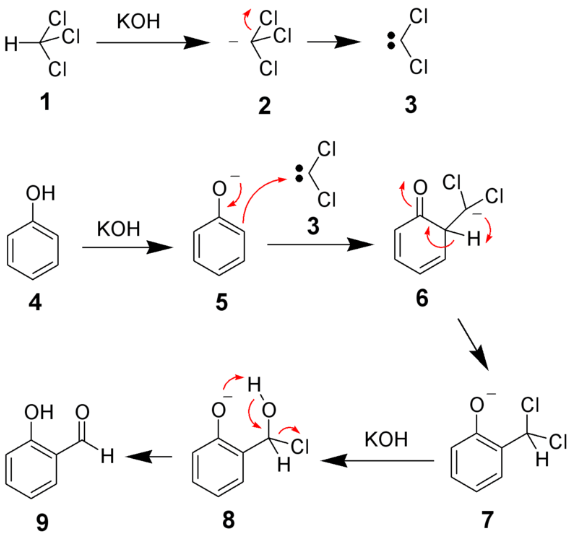
R-NH2  + CHCl3 + 3KOH     →      R-NC + 3KCl  + 3H2O (RNC is phenyl isocyanide which is foul smelling substance.

Distinguish between aliphatic primary amine and aniline.

Nitrous acid test is used for this test. Both aliphatic primary amine and aniline give this test but in different way.

Benzene diazonium chlorides (C6H5N2Cl ) gives yellow color after coupling reaction with aniline.

Distinguish reaction between secondary amine and tertiary amine.

Hinsberg test is used for this reaction

Tertiary amines do not give this test. Secondary amines and primary amine react with Hinsberg reagent but product of primary amine and this reagent is soluble in KOH but that of secondary amine is insoluble.

Name Reactions

 Ammonolysis

 Gabriel phthalimide synthesis

 Hoffmann bromamide degradation reaction

Coupling Reaction

Gattermann reaction

Other reactions

Acylation

Bromination of aniline

Nitration of aniline

Sulphonation of aniline

 Formation of amines from nitro compound

 Formation of amine from amide

 Formation of amine from nitriles

Reactions of Benzene diazonium chloride

Formation of nitrobenzene from benzene diazonium chloride

Chemistry Notes XII: Aldehydes, Ketones and Carboxylic Acids

Reasoning based questions

Q.1.The boiling point of aldehydes and ketones are higher than hydrocarbons  having comparable molecular masses why?

Ans. Boiling point of aldehydes and ketones are higher than that of  hydrocarbons because they are polar and hydrocarbons are non-polar  therefore, the intermolecular dipole-dipole attraction in  aldehydes and ketones is stronger than hydrocarbons.

Q.2.The boiling point of aldehydes and ketones are higher than ethers having comparable molecular masses why?

Ans. Boiling point of aldehydes and ketones are higher than that of  ethers because they are more polar than ethers therefore, the intermolecular dipole-dipole attraction in aldehydes and ketones is stronger than ethers.

Q.3. Boiling point of aldehydes and ketones are lower than those of alcohols of similar molecular masses why?

Ans. It is due to absence of intermolecular hydrogen bonding in aldehydes and ketones.

Q.4. The lower members of aldehydes and ketones such as methanal, ethanal and propanone are miscible in water why ?

Ans. Lower members of aldehydes and ketones are able to form hydrogen bond with water. As molecular mass increases hydrophobic alkyl part also increases thus solubility decreases.

Q.5. Arrange the following compounds in increasing order of their boiling point.

CH3CHO, CH3CH2OH, CH3OCH3, CH3CH2CH3     

Ans . CH3CH2OH (Alcohol) > CH3CHO (Aldehyde) > CH3OCH3 (Ethers) > CH3CH2CH3 (Alkane)

Above order is due to alcohols have hydrogen bonding between their molecules. Aldehydes have dipole- dipole interaction and hydrocarbons are non polar.

Q.6. Aldehydes and ketones generally give nucleophilic addition reactions why?

Ans .It is due to electrophilic nature of carbon of carbonyl group.

Q.7. Aldehydes are generally more reactive than ketones in nucleophilic addition reactions why?

Ans. It is due to two reasons.

1.Steric hindrance effect of alkyl groups present at electrophilic carbon.

The presence of two relatively large substituents in ketones hinders the approach of nucleophile to carbonyl carbon.

2. +I effect  of alkyl groups present at electrophilic carbon.

Two alkyl groups reduce the electrophilicity of the carbonyl carbon more effectively in  ketones.

Q.8. Arrange the following compounds in increasing order of their reactivity in nucleophilic addition reactions.

(i) Ethanal, Propanal, Propanone, Butanone.

(ii) Benzaldehyde, p-Tolualdehyde, p-Nitrobenzaldehyde, Acetophenone.

Ans (i). Butanone < Propanone < Propanal < Ethanal.

Ethanal and Propanal are aldehyde hence they are more reactive than propanone and butanone. Electrophilic carbon of butanone has larger alkyl groups than propanone hence former is less reactive.

(ii)  Acetophenone < p-Tolualdehyde < Benzaldehyde < p-Nitrobenzaldehyde

Above order is due to acetophenone is ketone. Pushing group (CH3) decreases the electrophilic nature of carbon of carbonyl group and that of pulling group (like NO2) increases.

Q.9. Carboxylic acids are higher boiling liquids than aldehydes, ketones and even alcohols having comparable molecular masses why ?

Ans. It is due to more extensive association of carboxylic acid molecules through intermolecular hydrogen bonding.

Q.10. Simple aliphatic carboxylic acids having upto four carbon atoms are miscible in water why?

Ans. It is due to the formation of hydrogen bonds with water. The solubility decreases with increasing number of carbon atoms. Higher carboxylic acids are insoluble in water due to the increased hydrophobic interaction of hydrocarbon part.

Q.11. Give the reactions which suggest carboxylic acids are acidic in nature.

Ans. CH3-COOH + Na    →  CH3COONa + H2

CH3COOH + NaHCO3 → CH3COONa + H2O + CO2

Q.12.What is Ka and PKa?

Ans. Ka is ionization constant of acid. Higher the value of Ka higher the acidic strength. PKa is –log Ka thus lower the PKa value higher the acidic strength.

Q.13.Carboxylic acids are more acidic than Phenol why?

Ans.

The carboxylate ion is more stabilized than phenoxide ion, so carboxylic acids are more acidic than phenols. The conjugate base of carboxylic acid, a carboxylate ion, is stabilised by two equivalent resonance structures in which the negative charge is at the more electronegative oxygen atom. The conjugate base of phenol, a phenoxide ion, has non-equivalent resonance structures in which the negative charge is at the less electronegative carbon atom.

Q.14.How does electron withdrawing group and electron releasing group affect the acidic strength of carboxylic acid?

Ans. Electron withdrawing groups increases the acidity of carboxylic acids by stabilising the conjugate base through delocalisation of the negative charge by inductive and/or resonance effects. Conversely, electron donating groups decrease the acidity by destabilising the conjugate base.

The effect of the following groups in increasing acidity order is

Ph < I < Br < Cl < F < CN < NO2 < CF3

Higher the carbon atoms in alkyl group higher the pushing effect.Thus, the following acids are arranged in order of increasing acidity

Q.15. Arrange the para-methoxybenzoic acid ,Benzoic acid and p-nitrobenzoic acid in decreasing order of acidic strength.

Ans.

p-nitrobenzoic acid > benzoic acid > p-metoxybenzoic acid

Electron withdrawing group increases while electron donating groups decrease the acidic strength of benzoic acid.

Q.16.Which is more acidic in prop-2-enoic acid and propanoic acid?

Ans. Conjugate –ve ion of prop-2-enoic acid is extra resonance stabilized hence it is more acidic than propanoic acid.

Q.17.Aromatic carboxylic acids undergo electrophilic substitution reactions in which the carboxyl group acts as a deactivating and meta-directing group why?

Ans.

Carboxyl group withdraw electrons from benzene ring by –R effect hence it is deactivating group since electron density is high at meta position hence it is meta directing.

Q.18.Benzoic acid do not undergo Friedel-Crafts reaction why?

Ans. Because the carboxyl group is deactivating and the catalyst aluminum chloride (Lewis acid) gets bonded to the carboxyl group).

Name Reactions in Aldehydes, Ketones and Carboxylic Acids

Rosenmund reduction

Rosenmund reduction

Stephen reaction

Etard reaction

Etard reaction

Gatterman-Koch reaction

Gatterman-Koch reaction

Clemmensen reduction

Clemmensen reduction

Wolff-Kishner reduction

Wolff-Kishner reduction

Aldol condensation

Aldol condensation


Cross aldol condensation


Cross aldol condensation

 Cannizzaro reaction

 Cannizzaro reaction

 Decarboxylation reaction

 Hell-Volhard-Zelinsky reaction

 Hell-Volhard-Zelinsky reaction

Distinguish reaction

Tollen’s reagent test

Distinguish between aldehydes and ketones.

Aldehydes react with Tollen’s reagent and give silver mirror test. Ketones give no reaction with  Tollen’s reagent

Fehling solution test

Distinguish between aldehydes and ketones.

Aldehydes react with Fehling reagent and give red brown ppt of Cu2O. Ketones give no reaction with  Fehling reagent. Aromatic Aldehydes don’t give Fehling’s test.

Iodoform test

Distinguish between aldehydes and aldehydes and ‘ketones and ketones’.

Those aldehydes and ketones having CH3CO-give Iodoform test thus in aldehyde family only ethanal gives this test. In ketone family all methyl ketones give this test.

R-CO-CH3+ 3I2 + 4 NaOH   →    R-COONa +CHI3

Sodium hydrogencarbonate test

Distinguish between Carboxylic acid/Benzoic acid and alcohols/phenols

Carboxylic acids and benzoic acid react with sodium hydrogencarbonate give this test and release CO2. Alcohols and phenols don’t react with sodiumhydrogencarbonate.

R-COOH + NaHCO3  →    R-COONa + H2O  + CO2

Other reactions

Reduction of ester


Formation of benzaldehyde from toluene

Formation of ketones from Grignard reagent.

2R-MgX   +  CdCl2→    R2Cd  + 2Mg(X)Cl

R’-CO-Cl + R2Cd   →  R’-CO-R + CdCl2

CH3-CH2-CN + C2H5MgBr → CH3-CH2-C(C2H5)=NMgBr  → CH3– CH2-CO-C2H5

Formation of ketone from benzene.

image57.jpg

Nitration of benzaldehyde

image58.jpg

Oxidation of Toluene

image59.jpg

Hydrolysis of acid derivatives

Formation of carboxylic acid from Grignard reagent.

Formation of phthalimide

Reduction of Carboxylic Acids

Nitration of Benzoic Acids

Halogenation of Benzoic Acids

Nucleophilic addition reaction of aldehydes and ketones

Reaction with HCN

Reaction with NaHSO3

Reaction with Grignard reagent

 Reaction with alcohol

Reaction with ammonia

R-CHO + NH3   →   R-CH=NH

imine

Reaction with amine

R-CHO +R-NH2    →  R-CH=N-R

Substituted imine (Schiff ‘Base)

Reaction with Hydroxyl amine

R-CHO + NH2OH     →      R-CH=N-OH

                                                   Oxime

Reaction with Hydarazine

R-CHO + NH2-NH2     →   R-CH=N-NH2

                                                   Hydrazone

Reaction with semicarbazide

R-CHO +NH2-CO-NH-NH2      →    R-CH=N -NH- CO-NH2

                                                                          Senicarbazone

Reaction with Phenyl hydrazine

R-CHO +C6H5-NH-NH2   →    R-CH=N -NH- C6H5

                                                       Phenyl hydrazone

Reaction with DNP 2,4-dinitrophenylhydrazine

Class 12 Chemistry Practice Papers

Chemistry Sample Papers 2022-23 with Solution

Chapter – Wise Test

Class 12 Chemistry Practice papers From Different Schools

Class 12 Chemistry Practice papers From Previous Years

Multiple Choice Questions

MCQs on Solutions – Class 12 Set 1

MCQs on Electrochemistry – Class 12 Set 1

MCQs – Chemical Kinetics -Set 1

MCQs – d & f Block Elements SET 1

MCQs – Haloalkanes & Haloarenes Class SET 1

MCQs – Alcohols, Phenols & Ethers Class 12 SET 1

MCQs – Aldehydes, Ketones & Carboxylic Acids SET 1

MCQs – Amines Class 12 Set 1

MCQs – Biomolecules Class 12 SET1