Haloalkane complete the reactions JEE/NEET-SET 1

Final Answers (with JEE/NEET Hints)

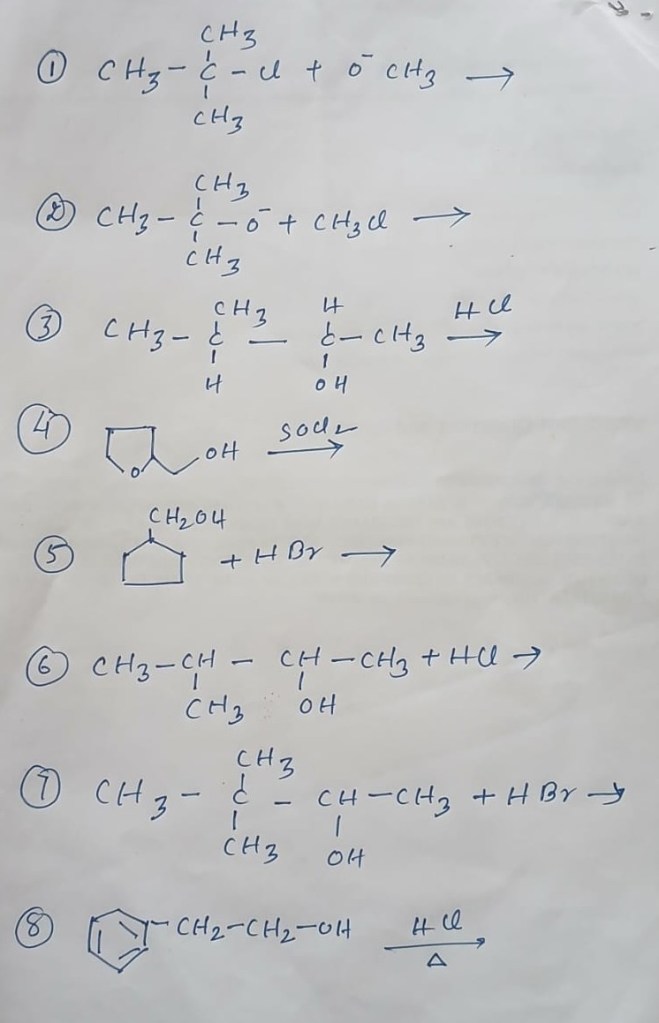
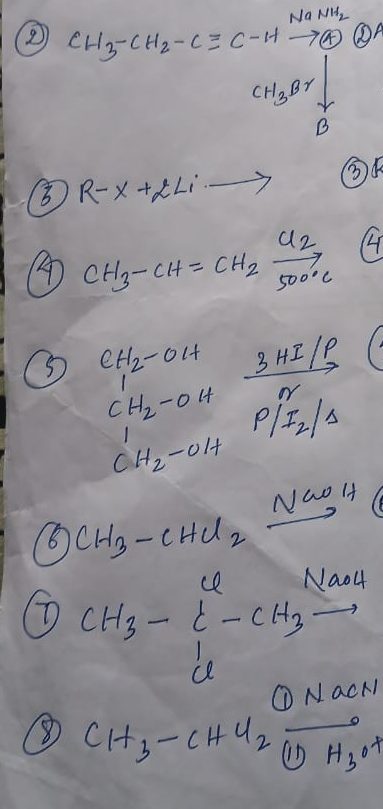
Q.Major ProductHint
12-Methylpropene (\mathbf{CH_2=C(CH_3)_2})3° alkyl halide + strong base (CH₃O⁻) ⇒ E2 elimination (SN2 impossible).
2tert-Butyl methyl ether (\mathbf{(CH_3)_3COCH_3})Williamson ether synthesis: keep the bulky group as alkoxide and use methyl halide for SN2.
32-Chloro-2-methylbutaneHCl + 2° alcohol → carbocation → 1,2-hydride shift → 3° carbocation → Cl⁻ attack.
42-(Chloromethyl)tetrahydrofuran (THF–CH₂Cl)SOCl₂ replaces only –OH by –Cl. Ether ring remains unchanged.
5BromocyclohexaneCyclopentylmethyl carbocation undergoes ring expansion (5 → 6 membered) before Br⁻ attack.
62-Chloro-2-methylbutaneSame as Q3: hydride shift gives a more stable 3° carbocation.
72-Bromo-2,3-dimethylbutane2° carbocation → 1,2-methyl shift → 3° carbocation → Br⁻ attack.
81-Chloro-1-phenylethane (\mathbf{C_6H_5CH(Cl)CH_3})Benzylic rearrangement forms a stable benzylic carbocation, then Cl⁻ attacks.

One-line Revision Tricks

  • 3° RX + strong base → Elimination (E2).
  • Williamson Ether: RO⁻ + CH₃X/1° RX → Ether (SN2).
  • HX + alcohol → Always check for carbocation rearrangement (hydride/methyl shift).
  • Cyclobutylmethyl & Cyclopentylmethyl carbocations → Think ring expansion.
  • SOCl₂ converts only –OH to –Cl; ethers are unaffected.

Final Answers

Please upload a clearer image of Questions 7 and 9 (or type the reagents), and I’ll draw the exact products.

Final Answers

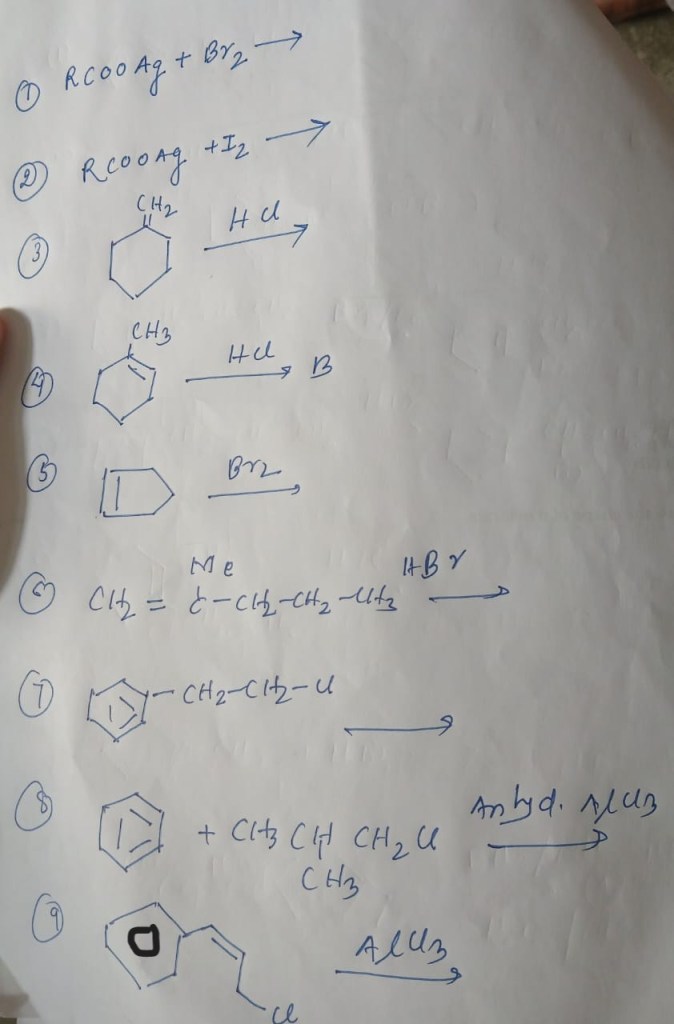
Q.Product
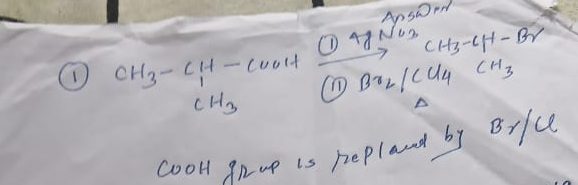
1R–Br + CO₂ + AgBr
2No reaction
31-Chloro-1-methylcyclohexane
41-Chloro-1-methylcyclohexane
5trans-1,2-Dibromide (anti addition)
62-Bromo-2-methylpentane
7Need reagent (not visible)
8tert-Butylbenzene
9Intramolecular Friedel–Crafts cyclization (exact structure unclear)

Heat of Neutralization – Full Concept (JEE/NEET)

Definition

Heat of neutralization (ΔHₙ) is the heat released when 1 equivalent (or 1 mole of H⁺) reacts with 1 equivalent (or 1 mole of OH⁻) to form 1 mole of water in a neutralization reaction.

General reaction:H+(aq)+OH−(aq)→H2O(l)\mathrm{H^+(aq) + OH^-(aq) \rightarrow H_2O(l)}

  • It is exothermic.
  • ΔH is negative.

Standard Heat of Neutralization

For a strong acid + strong base:ΔH=−57.1 kJ mol−1\boxed{\Delta H = -57.1 \text{ kJ mol}^{-1}}

or approximately−13.7 kcal mol−1\boxed{-13.7 \text{ kcal mol}^{-1}}

Examples

HCl+NaOH→NaCl+H2O\mathrm{HCl + NaOH \rightarrow NaCl + H_2O}HNO3+KOH→KNO3+H2O\mathrm{HNO_3 + KOH \rightarrow KNO_3 + H_2O}HBr+LiOH→LiBr+H2O\mathrm{HBr + LiOH \rightarrow LiBr + H_2O}

All haveΔH≈−57.1 kJ mol−1\boxed{\Delta H \approx -57.1\ \text{kJ mol}^{-1}}


Why is it always −57.1 kJ mol⁻¹?

Strong acids and strong bases completely ionize.

Example:HCl→H++Cl−\mathrm{HCl \rightarrow H^+ + Cl^-}NaOH→Na++OH−\mathrm{NaOH \rightarrow Na^+ + OH^-}

Actual reaction:H++Cl−+Na++OH−\mathrm{H^+ + Cl^- + Na^+ + OH^-}

↓Na++Cl−+H2O\mathrm{Na^+ + Cl^- + H_2O}

Net ionic equation:H++OH−→H2O\boxed{\mathrm{H^+ + OH^- \rightarrow H_2O}}

The spectator ions (Na⁺, Cl⁻) do not affect the heat released.


Strong Acid + Weak Base

Example:HCl+NH4OH→NH4Cl+H2O\mathrm{HCl + NH_4OH \rightarrow NH_4Cl + H_2O}

Observed heat:

≈ −51 to −55 kJ mol⁻¹

Why smaller?

Weak base is not completely ionized.

Energy is required for ionization:NH4OH→NH4++OH−\mathrm{NH_4OH \rightarrow NH_4^+ + OH^-}

Some heat is used in ionization.

Therefore,Heat released<57.1 kJ\boxed{\text{Heat released} < 57.1\ \text{kJ}}


Weak Acid + Strong BaseExample:CH3COOH+NaOH→CH3COONa+H2O\mathrm{CH_3COOH + NaOH \rightarrow CH_3COONa + H_2O}

Heat released:

≈ −55 kJ mol⁻¹

Reason:

Acetic acid is weak.CH3COOH⇌H++CH3COO−\mathrm{CH_3COOH \rightleftharpoons H^+ + CH_3COO^-}

Energy is required for ionization before H⁺ reacts.

Hence,ΔH<−57.1 kJ\boxed{\Delta H < -57.1\ \text{kJ}}


Weak Acid + Weak Base

Example:CH3COOH+NH4OH\mathrm{CH_3COOH + NH_4OH}

Heat released is the smallest among the four combinations because both reactants require ionization.


Order of Heat Released

Strong acid + Strong base>Strong acid + Weak base≈Weak acid + Strong base>Weak acid + Weak base\boxed{ \text{Strong acid + Strong base} > \text{Strong acid + Weak base} \approx \text{Weak acid + Strong base} > \text{Weak acid + Weak base} }Strong acid + Strong base>Strong acid + Weak base≈Weak acid + Strong base>Weak acid + Weak base​


Effect of Concentration

Heat of neutralization depends on the number of moles neutralized, not simply on concentration.

Example:

100 mL of 1 M HCl + 100 mL of 1 M NaOH

Moles reacted:0.1 mol0.1\ \text{mol}0.1 mol

Heat evolved:0.1×57.1=5.71 kJ0.1 \times 57.1 = 5.71\ \text{kJ}


Formula for Numerical Problems

Method 1

q=n×57.1 kJ\boxed{q = n \times 57.1\ \text{kJ}}

where nnn = moles of water formed (or moles of H⁺ neutralized).


Method 2 (Calorimetry)

q=mcΔT\boxed{q = mc\Delta T}

where

  • mm = mass of solution
  • cc = specific heat (≈ 4.18 J g⁻¹ K⁻¹)
  • ΔT\Delta T = temperature rise

Then,ΔH=−qmoles reacted\Delta H = \frac{-q}{\text{moles reacted}}


Polybasic Acids

H₂SO₄ + NaOH

H2SO4+2NaOH→Na2SO4+2H2O\mathrm{H_2SO_4 + 2NaOH \rightarrow Na_2SO_4 + 2H_2O}

Water formed = 2 mol

Heat released2×57.1=114.2 kJ2 \times 57.1 = 114.2\ \text{kJ}


H₃PO₄ + 3NaOH

H3PO4+3NaOH→Na3PO4+3H2O\mathrm{H_3PO_4 + 3NaOH \rightarrow Na_3PO_4 + 3H_2O}H3​PO4​+3NaOH→Na3​PO4​+3H2​O

Maximum heat:3×57.1=171.3 kJ3 \times 57.1 = 171.3\ \text{kJ}


Heat Released per Mole of Acid

AcidWater formedHeat released
HCl1−57.1 kJ
HNO₃1−57.1 kJ
H₂SO₄2−114.2 kJ
H₃PO₄ (complete)3−171.3 kJ

Important JEE/NEET Points

  • Heat of neutralization is always negative (exothermic).
  • It is defined per mole of water formed (or per mole of H⁺ neutralized).
  • Strong acid + strong base → −57.1 kJ mol⁻¹.
  • Weak acids/bases show a lower magnitude because part of the energy is used for ionization.
  • Spectator ions do not affect the heat of neutralization.
  • Use the limiting reagent to determine the moles of water formed.

Previous JEE/NEET-Type Questions

Q1

100 mL of 1 M HCl is mixed with 100 mL of 1 M NaOH. Heat evolved is:

Solution:

  • Moles HCl = 0.1 mol
  • Moles NaOH = 0.1 mol
  • Water formed = 0.1 mol

Heat:0.1×57.1=5.71 kJ0.1 \times 57.1 = \boxed{5.71\ \text{kJ}}


Q2

One mole of H₂SO₄ is completely neutralized by NaOH. Heat evolved is:

Water formed = 2 mol2×57.1=114.2 kJ2 \times 57.1 = \boxed{114.2\ \text{kJ}}


Q3

Which reaction has the greatest heat of neutralization?

A. HCl + NaOH
B. CH₃COOH + NaOH
C. HCl + NH₄OH
D. CH₃COOH + NH₄OH

Answer: A. HCl + NaOH (strong acid + strong base)


JEE/NEET Revision Box

  • Definition: Heat released when 1 mol of H₂O is formed by neutralization.
  • Strong acid + strong base: −57.1 kJ mol⁻¹
  • Weak acid/base: Lower magnitude due to ionization.
  • Formula: q=n×57.1 kJq = n \times 57.1\ \text{kJ}q=n×57.1 kJ
  • H₂SO₄ + 2NaOH: −114.2 kJ
  • H₃PO₄ + 3NaOH: −171.3 kJ (complete neutralization)
  • Always calculate using the moles of water formed (or H⁺ neutralized) and the limiting reagent.

Reaction of Amine with Nitrous Acid (HNO₂)

This is the most important reaction for distinguishing amines.

AmineReactionObservation
1° Aliphatic Amine (RNH₂)RNH₂ + HNO₂ → ROH + N₂↑ + H₂OBrisk effervescence (N₂ gas)
1° Aromatic Amine (ArNH₂)Forms diazonium salt (0–5°C)Stable only at low temperature
2° Amine (R₂NH)Forms N-nitrosoamineYellow oily liquid
3° Aliphatic Amine (R₃N)Forms soluble ammonium nitriteNo gas
3° Aromatic AmineForms p-nitroso derivativeGreen colour (often)

Examples

1° AliphaticCH3NH2+HNO2→CH3OH+N2↑+H2OCH_3NH_2 + HNO_2 \rightarrow CH_3OH + N_2\uparrow + H_2O

1° AromaticC6H5NH2+HNO2+HCl→C6H5N2+Cl−+2H2OC_6H_5NH_2 + HNO_2 + HCl \rightarrow C_6H_5N_2^+Cl^- + 2H_2O

2° Amine(CH3)2NH+HNO2→(CH3)2N−N=O+H2O(CH_3)_2NH + HNO_2 \rightarrow (CH_3)_2N-N=O + H_2O

1. 3° Aliphatic Amine (R₃N)

Example: Trimethylamine, (CH₃)₃N

Reaction:R3N+HNO2→R3NH+NO2−R_3N + HNO_2 \rightarrow R_3NH^+NO_2^-

  • Forms a trialkylammonium nitrite (salt).
  • No nitrogen gas (N₂) is evolved.
  • No N-nitrosoamine is formed.

Example:(CH3)3N+HNO2→(CH3)3NH+NO2−(CH_3)_3N + HNO_2 \rightarrow (CH_3)_3NH^+NO_2^-

Normality & Equivalent Weight – Complete Concept (NEET/JEE)

These two concepts are among the most important topics in Mole Concept, Redox Reactions, and Acid-Base Titrations.


1. What is Normality (N)?

Definition:

Normality is the number of gram equivalents of solute present in 1 litre of solution.Normality=Gram EquivalentsVolume (L)\boxed{\text{Normality}=\frac{\text{Gram Equivalents}}{\text{Volume (L)}}}

Unit

eq/L or simply N


2. Gram Equivalent

A gram equivalent is the amount of substance equal to its equivalent weight.Gram Equivalent=MassEquivalent Weight\boxed{\text{Gram Equivalent}=\frac{\text{Mass}}{\text{Equivalent Weight}}}


3. Equivalent Weight

Equivalent weight is the mass of a substance that supplies or reacts with one equivalent.

General formula:Equivalent Weight=Molar Massn-factor\boxed{\text{Equivalent Weight}=\frac{\text{Molar Mass}}{n\text{-factor}}}

where n-factor depends on the reaction.


4. Relation between Molarity and Normality

N=M×n-factor\boxed{N=M\times n\text{-factor}}

orM=Nn-factor\boxed{M=\frac{N}{n\text{-factor}}}​​


Example

0.5 M H₂SN=0.5×2=1NN=0.5\times2=1N


5. n-factor (Most Important for NEET/JEE)

The value of n-factor changes according to the reaction.


A. Acids

n-factor = Number of ionisable H⁺ released

Acidn-factor
HCl1
HNO₃1
CH₃COOH1
H₂SO₄2
H₂CO₃2
H₃PO₄3

Example

Equivalent weight of H₂SO₄

Molar mass = 98Eq.wt=982=49Eq.wt=\frac{98}{2}=49


B. Bases

n-factor = Number of OH⁻ ions furnished

Basen-factor
NaOH1
KOH1
Ba(OH)₂2
Ca(OH)₂2
Al(OH)₃3

Example

Equivalent weight of Ba(OH)₂

Molar mass =171Eq.wt=1712=85.5Eq.wt=\frac{171}{2}=85.5


C. Salts

n-factor = Total positive or negative charge involved

Saltn-factor
NaCl1
Na₂CO₃2
Na₂SO₄2
K₂Cr₂O₇2
Na₃PO₄3
Al₂(SO₄)₃6

Example

Na₂CO₃

Molar mass =106Eq.wt=1062=53Eq.wt=\frac{106}{2}=53


D. Oxidising Agents (Redox)

n-factor = Electrons gained per molecule

Examples

KMnO₄

Acidic medium

Mn+7→Mn+2Mn^{+7}\rightarrow Mn^{+2}

Electrons gained =5

n-factor =5

Equivalent weight1585=31.6\frac{158}{5}=31.6


Neutral/Basic medium

Mn+7→MnO2Mn^{+7}\rightarrow MnO_2

Electrons gained =3

n-factor =3

Equivalent weight1583=52.7\frac{158}{3}=52.7


K₂Cr₂O₇

Acidic medium

Cr(+6)→Cr(+3)

Each Cr gains 3 electrons.

Two Cr atoms

Total electrons =6

n-factor =6

Equivalent weight2946=49\frac{294}{6}=49


E. Reducing Agents

n-factor = Electrons lost

Example

Fe²⁺→Fe³⁺

Electron lost =1

n-factor =1

Equivalent weight561=56\frac{56}{1}=56


Example

Sn²⁺→Sn⁴⁺

Electron loss =2

n-factor =2


6. Equivalent Weight of Elements

Equivalent weight=Atomic massValency=\frac{\text{Atomic mass}}{\text{Valency}}

Example

ElementEq. wt
Na23
Mg12
Al9
Fe²⁺28
Fe³⁺18.67

7. Equivalent Weight of Compounds

Eq.wt=Molar massn-factorEq.wt=\frac{\text{Molar mass}}{n\text{-factor}}

Examples

CompoundEq.wt
HCl36.5
H₂SO₄49
NaOH40
Ca(OH)₂37
Na₂CO₃53
KMnO₄ (acidic)31.6
KMnO₄ (basic)52.7
K₂Cr₂O₇49

8. Normality Formulae

From mass

N=W×1000Eq.wt×V(mL)\boxed{N=\frac{W\times1000}{Eq.wt\times V(mL)}}


From molarity

N=M×n\boxed{N=M\times n}


Dilution

N1V1=N2V2\boxed{N_1V_1=N_2V_2}


9. Titration Formula

At equivalence pointN1V1=N2V2\boxed{N_1V_1=N_2V_2}

Example

20 mL HCl requires 10 mL NaOH (2 N)N(HCl)×20=2×10N(HCl)\times20=2\times10N(HCl)=1NN(HCl)=1N


10. Important NEET/JEE Points

  • Equivalent weight = Molar mass ÷ n-factor
  • Normality = Molarity × n-factor
  • n-factor depends on the reaction
  • For acids: ionisable H⁺
  • For bases: replaceable OH⁻
  • For salts: total ionic charge involved
  • For redox: electrons exchanged
  • Normality is widely used in titration calculations
  • Molarity is fixed for a given solution, but normality can change if the n-factor changes with the reaction.

Quick Revision Table

Substancen-factorEquivalent Weight
HCl136.5
H₂SO₄249
H₃PO₄332.7
NaOH140
Ca(OH)₂237
Na₂CO₃253
Ba(OH)₂285.5
KMnO₄ (acidic)531.6
KMnO₄ (basic/neutral)352.7
K₂Cr₂O₇649
Fe²⁺156
Fe³⁺318.67

NEET/JEE Shortcut

Remember the sequence:

  1. Find the reaction.
  2. Determine the n-factor from the reaction.
  3. Calculate Equivalent Weight = Molar Mass ÷ n-factor.
  4. Use Normality = Molarity × n-factor or N₁V₁ = N₂V₂ for titration problems.

Stamen → Microsporangium → Pollen Grain class 12 biology cbse

Here are the important NEET/CBSE points from this passage, arranged in a simple flow:

Stamen → Microsporangium → Pollen Grain

1. Stamen

Stamen = Filament + Anther

  • Filament → long, slender stalk
  • Anther → terminal, generally bilobed structure
  • Filament is attached to thalamus or petal.
  • Number and length of stamens vary among species.

2. Anther

A typical angiosperm anther is:

  • Bilobed
  • Each lobe has 2 theca
  • Therefore, anther is dithecous
  • Total 4 microsporangia → 2 in each lobe
  • In transverse section → tetragonal/four-sided
  • Microsporangia later develop into pollen sacs
  • Pollen sacs contain pollen grains

3. Wall layers of Microsporangium

From outside → inside:

Epidermis → Endothecium → Middle layers → Tapetum

LayerMain function
EpidermisProtection
EndotheciumProtection + helps in dehiscence
Middle layersProtection
TapetumNourishes developing pollen grains

⭐ Most important: Tapetum is the innermost wall layer.

The centre of a young microsporangium contains sporogenous tissue.


4. Microsporogenesis

Sporogenous tissue → Pollen Mother Cell (PMC) → Meiosis → Microspore tetrad → Pollen grains

Key points:

  • PMC is diploid (2n)
  • PMC undergoes meiosis
  • Produces 4 haploid (n) microspores
  • Four microspores remain together initially → microspore tetrad
  • Later they separate and develop into pollen grains

Definition ⭐

Microsporogenesis: Formation of microspores from a pollen mother cell through meiosis.


5. Pollen Grain

Pollen grain = Male gametophyte 🌱♂️

Generally:

  • Spherical
  • About 25–50 μm diameter
  • Has a two-layered wall

Pollen wall

Exine → outer wall

  • Made of sporopollenin
  • Extremely resistant
  • Resistant to high temperature, strong acids and alkalis
  • No known enzyme degrades sporopollenin
  • Has germ pores

Intine → inner wall

  • Thin and continuous
  • Made of cellulose + pectin

Germ pore

Aperture in exine where sporopollenin is absent.

Function: Allows emergence of the pollen tube during germination.


6. Mature Pollen Grain

A mature pollen grain may be:

2-celled stage

Vegetative cell + Generative cell

Vegetative cell

  • Larger
  • Abundant food reserve
  • Large, irregular nucleus

Generative cell

  • Smaller
  • Spindle-shaped
  • Dense cytoplasm
  • Has a nucleus

3-celled stage

Generative cell undergoes mitosis → 2 male gametes

So:

2-celled pollen = Vegetative cell + Generative cell

3-celled pollen = Vegetative cell + 2 male gametes

⭐ >60% angiosperms: pollen grains are shed at 2-celled stage.


🔥 Most important NEET facts

  1. Stamen = Filament + Anther
  2. Typical anther is bilobed and dithecous.
  3. Anther has 4 microsporangia.
  4. Microsporangia develop into pollen sacs.
  5. Tapetum → nutrition to developing pollen grains.
  6. PMC is 2n.
  7. Microspores are n.
  8. PMC undergoes meiosis.
  9. 4 microspores → microspore tetrad.
  10. Microsporogenesis = PMC → microspores by meiosis.
  11. Pollen grain = male gametophyte.
  12. Exine → sporopollenin.
  13. Intine → cellulose + pectin.
  14. Germ pore → sporopollenin absent.
  15. Generative cell → 2 male gametes by mitosis.
  16. Most angiosperms shed pollen at 2-celled stage.
  17. Rice and wheat pollen may lose viability within ~30 minutes.
  18. Some Rosaceae, Leguminosae and Solanaceae pollen can remain viable for months.
  19. Pollen can be stored in liquid nitrogen at −196°C → pollen banks.

Flower – A Fascinating Organ of Angiosperms

1. Importance of Flowers

Flowers have been closely associated with human beings since ancient times. They have:

  • Aesthetic value – beauty and decoration
  • Ornamental value – used in homes and gardens
  • Social value – used in ceremonies and celebrations
  • Religious value – used in worship
  • Cultural value – associated with traditions and festivals
  • Used to express love, affection, happiness, grief and mourning

2. Examples of Ornamental Flowers

Commonly cultivated at homes and in gardens:

  1. Rose
  2. Marigold
  3. Jasmine
  4. Hibiscus
  5. Petunia

3. Floriculture

Floriculture is the branch of horticulture concerned with the cultivation and management of flowering plants and ornamental flowers.

4. Biological Importance of Flowers

To a biologist, flowers are:

  • Morphological marvels
  • Embryological marvels
  • The sites of sexual reproduction in angiosperms.

5. Two Important Reproductive Parts

The two parts of a flower in which the important units of sexual reproduction develop are:

Flower partReproductive unit
AndroeciumPollen grains (male gametophytes)
GynoeciumEmbryo sac (female gametophyte)

6. Pre-fertilisation: Structures and Events

Before the flower becomes visible, the plant undergoes hormonal and structural changes that initiate flowering.

Sequence:

Hormonal & structural changes → Floral primordium → Inflorescence → Floral buds → Flowers

In the developing flower:

  • Androecium → male reproductive structure
  • Gynoecium → female reproductive structure

Both differentiate and develop before fertilisation.

Individual partCollective term / Whorl
PetalCorolla
SepalCalyx
CarpelGynoecium
StamenAndroecium

Easy way to remember 🌸

Petals → Corolla
Sepals → Calyx
Carpels → Gynoecium
Stamens → Androecium

👉 Calyx + Corolla = Accessory/Non-reproductive whorls
👉 Androecium + Gynoecium = Reproductive whorls

⭐ Key Flow

Flowering decision → Floral primordium → Inflorescence → Floral bud → Flower → Androecium + Gynoecium

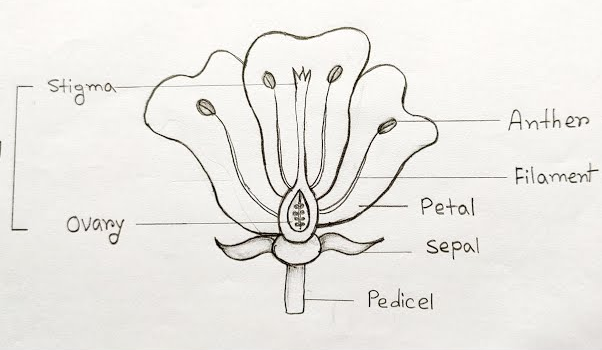
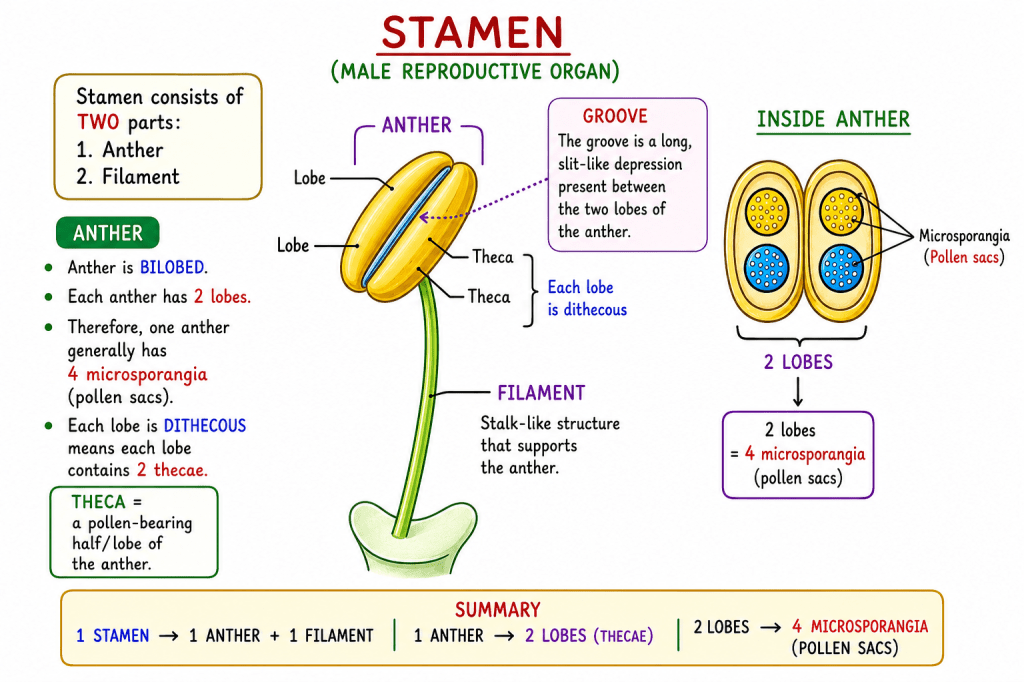
A diagrammatic representation of L.S. of a flower

Stamen — key points from the diagram

  • Stamen = male reproductive organ of a flower.
  • It consists of two parts:
    1. Anther
    2. Filament

Anther

  • Typically bilobed.
  • Each anther has 2 lobes.
  • Therefore, one anther generally has 4 microsporangia (pollen sacs).
  • Each lobe is dithecous → each lobe contains 2 thecae.
  • Theca = a pollen-bearing half/lobe of the anther.

Filament

  • A stalk-like structure that supports the anther.
  • It connects the anther to the flower.

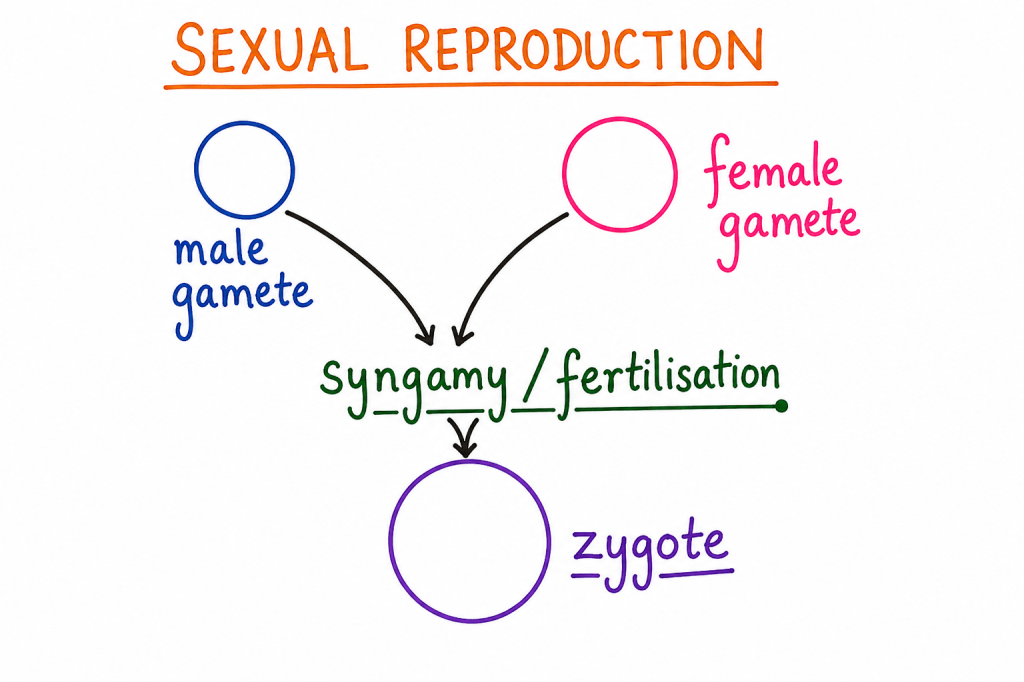
1. Sporophyte (2n)

  • The sporophyte is the diploid (2n) plant body.
  • It produces spores.
  • Special cells in the sporophyte undergo meiosis.

2. Meiosis → Spores (n)

  • Meiosis reduces the chromosome number: 2n → n
  • Therefore, the spores are haploid (n).
  • These spores are produced in spore-forming structures of the sporophyte.

3. Spore → Gametophyte (n)

  • A haploid spore grows and develops into a gametophyte.
  • The gametophyte is therefore haploid (n).

4. Gametophyte → Gametes (n)

  • The gametophyte produces gametes by mitosis, not meiosis.
  • Since the gametophyte is already haploid: n → n

Remember:

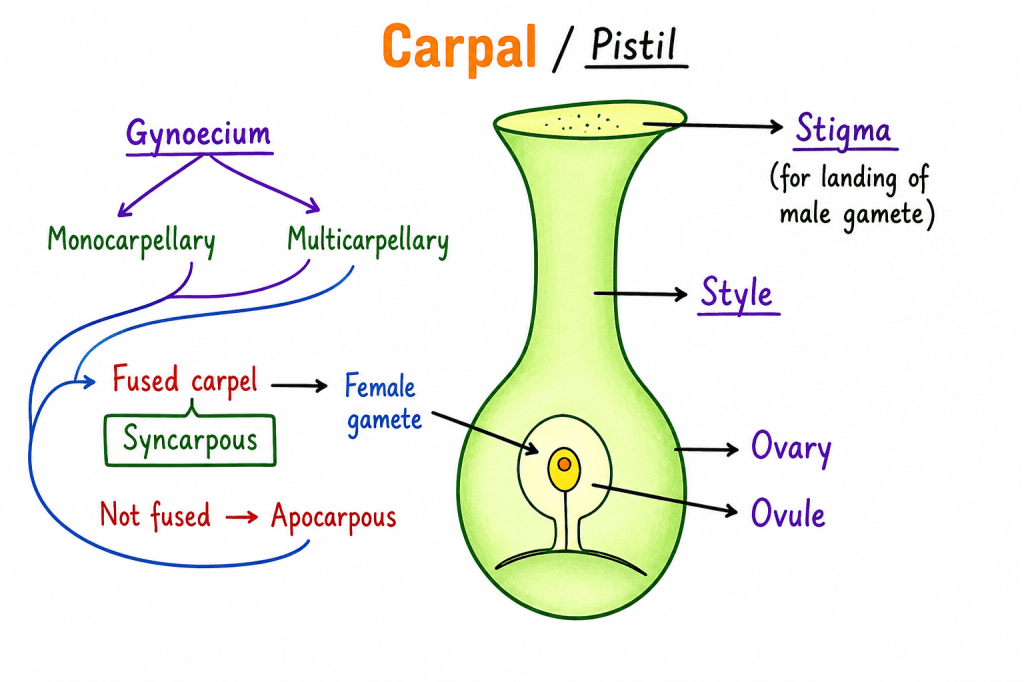
Ovary → Fruit
Ovule → Seed
Ovary wall → Pericarp
Integuments of ovule → Seed coat

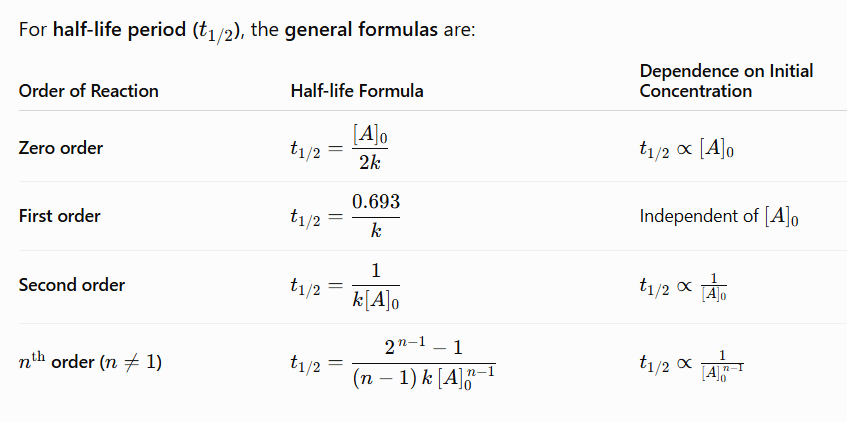
General formula for the half life period for nth order reaction

For half-life period (t1/2t_{1/2}t1/2​), the general formulas

General formula for nthn^{\text{th}}nth order (n≠1n \neq 1)

t1/2=2 n−1−1(n−1) k [A]0 n−1\boxed{t_{1/2}=\frac{2^{\,n-1}-1}{(n-1)\,k\,[A]_0^{\,n-1}}}

This formula gives:

  • Zero order (n=0): t1/2=[A]02k\displaystyle t_{1/2}=\frac{[A]_0}{2k}
  • Second order (n=2): t1/2=1k[A]0\displaystyle t_{1/2}=\frac{1}{k[A]_0}

For first order (n=1), use the separate formula:t1/2=0.693k\boxed{t_{1/2}=\frac{0.693}{k}}

because the general nthn^{\text{th}}nth-order expression is not valid for n=1

Wave Nature of Matter (de Broglie Hypothesis) – CBSE Class 12 Notes

Dual Nature of Light

  • Light exhibits both wave nature and particle nature.
  • Wave nature is observed in:
    • Interference
    • Diffraction
    • Polarisation
  • Particle nature is observed in:
    • Photoelectric effect
    • Compton effect

de Broglie Hypothesis

  • In 1924, French physicist Louis de Broglie proposed that moving material particles also possess wave nature.
  • According to him, if light (energy) shows dual nature, then matter should also exhibit dual nature.

de Broglie Wavelength

The wavelength associated with a moving particle is called the de Broglie wavelength.

Formula

λ=hp\boxed{\lambda=\frac{h}{p}}

Since,p=mvp=mv

therefore,λ=hmv\boxed{\lambda=\frac{h}{mv}}

where:

  • λ\lambda = de Broglie wavelength
  • hh = Planck’s constant (6.626×10⁻³⁴ J s)(6.626 \times 10^{-34}\,\text{J s})(6.626×10⁻³⁴J s)
  • pp = Momentum of particle
  • mm = Mass of particle
  • vv= Velocity of particle

Significance of de Broglie Equation

  • It establishes the dual nature of matter.
  • The left side (λ\lambdaλ) represents the wave property.
  • The right side (mvmvmv) represents the particle property.

de Broglie Wavelength of a Photon

For a photon,p=hνcp=\frac{h\nu}{c}

Substituting in the de Broglie equation,λ=hp=hchν=cν\lambda=\frac{h}{p} =\frac{hc}{h\nu} =\frac{c}{\nu}

Since,λ=cν\boxed{\lambda=\frac{c}{\nu}}

Thus, the de Broglie wavelength of a photon is the same as the wavelength of electromagnetic radiation.


Dependence of de Broglie Wavelength

Fromλ=hmv\lambda=\frac{h}{mv}

  • Mass increases → Wavelength decreases
  • Velocity increases → Wavelength decreases

Thus,

  • Heavy particles have very small de Broglie wavelength.
  • Light particles have larger de Broglie wavelength.

Why Don’t We Observe Wave Nature of Everyday Objects?

  • Macroscopic objects have very large mass, so their de Broglie wavelength is extremely small.
  • Such small wavelengths cannot be detected experimentally.
  • Therefore, everyday objects do not show observable wave nature.

Wave Nature of Microscopic Particles

  • Electrons, protons, neutrons and other subatomic particles have small mass.
  • Their de Broglie wavelength is measurable.
  • Hence, they exhibit wave properties such as diffraction and interference.

CBSE Important Points

  • Proposed by Louis de Broglie (1924).
  • Every moving particle has an associated matter wave.
  • Matter waves are called de Broglie waves.
  • De Broglie wavelength is: λ=hmv\boxed{\lambda=\frac{h}{mv}}
  • Higher momentum → Smaller wavelength.
  • Wave nature is significant only for microscopic particles.
  • The de Broglie wavelength of a photon is equal to the wavelength of the corresponding electromagnetic radiation.

Particle Nature of Light: The Photon (CBSE Class 12 Notes)

Photon

  • Photon is the particle (quantum) of electromagnetic radiation (light).
  • The concept of the photon was proposed by Albert Einstein to explain the photoelectric effect.

Properties of Photon

1. Particle Nature of Light

  • During interaction with matter, light behaves as if it is made up of tiny particles called photons.

2. Energy of a Photon

  • Each photon has energy:

E=hν=hcλE = h\nu = \frac{hc}{\lambda}

where:

  • EE = Energy of photon
  • hh = Planck’s constant
  • ν\nu = Frequency
  • cc = Speed of light
  • λ\lambda = Wavelength

3. Momentum of a Photon

  • Momentum of a photon is:

p=hνc=hλp = \frac{h\nu}{c} = \frac{h}{\lambda}

4. Speed of a Photon

  • Every photon travels with the speed of light (c = 3 × 10⁸ m s⁻¹) in vacuum.

5. Photon Energy Depends on Frequency

  • Photons of the same frequency (or wavelength) have the same energy and momentum.
  • Higher frequency → Higher energy
  • Longer wavelength → Lower energy

6. Intensity of Light

  • Increasing the intensity of light does not change the energy of a photon.
  • It only increases the number of photons falling per second on a given area.

7. Electrical Nature

  • Photons are electrically neutral (no charge).
  • Therefore, they are not deflected by electric or magnetic fields.

8. Conservation Laws

  • During photon-particle interactions (e.g., photoelectric effect or Compton scattering):
    • Total energy is conserved.
    • Total momentum is conserved.
  • The number of photons may change because photons can be absorbed or emitted.

Important Formulae

QuantityFormula
Energy of photonE=hν=hcλE = h\nu = \dfrac{hc}{\lambda}
Momentum of photonp=hνc=hλp = \dfrac{h\nu}{c} = \dfrac{h}{\lambda}
Speed of photonc=3×10⁸ m s−1c = 3 \times 10^8\ \text{m s}^{-1}

CBSE Important Facts

  • Einstein explained the photoelectric effect using the photon theory of light.
  • Light shows wave nature during propagation and particle nature during interaction with matter.
  • Photon energy is independent of the intensity of light.
  • Photon has energy and momentum but no rest mass and no electric charge.

CBSE Class 12 Physics – Einstein’s Photoelectric Equation

1. State Einstein’s photoelectric equation. (1 Mark)

Answer:Kmax⁡=hν−ϕ0K_{\max} = h\nu – \phi_0

where:

  • Kmax⁡K_{\max}=Maximum kinetic energy of photoelectrons
  • h = Planck’s constant
  • ν = Frequency of incident light
  • ϕ0\phi_0 = Work function of the metal

2. What is the work function? (1 Mark)

Answer:
The work function (ϕ0​) is the minimum energy required to remove an electron from the surface of a metal.


3. Define threshold frequency. (1 Mark)

Answer:
The minimum frequency of incident radiation required to cause photoelectric emission is called the threshold frequency ν0=ϕ0h\nu_0=\frac{\phi_0}{h}


4. Why does increasing intensity not increase the maximum kinetic energy of photoelectrons? (2 Marks)

Answer:

  • The energy of each photon depends only on its frequency (E=hν).
  • Increasing intensity increases only the number of photons, not the energy of each photon.
  • Hence, the maximum kinetic energy of photoelectrons remains unchanged.

5. Why is there no photoelectric emission below the threshold frequency? (2 Marks)

Answer:
When ν<ν0\nu < \nu_0hν<ϕ0h\nu < \phi_0

The photon energy is less than the work function, so electrons cannot escape from the metal surface regardless of the intensity of light.


6. How does Einstein’s theory explain the effect of intensity? (2 Marks)

Answer:

  • Intensity is proportional to the number of incident photons.
  • More photons eject more electrons.
  • Therefore, photoelectric current increases, while the maximum kinetic energy remains unchanged.

7. Explain why photoelectric emission is instantaneous according to Einstein’s theory. (2 Marks)

Answer:
Each electron absorbs the energy of a single photon in one step. If the photon energy exceeds the work function, the electron is emitted immediately. Hence, there is no time lag.


8. Write the relation between stopping potential and frequency. (2 Marks)

Answer:eV0=hν−ϕ0eV_0=h\nu-\phi_0

orV0=heν−ϕ0eV_0=\frac{h}{e}\nu-\frac{\phi_0}{e}


9. Draw the graph of stopping potential versus frequency and write its significance. (3 Marks)

Answer:

  • The graph is a straight line.
  • Slope = he\frac{h}{e}
  • X-intercept = Threshold frequency (ν0)(\nu_0)
  • Y-intercept = −ϕ0e-\frac{\phi_0}{e}

10. State any four conclusions of Einstein’s photoelectric theory. (3 Marks)

Answer:

  1. Light consists of photons.
  2. Energy of each photon is hνh\nuhν.
  3. One photon transfers its energy to one electron.
  4. Photoelectric emission occurs only if ν≥ν0\nu \ge \nu_0ν≥ν0​.
  5. Maximum kinetic energy depends only on frequency.
  6. Photoelectric current depends on intensity.

Most Important Board Formulae

  • E=hνE=h\nu
  • Kmax⁡=hν−ϕ0K_{\max}=h\nu-\phi_0
  • ϕ0=hν0\phi_0=h\nu_0
  • ν0=ϕ0h\nu_0=\frac{\phi_0}{h}
  • eV0=hν−ϕ0eV_0=h\nu-\phi_0
  • V0=heν−ϕ0eV_0=\frac{h}{e}\nu-\frac{\phi_0}{e}

These are the most frequently asked CBSE Class 12 board questions from Einstein’s Photoelectric Equation.