Sarvan Kumarhttp://sarvankumar.wordpress.comMy name is Sarvan Kumar, I am post graduate in chemistry (MSc). besides teaching chemistry at various schools and coaching centres I have been giving home tuitions to students for 10 years. I have helped students score good marks in chemistry not only in board examination but also JEE, NEET, SAT, IGCSE and IB examinations. Nearly 90% of my students have scored more than 95% in their CBSE board examination. Moreover they have also secured a seat in prestigious engineering and medical college.
Since every student is different hence my unique style of teach
Al has only 6 electrons around it in monomeric AlCl₃.
Therefore, AlCl₃ is an electron-deficient compound and acts as a Lewis acid.
Dimerisation
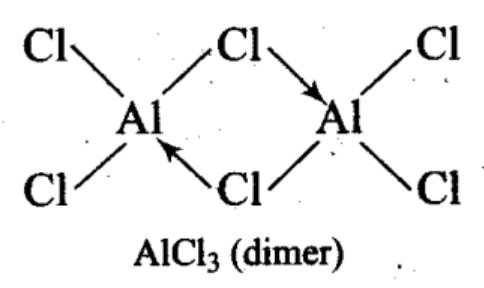
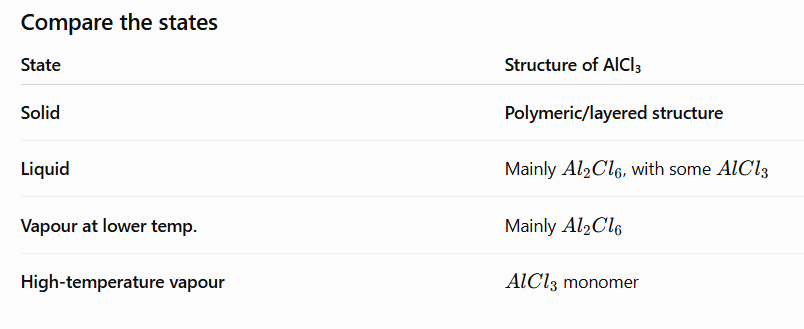
AlCl₃ exists as Al₂Cl₆ (especially in vapour/organic solvents under suitable conditions).Two AlCl₃ units are joined through two bridging Cl atoms.
AlCl₃ ⇌ Al₂Cl₆
Hybridisation in AlCl₃
Monomeric AlCl₃ → sp², trigonal planar.
Al₂Cl₆ → each Al is approximately sp³ because of the two bridging Cl bonds
Most common JEE question
Q. The geometry and hybridisation of Al in monomeric AlCl₃ are:
A. Linear, sp B. Trigonal planar, sp² C. Tetrahedral, sp³ D. Pyramidal, sp³
Answer: B — Trigonal planar, sp².
Shortcut: AlCl₃ = electron deficient → Lewis acid → dimerises to Al₂Cl₆.
so in di bridge structure two cordinate bonds
Yes. In the dimer Al2Cl6, there are two bridging Cl atoms, and the bonding is commonly represented with two coordinate (dative) bonds.
Al2Cl6 structure
Each AlCl₃ initially has 3 Al–Cl bonds.
One Cl atom from each AlCl₃ donates a lone pair to the electron-deficient Al of the other unit.
Thus, 2 bridging Cl atoms → 2 coordinate bonds.
Important: The two coordinate bonds are often drawn as Al←Cl. After formation, the Al–Cl bridging bonds can have considerable covalent character; the arrow mainly indicates the origin of the electron pair.
Here are NEET/JEE-ready notes from the given passage, with the most important facts highlighted.
Gynoecium — Female Reproductive Part
Gynoecium = female reproductive part of a flower.
It may be:
Monocarpellary → one pistil
Multicarpellary → more than one pistil
Multicarpellary pistils may be:
Syncarpous → carpels fused
Apocarpous → carpels free
Parts of a Pistil
Stigma → Style → Ovary
Part
Function
Stigma
Landing platform for pollen grains
Style
Slender elongated part below stigma
Ovary
Basal swollen part containing ovules
Inside the ovary:
Ovarian cavity = Locule
Placenta is present inside the locule.
Ovules (megasporangia) arise from the placenta.
Structure of Ovule
An ovule is attached to the placenta by a stalk called the funicle.
Important terms
Funicle → stalk attaching ovule to placenta Hilum → junction between ovule and funicle Integuments → protective coverings around nucellus Micropyle → small opening in integuments Chalaza → basal region opposite micropyle Nucellus → mass of cells enclosed by integuments Embryo sac → female gametophyte present inside nucellus
Simple arrangement
Micropyle → Nucellus + Embryo sac → Chalaza
Megasporogenesis
Megasporogenesis = formation of megaspores from Megaspore Mother Cell (MMC).
Early Greeks (e.g., Hippocrates) and the Ayurveda system believed health depended on the balance of four “humors”.
One humor was black bile.
They believed people with excess black bile had a hot personality and suffered from fever.
This was based on observation and philosophical thinking, not experiments.
Modern Scientific Concept
William Harvey discovered blood circulation through experiments.
The invention of the thermometer proved that people with black bile did not necessarily have higher body temperature.
Thus, the humor theory was disproved.
Modern Definition of Health (WHO)
Health is a state of complete physical, mental, and social well-being, and not merely the absence of disease or physical fitness.
Three Components of Health
1. Physical Health
Proper functioning of body organs
Freedom from illness
Good physical fitness
2. Mental Health
Ability to think clearly
Emotional stability
Freedom from stress and anxiety
3. Social Health
Good relationships
Ability to work with others
Positive participation in society
Factors Affecting Health
1. Genetic Disorders
Defects present from birth due to inheritance from parents.
Examples
Haemophilia
Sickle-cell anaemia
Colour blindness
2. Infections
Diseases caused by microorganisms like:
Bacteria
Viruses
Fungi
Protozoa
Helminths (worms)
3. Lifestyle Factors
Balanced diet
Safe drinking water
Proper rest
Regular exercise
Personal hygiene
Avoiding smoking, alcohol and drugs
Role of Mind in Health
Modern biology explains that:
Mind → Nervous System + Endocrine System → Immune System → Health
Mental stress weakens immunity.
Positive mental health improves resistance to disease.
Importance of Good Health
Good health leads to:
Higher work efficiency
Increased productivity
Economic prosperity
Longer lifespan (longevity)
Lower infant mortality
Lower maternal mortality
Better quality of life
Measures to Maintain Good Health
Balanced diet
Personal hygiene
Regular exercise
Yoga
Vaccination (Immunisation)
Awareness about diseases
Safe drinking water
Hygienic food
Proper waste disposal
Control of disease vectors (mosquitoes, flies, etc.)
Yoga
Benefits:
Improves physical fitness
Reduces stress
Enhances mental health
Improves flexibility
Strengthens immunity
Disease
Definition
A disease is a condition in which the normal functioning of one or more organs or body systems is disturbed, producing characteristic signs and symptoms.
Signs vs Symptoms
Signs
Symptoms
Objective
Subjective
Seen by doctor
Felt by patient
Example: Fever, rash
Example: Pain, headache, nausea
Classification of Diseases
1. Infectious (Communicable) Diseases
Definition
Diseases that spread from one person to another through pathogens.
Characteristics
Caused by microorganisms
Communicable
Preventable by hygiene and vaccination
Examples
Tuberculosis (TB)
Malaria
Typhoid
Cholera
Measles
Chickenpox
Influenza
COVID-19
AIDS
Important Point
Some infectious diseases like AIDS are fatal.
2. Non-Infectious (Non-Communicable) Diseases
Definition
Diseases that do not spread from one person to another.
Causes
Genetic defects
Nutritional deficiency
Hormonal imbalance
Lifestyle
Ageing
Cancer
Examples
Diabetes
Hypertension
Cancer
Heart disease
Asthma
Haemophilia
Important Point
Among non-infectious diseases, cancer is a major cause of death.
Drug and Alcohol Abuse
Drug and alcohol abuse:
Damages the brain
Affects liver and heart
Weakens immunity
Reduces work efficiency
May lead to addiction and mental disorders
NEET Important Flow Chart
Health
│
├── Physical Well-being
├── Mental Well-being
└── Social Well-being
│
▼
Factors Affecting Health
│
├── Genetic Disorders
├── Infections
└── Lifestyle
│
▼
Good Health
│
├── Balanced Diet
├── Hygiene
├── Exercise
├── Yoga
├── Vaccination
├── Waste Disposal
└── Vector Control
│
▼
Disease
│
├── Infectious
│ ├── Communicable
│ └── Example: TB, Malaria, AIDS
│
└── Non-Infectious
├── Non-communicable
└── Example: Cancer, Diabetes
NCERT & NEET Important Points
Health is not merely the absence of disease.
Health includes physical, mental, and social well-being.
Mind influences health through the nervous system, endocrine system, and immune system.
Health is affected by genetic disorders, infections, and lifestyle.
Balanced diet, hygiene, exercise, yoga, vaccination, waste disposal, and vector control help maintain health.