
1. Importance of Flowers
Flowers have been closely associated with human beings since ancient times. They have:
- Aesthetic value – beauty and decoration
- Ornamental value – used in homes and gardens
- Social value – used in ceremonies and celebrations
- Religious value – used in worship
- Cultural value – associated with traditions and festivals
- Used to express love, affection, happiness, grief and mourning
2. Examples of Ornamental Flowers
Commonly cultivated at homes and in gardens:
- Rose
- Marigold
- Jasmine
- Hibiscus
- Petunia
3. Floriculture
Floriculture is the branch of horticulture concerned with the cultivation and management of flowering plants and ornamental flowers.
4. Biological Importance of Flowers
To a biologist, flowers are:
- Morphological marvels
- Embryological marvels
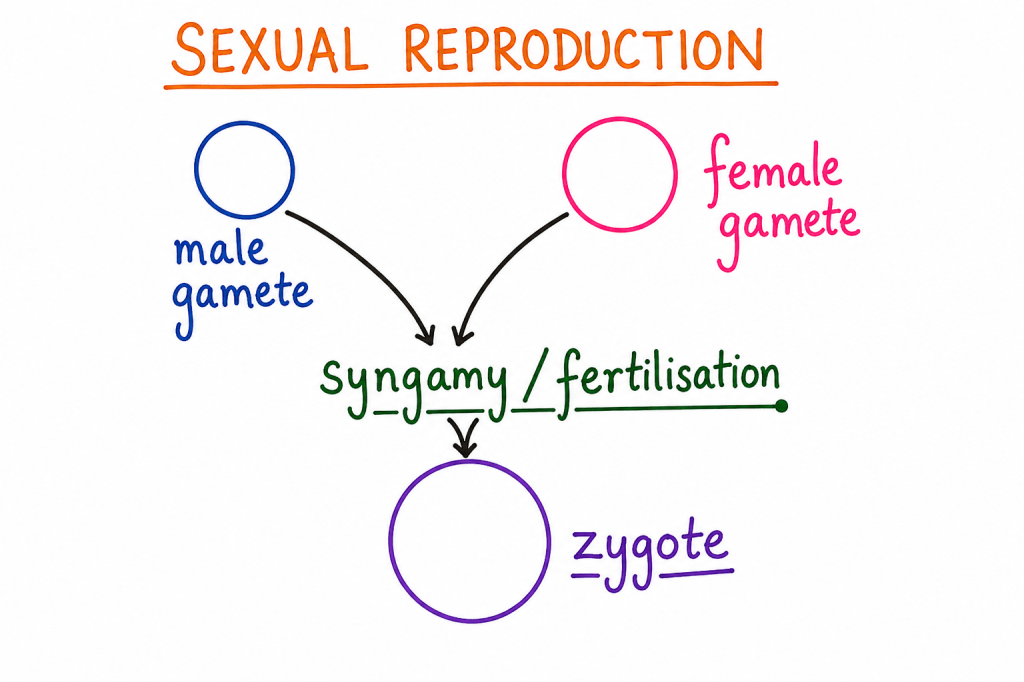
- The sites of sexual reproduction in angiosperms.
5. Two Important Reproductive Parts
The two parts of a flower in which the important units of sexual reproduction develop are:
| Flower part | Reproductive unit |
|---|---|
| Androecium | Pollen grains (male gametophytes) |
| Gynoecium | Embryo sac (female gametophyte) |
6. Pre-fertilisation: Structures and Events
Before the flower becomes visible, the plant undergoes hormonal and structural changes that initiate flowering.
Sequence:
Hormonal & structural changes → Floral primordium → Inflorescence → Floral buds → Flowers
In the developing flower:
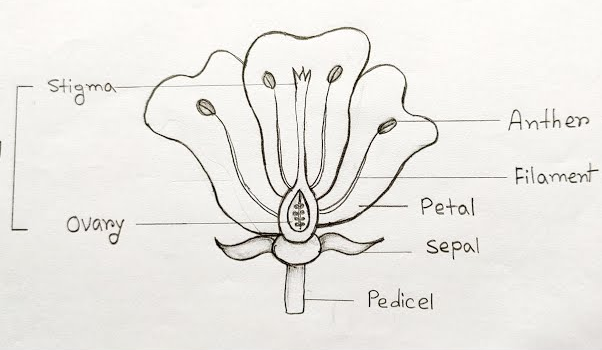
- Androecium → male reproductive structure
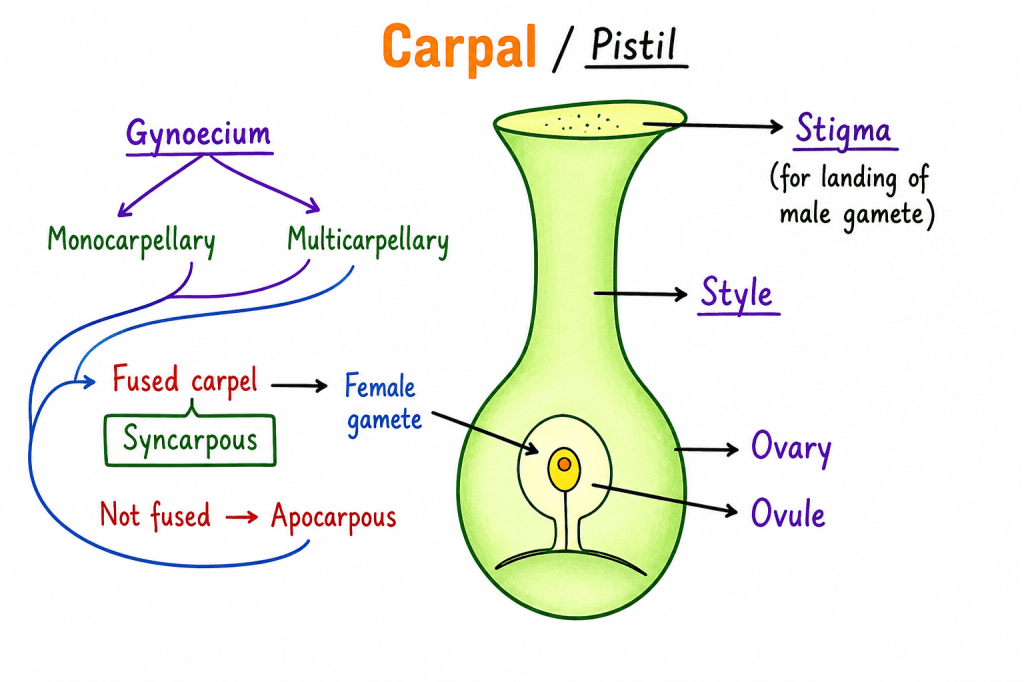
- Gynoecium → female reproductive structure
Both differentiate and develop before fertilisation.
| Individual part | Collective term / Whorl |
|---|---|
| Petal | Corolla |
| Sepal | Calyx |
| Carpel | Gynoecium |
| Stamen | Androecium |
Easy way to remember 🌸
Petals → Corolla
Sepals → Calyx
Carpels → Gynoecium
Stamens → Androecium
👉 Calyx + Corolla = Accessory/Non-reproductive whorls
👉 Androecium + Gynoecium = Reproductive whorls
⭐ Key Flow
Flowering decision → Floral primordium → Inflorescence → Floral bud → Flower → Androecium + Gynoecium
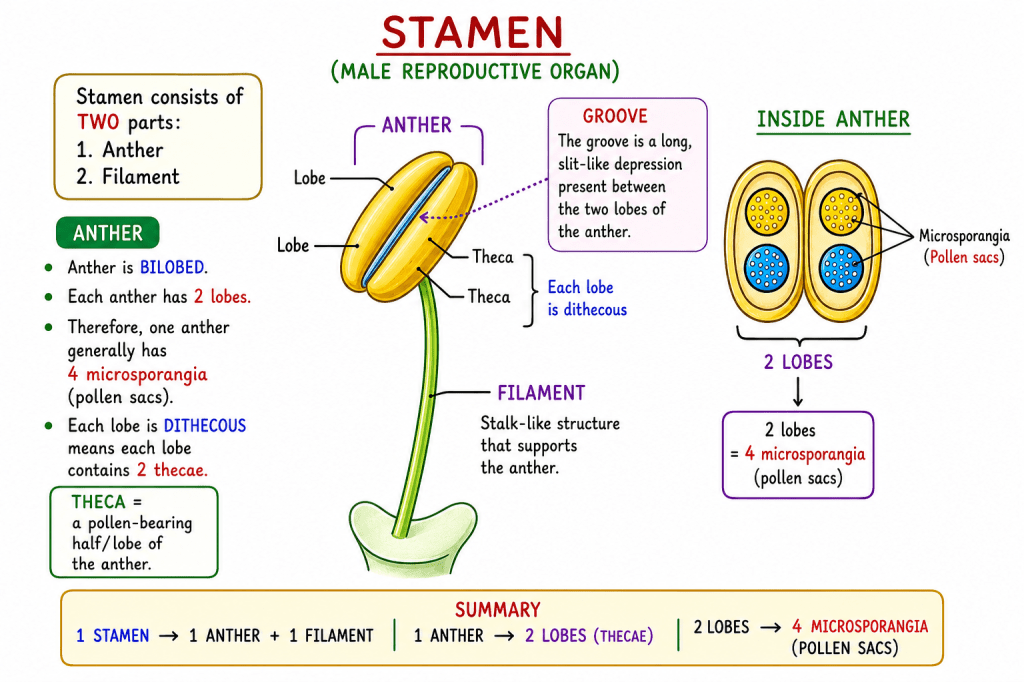
Stamen — key points from the diagram
- Stamen = male reproductive organ of a flower.
- It consists of two parts:
- Anther
- Filament
Anther
- Typically bilobed.
- Each anther has 2 lobes.
- Therefore, one anther generally has 4 microsporangia (pollen sacs).
- Each lobe is dithecous → each lobe contains 2 thecae.
- Theca = a pollen-bearing half/lobe of the anther.
Filament
- A stalk-like structure that supports the anther.
- It connects the anther to the flower.
1. Sporophyte (2n)
- The sporophyte is the diploid (2n) plant body.
- It produces spores.
- Special cells in the sporophyte undergo meiosis.
2. Meiosis → Spores (n)
- Meiosis reduces the chromosome number: 2n → n
- Therefore, the spores are haploid (n).
- These spores are produced in spore-forming structures of the sporophyte.
3. Spore → Gametophyte (n)
- A haploid spore grows and develops into a gametophyte.
- The gametophyte is therefore haploid (n).
4. Gametophyte → Gametes (n)
- The gametophyte produces gametes by mitosis, not meiosis.
- Since the gametophyte is already haploid: n → n
Remember:
Ovary → Fruit
Ovule → Seed
Ovary wall → Pericarp
Integuments of ovule → Seed coat

