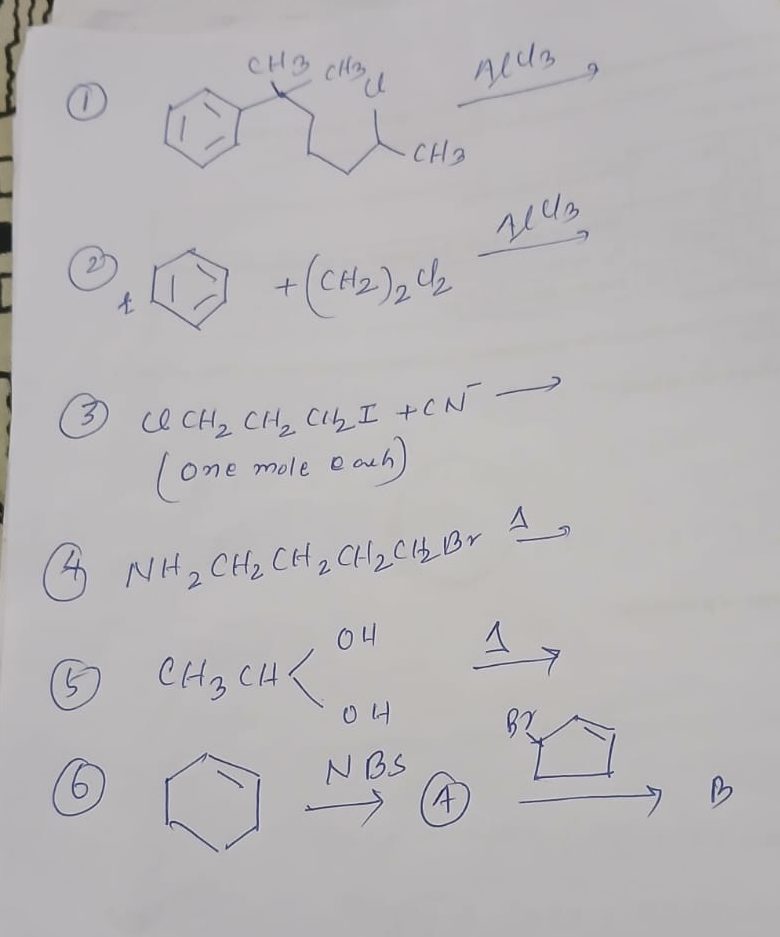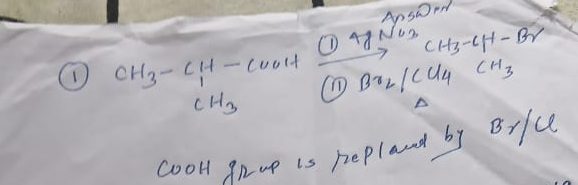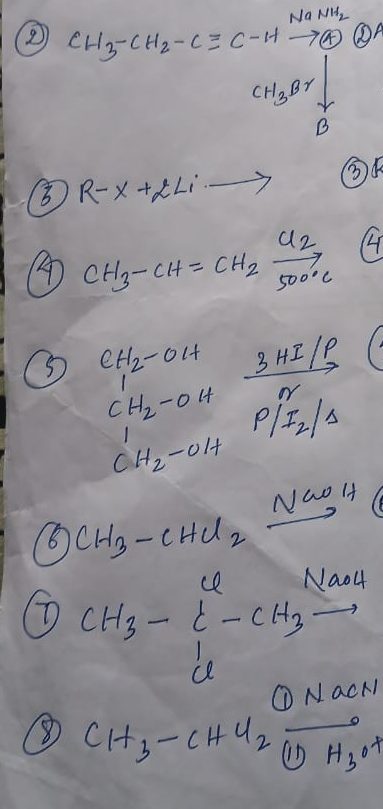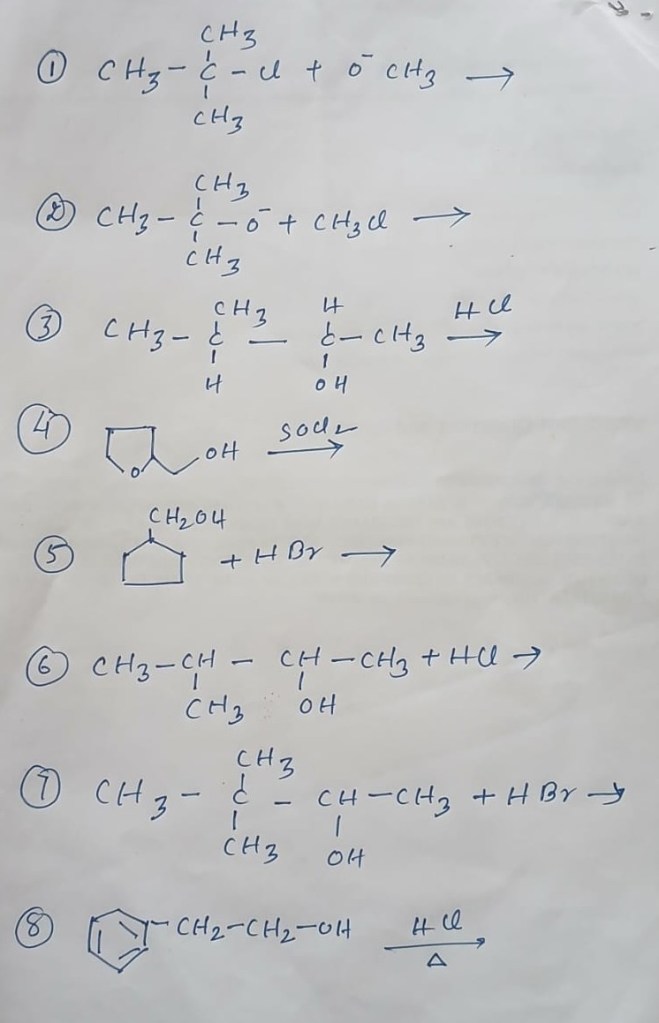
Final Answers (with JEE/NEET Hints)
| Q. | Major Product | Hint |
|---|---|---|
| 1 | 2-Methylpropene (\mathbf{CH_2=C(CH_3)_2}) | 3° alkyl halide + strong base (CH₃O⁻) ⇒ E2 elimination (SN2 impossible). |
| 2 | tert-Butyl methyl ether (\mathbf{(CH_3)_3COCH_3}) | Williamson ether synthesis: keep the bulky group as alkoxide and use methyl halide for SN2. |
| 3 | 2-Chloro-2-methylbutane | HCl + 2° alcohol → carbocation → 1,2-hydride shift → 3° carbocation → Cl⁻ attack. |
| 4 | 2-(Chloromethyl)tetrahydrofuran (THF–CH₂Cl) | SOCl₂ replaces only –OH by –Cl. Ether ring remains unchanged. |
| 5 | Bromocyclohexane | Cyclopentylmethyl carbocation undergoes ring expansion (5 → 6 membered) before Br⁻ attack. |
| 6 | 2-Chloro-2-methylbutane | Same as Q3: hydride shift gives a more stable 3° carbocation. |
| 7 | 2-Bromo-2,3-dimethylbutane | 2° carbocation → 1,2-methyl shift → 3° carbocation → Br⁻ attack. |
| 8 | 1-Chloro-1-phenylethane (\mathbf{C_6H_5CH(Cl)CH_3}) | Benzylic rearrangement forms a stable benzylic carbocation, then Cl⁻ attacks. |
One-line Revision Tricks
- 3° RX + strong base → Elimination (E2).
- Williamson Ether: RO⁻ + CH₃X/1° RX → Ether (SN2).
- HX + alcohol → Always check for carbocation rearrangement (hydride/methyl shift).
- Cyclobutylmethyl & Cyclopentylmethyl carbocations → Think ring expansion.
- SOCl₂ converts only –OH to –Cl; ethers are unaffected.
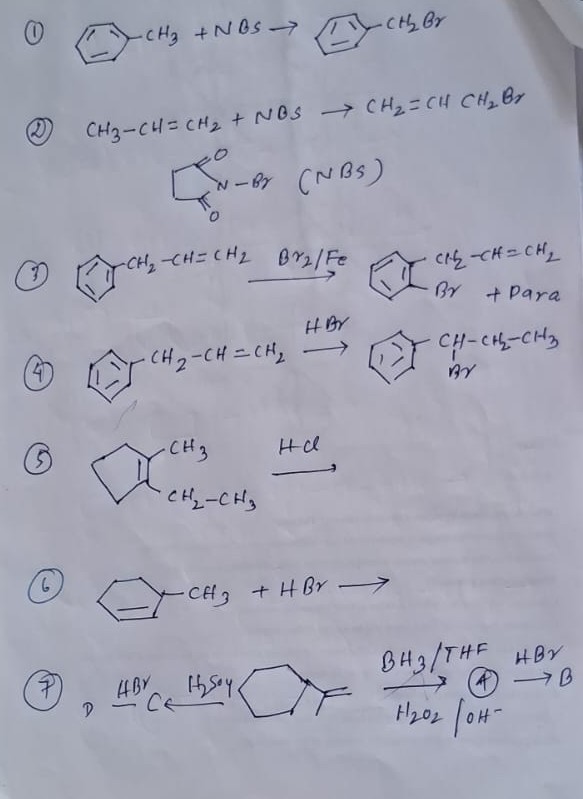
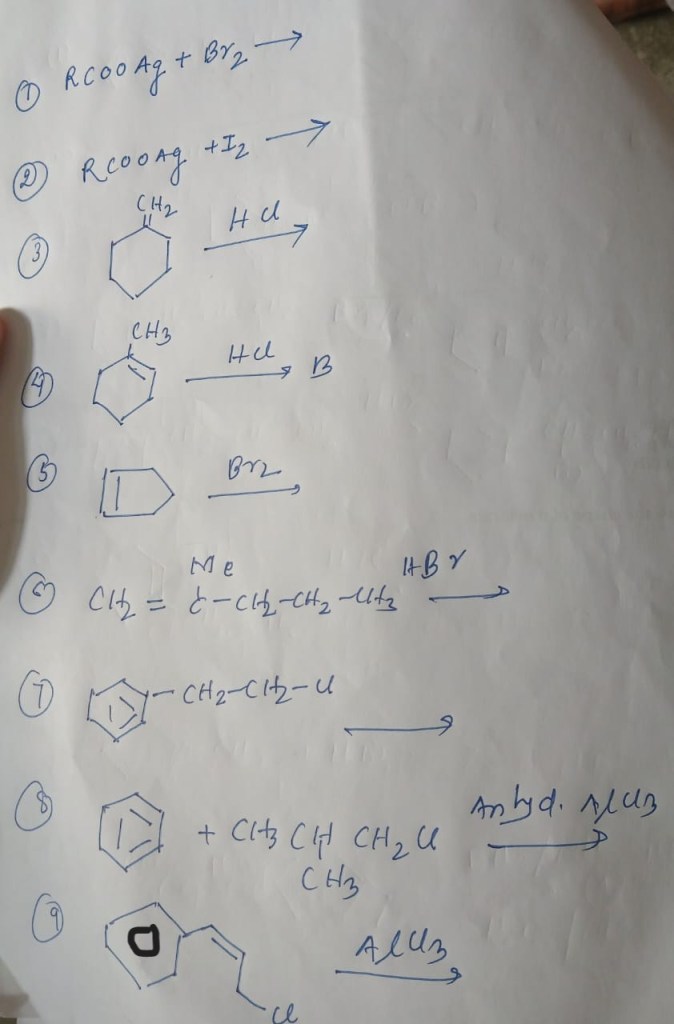
Final Answers
Please upload a clearer image of Questions 7 and 9 (or type the reagents), and I’ll draw the exact products.

Final Answers
| Q. | Product |
|---|---|
| 1 | R–Br + CO₂ + AgBr |
| 2 | No reaction |
| 3 | 1-Chloro-1-methylcyclohexane |
| 4 | 1-Chloro-1-methylcyclohexane |
| 5 | trans-1,2-Dibromide (anti addition) |
| 6 | 2-Bromo-2-methylpentane |
| 7 | Need reagent (not visible) |
| 8 | tert-Butylbenzene |
| 9 | Intramolecular Friedel–Crafts cyclization (exact structure unclear) |