Microbes in Human Welfare NCERT solution Class12

Here are CBSE Class 12 Biology (NCERT) Board Exam Answers for Chapter: Microbes in Human Welfare. These answers are written in the style expected in the CBSE board examination.


1. Which sample would you carry to demonstrate microbes under a microscope and why?

Answer:
I would carry a sample of curd because it contains a large number of lactic acid bacteria (LAB), especially Lactobacillus. These bacteria are easily visible under a microscope after proper staining and are present in large numbers due to fermentation.


2. Give examples to prove that microbes release gases during metabolism.

Answer:
Examples are:

  • Yeast produces carbon dioxide during fermentation of dough, causing bread and idli batter to rise.
  • In biogas plants, methanogenic bacteria produce methane (CH₄) along with carbon dioxide and hydrogen sulphide.
  • During the preparation of Swiss cheese, Propionibacterium shermanii releases carbon dioxide, forming large holes.

3. In which food would you find lactic acid bacteria? Mention some of their useful applications.

Answer:
Lactic acid bacteria are found in curd.

Applications:

  • Convert milk into curd.
  • Increase the nutritional value by increasing vitamin B₁₂.
  • Improve digestion.
  • Prevent the growth of harmful microbes in the stomach.

4. Name some traditional Indian foods made of wheat, rice and Bengal gram which involve the use of microbes.

Answer:
Examples include:

  • Idli
  • Dosa
  • Dhokla
  • Jalebi
  • Bhatura

These foods are prepared by microbial fermentation, mainly involving lactic acid bacteria and yeast.


5. In which way have microbes played a major role in controlling diseases caused by harmful bacteria?

Answer:
Microbes produce antibiotics, which kill or inhibit the growth of disease-causing bacteria.
Example:

  • Penicillin, produced by Penicillium notatum, is used to treat many bacterial infections.

6. Name any two species of fungus used in the production of antibiotics.

Answer:

  • Penicillium notatum
  • Penicillium chrysogenum

7. What is sewage? In which way can sewage be harmful to us?

Answer:
Sewage is municipal wastewater containing human excreta, domestic waste and industrial effluents.

Harmful effects:

  • Contains disease-causing microorganisms.
  • Pollutes water bodies.
  • Reduces dissolved oxygen.
  • Spreads water-borne diseases such as cholera, typhoid and dysentery.

8. What is the key difference between primary and secondary sewage treatment?

Answer:

Primary TreatmentSecondary Treatment
Physical processBiological process
Removes floating and suspended solidsRemoves organic matter using microbes
Uses screening and sedimentationUses aerobic microbes in aeration tanks

9. Do you think microbes can also be used as a source of energy? If yes, how?

Answer:
Yes. Methanogenic bacteria convert cattle dung and organic waste into biogas, which mainly contains methane. Biogas is used as a clean and renewable source of energy for cooking, lighting and electricity generation.


10. How can microbes decrease the use of chemical fertilisers and pesticides?

Answer:
Microbes are used as biofertilisers and biopesticides.

  • Biofertilisers such as Rhizobium, Azotobacter and cyanobacteria fix atmospheric nitrogen and improve soil fertility.
  • Biopesticides such as Bacillus thuringiensis (Bt) control insect pests without polluting the environment.

11. Assign the correct labels to the water samples based on BOD values.

Answer:

  • Most polluted sample: C (400 mg/L)
  • Untreated sewage: C
  • River water: B (8 mg/L)
  • Secondary effluent: A (20 mg/L)

Higher BOD indicates greater organic pollution.


12. Name the microbes from which Cyclosporin A and Statins are obtained.

Answer:

  • Cyclosporin A: Trichoderma polysporum
  • Statins: Monascus purpureus

13. Role of microbes in:

(a) Single Cell Protein (SCP)

Answer:

  • Microbes such as Spirulina, yeast and Methylophilus methylotrophus are used as SCP.
  • They are rich in proteins, vitamins and minerals.
  • Used as food supplements and animal feed.

(b) Soil

Answer:

  • Decompose organic matter and recycle nutrients.
  • Fix atmospheric nitrogen.
  • Improve soil fertility.
  • Help in nutrient cycling and humus formation.

14. Arrange the following in decreasing order of importance for the welfare of human society and give reasons.

Answer:

Penicillin > Curd > Biogas > Citric acid

Reasons:

  • Penicillin: Saves millions of lives by treating bacterial diseases.
  • Curd: Nutritious food with beneficial bacteria that improve digestion.
  • Biogas: Renewable, eco-friendly source of energy and helps in waste management.
  • Citric acid: Mainly used as a food preservative and flavouring agent in industries.

15. How do biofertilisers enrich soil fertility?

Answer:
Biofertilisers improve soil fertility by:

  • Fixing atmospheric nitrogen (Rhizobium, Azotobacter, cyanobacteria).
  • Solubilising phosphate.
  • Increasing nutrient availability.
  • Improving soil texture and microbial activity.
  • Reducing the need for chemical fertilisers.

Important Board Exam Keywords

  • Lactic Acid Bacteria (LAB)
  • Fermentation
  • Antibiotics
  • Penicillin
  • Biofertilisers
  • Biopesticides
  • Methanogens
  • Biogas
  • Biological Oxygen Demand (BOD)
  • Activated sludge
  • Rhizobium
  • Lactobacillus
  • Trichoderma polysporum
  • Monascus purpureus
  • Bacillus thuringiensis (Bt)

These answers are concise, NCERT-based, and suitable for CBSE Class 12 Board examinations (2–5 marks).

Microbes in Sewage Treatment (Step by Step)

MICROBES IN HUMAN WELFARE:: TOPIC 4NEET & CBSE Class 12 Biology


What is Sewage?

  • Sewage = Municipal wastewater containing:
    • Human excreta
    • Organic matter
    • Microorganisms
    • Disease-causing (pathogenic) microbes

Why is sewage treated?

Untreated sewage:

  • Pollutes rivers and lakes.
  • Decreases dissolved oxygen.
  • Spreads water-borne diseases.
  • Harms aquatic organisms.

Therefore, sewage is treated in Sewage Treatment Plants (STPs).


Sewage Treatment – Flow Chart

Sewage
↓
Primary Treatment (Physical)
↓
Primary Effluent
↓
Secondary Treatment (Biological)
↓
Activated Sludge
↓
Anaerobic Sludge Digester
↓
Biogas Produced
↓
Treated Water Released into Rivers

STEP 1 : Primary Treatment (Physical Treatment)

Purpose

Removes large and small solid particles.

Processes

(A) Filtration

Removes:

  • Plastic
  • Cloth
  • Wood pieces
  • Floating debris

↓

(B) Sedimentation

Heavy particles settle down.

Removes:

  • Sand
  • Soil
  • Pebbles
  • Grit

Products formed

Settled solids
→ Primary Sludge

Upper liquid
→ Primary Effluent

Primary effluent is sent for biological treatment.


STEP 2 : Secondary Treatment (Biological Treatment)

This is the most important NEET topic.

The primary effluent enters large aeration tanks.

What happens?

✔ Air is continuously pumped.

✔ Mechanical agitation is done.

This provides oxygen.

↓

Useful aerobic bacteria multiply rapidly.


Formation of Flocs

Bacteria combine with fungal filaments.

They form mesh-like structures called

Flocs

Definition

Flocs are masses of bacteria associated with fungal filaments.


Function of Flocs

The microbes consume organic matter present in sewage.

As organic matter decreases,

↓

BOD decreases.


What is BOD?

BOD = Biochemical Oxygen Demand

Definition

Amount of oxygen required by bacteria to oxidize organic matter present in 1 litre of water.


Important Points

High BOD

More organic matter

More pollution

Low BOD

Cleaner water

Less pollution

NEET Line

Greater the BOD, greater the pollution.


Activated Sludge

After BOD decreases,

The sewage enters a settling tank.

Flocs settle at the bottom.

This settled material is called

Activated Sludge


What happens to Activated Sludge?

Small Portion

Sent back into aeration tank.

Purpose:

Acts as inoculum (starter culture).


Remaining Portion

Transferred to

Anaerobic Sludge Digester


STEP 3 : Anaerobic Digestion

Inside sludge digester,

Anaerobic bacteria digest

  • Dead bacteria
  • Fungi
  • Organic matter

Gases Produced

During digestion,

Biogas is produced.

Contains:

  • Methane (CH₄)
  • Hydrogen sulphide (H₂S)
  • Carbon dioxide (CO₂)

Uses of Biogas

  • Fuel
  • Electricity
  • Cooking
  • Heating

STEP 4 : Final Effluent

After treatment,

Water becomes much cleaner.

It is discharged into

  • Rivers
  • Lakes
  • Streams

Importance of Sewage Treatment

✔ Reduces pollution

✔ Removes pathogens

✔ Reduces BOD

✔ Produces biogas

✔ Protects aquatic life

✔ Prevents water-borne diseases


Ganga Action Plan (GAP)

Purpose:

Clean River Ganga.

Method:

Construction of Sewage Treatment Plants (STPs).


Yamuna Action Plan (YAP)

Purpose:

Reduce pollution in River Yamuna.

Method:

Treat sewage before discharge.


Complete Process (Easy Flow)

Raw Sewage
↓
Filtration
↓
Sedimentation
↓
Primary Sludge + Primary Effluent
↓
Aeration Tank
↓
Aerobic bacteria + Fungi
↓
Flocs formed
↓
Organic matter consumed
↓
BOD decreases
↓
Settling Tank
↓
Activated Sludge
↙ ↘
Small part Large part
(Inoculum) ↓
Anaerobic
Sludge Digester
↓
Methane + CO₂ + H₂S
↓
Biogas
↓
Treated Water Released

NEET Important Definitions

Sewage

Municipal wastewater containing human excreta, organic matter, and microbes.

Primary Sludge

Solid particles settled during primary treatment.

Primary Effluent

Liquid remaining after primary treatment.

Flocs

Masses of aerobic bacteria associated with fungal filaments.

Activated Sludge

Settled bacterial flocs obtained after secondary treatment.

BOD

Amount of oxygen required by bacteria to oxidize organic matter present in 1 litre of water.

Biogas

Mixture of methane, carbon dioxide, and hydrogen sulphide produced during anaerobic digestion.


NCERT-Based NEET Questions

  1. Primary treatment is: Physical treatment.
  2. Secondary treatment is: Biological treatment.
  3. Flocs are formed by: Bacteria + fungal filaments.
  4. Activated sludge contains: Settled bacterial flocs.
  5. BOD stands for: Biochemical Oxygen Demand.
  6. High BOD indicates: High pollution.
  7. Biogas mainly contains: Methane.
  8. Biogas is produced in: Anaerobic sludge digester.
  9. Small amount of activated sludge is used as: Inoculum.
  10. Large amount of activated sludge is sent to: Anaerobic sludge digester.

Memory Trick

“Filter → Settle → Air → Flocs → BOD ↓ → Activated Sludge → Biogas → River”

This sequence is the complete sewage treatment process and is one of the most frequently tested NCERT topics in NEET Biology.

Chemicals, Enzymes and Other Bioactive Molecules – Key Points

MICROBES IN HUMAN WELFARE TOPIC 3


1. Industrial Chemicals Produced by Microbes

MicrobeTypeProduct
Aspergillus nigerFungusCitric acid
Acetobacter acetiBacteriumAcetic acid (Vinegar)
Clostridium butylicumBacteriumButyric acid
LactobacillusBacteriumLactic acid
Saccharomyces cerevisiae (Yeast)FungusEthanol (Alcohol)

2. Industrial Enzymes

Lipase

  • Breaks down fats (lipids).
  • Used in detergents.
  • Removes oil and grease stains from clothes.

Pectinase

  • Breaks down pectin in fruits.
  • Used to clarify fruit juices.

Protease

  • Breaks down proteins.
  • Also used for juice clarification.

Result: Market fruit juices are clearer than homemade juices.


3. Streptokinase

  • Produced by Streptococcus bacteria.
  • Modified using genetic engineering.
  • Called a Clot Buster.
  • Dissolves blood clots.
  • Used after myocardial infarction (heart attack).

4. Cyclosporin A

  • Produced by Trichoderma polysporum (Fungus).
  • Functions as an Immunosuppressant.
  • Used in organ transplantation.
  • Prevents organ rejection by suppressing the immune system.

5. Statins

  • Produced by Monascus purpureus (Yeast).
  • Used to lower blood cholesterol.
  • Works by competitively inhibiting the enzyme responsible for cholesterol synthesis.

One-Line Revision

  • Aspergillus niger → Citric acid
  • Acetobacter aceti → Acetic acid
  • Clostridium butylicum → Butyric acid
  • Lactobacillus → Lactic acid
  • Saccharomyces cerevisiae → Ethanol
  • Lipase → Detergents (oil stain removal)
  • Pectinase + Protease → Fruit juice clarification
  • Streptokinase → Clot buster (heart attack patients)
  • Trichoderma polysporum → Cyclosporin A (Immunosuppressant)
  • Monascus purpureus → Statins (Lower cholesterol)

NEET Most Important Table

MicrobeProductUse
Aspergillus nigerCitric acidFood & pharmaceutical industry
Acetobacter acetiAcetic acidVinegar production
Clostridium butylicumButyric acidIndustrial chemical
LactobacillusLactic acidDairy and food industry
Saccharomyces cerevisiaeEthanolAlcohol production
StreptococcusStreptokinaseDissolves blood clots
Trichoderma polysporumCyclosporin AOrgan transplantation
Monascus purpureusStatinsLowers cholesterol

NEET Memory Trick

“AACLuS Makes Life Pretty Smart”

  • A → Aspergillus → Citric acid
  • A → Acetobacter → Acetic acid
  • C → Clostridium → Butyric acid
  • L → Lactobacillus → Lactic acid
  • S → Saccharomyces → Ethanol
  • P → Pectinase + Protease → Clear juice
  • S → Streptococcus → Streptokinase (Clot buster)
  • T → Trichoderma → Cyclosporin A
  • M → Monascus → Statins (Cholesterol lowering)

NEET Tip: The microbe–product pairs (Aspergillus–Citric acid, Trichoderma–Cyclosporin A, Monascus–Statins, Streptococcus–Streptokinase) are among the most frequently tested facts from this chapter.

Microbes in Industrial Products – NCERT Key Points (NEET/CBSE)

MICROBES IN HUMAN WELFARE class 12 biology

1. Industrial Use of Microbes

  • Microbes are used to produce many commercially valuable products.
  • Major industrial products include:
    • Fermented beverages
    • Antibiotics
  • Industrial-scale production is carried out in large vessels called fermentors (bioreactors).

2. Fermented Beverages

Microorganism Used

  • Yeast: Saccharomyces cerevisiae
  • Also called Brewer’s yeast.

Raw Materials

  • Malted cereals
  • Fruit juices

Main Product

  • Ethanol (Alcohol)

Metabolic Pathway

  • Alcoholic fermentation (Anaerobic respiration)

Alcohol Produced

BeverageDistillation
Wine❌ No
Beer❌ No
Whisky✅ Yes
Brandy✅ Yes
Rum✅ Yes

Important Points

  • Yeast converts sugars into:
    • Ethanol
    • CO₂
  • Type of alcoholic beverage depends on:
    • Raw material used
    • Distillation process

3. Antibiotics

Definition

  • Antibiotics are chemical substances produced by certain microbes.
  • They kill or inhibit the growth of disease-causing microorganisms.

Meaning

  • Anti = Against
  • Bio = Life
  • Together means “Against life” (against disease-causing microbes).

Importance

  • One of the greatest discoveries of the 20th century.
  • Revolutionized the treatment of bacterial diseases.

4. Penicillin

First Antibiotic

  • Penicillin was the first antibiotic discovered.

Discovery

  • Discovered accidentally (chance discovery).

Discovered By

  • Alexander Fleming

Year of Nobel Prize

  • 1945

Source Organism

  • Penicillium notatum (mould)

Discovery Story

  • Fleming observed that a mould was growing on an unwashed culture plate containing Staphylococci.
  • Around the mould, bacteria failed to grow.
  • The mould produced a chemical called Penicillin.

Full Potential Established By

  • Ernest Chain
  • Howard Florey

Major Use

  • Widely used to treat American soldiers during World War II.

Nobel Prize (1945)

Awarded jointly to:

  • Alexander Fleming
  • Ernest Chain
  • Howard Florey

5. Diseases Controlled by Antibiotics

Antibiotics have greatly reduced deaths due to:

  • Plague
  • Whooping cough (Pertussis)
  • Diphtheria
  • Leprosy

NEET Important Table

ProductMicroorganismProduct Obtained
BreadSaccharomyces cerevisiaeCO₂
Beer/WineSaccharomyces cerevisiaeEthanol
PenicillinPenicillium notatumPenicillin
Swiss CheesePropionibacterium sharmaniiCO₂ (holes)
CurdLactobacillusLactic acid

Scientists to Remember

ScientistContribution
Alexander FlemingDiscovered penicillin
Ernest ChainDeveloped penicillin for medical use
Howard FloreyDeveloped penicillin for medical use

NEET One-Liners

  • Industrial production of microbes is carried out in fermentors.
  • Brewer’s yeast = Saccharomyces cerevisiae.
  • Yeast converts sugars into ethanol and CO₂.
  • Wine and beer are produced without distillation.
  • Whisky, brandy, and rum are produced after distillation.
  • Penicillin is the first antibiotic discovered.
  • Source of penicillin: Penicillium notatum.
  • Penicillin was discovered accidentally by Alexander Fleming.
  • Chain and Florey established its therapeutic use.
  • Fleming, Chain, and Florey received the Nobel Prize in 1945.
  • Antibiotics kill or inhibit the growth of disease-causing microorganisms.

🎯 Most Important NCERT Facts for NEET

  • Fermentor = Large vessel used for industrial-scale microbial growth.
  • Brewer’s yeast = Saccharomyces cerevisiae.
  • Metabolic pathway for alcohol production = Alcoholic fermentation (anaerobic respiration).
  • First antibiotic = Penicillin.
  • Source = Penicillium notatum.
  • Discovered by = Alexander Fleming.
  • Nobel Prize = 1945 (Fleming, Chain, and Florey).

Microbes in Household Products – NCERT Key Points (NEET/CBSE)

MICROBES IN HUMAN WELFARE CLASS 12 BIOLOGY TOPIC 2

1. Curd Formation

  • Microbe involved: Lactobacillus and other Lactic Acid Bacteria (LAB).
  • LAB convert milk into curd.
  • They produce lactic acid, which:
    • Coagulates (curdles) milk proteins.
    • Partially digests milk proteins.
  • A small amount of curd is used as a starter (inoculum).
  • Starter contains millions of LAB.
  • At suitable temperature, LAB multiply rapidly and convert milk into curd.
  • LAB increase the nutritional value of curd by increasing Vitamin B₁₂.
  • LAB in the human intestine help prevent the growth of disease-causing microbes (probiotics).

2. Idli and Dosa Batter

  • Batter is fermented by bacteria (mainly LAB).
  • Fermentation produces CO₂ gas.
  • CO₂ makes the batter soft, fluffy, and puffed up.
  • Metabolic pathway involved: Fermentation (Anaerobic respiration).
  • The bacteria usually come from:
    • Previous fermented batter (starter)
    • Rice and urad dal surfaces
    • Surrounding environment

3. Bread Making

  • Microbe used: Baker’s yeast (Saccharomyces cerevisiae).
  • Yeast ferments sugars and produces:
    • CO₂
    • Ethanol
  • CO₂ causes the dough to rise and become soft.

4. Traditional Fermented Foods and Drinks

  • Toddy
    • Traditional drink of southern India.
    • Produced by fermenting palm sap.
  • Microbes are also used to ferment:
    • Fish
    • Soybean
    • Bamboo shoots

5. Cheese Production

  • Cheese is one of the oldest fermented foods.
  • Different microbes produce different:
    • Texture
    • Flavour
    • Taste

(a) Swiss Cheese

  • Microbe: Propionibacterium sharmanii
  • Produces large amounts of CO₂.
  • CO₂ forms the large holes (eyes) in Swiss cheese.

(b) Roquefort Cheese

  • Ripened using a specific fungus.
  • The fungus gives the cheese its characteristic flavour.

NEET Important Microbes Table

ProductMicroorganismImportant Function
CurdLactobacillus (LAB)Converts milk into curd; increases Vitamin B₁₂
Idli/DosaLactic Acid BacteriaFermentation; CO₂ makes batter fluffy
BreadSaccharomyces cerevisiaeCO₂ makes dough rise
ToddyYeastFerments palm sap
Swiss CheesePropionibacterium sharmaniiProduces holes by CO₂
Roquefort CheeseSpecific fungusDevelops characteristic flavour

NEET One-Liners

  • LAB = Lactic Acid Bacteria.
  • Lactobacillus converts milk into curd.
  • LAB increase Vitamin B₁₂ content in curd.
  • LAB suppress harmful microbes in the gut (probiotic effect).
  • Baker’s yeast = Saccharomyces cerevisiae.
  • CO₂ causes bread dough and idli batter to rise.
  • Swiss cheese holes are due to Propionibacterium sharmanii.
  • Roquefort cheese is ripened by a specific fungus.
  • Toddy is prepared by fermentation of palm sap.

🎯 NCERT Facts Frequently Asked in NEET

  • Starter used in curd making: Inoculum containing millions of LAB.
  • Gas responsible for puffing of idli/dosa batter: CO₂.
  • Metabolic pathway: Fermentation (anaerobic respiration).
  • Vitamin increased in curd: Vitamin B₁₂.

Microbes in Human Welfare Class 12 biology – NCERT Key Points (Introduction) | NEET/CBSE

Microbes – Key Points

  1. Microbes are microscopic organisms found everywhere on Earth.
  2. Besides plants and animals, microbes are the major components of biological systems.
  3. Microorganisms mainly belong to:
    • Monera (Bacteria)
    • Protista (Protozoa)
    • Fungi (Yeasts, moulds)
    • Viruses, viroids, and prions (acellular infectious agents)
  4. Only microscopic organisms include:
    • Bacteria
    • Protozoa
    • Many fungi (e.g., yeast)
    • Viruses
    • Viroids
    • Prions
  5. Microbes are found in:
    • Soil
    • Water
    • Air
    • Inside plants and animals
    • Human body
  6. Microbes survive even in extreme environments, such as:
    • Thermal vents (up to 100°C)
    • Deep underground
    • Beneath thick layers of snow
    • Highly acidic environments
  7. Major groups of microbes:
    • Bacteria
    • Fungi
    • Protozoa
    • Viruses
    • Viroids
    • Prions
  8. Bacteria and many fungi can be grown on nutritive media.
  9. They form colonies that are visible to the naked eye.
  10. Colony formation helps in the isolation, identification, and study of microorganisms.

Additional NCERT Points (Included from the Next Paragraph)

  1. Many microbes are disease-causing (pathogenic).
  2. Microbes cause diseases in:
  • Humans
  • Animals
  • Plants
  1. Not all microbes are harmful.
  2. Many microbes are beneficial and play an important role in human welfare.
  3. Microbes have diverse useful applications in daily life and industry.
  4. This chapter discusses the important contributions of microbes to human welfare.

NEET One-Liner Facts

  • Microbes are ubiquitous (present everywhere).
  • Pathogenic microbes cause diseases in humans, animals, and plants.
  • Beneficial microbes are used in food production, industry, medicine, agriculture, and environmental management.
  • Prions are infectious proteins.
  • Viroids are infectious RNA molecules without a protein coat.
  • Viruses are obligate intracellular parasites.
  • Colonies are visible masses of microorganisms formed on solid nutritive media.

Introduction to Cathode Rays – Key Points cbse 12 physics

Quick Revision

  • 1870 → Crookes discovered cathode rays.
  • 1879 → Crookes proposed negatively charged particles.
  • 1895 → Roentgen discovered X-rays.
  • 1897 → J. J. Thomson discovered electron and measured e/m ratio.

Cathode Rays and Electron Discovery – Key Points

  1. Cathode ray particles travel at speeds of about 0.1–0.2 times the speed of light.
  2. The accepted value of the charge-to-mass ratio (e/m) is:
    1.76×10¹¹ C kg−1
  3. The value of e/m is independent of:
    • The cathode material used.
    • The gas present in the discharge tube.
  4. This showed that cathode ray particles are universal in nature.
  5. In 1887, it was observed that some metals emit negatively charged particles when exposed to ultraviolet light (photoelectric effect).
  6. Certain metals also emit negatively charged particles when heated to high temperatures (thermionic emission).
  7. The e/m value of these particles was found to be the same as that of cathode ray particles.
  8. Therefore, all these particles were concluded to be identical in nature.
  9. In 1897, J. J. Thomson named these particles electrons.
  10. Thomson proposed that electrons are fundamental constituents of matter.
  11. For his work on conduction of electricity through gases and discovery of the electron, Thomson received the Nobel Prize in Physics (1906).
  12. In 1913, Robert A. Millikan performed the famous oil-drop experiment.
  13. Millikan measured the charge of an electron as:
    e=1.602×10⁻¹⁹ C
  14. He found that the charge on oil drops was always an integral multiple of the elementary charge.
  15. This established that electric charge is quantized.
  16. Using the values of e and e/m, the mass of an electron was calculated:
    m=9.11×10⁻³¹ kg

Important Years for NEET/JEE

  • 1887 → Photoelectric emission observed.
  • 1897 → J. J. Thomson discovered and named the electron.
  • 1906 → Thomson received Nobel Prize.
  • 1913 → Millikan’s oil-drop experiment.
  • (e = 1.602 \times 10^{-19}) C
  • (e/m = 1.76 \times 10^{11}) C kg⁻¹
  • (m = 9.11 \times 10^{-31}) kg.

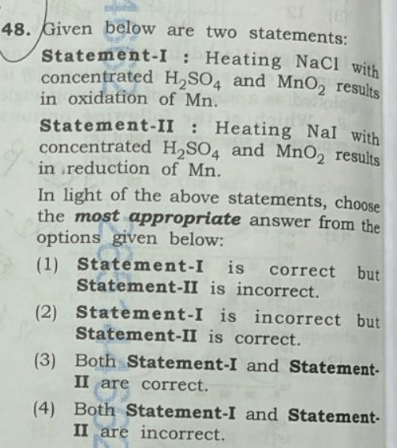
48. Given below are two statements:Statement-I: Heating NaCl with concentrated H₂SO₄ and MnO₂ results in oxidation of Mn Statement-II: Heating NaI with concentrated H₂SO₄ and MnO₂ results in reduction of Mn.

48. Given below are two statements:

Statement-I: Heating NaCl with concentrated H₂SO₄ and MnO₂ results in oxidation of Mn.

Statement-II: Heating NaI with concentrated H₂SO₄ and MnO₂ results in reduction of Mn.

In light of the above statements, choose the most appropriate answer from the options given below:

  1. Statement-I is correct but Statement-II is incorrect.
  2. Statement-I is incorrect but Statement-II is correct.
  3. Both Statement-I and Statement-II are correct.
  4. Both Statement-I and Statement-II are incorrect.

Answer: (2) Statement-I is incorrect but Statement-II is correct.

Reactions of Halide Salts with MnO₂ and Concentrated H₂SO₄

These are important for Salt Analysis, p-Block (Halogens), and Redox Reactions.


1. NaCl + MnO₂ + Conc. H₂SO₄

Step 1: Formation of HCl

2NaCl+H2SO4→Na2SO4+2HCl2NaCl + H_2SO_4 \rightarrow Na_2SO_4 + 2HCl

Step 2: Oxidation of HCl by MnO₂

MnO2+4HCl→MnCl2+Cl2+2H2OMnO_2 + 4HCl \rightarrow MnCl_2 + Cl_2 + 2H_2O

Overall Reaction

2NaCl+MnO2+2H2SO4→Cl2+MnSO4+Na2SO4+2H2O2NaCl + MnO_2 + 2H_2SO_4 \rightarrow Cl_2 + MnSO_4 + Na_2SO_4 + 2H_2O

Observation: Greenish-yellow chlorine gas evolved.

2. NaBr + MnO₂ + Conc. H₂SO₄

Step 1: Formation of HBr

2NaBr+H2SO4→Na2SO4+2HBr2NaBr + H_2SO_4 \rightarrow Na_2SO_4 + 2HBr

Step 2: Oxidation of HBr

MnO2+4HBr→MnBr2+Br2+2H2OMnO_2 + 4HBr \rightarrow MnBr_2 + Br_2 + 2H_2O

Overall Reaction

2NaBr+MnO2+2H2SO4→Br2+MnSO4+Na2SO4+2H2O2NaBr + MnO_2 + 2H_2SO_4 \rightarrow Br_2 + MnSO_4 + Na_2SO_4 + 2H_2O

Observation: Reddish-brown bromine vapours evolved.

Step 1: Formation of HI

2NaI+H2SO4→Na2SO4+2HI2NaI + H_2SO_4 \rightarrow Na_2SO_4 + 2HI

Step 2: Oxidation of HI

MnO2+4HI→MnI2+I2+2H2OMnO_2 + 4HI \rightarrow MnI_2 + I_2 + 2H_2O

Overall Reaction

2NaI+MnO2+2H2SO4→I2+MnSO4+Na2SO4+2H2O2NaI + MnO_2 + 2H_2SO_4 \rightarrow I_2 + MnSO_4 + Na_2SO_4 + 2H_2O

Observation: Violet iodine vapours evolved.

Reactions of Halide Salts with MnO₂ and Concentrated H₂SO₄

These are important for Salt Analysis, p-Block (Halogens), and Redox Reactions.

Memory Trick

Cl → Green, Br → Brown, I → Viole

NEET Shortcut

HalideGas/Vapour ProducedColour
Cl⁻Cl₂Greenish-yellow
Br⁻Br₂Reddish-brown
I⁻I₂Violet

Memory Trick:

Cl → Green, Br → Brown, I → Violet

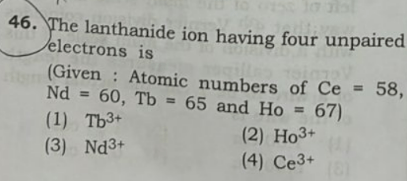
The lanthanide ion having four unpaired electrons is(Given : Atomic numbers of Ce = 58, Nd = 60, Tb = 65 and Ho = 67)

The Lanthanide Ion Having Four Unpaired Electrons

Question

The lanthanide ion having four unpaired electrons is:

  1. Tb³⁺
  2. Ho³⁺
  3. Nd³⁺
  4. Ce³⁺

Given: Atomic numbers
Ce = 58, Nd = 60, Tb = 65, Ho = 67


Step 1: Write the electronic configuration of Ln³⁺ ions

In lanthanides, the 6s electrons and one 5d electron (if present) are removed first to form the +3 ion.

Ce³⁺ (Z = 58)

Ce = [Xe] 4f¹5d¹6s²

Ce³⁺ = [Xe] 4f¹

Number of unpaired electrons = 1


Nd³⁺ (Z = 60)

Nd = [Xe] 4f⁴6s²

Nd³⁺ = [Xe] 4f³

Number of unpaired electrons = 3


Tb³⁺ (Z = 65)

Tb = [Xe] 4f⁹6s²

Tb³⁺ = [Xe] 4f⁸

For 4f⁸ configuration:

  • Seven f-orbitals are first singly occupied.
  • The eighth electron pairs up in one orbital.

Therefore, unpaired electrons = 6


Ho³⁺ (Z = 67)

Ho = [Xe] 4f¹¹6s²

Ho³⁺ = [Xe] 4f¹⁰

For 4f¹⁰ configuration:

  • Seven electrons occupy seven orbitals singly.
  • Three additional electrons pair up in three orbitals.

Therefore, unpaired electrons = 4


Step 2: Compare the number of unpaired electrons

IonConfigurationUnpaired Electrons
Ce³⁺4f¹1
Nd³⁺4f³3
Tb³⁺4f⁸6
Ho³⁺4f¹⁰4

Answer

Ho³⁺ has four unpaired electrons.

Correct Option: (2) Ho³⁺

Quick Trick: For an fⁿ configuration,

  • If n ≤ 7, unpaired electrons = n
  • If n > 7, unpaired electrons = 14 − n

For Ho³⁺: 4f¹⁰ → 14 − 10 = 4 unpaired electrons. ✔️