CBSE Class 12 Physics – Einstein’s Photoelectric Equation

1. State Einstein’s photoelectric equation. (1 Mark)

Answer:Kmax⁡=hν−ϕ0K_{\max} = h\nu – \phi_0

where:

  • Kmax⁡K_{\max}=Maximum kinetic energy of photoelectrons
  • h = Planck’s constant
  • ν = Frequency of incident light
  • ϕ0\phi_0 = Work function of the metal

2. What is the work function? (1 Mark)

Answer:
The work function (ϕ0​) is the minimum energy required to remove an electron from the surface of a metal.


3. Define threshold frequency. (1 Mark)

Answer:
The minimum frequency of incident radiation required to cause photoelectric emission is called the threshold frequency ν0=ϕ0h\nu_0=\frac{\phi_0}{h}


4. Why does increasing intensity not increase the maximum kinetic energy of photoelectrons? (2 Marks)

Answer:

  • The energy of each photon depends only on its frequency (E=hν).
  • Increasing intensity increases only the number of photons, not the energy of each photon.
  • Hence, the maximum kinetic energy of photoelectrons remains unchanged.

5. Why is there no photoelectric emission below the threshold frequency? (2 Marks)

Answer:
When ν<ν0\nu < \nu_0hν<ϕ0h\nu < \phi_0

The photon energy is less than the work function, so electrons cannot escape from the metal surface regardless of the intensity of light.


6. How does Einstein’s theory explain the effect of intensity? (2 Marks)

Answer:

  • Intensity is proportional to the number of incident photons.
  • More photons eject more electrons.
  • Therefore, photoelectric current increases, while the maximum kinetic energy remains unchanged.

7. Explain why photoelectric emission is instantaneous according to Einstein’s theory. (2 Marks)

Answer:
Each electron absorbs the energy of a single photon in one step. If the photon energy exceeds the work function, the electron is emitted immediately. Hence, there is no time lag.


8. Write the relation between stopping potential and frequency. (2 Marks)

Answer:eV0=hν−ϕ0eV_0=h\nu-\phi_0

orV0=heν−ϕ0eV_0=\frac{h}{e}\nu-\frac{\phi_0}{e}


9. Draw the graph of stopping potential versus frequency and write its significance. (3 Marks)

Answer:

  • The graph is a straight line.
  • Slope = he\frac{h}{e}
  • X-intercept = Threshold frequency (ν0)(\nu_0)
  • Y-intercept = −ϕ0e-\frac{\phi_0}{e}

10. State any four conclusions of Einstein’s photoelectric theory. (3 Marks)

Answer:

  1. Light consists of photons.
  2. Energy of each photon is hνh\nuhν.
  3. One photon transfers its energy to one electron.
  4. Photoelectric emission occurs only if ν≥ν0\nu \ge \nu_0ν≥ν0​.
  5. Maximum kinetic energy depends only on frequency.
  6. Photoelectric current depends on intensity.

Most Important Board Formulae

  • E=hνE=h\nu
  • Kmax⁡=hν−ϕ0K_{\max}=h\nu-\phi_0
  • ϕ0=hν0\phi_0=h\nu_0
  • ν0=ϕ0h\nu_0=\frac{\phi_0}{h}
  • eV0=hν−ϕ0eV_0=h\nu-\phi_0
  • V0=heν−ϕ0eV_0=\frac{h}{e}\nu-\frac{\phi_0}{e}

These are the most frequently asked CBSE Class 12 board questions from Einstein’s Photoelectric Equation.

Competition in Population Interactions | Class 12 Biology (NCERT Notes for NEET & CBSE)

Population interactions are ecological relationships between individuals of different species living in the same habitat. These interactions influence the survival, growth, reproduction, and distribution of organisms. Depending on whether the interacting species benefit, are harmed, or remain unaffected, population interactions are classified into mutualism, competition, predation, parasitism, commensalism, and amensalism.


Competition (−/− Interaction)

Definition

Competition is an interaction in which both species are harmed (-/-) because they compete for the same resource.

Resources may include:

  • Food
  • Water
  • Space
  • Light
  • Nutrients

Darwin’s View

  • Darwin considered competition (struggle for existence) as a major driving force of organic evolution.
  • According to him, only the fittest survive (“Survival of the Fittest”).

Important Facts

1. Competition is not limited to closely related species.

Wrong belief: Only closely related species compete.

Correct: Even unrelated species can compete.

Example:

  • Flamingoes and fishes compete for zooplankton in South American lakes.

2. Resources need not always be limited.

Competition can occur even when food is abundant.

This is called:

Interference Competition

  • One species directly interferes with another.
  • The presence of one species reduces the feeding efficiency of the other.

Even if:

  • Food is abundant
  • Space is abundant

competition may still occur.


Best Definition of Competition

Competition is a process in which

The fitness (intrinsic rate of increase, r) of one species decreases in the presence of another species.

Fitness

Means the ability to survive and reproduce.

r (Intrinsic Rate of Increase)

Represents how fast a population can grow.

Competition lowers the value of r.


Competitive Exclusion

Laboratory experiments show that

When resources are limited,

➡️ The competitively stronger species eliminates the weaker species.


Example 1: Galápagos Tortoise

  • Abingdon tortoise lived on Galápagos Islands.
  • Goats were introduced.
  • Goats were better browsers.
  • Tortoise became extinct.

Reason:

  • Strong competition for vegetation.

Competitive Release

Definition

When a competitively superior species is removed,

the weaker species expands its geographical distribution.

This phenomenon is called

Competitive Release


Example 2: Connell’s Barnacle Experiment

Two barnacle species:

  • Balanus
  • Chthamalus (correct spelling; NCERT may print Chathamalus)

Results:

  • Balanus is larger and competitively superior.
  • It occupies the intertidal zone.
  • Chthamalus is pushed into higher zones.

When Balanus is removed,
→ Chthamalus spreads into the intertidal region.

This demonstrates competitive release.


Herbivores vs Carnivores

Competition affects:

  • Herbivores → More
  • Plants → More
  • Carnivores → Less

Gause’s Competitive Exclusion Principle

Statement

Two closely related species competing for the same limiting resources cannot coexist indefinitely. The competitively inferior species will eventually be eliminated.

Condition

This principle is mainly true when:

✅ Resources are limiting.

If resources are abundant, coexistence may still be possible.


Modern View

Recent studies suggest that

Competition does not always end in extinction.

Species may evolve ways to coexist.


Resource Partitioning

Definition

When competing species use the same resource in different ways, competition decreases.

They may differ in:

  • Feeding time
  • Feeding place
  • Feeding method

This allows coexistence.


Example: MacArthur’s Warblers

  • Five closely related warbler species lived on the same tree.
  • They survived together because:
    • Each searched for insects in different parts of the tree.
    • Their feeding behaviour differed.

This is called resource partitioning.


NEET Important Examples

ExampleConcept
Flamingoes vs FishesCompetition between unrelated species
Abingdon Tortoise vs GoatsCompetitive exclusion in nature
Balanus vs ChthamalusCompetitive release
Five Warbler SpeciesResource partitioning

One-Line Revision

  • Competition = (-/-) interaction
  • Darwin → Survival of the fittest
  • Competition can occur between related or unrelated species
  • Resources need not be limiting
  • Interference competition → Competition despite abundant resources
  • Fitness decreases → r decreases
  • Gause’s Principle → Two species competing for the same limiting resource cannot coexist indefinitely
  • Competitive release → Removal of superior competitor expands weaker species’ range
  • Resource partitioning → Different feeding habits reduce competition
  • MacArthur → Five warbler species coexist by resource partitioning
  • Connell → Balanus excludes Chthamalus
  • Goats caused extinction of the Abingdon tortoise

NEET Memory Trick

“FGBCW”

  • F → Flamingoes vs Fishes (unrelated competition)
  • G → Gause’s Competitive Exclusion Principle
  • B → Balanus excludes Chthamalus
  • C → Competitive Release
  • W → Warblers → Resource Partitioning

CBSE Class 12 Physics – Einstein’s Photoelectric Equation (Important Facts)

These are the most important CBSE board exam facts from this topic.


1. Einstein’s Photon Theory (1905)

  • Proposed by Albert Einstein in 1905.
  • Light consists of tiny packets of energy called photons (quanta).
  • Energy of one photon is

E=hνE = h\nu

where:

  • h = Planck’s constant = 6.626 × 10⁻³⁴ J s
  • ν = Frequency of light

2. One Photon – One Electron Principle

One photon transfers its entire energy to one electron only.

One photon → One electron


3. Work Function (φ₀)

  • Minimum energy required to remove an electron from the metal surface.
  • Unit: Joule (J) or electron volt (eV).

4. Einstein’s Photoelectric Equation

Kmax⁡=hν−ϕ0\boxed{K_{\max}=h\nu-\phi_0}

OR12mvmax⁡2=hν−ϕ0\boxed{\frac12 mv_{\max}^2=h\nu-\phi_0}

This is the most important equation.


5. Threshold Frequency

ν0=ϕ0h\boxed{\nu_0=\frac{\phi_0}{h}}

  • Minimum frequency required to produce photoelectric emission.
  • If

ν<ν0\nu<\nu_0

No photoelectric emission occurs.


6. Threshold Wavelength

λ0=cν0\boxed{\lambda_0=\frac{c}{\nu_0}}

Maximum wavelength capable of producing photoelectric emission.


7. Stopping Potential

eV0=Kmax⁡\boxed{eV_0=K_{\max}}eV0​=Kmax​​

Combining with Einstein’s equation,eV0=hν−ϕ0\boxed{eV_0=h\nu-\phi_0}

orV0=heν−ϕ0e\boxed{V_0=\frac{h}{e}\nu-\frac{\phi_0}{e}}


8. V₀ vs ν Graph

  • Straight line
  • Slope

he\boxed{\frac{h}{e}}eh​​

  • Slope is same for all metals.
  • Intercept on frequency axis

ν0\nu_0ν0​


9. Dependence on Frequency

Increasing frequency:

✅ Increases maximum kinetic energy

✅ Increases stopping potential


10. Dependence on Intensity

Increasing intensity:

✅ Increases photoelectric current

❌ Does NOT increase maximum kinetic energy

❌ Does NOT change stopping potential


11. Instantaneous Emission

Photoelectrons are emitted without measurable time delay.

Reason:

Each electron absorbs the energy of one photon instantly.


12. Photoelectric Current

Forν>ν0\nu>\nu_0

Photoelectric current isCurrent∝Intensity\boxed{\text{Current} \propto \text{Intensity}}Current∝Intensity​

because higher intensity means more photons per second, producing more emitted electrons.


13. Maximum Kinetic Energy

Depends only on

  • Frequency of light

Does not depend on

  • Intensity
  • Time of exposure

14. Threshold Frequency Depends On

Threshold frequency depends on

  • Nature of metal
  • Work function

It does not depend on intensity.


15. Experimental Verification

  • Einstein proposed the theory in 1905.
  • Robert Andrews Millikan experimentally verified Einstein’s equation in 1916.
  • Millikan measured Planck’s constant (h) using the photoelectric effect.

Most Important Formula Sheet

QuantityFormula
Photon EnergyE=hνE=h\nuE=hν
Einstein EquationKmax⁡=hν−ϕ0K_{\max}=h\nu-\phi_0Kmax​=hν−ϕ0​
Kinetic EnergyKmax⁡=12mvmax⁡2K_{\max}=\frac12 mv_{\max}^2Kmax​=21​mvmax2​
Stopping PotentialeV0=Kmax⁡eV_0=K_{\max}eV0​=Kmax​
Combined EquationeV0=hν−ϕ0eV_0=h\nu-\phi_0eV0​=hν−ϕ0​
Threshold Frequencyν0=ϕ0h\nu_0=\frac{\phi_0}{h}ν0​=hϕ0​​
Threshold Wavelengthλ0=cν0\lambda_0=\frac{c}{\nu_0}λ0​=ν0​c​

CBSE One-Mark Questions (Frequently Asked)

  1. Define work function.
  2. Define threshold frequency.
  3. State Einstein’s photoelectric equation.
  4. What is the energy of a photon?
  5. On what does maximum kinetic energy depend?
  6. Why does photoelectric current increase with intensity?
  7. Why is photoelectric emission instantaneous?
  8. Who experimentally verified Einstein’s photoelectric equation?
  9. Write the relation between stopping potential and maximum kinetic energy.
  10. Why does increasing intensity not increase the maximum kinetic energy of photoelectrons?

These points cover almost all the theory-based questions typically asked from this topic in the CBSE Class 12 Physics board examination.

Photoelectric Effect and Wave Theory of Light

According to the wave theory, light is an electromagnetic wave in which energy is spread continuously over the entire wavefront.

When light falls on a metal surface, electrons should absorb this energy gradually.

Predictions of Wave Theory

1. Kinetic energy should increase with intensity ❌

  • Higher intensity means larger wave amplitude.
  • Therefore, each electron should absorb more energy.
  • Hence, the maximum kinetic energy (K.E.) of photoelectrons should increase.

Experimental observation:
The maximum kinetic energy depends on the frequency of light, not on intensity.


2. No threshold frequency should exist ❌

According to wave theory:

  • Every frequency carries energy.
  • If light is sufficiently intense or allowed to fall for a long time, electrons should eventually receive enough energy to escape.

Therefore, photoelectric emission should occur at every frequency.

Experimental observation:
A threshold frequency (ν0\nu_0ν0​) exists. Below this frequency, no photoelectric emission occurs, regardless of intensity or exposure time.


3. Intensity alone should produce emission ❌

Wave theory predicts:

  • Increasing intensity should eventually eject electrons even if frequency is low.

Experimental observation:
Increasing intensity below the threshold frequency does not produce any photoelectrons.


4. There should be a time delay ❌

According to wave theory:

  • Energy is absorbed gradually.
  • Each electron receives only a tiny fraction of the wave’s energy at a time.
  • It should take seconds, minutes, or even hours for an electron to accumulate enough energy to escape.

Experimental observation:
Photoelectric emission is instantaneous (within about 10−910^{-9}10−9 s or less).


Why Wave Theory Fails

Wave Theory PredictionExperimental Observation
K.E. increases with intensityK.E. depends on frequency
No threshold frequencyThreshold frequency exists
Low-frequency intense light should eject electronsNo emission below threshold frequency
Time delay expectedEmission is instantaneous

Conclusion

The wave theory of light could not explain the photoelectric effect because its predictions contradicted experimental observations. These failures led Albert Einstein to propose the photon (quantum) theory of light, according to which light consists of packets of energy called photons, each having energy:E=hνE = h\nuE=hν

This theory successfully explained all the observations of the photoelectric effect.

NEET One-Line Revision

Wave theory fails because it cannot explain:

  1. Threshold frequency
  2. Dependence of K.E. on frequency
  3. Independence of K.E. from intensity
  4. Instantaneous emission of photoelectrons

The work done in different thermodynamic process

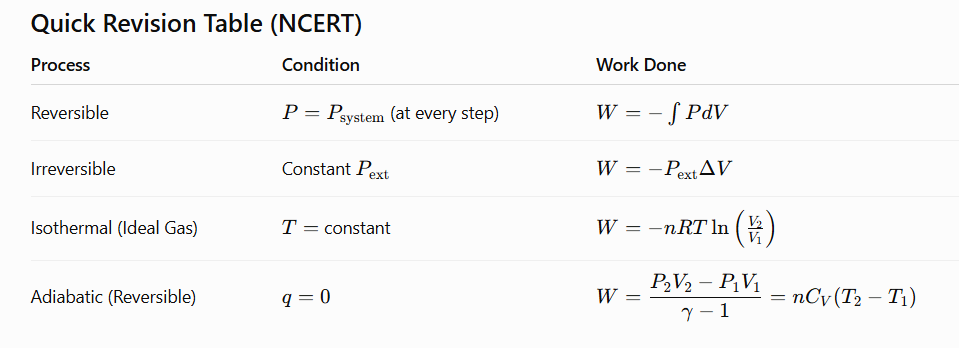
The work done depends on the type of thermodynamic process. Here are the formulas used in Class 11–12 Chemistry and Physics.

1. Reversible Process

A reversible process is carried out infinitely slowly, so the system remains in equilibrium throughout.

For expansion/compression:W=−∫V1V2P dVW = -\int_{V_1}^{V_2} P\,dV

If the process is reversible and isothermal (ideal gas):W=−nRTln⁡(V2V1)W = -nRT\ln\left(\frac{V_2}{V_1}\right)

orW=−2.303 nRTlog⁡(V2V1)W = -2.303\,nRT\log\left(\frac{V_2}{V_1}\right)


2. Irreversible Process

If the external pressure is constant:W=−Pext(V2−V1)W = -P_{\text{ext}}(V_2 – V_1)

Special case (free expansion):Pext=0P_{\text{ext}} = 0W=0W = 0


3. Isothermal Process (Temperature Constant)

For an ideal gas:ΔU=0\Delta U = 0

Therefore,q=−Wq = -W

Work done (reversible):W=−nRTln⁡(V2V1)W = -nRT\ln\left(\frac{V_2}{V_1}\right)

orW=−2.303 nRTlog⁡(V2V1)W = -2.303\,nRT\log\left(\frac{V_2}{V_1}\right)


4. Adiabatic Process (No Heat Exchange)

q=0q = 0ΔU=W\Delta U = W

For a reversible adiabatic process:PVγ=constantPV^\gamma = \text{constant}

andW=P2V2−P1V1γ−1W=\frac{P_2V_2-P_1V_1}{\gamma-1}

orW=nCV(T2−T1)W=nC_V(T_2-T_1)

whereγ=CPCV\gamma=\frac{C_P}{C_V}

NEET/JEE Perspective

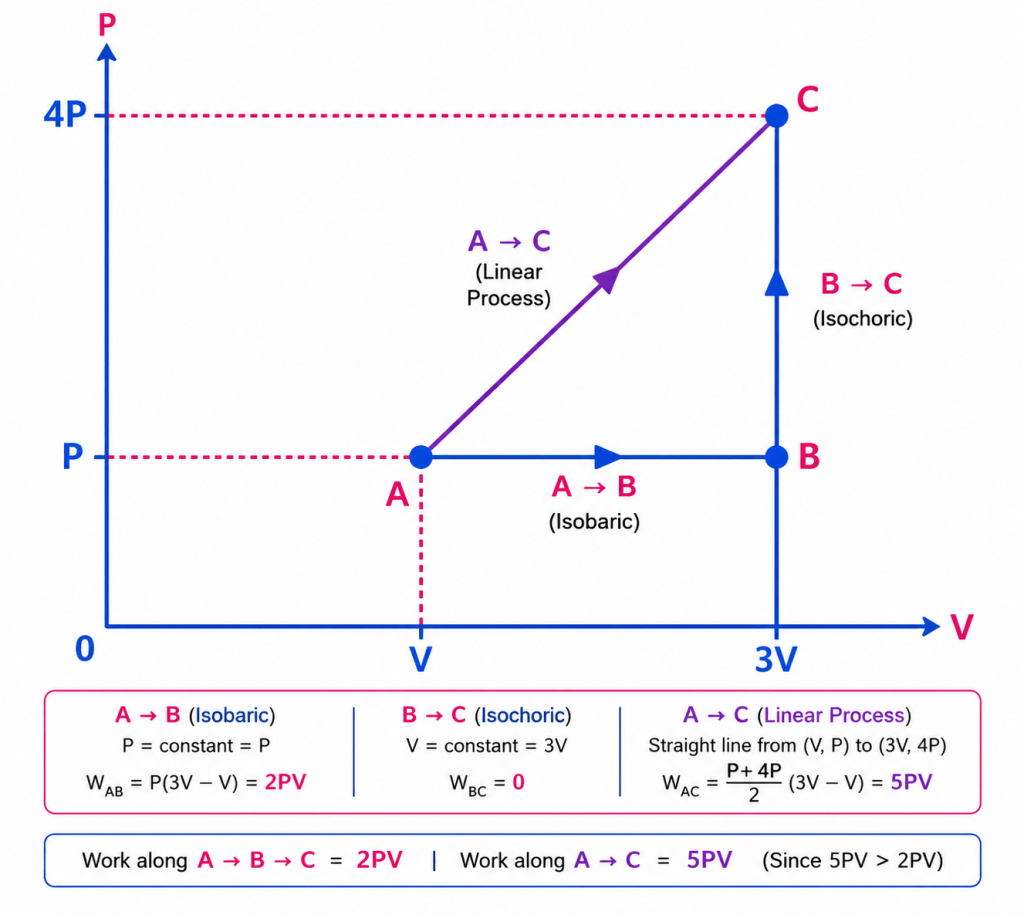
A linear process. It is not automatically reversible or irreversible. If the problem asks for work, calculate the area under the straight line:W=P1+P22(V2−V1)=5PV.W=\frac{P_1+P_2}{2}(V_2-V_1)=5PV.

Quick Revision Table (NCERT)

Important NCERT Facts

  • Reversible expansion gives maximum work.
  • Irreversible expansion gives less work than reversible expansion.
  • Free expansion: W=0W = 0W=0.
  • Isothermal (ideal gas): ΔU=0\Delta U = 0ΔU=0.
  • Adiabatic: q=0q = 0q=0.

What is Biomacromolecules?

Biomacromolecules are large biomolecules with molecular weights greater than 10,000 Da. They are found in the acid-insoluble fraction of cells and include proteins, nucleic acids (DNA and RNA), and polysaccharides. These are generally polymeric molecules made up of repeating smaller units (monomers).

The acid-soluble fraction contains micromolecules, such as amino acids, sugars, nucleotides, and other small molecules, with molecular weights ranging from 18 to about 800 Da.

Although lipids have low molecular weights (usually less than 800 Da), they are present in the acid-insoluble fraction because they are organized into cell membranes. When cells are broken, membrane fragments form insoluble vesicles, causing lipids to separate with the acid-insoluble fraction. Therefore, lipids are not true biomacromolecules.

Key Facts (NEET/CBSE)

  • Micromolecules: Molecular weight < 1000 Da (acid-soluble fraction).
  • Biomacromolecules: Molecular weight > 10,000 Da (acid-insoluble fraction).
  • Examples of biomacromolecules: Proteins, nucleic acids, polysaccharides.
  • Lipids are an exception: Present in the acid-insoluble fraction but not true macromolecules.
  • Water is the most abundant chemical in living organisms.

Primary and Secondary Metabolites NEET Concepts

Here are the most important facts from NCERT Class 11 Biology – Biomolecules (Primary and Secondary Metabolites) for NEET and CBSE.

Primary Metabolites

  • Definition: Compounds directly involved in the growth, development, reproduction, and survival of an organism.
  • They are essential for life.
  • Found in all living organisms (plants, animals, fungi, and microbes).
  • Usually present in large quantities.
  • Produced continuously during normal metabolism.
  • They have well-defined physiological functions.

Examples

  • Carbohydrates (glucose, starch)
  • Proteins
  • Amino acids
  • Lipids
  • Nucleic acids (DNA, RNA)
  • Vitamins
  • ATP

Functions

  • Provide energy
  • Form cell structures
  • Store genetic information
  • Catalyse reactions (enzymes)
  • Growth and repair of tissues

Secondary Metabolites

  • Definition: Organic compounds that are not directly required for growth and reproduction, but help the organism survive in its environment.
  • Mainly found in plants, fungi, and microorganisms.
  • Usually present in small amounts.
  • Often species-specific.
  • Many have commercial and medicinal importance.

Examples (NCERT)

  • Alkaloids
  • Flavonoids
  • Rubber
  • Essential oils
  • Antibiotics
  • Coloured pigments
  • Scents
  • Gums
  • Spices

Functions

  • Defence against herbivores and pathogens
  • Attract pollinators
  • Seed dispersal
  • Protection from UV radiation
  • Ecological interactions
  • Communication between organisms

Human Uses of Secondary Metabolites

  • 💊 Medicines (antibiotics, alkaloids)
  • 🌶️ Spices (pepper, clove, cinnamon)
  • 🌸 Perfumes (essential oils)
  • 🎨 Natural dyes and pigments
  • 🚗 Rubber industry
  • 🍬 Food flavouring

Difference Between Primary and Secondary Metabolites

Primary MetabolitesSecondary Metabolites
Essential for lifeNot directly essential for growth
Found in all organismsMainly in plants, fungi and microbes
Large quantitySmall quantity
Direct role in metabolismEcological and protective role
Common to most speciesOften species-specific
Examples: Glucose, proteins, DNAAlkaloids, flavonoids, antibiotics, rubber

NCERT Facts to Remember

  • Primary metabolites have identifiable functions in normal physiological processes.
  • Functions of many secondary metabolites are still not fully understood.
  • Many secondary metabolites are valuable for human welfare.
  • Some secondary metabolites have ecological importance.

NEET One-Liners

  • Primary metabolites = Essential for life.
  • Secondary metabolites = Helpful for survival, defence, and ecological interactions.
  • Antibiotics, alkaloids, flavonoids, rubber, essential oils, gums, spices and pigments are secondary metabolites.
  • Glucose, amino acids, proteins, lipids and nucleic acids are primary metabolites.

Memory Trick

Primary = “P for Personal Survival” (essential for the organism)

Secondary = “S for Survival in Surroundings” (defence, attraction, ecological role, and human use)

When carboxylic acid is called a fatty acid?

A carboxylic acid is called a fatty acid when it has a long hydrocarbon chain attached to the carboxyl group (-COOH).

where R is a long hydrocarbon chain, usually containing 4 to 36 carbon atoms (most common are 12–22 carbons).

Examples

CompoundFormulaFatty Acid?Reason
Formic acidHCOOH❌ NoNo hydrocarbon chain
Acetic acidCH₃COOH❌ NoOnly 2 carbons
Propionic acidCH₃CH₂COOH❌ NoToo short
Butyric acidCH₃(CH₂)₂COOH✔️ Yes (short-chain fatty acid)4 carbons
Palmitic acidC₁₅H₃₁COOH✔️ Yes16 carbons
Stearic acidC₁₇H₃₅COOH✔️ Yes18 carbons
Oleic acidC₁₇H₃₃COOH✔️ Yes18 carbons, one double bond

Classification of fatty acids

  • Short-chain: 4–6 carbons
  • Medium-chain: 8–12 carbons
  • Long-chain: 14–20 carbons
  • Very long-chain: 22 or more carbons

Saturated vs Unsaturated

Saturated fatty acid (no C=C bond)

  • Palmitic acid (C₁₆:0)
  • Stearic acid (C₁₈:0)

Unsaturated fatty acid (one or more C=C bonds)

  • Oleic acid (C₁₈:1)
  • Linoleic acid (C₁₈:2)
  • Linolenic acid (C₁₈:3)

NEET/JEE Definition

Fatty acids are aliphatic monocarboxylic acids containing a long hydrocarbon chain. They may be saturated or unsaturated and are the building blocks of fats and oils (triglycerides).

Important Note

There is no strict carbon-number cutoff in chemistry, but in biology and biochemistry, carboxylic acids with long hydrocarbon chains (typically C₄ and above, especially C₁₂–C₂₂) are referred to as fatty acids. Acetic acid and propionic acid are carboxylic acids, but they are generally not considered fatty acids in the context of fats and oils.

Difference between fats and lipids?

The terms lipids and fats are related, but they are not the same. Fats are a type of lipid, while lipids are a broader group of biological molecules.

FeatureLipidsFats
DefinitionA broad class of water-insoluble biomoleculesA specific type of lipid (mainly triglycerides)
CompositionIncludes fats, oils, waxes, phospholipids, steroids, etc.Made of one glycerol molecule and three fatty acids (triglycerides)
ExamplesCholesterol, phospholipids, waxes, fats, oilsButter, ghee, lard, animal fat
FunctionsEnergy storage, cell membrane formation, hormones, insulation, waterproofingMainly long-term energy storage and insulation
Physical StateCan be solid or liquidUsually solid at room temperature (animal fats); liquid forms are often called oils
Found InAll living organismsMainly animals, though plants also produce fats and oils

Key Points

  • Lipids = Umbrella term
    • Fats
    • Oils
    • Waxes
    • Phospholipids
    • Steroids (e.g., cholesterol)
  • Fats = One category of lipids
    • Store excess energy.
    • Protect organs.
    • Help maintain body temperature.

Easy Analogy

  • Lipids are like “vehicles.”
  • Fats are like “cars.”

Just as every car is a vehicle but not every vehicle is a car, every fat is a lipid, but not every lipid is a fat.

Exam Tip (NEET/CBSE)

All fats are lipids, but all lipids are not fats. This is a commonly asked conceptual question in biology and chemistry.

Fats are esters?

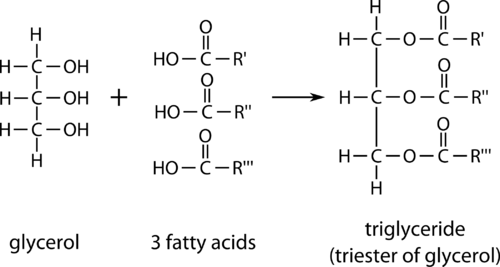
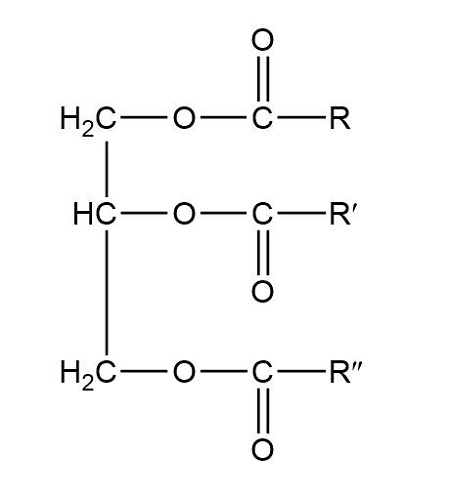
More specifically, fats are triesters (triglycerides or triacylglycerols) formed by the reaction of glycerol with three fatty acid molecules.

Formation of a fat (esterification)

Glycerol+3 Fatty acids→Triglyceride (fat)+3 H2O\text{Glycerol} + 3\ \text{Fatty acids} \rightarrow \text{Triglyceride (fat)} + 3\ \text{H}_2\text{O}

For example:Glycerol+3 Stearic acid→Tristearin+3 H2O\text{Glycerol} + 3\ \text{Stearic acid} \rightarrow \text{Tristearin} + 3\ \text{H}_2\text{O}

Difference between oils and fats?

Fats and oils are both triglycerides (triacylglycerols)—they are esters of glycerol and three fatty acids. The main difference is the type of fatty acids they contain, which determines whether they are solid or liquid at room temperature.

FeatureFatsOils
Physical state (25°C)Solid or semi-solidLiquid
Fatty acidsRich in saturated fatty acidsRich in unsaturated fatty acids
Carbon–carbon bondsMostly single bonds (C–C)One or more double bonds (C=C)
Packing of moleculesPack tightlyDo not pack tightly because of bends caused by double bonds
Melting pointHigherLower
Common sourceMostly animals (butter, ghee, lard)Mostly plants and fish (mustard oil, sunflower oil, olive oil)
ExamplesButter, ghee, tallowOlive oil, coconut oil*, sunflower oil

Why are oils liquid?

Unsaturated fatty acids contain C=C double bonds, usually in the cis configuration. These create kinks (bends) in the hydrocarbon chains, preventing the molecules from packing closely together. As a result, the intermolecular forces are weaker, so they melt at lower temperatures and remain liquid.

Why are fats solid?

Saturated fatty acids have no C=C double bonds, so their chains are straight. They pack closely together, leading to stronger intermolecular forces and a higher melting point, making them solid at room temperature.

CBSE Class 12 Biology – Origin and Evolution of Man (NCERT) Important Facts

These are the highest-yield NCERT facts for CBSE Class 12 Board Exams, useful for MCQs, 1-mark, 2-mark, Assertion-Reason, and Case-Based Questions.


Evolution of Humans (NCERT Timeline)

TimeOrganismImportant Feature
15 myaDryopithecusApe-like
15 myaRamapithecusMore man-like
3–4 myaEarly hominidsWalked upright
2 myaAustralopithecinesUsed stone tools, mainly fruit eaters
~2 myaHomo habilisFirst human-like being, brain 650–800 cc
1.5 myaHomo erectusBrain ~900 cc, probably ate meat
100,000–40,000 years agoNeanderthal manBrain ~1400 cc, buried dead
75,000–10,000 years agoHomo sapiensModern humans developed

1. Dryopithecus

  • Lived about 15 million years ago (mya).
  • Hairy and walked like modern apes.
  • More ape-like than human-like.

2. Ramapithecus

  • Lived about 15 mya.
  • More man-like than Dryopithecus.
  • Considered closer to the human lineage in NCERT.

3. Early Hominids

  • Fossils found in Ethiopia and Tanzania.
  • Lived about 3–4 mya.
  • Walked upright (bipedal).
  • About 4 feet tall.

4. Australopithecines

  • Lived about 2 million years ago.
  • Found mainly in East African grasslands.
  • Used stone tools.
  • Mainly fruit eaters.

5. Homo habilis

  • Considered the first human-like being in NCERT.
  • Brain capacity: 650–800 cc.
  • Probably did not eat meat.

6. Homo erectus

  • Fossils discovered in Java (1891).
  • Lived about 1.5 million years ago.
  • Brain capacity: ~900 cc.
  • Probably ate meat.

7. Neanderthal Man

  • Lived between 100,000–40,000 years ago.
  • Brain capacity: ~1400 cc.
  • Used animal hides for clothing.
  • Buried their dead, indicating social and cultural behavior.

8. Homo sapiens

  • Originated in Africa.
  • Migrated to different continents.
  • Developed into different human populations.

9. Ice Age

  • Lasted from about 75,000 to 10,000 years ago (as per NCERT context).
  • Modern Homo sapiens became widespread during this period.

10. Cave Art

  • Developed around 18,000 years ago.
  • Indicates advanced thinking and creativity.

11. Agriculture

  • Began about 10,000 years ago.
  • Led to:
    • Permanent settlements
    • Farming
    • Development of civilizations

Evolution Sequence (Very Important)

Dryopithecus
⬇
Ramapithecus
⬇
Early Hominids
⬇
Australopithecines
⬇
Homo habilis
⬇
Homo erectus
⬇
Neanderthal Man
⬇
Homo sapiens (Modern Humans)


Brain Capacity (Frequently Asked)

OrganismBrain Capacity
Homo habilis650–800 cc
Homo erectus~900 cc
Neanderthal man~1400 cc

One-Mark Questions

Q1. Which primate was more ape-like?
Answer: Dryopithecus.

Q2. Which primate was more man-like?
Answer: Ramapithecus.

Q3. Where were early hominid fossils found?
Answer: Ethiopia and Tanzania.

Q4. Which species is considered the first human-like being in NCERT?
Answer: Homo habilis.

Q5. What was the brain capacity of Homo habilis?
Answer: 650–800 cc.

Q6. Where was Homo erectus discovered?
Answer: Java.

Q7. Which human ancestor buried their dead?
Answer: Neanderthal man.

Q8. Where did Homo sapiens originate?
Answer: Africa.

Q9. When did agriculture begin?
Answer: About 10,000 years ago.


NCERT Keywords for Board Exams

  • Dryopithecus
  • Ramapithecus
  • Hominids
  • Australopithecines
  • Homo habilis
  • Homo erectus
  • Neanderthal Man
  • Homo sapiens
  • Bipedalism
  • Stone Tools
  • Cave Art
  • Agriculture
  • Brain Capacity
  • Ethiopia
  • Tanzania
  • Java
  • Africa

High-Yield NCERT Facts to Remember

  • Dryopithecus → More ape-like.
  • Ramapithecus → More man-like.
  • Australopithecines → Used stone tools, mainly fruit eaters.
  • Homo habilis → First human-like being; 650–800 cc brain.
  • Homo erectus → ~900 cc brain; probably ate meat.
  • Neanderthal man → ~1400 cc brain; buried the dead.
  • Homo sapiens → Originated in Africa.
  • Cave art → Around 18,000 years ago.
  • Agriculture → Around 10,000 years ago.