
The terms lipids and fats are related, but they are not the same. Fats are a type of lipid, while lipids are a broader group of biological molecules.
| Feature | Lipids | Fats |
|---|---|---|
| Definition | A broad class of water-insoluble biomolecules | A specific type of lipid (mainly triglycerides) |
| Composition | Includes fats, oils, waxes, phospholipids, steroids, etc. | Made of one glycerol molecule and three fatty acids (triglycerides) |
| Examples | Cholesterol, phospholipids, waxes, fats, oils | Butter, ghee, lard, animal fat |
| Functions | Energy storage, cell membrane formation, hormones, insulation, waterproofing | Mainly long-term energy storage and insulation |
| Physical State | Can be solid or liquid | Usually solid at room temperature (animal fats); liquid forms are often called oils |
| Found In | All living organisms | Mainly animals, though plants also produce fats and oils |
Key Points
- Lipids = Umbrella term
- Fats
- Oils
- Waxes
- Phospholipids
- Steroids (e.g., cholesterol)
- Fats = One category of lipids
- Store excess energy.
- Protect organs.
- Help maintain body temperature.
Easy Analogy
- Lipids are like “vehicles.”
- Fats are like “cars.”
Just as every car is a vehicle but not every vehicle is a car, every fat is a lipid, but not every lipid is a fat.
Exam Tip (NEET/CBSE)
All fats are lipids, but all lipids are not fats. This is a commonly asked conceptual question in biology and chemistry.
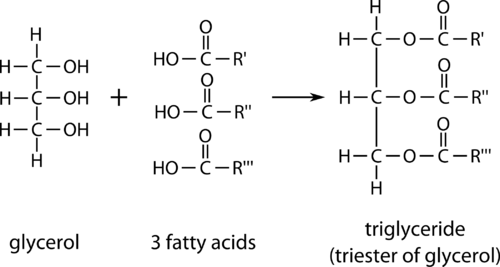
Fats are esters?
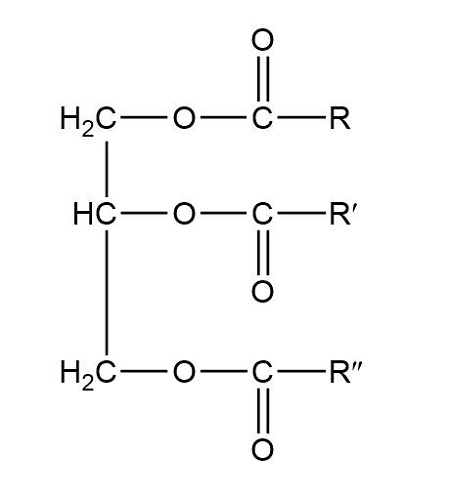
More specifically, fats are triesters (triglycerides or triacylglycerols) formed by the reaction of glycerol with three fatty acid molecules.
Formation of a fat (esterification)
For example:
Difference between oils and fats?
Fats and oils are both triglycerides (triacylglycerols)—they are esters of glycerol and three fatty acids. The main difference is the type of fatty acids they contain, which determines whether they are solid or liquid at room temperature.
| Feature | Fats | Oils |
|---|---|---|
| Physical state (25°C) | Solid or semi-solid | Liquid |
| Fatty acids | Rich in saturated fatty acids | Rich in unsaturated fatty acids |
| Carbon–carbon bonds | Mostly single bonds (C–C) | One or more double bonds (C=C) |
| Packing of molecules | Pack tightly | Do not pack tightly because of bends caused by double bonds |
| Melting point | Higher | Lower |
| Common source | Mostly animals (butter, ghee, lard) | Mostly plants and fish (mustard oil, sunflower oil, olive oil) |
| Examples | Butter, ghee, tallow | Olive oil, coconut oil*, sunflower oil |
Why are oils liquid?
Unsaturated fatty acids contain C=C double bonds, usually in the cis configuration. These create kinks (bends) in the hydrocarbon chains, preventing the molecules from packing closely together. As a result, the intermolecular forces are weaker, so they melt at lower temperatures and remain liquid.
Why are fats solid?
Saturated fatty acids have no C=C double bonds, so their chains are straight. They pack closely together, leading to stronger intermolecular forces and a higher melting point, making them solid at room temperature.
 Sarvan sir- Chemistry For All