Hydrocarbons form the fundamental backbone of Organic Chemistry, consisting only of carbon and hydrogen atoms. They are broadly classified into alkanes, alkenes, alkynes, and aromatic hydrocarbons based on bonding and structure. Understanding their properties and reactions is crucial for mastering concepts in competitive exams like JEE and NEET. This test paper is designed to evaluate conceptual clarity, problem-solving ability, and application skills. It covers important topics such as nomenclature, isomerism, and reaction mechanisms of hydrocarbons.
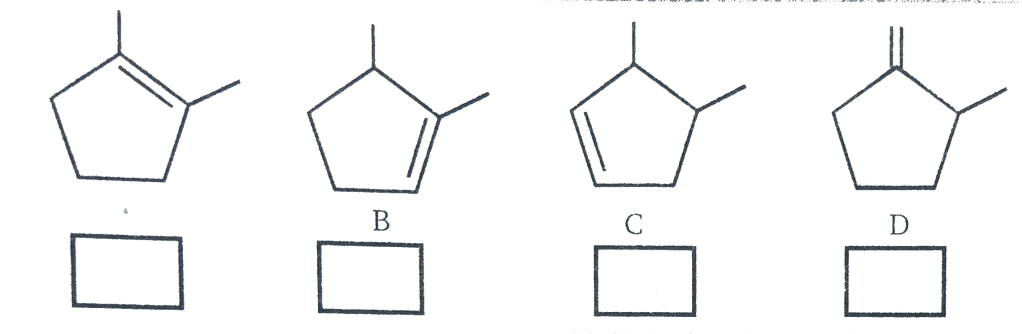
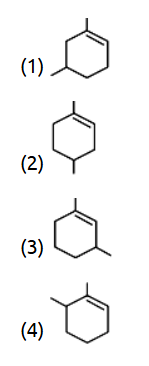
Arrange the following alkenes in order of their stability
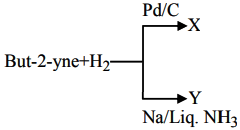
2. But-2-yne and hydrogen (one mole each) are separately treated with (i) P d / C and (ii) N a / liq. N H 3 to give the products X and Y respectively
Identify the incorrect statements.
A. X and Y are stereoisomers.
B. Dipole moment of X is zero
C. Boiling point of X is higher than Y .
D. X and Y react with O 3 / Z n + H 2 O to give different products.
Choose the correct answer from the options given below :
(1) B and C only
(2) B and D only
(3) A and B only
(4) A and C only
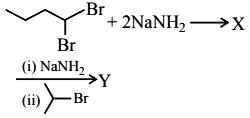
3.
The product Y formed is :
(1) 2-methylhex-2-yne
(2) 5-methylhex-2-yne
(3) 2-methylhex-3-yne
(4) Isopropylbut-1-yne
4
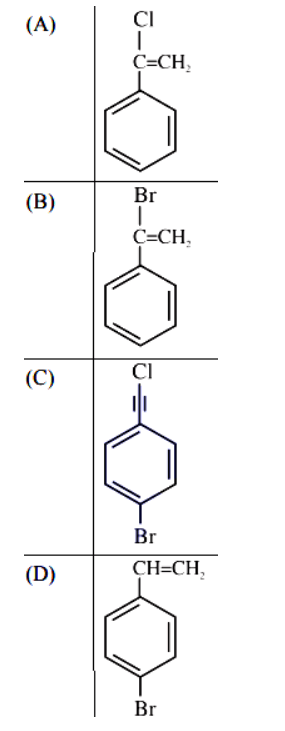
5. Which compound would give 3-methyl-6- oxoheptanal upon ozonolysis ?
6. Given below are two statements :
Statement (I) : Neopentane forms only one monosubstituted derivative.
Statement (II) : Melting point of neopentane is higher than n-pentane.
In the light of the above statements, choose the most appropriate answer from the options given below :
(1) Statement I is correct but Statement II is incorrect
(2) Both Statement I and Statement II are correct
(3) Both Statement I and Statement II are incorrect
7. Total number of sigma (σ) and pi(π) bonds respectively present in hex-1-en-4-yne are:
(1) 13, 3
(2) 14, 3
(3) 3, 14
(4) 14, 13
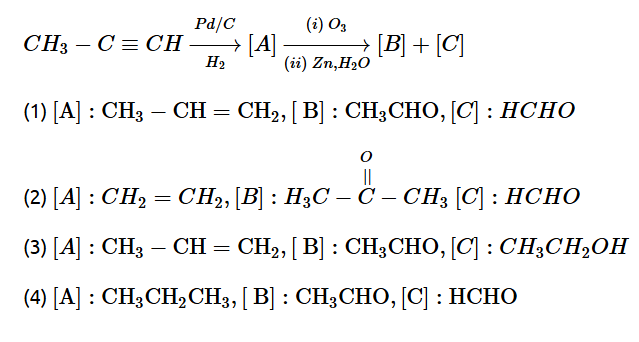
8. Identify product [A], [B] and [C] in the following reaction sequence.
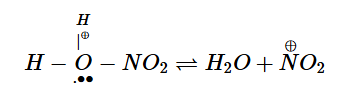
9.Statement I : Nitration of benzene involves the following step –
Statement II: Use of Lewis base promotes the electrophilic substitution of benzene. In the light of the above statements, choose the most appropriate answer from the options given below :
(1) Both Statement I and Statement II are incorrect
(2) Statement I is correct but Statement II is incorrect (3) Both Statement I and Statement II are correct (4) Statement I is incorrect but Statement II is correct
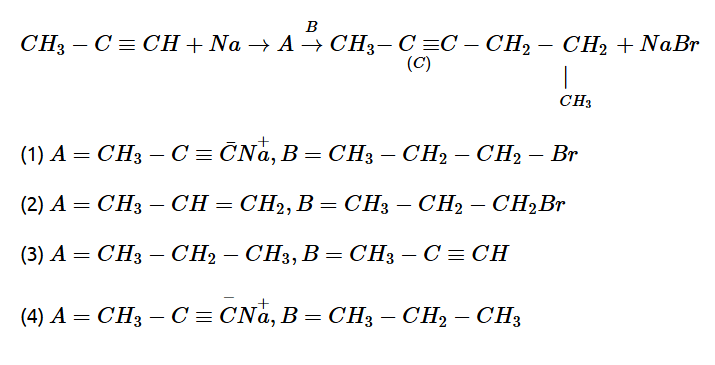
10.Compound A formed in the following reaction reacts with B gives the product C. Find out A and B
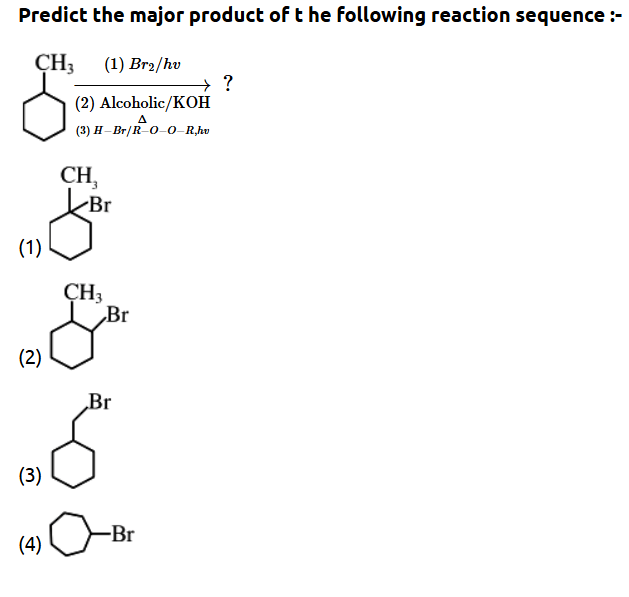
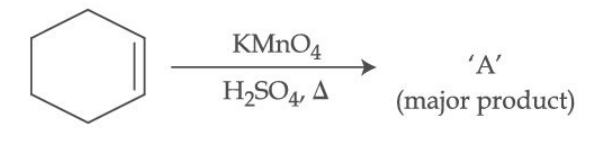
11. Product ‘A’ of following sequence of reactions is
12
A) Cyclohexanol B) Hexane-1,6-dioic acid (Adipic acid) C) Cyclohexanone D) 1,2-diol (Glycol)
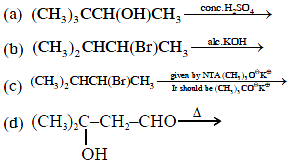
13.Consider the following reaction :
Which of these reaction(s) will not produce Saytzeff product ?
Which of these reaction(s) will not produce Saytzeff product ? (
1) (c) only
(2) (a) (c) and (d)
(3) (d) only
(4) (b) and (d)
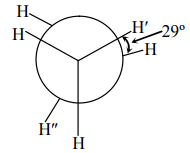
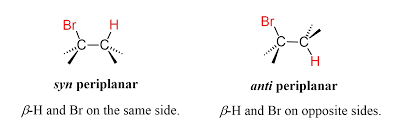
15. In the following skew conformation of ethane, H’–C–C–H” dihedral angle is :
In the following skew conformation of ethane, H’–C–C–H” dihedral angle is :
Proposed by John Alexander Reina Newlands (1864), this was another early attempt to classify elements.
🔹 What is Newlands’ Law of Octaves?
Statement: When elements are arranged in increasing order of atomic mass, every 8th element has properties similar to the first, just like musical octaves 🎵
Rotate plane polarized light in opposite directions
(2) Diastereomers
Not mirror images
Different physical properties
Meso Compounds
Have chiral centers but optically inactive
Due to internal plane of symmetry
Optical Activity
d(+) → dextrorotatory
l(–) → levorotatory
Optical Activity of Diastereomers
Case 1: Optically Active
If molecule:
Has chiral center(s)
No plane of symmetry
✔ Then diastereomer rotates plane polarized light
Case 2: Optically Inactive
If molecule:
Has internal plane of symmetry (meso form)
✔ Then diastereomer is optically inactive
Example
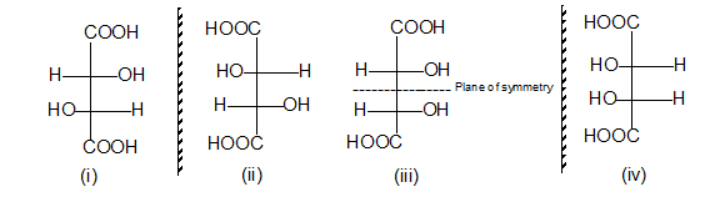
Tartaric acid:
(R,R) and (S,S) → Enantiomers → optically active
(R,S) → Meso form → optically inactive
here:
(R,R) vs (R,S) = Diastereomers
But:
(R,R) → active
(R,S) → inactive
Final Answer
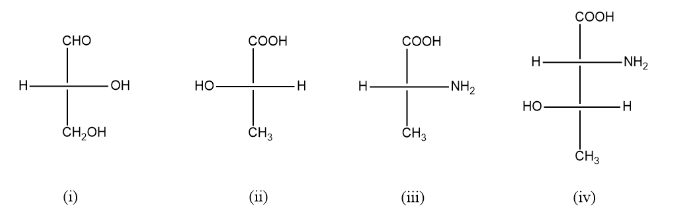
Enantiomers:
(i) & (ii)
Meso:
(iii)
Diastereomers:
(i) & (iii)
(ii) & (iii)
(i) & (iv)
(ii) & (iv)
(iii) & (iv)
Key Recall
(i) & (ii) → enantiomers → both optically active
(iii) → meso → optically inactive
(iv) → optically active
Diastereomer Pairs Analysis
(i) & (iii)
(i) → active
(iii) → inactive (meso) Pair: one active + one inactive
(ii) & (iii)
(ii) → active
(iii) → inactive Pair: one active + one inactive
(iii) & (iv)
(iii) → inactive
(iv) → active Pair: one active + one inactive
(i) & (iv)
(i) → active
(iv) → active Pair: both optically active
(ii) & (iv)
(ii) → active
(iv) → active Pair: both optically active
3. Effect on number of stereoisomers
General:
With plane of symmetry:
Some structures become identical (meso)
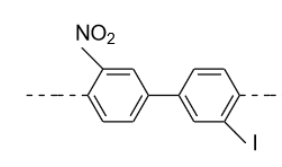
How to find the plane of symmetry in biphenyls and substituted cyclohexane?
Optical activity is shown by compounds in which plane of symmetry is not present, if plane of symmetry is present in any compound then they will never show optical activity.
Optical activity is a kind of property of any compound which rotates the plane polarized light to the right or left side from the direction of upcoming light. In biphenyls two benzene rings are present and if a plane of symmetry is present within the molecule then they don’t show optical activity.
This molecule does not have a plane of symmetry
Biphenyl rotation:
Structure: Biphenyl has two benzene rings connected by a single C–C bond.
So, in principle, it’s a single bond, which allows rotation.
Rotation limitation:
Each benzene ring is planar.
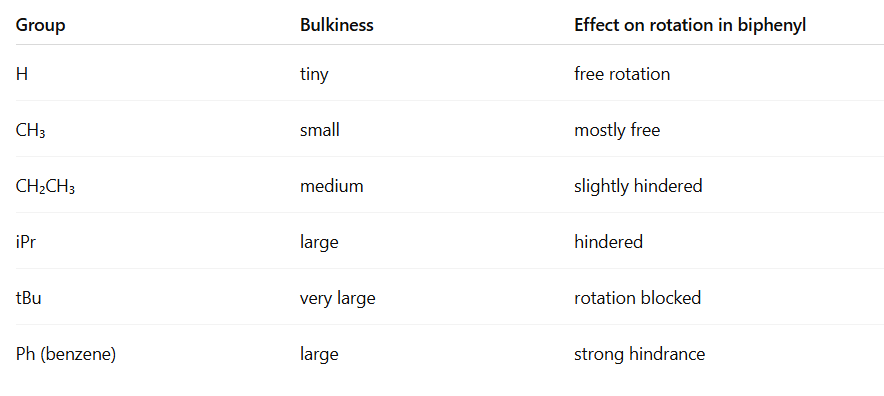
If there are no substituents at ortho positions, the two rings can rotate freely at room temperature.
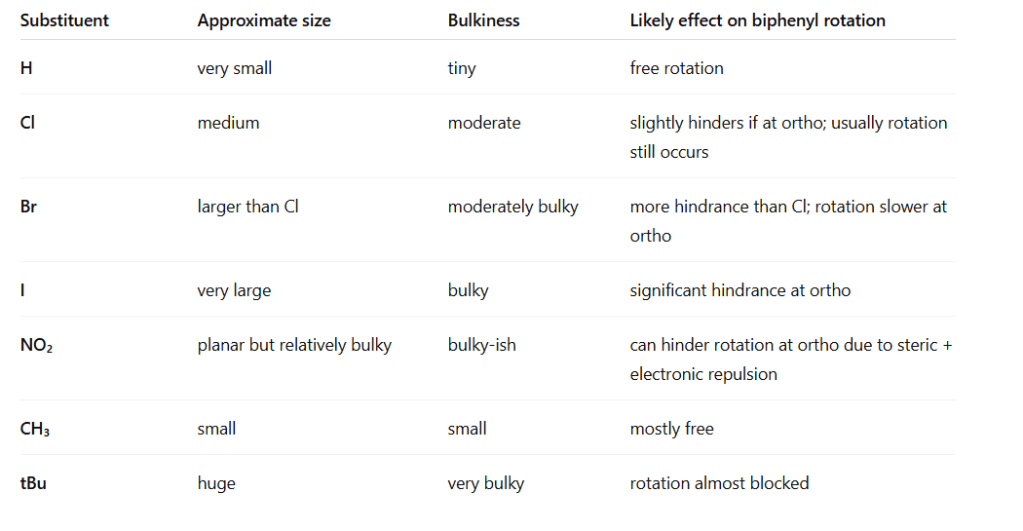
If there are bulky groups at the ortho positions (next to the connecting bond), steric hindrance prevents free rotation, and the molecule may adopt a twisted conformation.
Extremely hindered biphenyls can even be atropisomers (stable enantiomers due to restricted rotation)
. It is chiral if the biphenyl can’t rotate freely (restricted rotation around the central C–C bond) and may exist as atropisomers.
Position matters most
Only ortho substituents (2,2’ positions on biphenyl) cause steric hindrance.
This question set is designed to strengthen key concepts of Organic Chemistry, especially reactions involving amines, diazonium salts, and important named reactions frequently asked in NEET and JEE. It covers a wide range of reagent-based transformations to help students improve accuracy and reaction recognition skills. Practice these questions regularly to build a strong conceptual foundation and boost exam confidence
1.
Nitrile on reduction gives: A) Alcohol B) Aldehyde C) Primary amine D) Secondary amine
2.
Amide + Br₂/NaOH gives: A) Same carbon amine B) One carbon higher amine C) One carbon lower amine D) Alcohol
3.
Which reagent converts alkyl halide to nitrile? A) KOH B) AgCN C) KCN D) NH₃
4.
Reduction of isocyanide gives: A) Primary amine B) Secondary amine C) Tertiary amine D) Alcohol
5.
Nitrile hydrolysis produces: A) Alcohol B) Aldehyde C) Carboxylic acid D) Amine
6.
Carboxylic acid reacts with NH₃ to give: A) Ester B) Amide C) Amine D) Nitrile
7.
Primary amine + HNO₂ gives: A) Alkene B) Alcohol C) Nitrile D) Amide
8.
Aniline + HNO₂ (0–5°C) forms: A) Nitrobenzene B) Diazonium salt C) Phenol D) Benzene
9.
C₆H₅N₂⁺Cl⁻ + KI gives: A) Chlorobenzene B) Bromobenzene C) Iodobenzene D) Fluorobenzene
10.
Sandmeyer reaction involves: A) HNO₃ B) Cu salts C) KMnO₄ D) NaBH₄
11.
C₆H₅N₂Cl + H₂O (warm) gives: A) Benzene B) Phenol C) Aniline D) Nitrobenzene
12.
C₆H₅N₂Cl + H₃PO₂ gives: A) Phenol B) Benzene C) Aniline D) Chlorobenzene
13.
C₆H₅N₂Cl + HBF₄ / heat gives: A) Chlorobenzene B) Bromobenzene C) Fluorobenzene D) Iodobenzene
14.
LiAlH₄ reduces CH₃COOH to: A) Aldehyde B) Primary alcohol C) Ketone D) Secondary alcohol
15.
Aldehyde reduction gives: A) Secondary alcohol B) Primary alcohol C) Ketone D) Acid
16.
Ketone reduction gives: A) Primary alcohol B) Secondary alcohol C) Tertiary alcohol D) Acid
17.
Carbylamine test is given by: A) Primary amine B) Secondary amine C) Tertiary amine D) Amide
18.
Aniline + Br₂/H₂O gives: A) Monobromo B) Dibromo C) 2,4,6-tribromoaniline D) No reaction
19.
Aniline nitration gives mainly: A) Meta product B) Ortho + para + some aniline C) Only para D) Only ortho
20.
Aniline + acetic anhydride forms: A) Benzamide B) Acetanilide C) Nitrobenzene D) Phenol
21.
Acetanilide + Br₂/CH₃COOH gives: A) Ortho product B) Para product C) Meta product D) Mixture
22.
Gabriel phthalimide synthesis gives: A) Primary amine B) Secondary amine C) Tertiary amine D) Amide
23.
Nitrile partial hydrolysis gives: A) Acid B) Amide C) Amine D) Alcohol
24.
Aniline + conc. H₂SO₄ gives: A) Nitrobenzene B) Sulphanilic acid C) Phenol D) Benzene
25.
Coupling reaction of diazonium salt gives: A) Alcohol B) Azo dye C) Acid D) Alkene
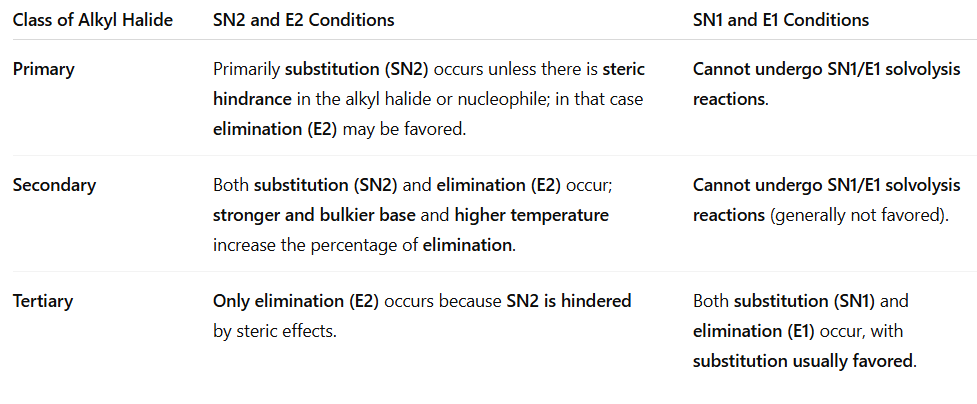
Because a tertiary alkyl halide cannot undergo an SN2 reaction, only an elimination product is formed when a tertiary alkyl halide reacts with a strong base.
Tert-butyl bromide + Ethoxide ion (C₂H₅O⁻)
Substrate: Tertiary alkyl halide Reagent: Strong base and good nucleophile
Key Concept
Tertiary alkyl halides do not undergo SN2 reactions due to strong steric hindrance.
When a strong base like ethoxide ion is present, the reaction proceeds mainly by E2 elimination.
Reaction (E2)
Major Product
2-Methylpropene (Isobutene)
Structure: (CH₃)₂C=CH₂
Reason
Substrate is tertiary
SN2 is blocked due to steric hindrance
Strong base present
Therefore E2 elimination dominates
Major product:2-Methylpropene (alkene) (100%)
CASE IV: SN1/E1 Reactions of Tertiary Alkyl Halides
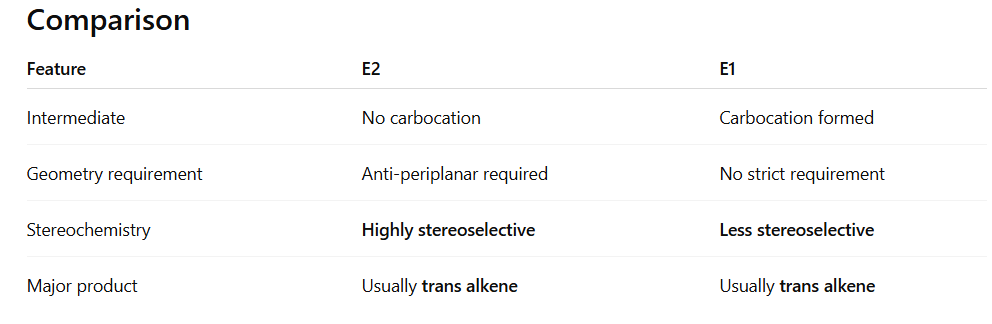
In organic chemistry, competition between E1 Reaction and E2 Reaction occurs when a substrate and reaction conditions allow both elimination pathways. The dominant mechanism depends on several factors.
Primary and secondary alkyl halides undergo elimination mainly through the E2 mechanism because the carbocations that would form in an E1 Reaction are relatively unstable, and solvolysis reactions usually involve a high concentration of base that favors the E2 Reaction.
However, tertiary alkyl halides can undergo both E2 and E1 reactions because they are capable of forming relatively stable tertiary carbocations.
Because tertiary alkyl halides are able to undergo both E2 and E1 elimination reactions, the overall rate of the reaction depends on both pathways. Therefore, the rate law is the sum of the rate laws for the E2 and E1 reactions.
Thus, An E2 reaction is favored by a high concentration of a strong base. An E1 reaction is favored by a low concentration of a weak base
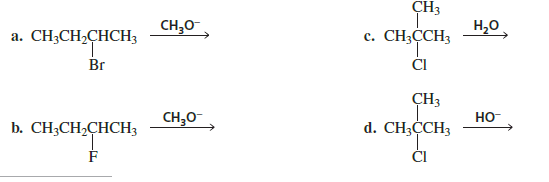
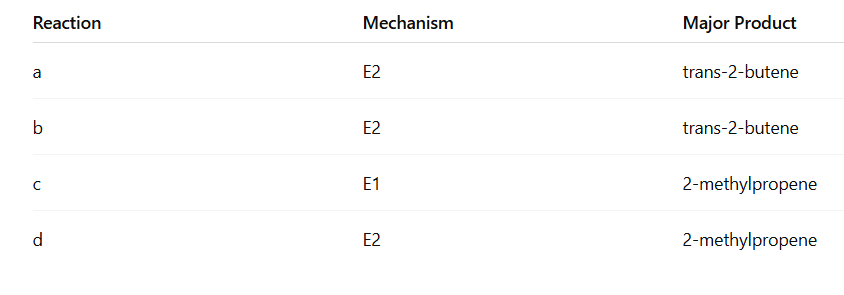
For each of the following reactions, (1) decide whether an E2 or an E1 occurs, and (2) draw the major elimination product:
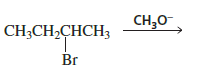
When 2‑Bromobutane reacts with Methoxide Ion, the reaction mainly proceeds through an E2 Reaction because:
2-Bromobutane is a secondary alkyl halide.
CH₃O⁻ (methoxide) is a strong base.
Strong bases favor E2 elimination.
The elimination forms bu-2-tene:
Major product: 2‑Butene (especially trans-2-butene, most stable)
Minor product: 1‑Butene
Reason (Zaitsev rule)
According to Zaitsev Rule, the more substituted alkene forms as the major product.
Order of products:
Substrate: secondary alkyl halide
Base: strong (CH₃O⁻)
Mechanism: E2 elimination
Major product: trans-2-butene
Problem: For each of the following reactions, (1) decide whether an E2 or an E1 occurs, and (2) draw the major elimination product:
Strong base → E2
Weak base + tertiary substrate → E1
Zaitsev alkene = major product
let’s analyze each reaction using two steps: Decide E1 or E2 Write the major elimination product
(a)
Substrate: 2-Bromobutane Reagent: CH₃O⁻ (methoxide) → strong base
Reasoning
Secondary alkyl halide
Strong base present E2 mechanism dominates
Elimination (Zaitsev rule) The base removes a β-hydrogen giving the more substituted alkene.





 Sarvan sir- Chemistry For All