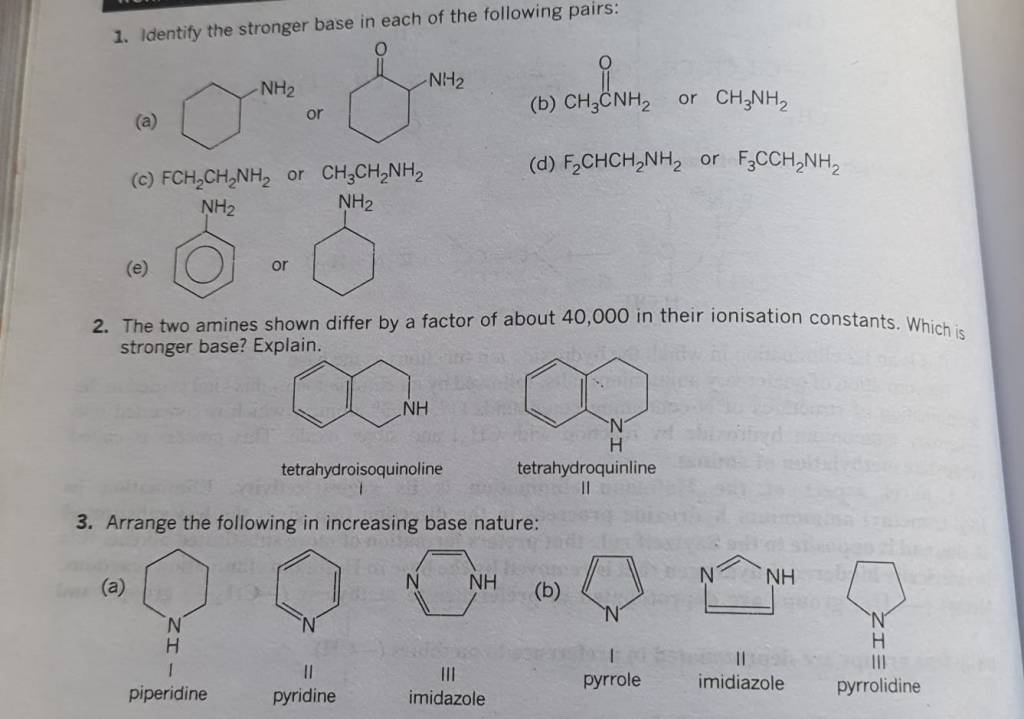
Basic strength of amines is a very important concept for NEET/JEE

What is basic strength?

Amines act as bases because of the lone pair on nitrogen (N) that can accept a proton (H⁺)

Key Concepts Affecting Basic Strength

1. Availability of Lone Pair

  • More available lone pair → stronger base
  • If lone pair is involved in resonance or bonding → weaker base

2. Inductive Effect (+I and –I)

  • Alkyl groups donate electrons (+I effect) → increase electron density on N → increase basicity

Order in gas phase:3>2>1>NH33^\circ > 2^\circ > 1^\circ > NH_3

But this changes in aqueous solution (see point 4).

3. Resonance Effect

  • If lone pair participates in resonance → less available → weaker base

Example:

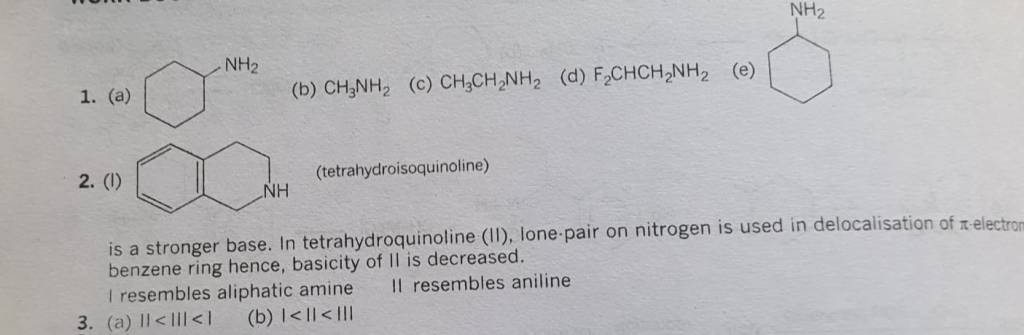
  • Aniline is less basic because lone pair is delocalized in benzene ring

4. Solvation Effect (VERY IMPORTANT for NEET)

In aqueous solution, stability of protonated amine matters.

  • More H-bonding → more stable → stronger base
  • 1° amines are better solvated than 3° amines

Order in aqueous solution:2>1>3>NH32^\circ > 1^\circ > 3^\circ > NH_3

5. Steric Hindrance

  • Bulky groups around N hinder protonation
  • More crowding → weaker base

This is why 3° amines are weaker in water

6. Hybridization of Nitrogen

sp3>sp2>spsp^3 > sp^2 > sp

  • More s-character → electrons closer to nucleus → less available → weaker base

7. Aromatic vs Aliphatic Amines

  • Aliphatic amines → stronger base
  • Aromatic amines (like aniline) → weaker due to resonance

Important Orders to Remember

Gas Phase:

3>2>1>NH33^\circ > 2^\circ > 1^\circ > NH_3

Aqueous Solution:

2>1>3>NH32^\circ > 1^\circ > 3^\circ > NH_3

Aromatic vs Aliphatic:

Aliphatic amine>Aromatic amine\text{Aliphatic amine} > \text{Aromatic amine}

Basic strength in heterocyclic compounds


Core Idea (MOST IMPORTANT)

Is the nitrogen lone pair part of the aromatic system or not?

Case 1: Lone pair NOT involved in aromaticity → Basic

Example: Pyridine-type

  • Nitrogen is sp² hybridized
  • Lone pair lies in an sp² orbital (outside π-system)
  • Available for protonation → basic

Example:
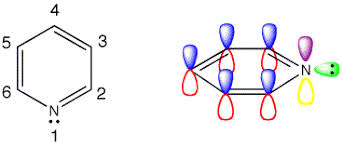
Pyridine

Case 2: Lone pair involved in aromaticity → Very weak base

Example: Pyrrole-type

  • Lone pair is part of aromatic sextet (6π electrons)
  • Not available for H⁺ → very weak base

Example:
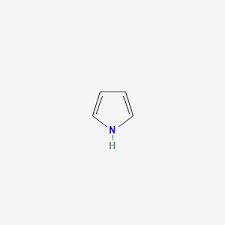
Pyrrole

Case 3: Multiple heteroatoms (competition effect)

Example: Imidazole, Pyrazole

  • One N behaves like pyridine (basic)
  • Other N behaves like pyrrole (non-basic)
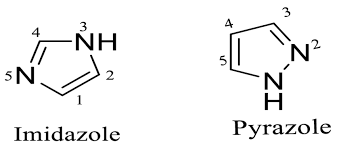
So overall: moderately basic

key Rule

The nitrogen whose lone pair is NOT involved in aromaticity is basic.

Imidazole

  • N–H nitrogen (shown with H)
    ❌ Lone pair is part of aromatic sextet → NOT basic
  • Other nitrogen (without H)
    ✅ Lone pair is free → BASIC

Basic position = N without H (pyridine-like N)

Pyrazole

  • N–H nitrogen
    ❌ Lone pair involved in aromaticity → NOT basic
  • Adjacent nitrogen (without H)
    ✅ Lone pair free → BASIC

Basic position = N without H

Important Examples & Order

1. Pyridine vs Pyrrole

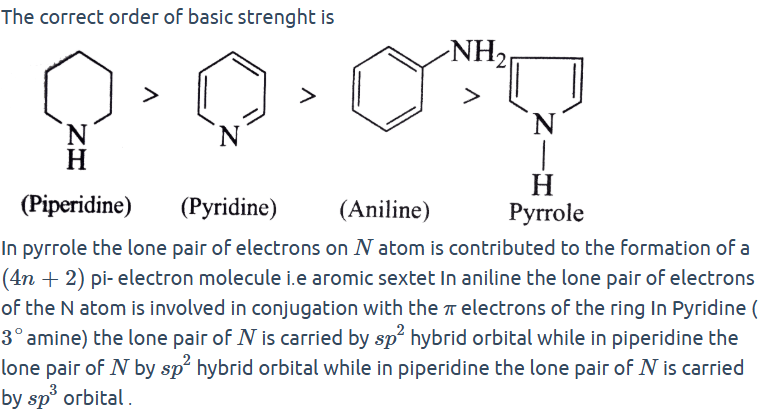
Pyridine>Pyrrole\text{Pyridine} > \text{Pyrrole}

✔ Pyridine → basic
✔ Pyrrole → almost non-basic

2. Aliphatic vs Aromatic Heterocycles

Aliphatic amine>Pyridine>Pyrrole\text{Aliphatic amine} > \text{Pyridine} > \text{Pyrrole}

3. Imidazole (VERY IMPORTANT)

Imidazole>Pyridine\text{Imidazole} > \text{Pyridine}

Reason: Extra stabilization of conjugate acid

Summary Table

Compound TypeLone PairBasic Strength
PyridineFreeModerate
PyrroleIn aromaticityVery weak
ImidazoleOne freeModerate–strong

Standard Basic Strength Order (Important)

Piperidine>Pyrrolidine>Imidazole>Pyridine>Pyrazole>Pyrrole\text{Piperidine} > \text{Pyrrolidine} > \text{Imidazole} > \text{Pyridine} > \text{Pyrazole} > \text{Pyrrole}

Piperidine>Pyrrolidine>Imidazole>Pyridine>Aniline>Pyrazole>Pyrrole
Answers:
Organic Reagents MCQs (NEET/JEE Practice) set 1/level NCERT

This question set is designed to strengthen key concepts of Organic Chemistry, especially reactions involving amines, diazonium salts, and important named reactions frequently asked in NEET and JEE. It covers a wide range of reagent-based transformations to help students improve accuracy and reaction recognition skills. Practice these questions regularly to build a strong conceptual foundation and boost exam confidence

1.

Nitrile on reduction gives:
A) Alcohol
B) Aldehyde
C) Primary amine
D) Secondary amine


2.

Amide + Br₂/NaOH gives:
A) Same carbon amine
B) One carbon higher amine
C) One carbon lower amine
D) Alcohol


3.

Which reagent converts alkyl halide to nitrile?
A) KOH
B) AgCN
C) KCN
D) NH₃


4.

Reduction of isocyanide gives:
A) Primary amine
B) Secondary amine
C) Tertiary amine
D) Alcohol


5.

Nitrile hydrolysis produces:
A) Alcohol
B) Aldehyde
C) Carboxylic acid
D) Amine


6.

Carboxylic acid reacts with NH₃ to give:
A) Ester
B) Amide
C) Amine
D) Nitrile


7.

Primary amine + HNO₂ gives:
A) Alkene
B) Alcohol
C) Nitrile
D) Amide


8.

Aniline + HNO₂ (0–5°C) forms:
A) Nitrobenzene
B) Diazonium salt
C) Phenol
D) Benzene


9.

C₆H₅N₂⁺Cl⁻ + KI gives:
A) Chlorobenzene
B) Bromobenzene
C) Iodobenzene
D) Fluorobenzene


10.

Sandmeyer reaction involves:
A) HNO₃
B) Cu salts
C) KMnO₄
D) NaBH₄


11.

C₆H₅N₂Cl + H₂O (warm) gives:
A) Benzene
B) Phenol
C) Aniline
D) Nitrobenzene


12.

C₆H₅N₂Cl + H₃PO₂ gives:
A) Phenol
B) Benzene
C) Aniline
D) Chlorobenzene


13.

C₆H₅N₂Cl + HBF₄ / heat gives:
A) Chlorobenzene
B) Bromobenzene
C) Fluorobenzene
D) Iodobenzene


14.

LiAlH₄ reduces CH₃COOH to:
A) Aldehyde
B) Primary alcohol
C) Ketone
D) Secondary alcohol


15.

Aldehyde reduction gives:
A) Secondary alcohol
B) Primary alcohol
C) Ketone
D) Acid


16.

Ketone reduction gives:
A) Primary alcohol
B) Secondary alcohol
C) Tertiary alcohol
D) Acid


17.

Carbylamine test is given by:
A) Primary amine
B) Secondary amine
C) Tertiary amine
D) Amide


18.

Aniline + Br₂/H₂O gives:
A) Monobromo
B) Dibromo
C) 2,4,6-tribromoaniline
D) No reaction


19.

Aniline nitration gives mainly:
A) Meta product
B) Ortho + para + some aniline
C) Only para
D) Only ortho


20.

Aniline + acetic anhydride forms:
A) Benzamide
B) Acetanilide
C) Nitrobenzene
D) Phenol


21.

Acetanilide + Br₂/CH₃COOH gives:
A) Ortho product
B) Para product
C) Meta product
D) Mixture


22.

Gabriel phthalimide synthesis gives:
A) Primary amine
B) Secondary amine
C) Tertiary amine
D) Amide


23.

Nitrile partial hydrolysis gives:
A) Acid
B) Amide
C) Amine
D) Alcohol


24.

Aniline + conc. H₂SO₄ gives:
A) Nitrobenzene
B) Sulphanilic acid
C) Phenol
D) Benzene


25.

Coupling reaction of diazonium salt gives:
A) Alcohol
B) Azo dye
C) Acid
D) Alkene

Answers:

1-C, 2-C, 3-C, 4-B, 5-C, 6-B, 7-B, 8-B, 9-C, 10-B, 11-B, 12-B, 13-C, 14-B, 15-B, 16-B, 17-A, 18-C, 19-B, 20-B, 21-B, 22-A, 23-B, 24-B, 25-B