Sarvan Kumarhttp://sarvankumar.wordpress.comMy name is Sarvan Kumar, I am post graduate in chemistry (MSc). besides teaching chemistry at various schools and coaching centres I have been giving home tuitions to students for 10 years. I have helped students score good marks in chemistry not only in board examination but also JEE, NEET, SAT, IGCSE and IB examinations. Nearly 90% of my students have scored more than 95% in their CBSE board examination. Moreover they have also secured a seat in prestigious engineering and medical college.
Since every student is different hence my unique style of teach
Nucleophilicity means the ability of a species to donate an electron pair to an electrophile and form a bond. In exams, students must quickly compare nucleophiles using a few core rules.
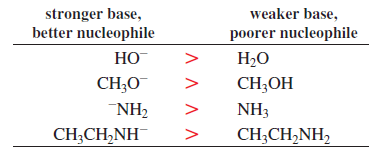
When we talk about atoms or molecules that have lone-pair electrons, sometimes we call them bases and sometimes we call them nucleophiles (Table 9.1). What is the difference between a base and a nucleophile?
Basicity tells us how easily a compound (base) can donate its lone pair of electrons to a proton (H⁺). A strong base donates its electron pair more easily than a weak base.
Basicity is related to the acid dissociation constant (Ka) of its conjugate acid, which shows how easily that conjugate acid releases a proton. If the conjugate acid releases H⁺ easily, the base is weaker; if it does not release H⁺ easily, the base is stronger.
Nucleophilicity describes how easily a compound (nucleophile) can attack an electron-deficient atom and form a new bond. It is measured by the rate constant (k), which indicates how fast the nucleophile reacts in a chemical reaction.
Note: Species with a negative charge is a stronger base and a better nucleophile than a species that has the same attacking atom but is neutral
If the attacking atoms are the same size, stronger bases are better nucleophiles.
−NH2 > HO− > F−
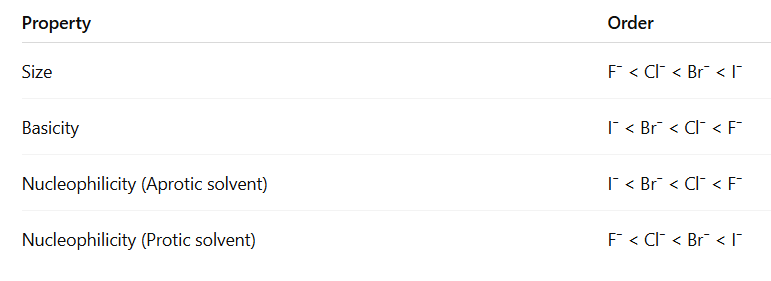
If, however, the attacking atoms of the nucleophiles are very different in size, another factor comes into play: the polarizability
Effect of Solvent on Nucleophilicity (Simple Point-wise) 🧪
Species with negative charge are stronger bases than neutral ones.
Example
Basicity is a measure of how well a compound (a base) shares its lone pair with a proton. The stronger the base, the better it shares its electrons. Basicity is measured by an equilibrium constant (the acid dissociation constant, Ka) that indicates the tendency of the conjugate acid of the base to lose a proton
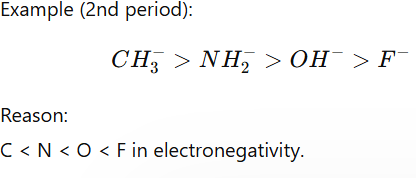
2. Electronegativity (Across a Period)
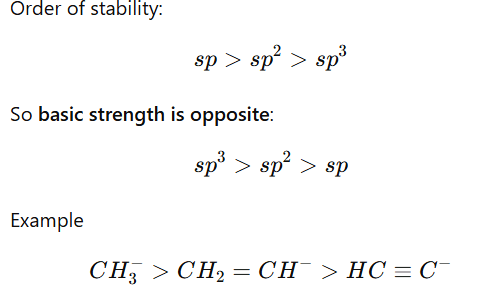
If atoms are in the same period, basicity decreases with electronegativity.
Less electronegative atom holds negative charge poorly → stronger base.
3.Hybridization Effect
More s-character stabilizes negative charge, making the base weaker.
4.Resonance
If negative charge is delocalized, the base becomes less basic.
Example:
Acetate ion vs Ethoxide
5.Inductive Effect
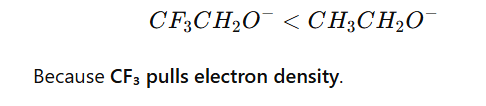
Electron-withdrawing groups (–I effect) decrease basicity.
Example
6. Aromaticity
If negative charge contributes to aromatic stabilization, the base becomes weaker.
Example Cyclopentadienyl anion is stable → weak base.
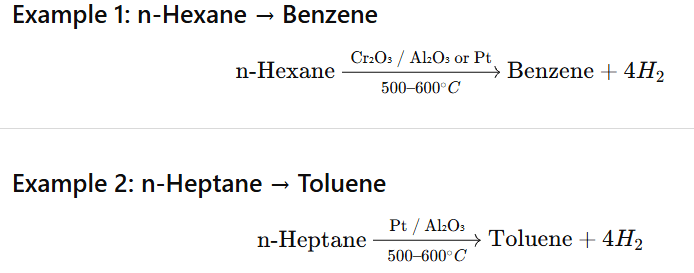
Aromatisation is the conversion of higher alkanes (C₆ or more) into aromatic hydrocarbons (benzene and its derivatives) by dehydrogenation and cyclisation at high temperature in presence of catalysts.
n-Octane (C₈) → Xylene (or ethylbenzene)
Also possible under catalytic reforming conditions.
Theoretical Point of View
There is no fixed maximum carbon limit. Any C₆ or higher straight-chain alkane (C₆⁺) can undergo aromatisation because at least six carbons are required to form a benzene ring.
🔹 Practical / Industrial Point of View
In petroleum refining (catalytic reforming):
✔ Most effective for C₆ to C₁₀ alkanes ✔ Above C₁₀–C₁₂, cracking and side reactions increase ✔ Very long chains prefer cracking rather than clean aromatisation
So practically:
Cyclohexane undergoes multiple dehydrogenations:
👉 Total 4 molecules of H₂ released.
🔹 Key Concept
✔ First dehydrogenation, then cyclisation, then aromatic stabilization ✔ Metal catalyst helps in removal of hydrogen ✔ Final product gains extra stability due to aromatic resonance
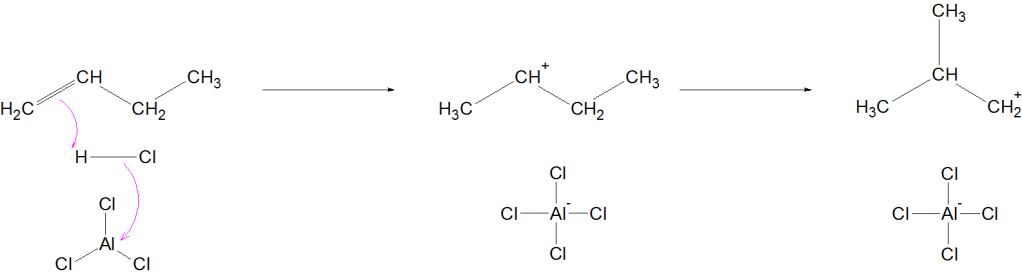
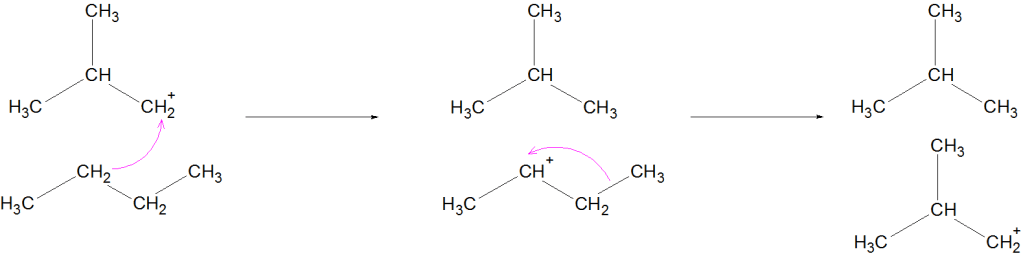
Isomerisation of alkane is the process in which a straight-chain alkane (n-alkane) is converted into its branched-chain isomer without changing the molecular formula.
Conditions Required
Catalyst:
Anhydrous AlCl₃
HF
Pt/Al₂O₃
Temperature: 250–400°C (industrial process)
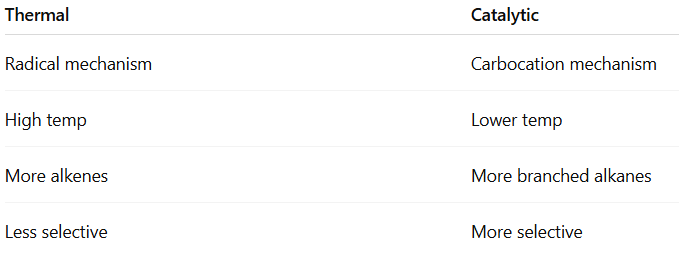
Occurs via carbocation mechanism
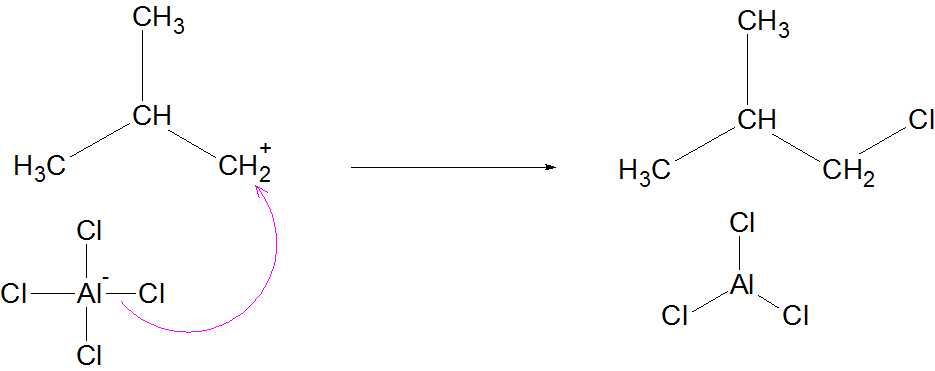
Mechanism (Simplified for JEE/NEET)
Formation of carbocation
Hydride shift or methyl shift
Formation of more stable branched carbocation
Deprotonation → Branched alkane
Industrial Importance
Used in petroleum refining
Improves octane number of petrol
Branched alkanes burn more smoothly (less knocking)
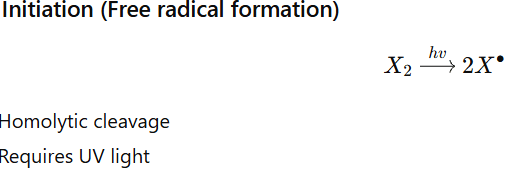
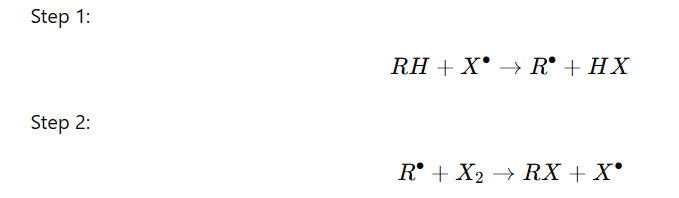
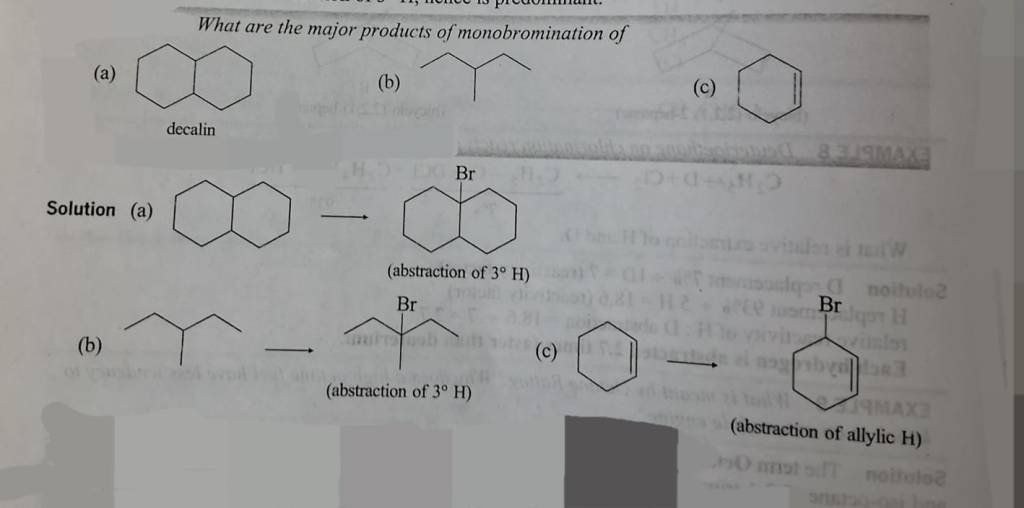
Free radical halogenation is a substitution reaction of alkanes in which a hydrogen atom is replaced by a halogen (Cl or Br) in the presence of UV light (hv) or heat.
(X = Cl or Br)
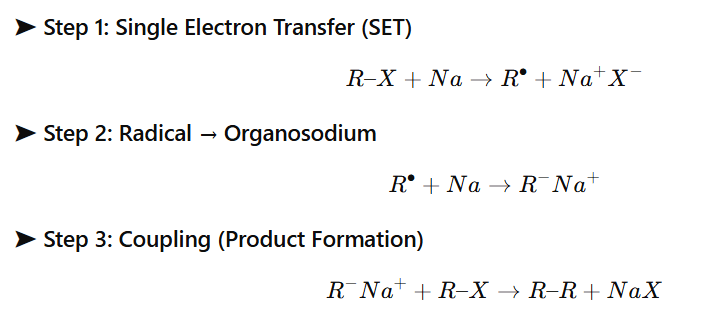
Mechanism:
Step 1
Step 2: Propagation (Chain continues)
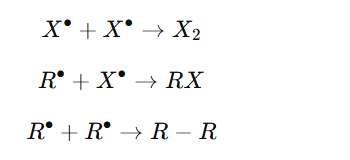
Step 3:Termination (Radicals combine)
Order of Reactivity of Halogens
But in practice:
Fluorination → Explosive
Chlorination → Fast, less selective
Bromination → Slow, more selective
Iodination → Not feasible (endothermic)
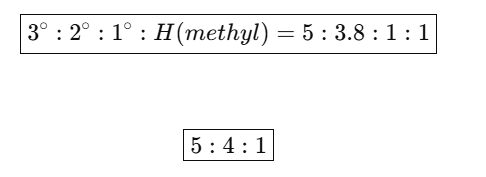
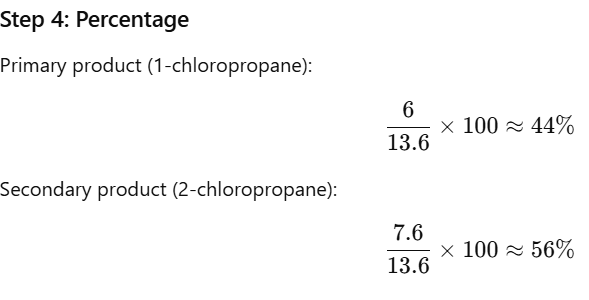
Selectivity Rule (Very Important for JEE)
Relative Reactivity of Hydrogens
Because: ✔ Stability of radical ✔ Hyperconjugation ✔ Inductive effect
Energy Profile Concept
✔ Chlorination → Low activation difference ✔ Bromination → Large activation difference 👉 Bromination gives major substituted product (Hammond postulate)
JEE / NEET Special Points
✔ Reaction requires UV light ✔ Radical inhibitor (like O₂) slows reaction ✔ Tertiary hydrogen is most reactive ✔ Allylic and benzylic positions are highly reactive ✔ Reaction gives mixture of products
Allylic Halogenation (Very Important Exception)
When alkene is treated with halogen under radical conditions → substitution occurs at allylic position, not addition.
Example: Propene + Br₂ (hv) → Allylic bromide
Best reagent: NBS (N-Bromosuccinimide) Reason: ✔ Allylic radical is resonance stabilized ✔ More stable than normal 3° radical sometimes
Benzylic Halogenation
Example: Toluene + Br₂ (hv) → Benzyl bromide
Reason: ✔ Benzyl radical is highly resonance stabilized ✔ Very reactive position
Iodination is carried out in presence of HIO₃ because it oxidizes HI to I₂, removing HI and shifting equilibrium forward, making the reaction feasible.
The Problem (Normal Iodination
✔ Propagation step is endothermic ✔ Reaction is reversible ✔ HI formed shifts equilibrium backward 👉 So iodination is normally very slow / does not proceed.
⚡ Role of HIO₃ (Iodic Acid)
When HIO₃ is added:
What happens?
✔ HI (product) is removed ✔ Equilibrium shifts forward (Le Chatelier principle) ✔ Reaction becomes feasible
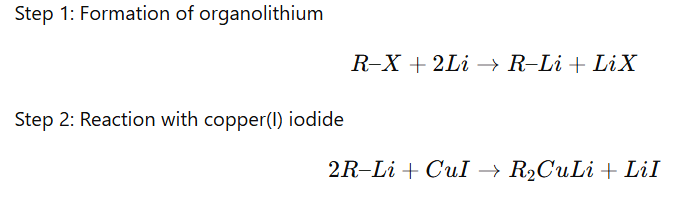
Corey–House synthesis is a method used to prepare higher alkanes by coupling an alkyl halide with a Gilman reagent (lithium dialkylcuprate, R₂CuLi).
Preparation of Gilman Reagent
Important JEE/NEET Points
✔ Best with primary alkyl halides ✔ Does not work well with tertiary halides (elimination dominates) ✔ Useful for forming unsymmetrical alkanes ✔ Milder and more selective than Wurtz reaction ✔ Works via substitution mechanism
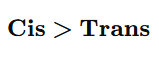
“Hydrogenation rate of cyclic alkenes depends on ring strain. Smaller rings possess greater angle strain and hence higher heat of hydrogenation. Therefore, they react faster.”
JEE/NEET Important Order
Rate of hydrogenation:
Comparison Example (Very Important for Exams)
Compare:
1,3-Butadiene (conjugated)
1,4-Pentadiene (isolated)
Stability Order:
Rate of Hydrogenation:
JEE/NEET Important Order
Rate of hydrogenation:
(Benzene hydrogenates very slowly due to aromatic stability)
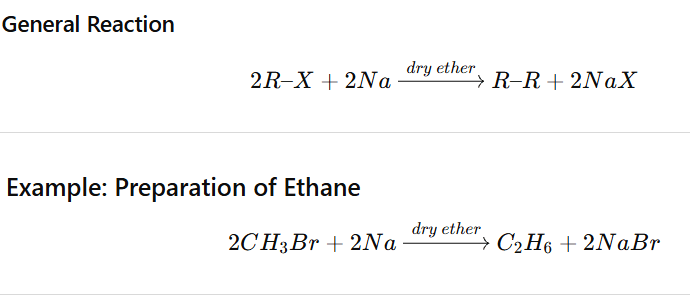
✔ Only alkali metals (Na, K, Li) give Wurtz-type coupling ✔ Sodium is preferred due to controlled reactivity ✔ Mg and Zn mainly form organometallic intermediates instead of direct alkane
Wurtz Reaction – Metals Other Than Sodium
Although sodium (Na) is the classical metal used in Wurtz reaction, some other metals can also promote coupling of alkyl halides
Potassium (K)
✔ More reactive than sodium ✔ Reaction is more vigorous ❌ Harder to control 📌 Rarely used in practice (safety issue)
Lithium (Li)
✔ Can participate in similar coupling ✔ Often forms organolithium intermediates 📌 Used more in organometallic synthesis than classical Wurtz
Silver (Ag)
✔ Used mainly for radical formation studies ❌ Not common for alkane synthesis 📌 Often used in rearrangement or carbocation studies
Zinc (Zn)
Zinc does not give classical Wurtz coupling easily but forms:
✔ Forms organozinc compounds ✔ Used in coupling reactions (e.g., Reformatsky type)
Magnesium (Mg)
R–X+Mg→R–MgX
✔ Forms Grignard reagent ❌ Does NOT directly give Wurtz alkane 📌 Very important alternative pathway
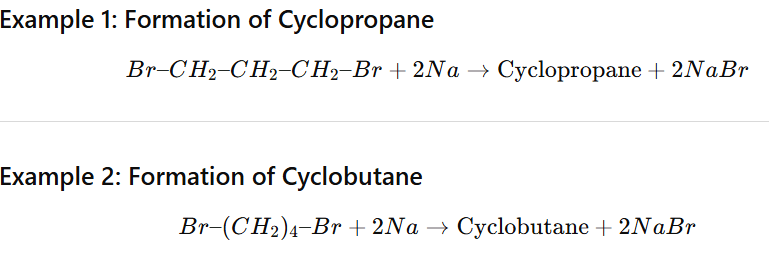
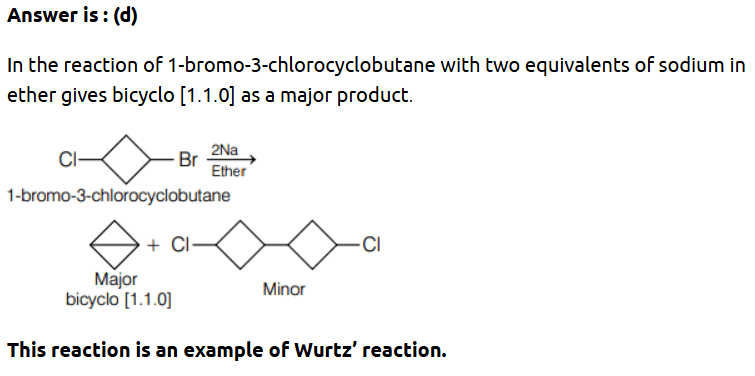
Cyclic Wurtz Reaction (Intramolecular Wurtz)
Cyclic Wurtz reaction is an intramolecular version of the Wurtz reaction in which a dihaloalkane reacts with sodium metal in dry ether to form a cycloalkane.
JEE / NEET Important Points
Best for small rings (3–5 members).
Large rings are difficult due to entropy factor.
Competes with intermolecular Wurtz (polymerization possible).
Primary dihalides give better yield.
Dry ether is essential.
Mechanism involves free radicals.
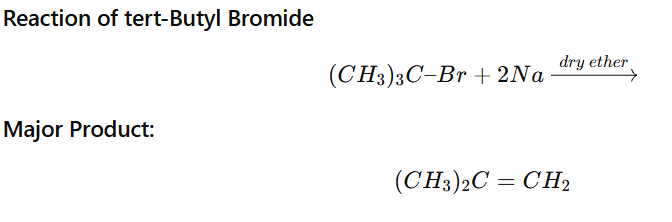
Product of Tertiary Alkyl Halide in Wurtz Reaction
When a tertiary alkyl halide (3° RX) is treated with sodium (Na) in dry ether, it does not give Wurtz coupling product efficiently.
Major product = Alkene (Elimination product) Coupling product is minor or negligible.
Example
Why Elimination Occurs?
✔ Tertiary halides easily form stable tertiary radicals / carbanions ✔ Strong base character of sodium promotes β-elimination ✔ Steric hindrance prevents effective coupling
Thus, E2-type elimination dominates over coupling.
JEE / NEET Important Points
Primary RX → best for Wurtz coupling
Secondary RX → mixture
Tertiary RX → alkene (major)
Elimination increases with substitution.
Reaction follows radical pathway but elimination competes strongly.
Reactivity Order (Bond Strength Basis)
JEE / NEET Important Points
Alkyl bromides are preferred.
Primary halides give best results.
Aryl halides do NOT undergo normal Wurtz (need Wurtz–Fittig).
Fluorides are practically inactive.
Dry ether is essential for the reaction.
Reasons for Using Dry Ether
1. Provides Anhydrous Medium
✔ Sodium reacts violently with water:
If moisture is present, sodium will react with water instead of alkyl halide. Therefore, ether must be dry.
Why is solvent needed in Wurtz reaction? Solvent used → Dry ether 1. Medium for Reaction Sodium is solid Alkyl halide is liquid Reaction occurs at sodium surface Ether provides: Proper contact between reactant.
2. Uniform reaction medium
Without solvent → reaction is uncontrolled / incomplete. 3. Stabilizes Reactive Intermediates Wurtz reaction proceeds via: Radical pathway or Organosodium intermediate (R–Na) Dry ether:
MCQ Questions for practice:
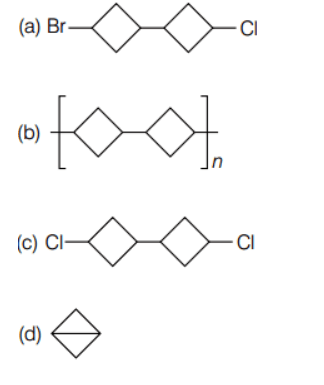
In the reaction of 1-bromo-3-chlorocyclobutane with two equivalents of sodium in ether, the major product is