A) Bond order 1 B) Bond order 2 C) Bond order 3 D) Bond order 0
Q45.
Which species is paramagnetic?
A) N₂ B) O₂ C) F₂ D) Ne₂
Q46.
The oxidation state of Mn in KMnO₄ is:
A) +2 B) +4 C) +6 D) +7
Q47.
A reaction in which the same element is simultaneously oxidised and reduced is called:
A) Displacement B) Comproportionation C) Disproportionation D) Neutralisation
Q48.
In a comproportionation reaction:
A) Same oxidation state gives two different oxidation states B) Two different oxidation states combine to give an intermediate oxidation state C) Only oxidation occurs D) Only reduction occurs
Q49.
During electrolysis of molten NaCl, the product at the cathode is:
A) Cl₂ B) NaOH C) Na D) H₂
Q50.
During electrolysis of aqueous CuSO₄ using inert electrodes, the cathode reaction is predominantly:
A) 2H₂O → O₂ + 4H⁺ + 4e⁻ B) Cu²⁺ + 2e⁻ → Cu C) SO₄²⁻ → SO₂ D) H₂O → H₂
Take F = 96500 C mol⁻¹ and R = 8.314 J K⁻¹ mol⁻¹, wherever required.
SECTION A — 1 × 6 = 6 Marks
Answer all questions.
Q1. Calculate the molality of a solution prepared by dissolving 18 g glucose (M = 180 g mol⁻¹) in 180 g of water.
Q2. The vapour pressure of pure water at 300 K is 31.8 mm Hg. Calculate the vapour pressure of a solution containing 1 mole of glucose in 9 moles of water.
Q3. Calculate the EMF of the cell at 298 K:
Zn | Zn²⁺ (0.1 M) || Cu²⁺ (0.01 M) | Cu
Given: E°cell = 1.10 V.
Q4. A current of 2 A is passed through a CuSO₄ solution for 30 minutes. Calculate the mass of copper deposited. (Molar mass of Cu = 63.5 g mol⁻¹)
Q5. A first-order reaction has a half-life of 20 minutes. Calculate its rate constant.
Q6. For a reaction, the rate constant is 2.0 × 10⁻³ s⁻¹. Calculate its half-life.
SECTION B — 2 × 6 = 12 Marks
Answer all questions.
Q7.5.85 g NaCl is dissolved in 500 g water. Calculate the depression in freezing point. Given: Kf = 1.86 K kg mol⁻¹. Assume complete dissociation of NaCl.
Q8. Calculate the molarity of a solution prepared by dissolving 4.9 g H₂SO₄ in water to make the final volume 250 mL. (Molar mass of H₂SO₄ = 98 g mol⁻¹)
Q9. Calculate the standard Gibbs energy change for a cell reaction involving n = 2 electrons, if E°cell = 1.10 V. Given: F = 96500 C mol⁻¹.
Q10. The conductivity of a 0.02 M KCl solution is 2.5 × 10⁻³ S cm⁻¹. Calculate its molar conductivity.
Q11. For a first-order reaction, 75% of the reactant decomposes in 40 minutes. Calculate the rate constant.
Q12. A reaction follows second-order kinetics. Its rate constant is 0.5 L mol⁻¹ s⁻¹ and initial concentration is 0.2 mol L⁻¹. Calculate the half-life of the reaction.
SECTION C — 3 × 4 = 12 Marks
Answer all questions.
Q13. A solution is prepared by dissolving 10 g of a non-volatile solute in 90 g of water. The vapour pressure of pure water at a certain temperature is 40 mm Hg, while that of the solution is 38 mm Hg.
Calculate the molar mass of the solute.
Q14. A conductivity cell containing 0.01 M KCl solution has a resistance of 100 Ω. The conductivity of the solution is 1.41 × 10⁻³ S cm⁻¹.
Calculate:
a) Cell constant b) Conductance of the solution c) Molar conductivity of KCl
Q15. A galvanic cell is represented as:
Mg | Mg²⁺ (0.01 M) || Cu²⁺ (0.001 M) | Cu
Given:
E°(Mg²⁺/Mg) = −2.37 V E°(Cu²⁺/Cu) = +0.34 V
Calculate:
a) E°cell b) Ecell at 298 K c) ΔG° for the cell reaction
Q16. The decomposition of a substance follows first-order kinetics. Its concentration decreases from 0.80 M to 0.20 M in 30 minutes.
Calculate:
a) Rate constant b) Half-life c) Time required for the concentration to decrease from 0.20 M to 0.05 M
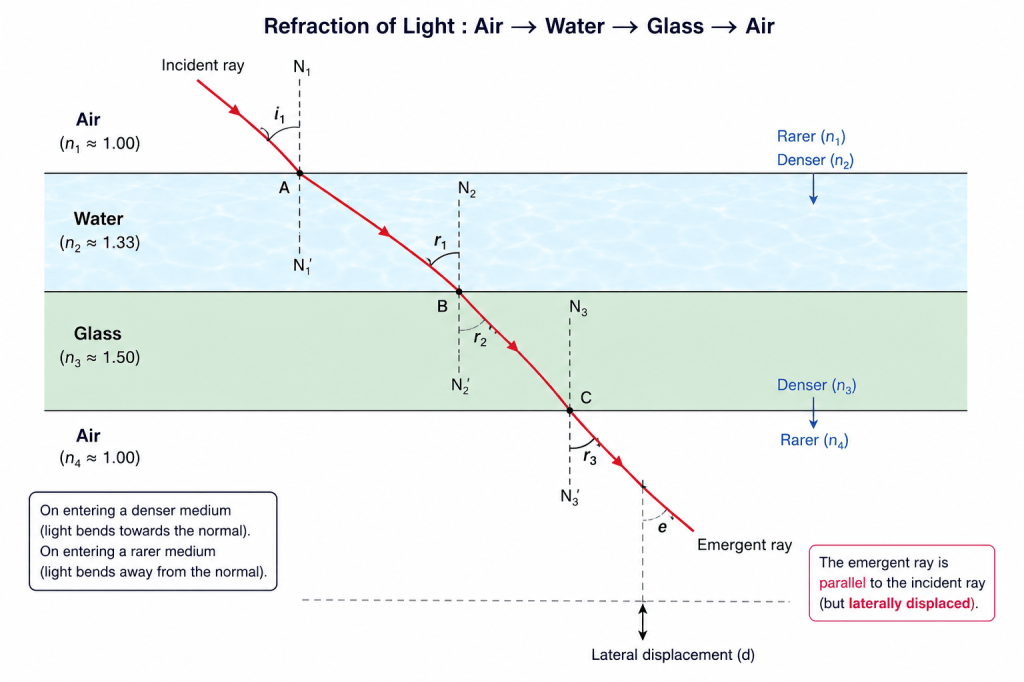
When a ray of light travels from one transparent medium to another, its speed changes, causing the ray to change its direction. This phenomenon is called refraction of light.
Consider a light ray travelling through air → water → glass → air.
1. Air to Water
When light enters water from air, it travels from a rarer medium to a denser medium. Therefore, the ray bends towards the normal.
2. Water to Glass
When the ray travels from water to glass, it again enters a denser medium because the refractive index of glass is greater than that of water. Hence, the ray bends towards the normal again.
3. Glass to Air
Finally, when the ray emerges from glass into air, it travels from a denser medium to a rarer medium. Therefore, it bends away from the normal.
Important Result
If the first and last surfaces are parallel, the final emergent ray is parallel to the original incident ray, although it is shifted sideways. This sideways shift is called lateral displacement.
Remember for JEE/NEET:
Rarer → Denser → Towards normal Denser → Rarer → Away from normal
The amount of bending depends on the refractive indices of the media and the angle at which light strikes the surface.
1. Which of the following is the correct order of acidic strength in aqueous medium? A. H₂O > CH₃OH > NH₃ B. CH₃OH > H₂O > NH₃ C. NH₃ > H₂O > CH₃OH D. H₂O > NH₃ > CH₃OH
2. The noble gas configuration of phosphorus (Z = 15) is: A. [Ne] 3s² 3p³ B. [He] 2s² 2p⁶ 3s² 3p³ C. [Ar] 3s² 3p³ D. [Ne] 3s² 3p⁵
3. An element having electronic configuration [Ne] 3s² 3p⁵ belongs to: A. Group 15, Period 3 B. Group 17, Period 3 C. Group 17, Period 2 D. Group 7, Period 3
4. Which group shows the strongest +R effect? A. –NO₂ B. –COOH C. –NH₂ D. –CN
5. The reagents used in the Gattermann–Koch reaction are: A. CO + HCl/AlCl₃, CuCl B. CO₂ + HCl/AlCl₃ C. CO + Cl₂/FeCl₃ D. HCN + HCl/AlCl₃
6. Which ligand is strongest according to the spectrochemical series? A. Cl⁻ B. F⁻ C. NH₃ D. CN⁻
7. Reimer–Tiemann reaction of phenol with CHCl₃/NaOH gives mainly: A. Benzaldehyde B. Salicylaldehyde C. Benzoic acid D. Toluene
8. The major product of Kolbe’s reaction of sodium phenoxide followed by acidification is: A. Benzoic acid B. Salicylic acid C. Phenol D. Benzaldehyde
9. A secondary amine reacts with nitrous acid to form: A. Nitroalkane B. N-nitrosoamine C. Alcohol D. Alkene
10. The equivalent weight of H₂SO₄ in an acid-base reaction is: A. 98 B. 49 C. 24.5 D. 196
11. For a hydrogen-like atom, the energy of an electron in orbit n is proportional to: A. n² B. 1/n C. –1/n² D. –n²
12. The correct order of dipole moment is: A. HF > HCl > HBr > HI B. HI > HBr > HCl > HF C. HCl > HF > HBr > HI D. HF > HI > HBr > HCl
13. A reaction in which two species undergo oxidation-state changes to produce a species having an intermediate oxidation state is called: A. Disproportionation B. Comproportionation C. Neutralisation D. Hydrolysis
14. Which pair represents structural isomers? A. cis-2-butene and trans-2-butene B. n-butane and isobutane C. (R)-2-butanol and (S)-2-butanol D. cis-2-butene and 2-butene
15. Which alkane conformation is the most stable? A. Eclipsed B. Fully eclipsed C. Staggered D. Partially eclipsed
16. Ozonolysis of propene followed by reductive work-up gives: A. Methanal + ethanal B. Methanal + methanol C. Ethanal + ethanol D. Acetone + methanal
17. Which statement is correct for an SN2 reaction? A. It proceeds through carbocation formation B. Rate depends only on substrate concentration C. It involves backside attack D. It is favoured by tertiary alkyl halides
18. Acid chlorides react with water to produce: A. Alcohol B. Aldehyde C. Carboxylic acid D. Ether
19. Hydration of a terminal alkyne in the presence of HgSO₄/H₂SO₄ ultimately gives: A. Primary alcohol B. Aldehyde C. Ketone D. Ether
20. The reaction of an alkene with cold, dilute alkaline KMnO₄ is commonly used as: A. Baeyer test B. Tollens’ test C. Fehling’s test D. Lucas test
SECTION B — STATEMENT / CONCEPT
10 × 2 = 20 marks
21. Consider the following statements about SN1 and SN2 reactions:
SN1 reactions involve carbocation formation.
SN2 reactions proceed through a single-step mechanism.
SN1 is generally favoured by tertiary substrates.
SN2 reactions show retention of configuration.
Which statements are correct? A. 1, 2 and 3 only B. 1 and 4 only C. 2 and 3 only D. All four
22. For a zero-order reaction, the time required for complete consumption of reactant is finite, whereas for a first-order reaction, complete consumption theoretically requires infinite time.
If the half-life of a first-order reaction is 20 min, the time required for 75% completion is:
A. 20 min B. 30 min C. 40 min D. 60 min
23. HBr adds to propene in the presence of peroxide.
Answer the following:
(i) State the major product. (ii) Name the rule responsible for this orientation. (iii) Why does this reaction proceed through a radical mechanism?
24. Match the following:
Reaction
Product/feature
A. Clemmensen reduction
1. Zn(Hg)/HCl
B. Wolff–Kishner reduction
2. NH₂NH₂/KOH
C. Cannizzaro reaction
3. Aldehydes without α-H
D. Aldol reaction
4. Aldehydes/ketones having α-H
Choose the correct matching.
25. Give the products obtained in the following tests:
Write the expression for work done when expansion is:
(i) Reversible and isothermal (ii) Against constant external pressure
30. Define the following:
(i) Heat capacity (ii) Specific heat capacity (iii) Molar heat capacity
Also write the relationship between heat supplied and temperature change.
SECTION C — NUMERICAL / JEE-LEVEL
5 × 2 = 10 marks
31. The enthalpy change of a reaction at constant pressure is –50 kJ mol⁻¹. If the reaction involves gaseous reactants and products, explain why ΔH and ΔU may differ. Write the relation between ΔH and ΔU for gaseous reactions.
32. Calculate the heat required to raise the temperature of 200 g of water from 25°C to 75°C, given:
Specific heat of water = 4.2 J g⁻¹ K⁻¹.
33. The enthalpy of neutralisation of a strong acid by a strong base is approximately:
A. +57.1 kJ mol⁻¹ B. –57.1 kJ mol⁻¹ C. –5.71 kJ mol⁻¹ D. +5.71 kJ mol⁻¹
Explain the reason for its nearly constant value.
34. Using Hess’s law:
C + ½O₂ → CO ΔH = –110.5 kJ mol⁻¹ CO + ½O₂ → CO₂ ΔH = –283.0 kJ mol⁻¹
Calculate ΔH for:
C + O₂ → CO₂
35. For the reaction:
N₂(g) + 3H₂(g) → 2NH₃(g)
Predict the sign of ΔS and explain your answer.
BONUS JEE/NEET REACTION REVISION
Before attempting the paper, revise these high-yield reaction pairs:
Reimer–Tiemann: Phenol → salicylaldehyde
Kolbe–Schmitt: Phenol → salicylic acid
Gattermann–Koch: Benzene → benzaldehyde
Clemmensen: C=O → CH₂ using Zn(Hg)/HCl
Wolff–Kishner: C=O → CH₂ using NH₂NH₂/KOH
Cannizzaro: Aldehyde without α-H → alcohol + carboxylate
Aldol: Carbonyl compound with α-H → β-hydroxy carbonyl compound