
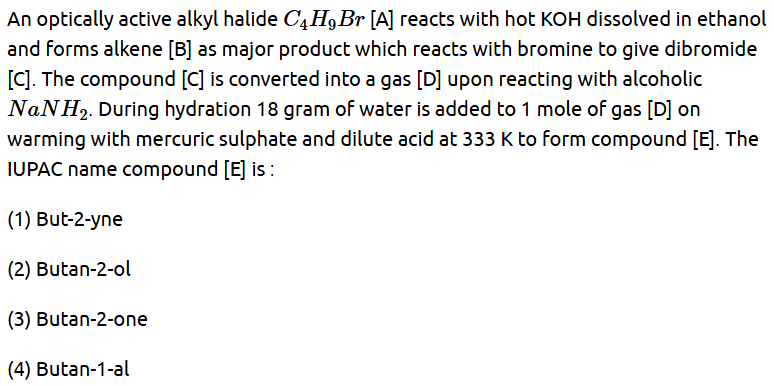
Step 1: Identify the optically active alkyl bromide (A)
Given molecular formula = C₄H₉Br and it is optically active.
Possible isomers:
- CH₃CH₂CH₂CH₂Br (1-bromobutane) ❌
- CH₃CHBrCH₂CH₃ (2-bromobutane) ✅ (chiral)
- (CH₃)₂CHCH₂Br (isobutyl bromide) ❌
- (CH₃)₃CBr (tert-butyl bromide) ❌
Hence,A=2-bromobutane
Step 2: Alcoholic KOH (Hot)
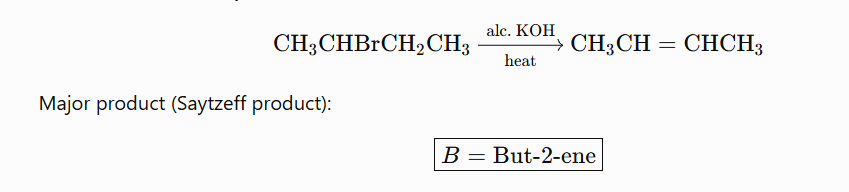
Step 3: Addition of Br₂
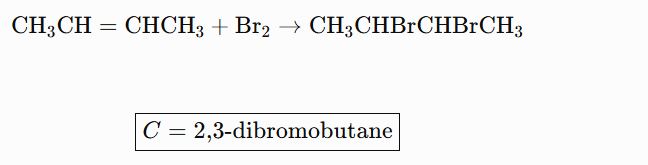
Step 4: Reaction with alcoholic NaNH₂
Vicinal dibromide + excess NaNH₂ undergoes double dehydrohalogenation.
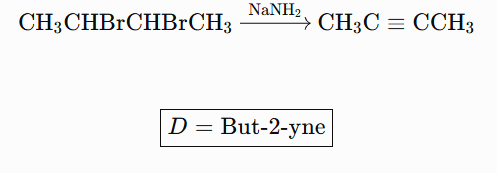
Step 5: Hydration of alkyne
Conditions:
- HgSO₄
- Dil. H₂SO₄
- 333 K
Hydration of an internal alkyne gives a ketone after keto-enol tautomerism.

Final Answer
(3) Butan-2-one

