Sarvan Kumarhttp://sarvankumar.wordpress.comMy name is Sarvan Kumar, I am post graduate in chemistry (MSc). besides teaching chemistry at various schools and coaching centres I have been giving home tuitions to students for 10 years. I have helped students score good marks in chemistry not only in board examination but also JEE, NEET, SAT, IGCSE and IB examinations. Nearly 90% of my students have scored more than 95% in their CBSE board examination. Moreover they have also secured a seat in prestigious engineering and medical college.
Since every student is different hence my unique style of teach
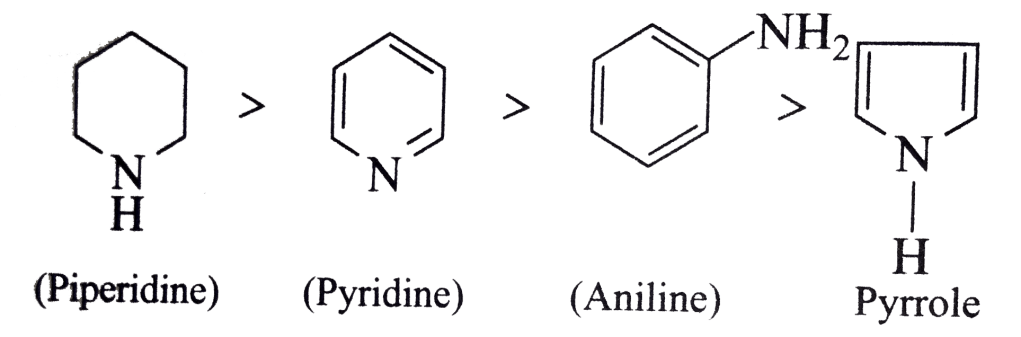
In piperidine, the nitrogen is sp³-hybridized and the lone pair is “free” (not delocalized into any aromatic system), so it can readily accept a proton → very basic.
In pyridine, the nitrogen is sp² and its lone pair resides in an orbital perpendicular to the aromatic π system (i.e. not part of the aromatic sextet), so it is available for protonation, but less “free” than in piperidine → moderate base.
In pyrrole, the nitrogen’s lone pair is part of the aromatic π system (delocalized), and protonating it would disrupt aromaticity; hence the lone pair is not readily available → very weak base
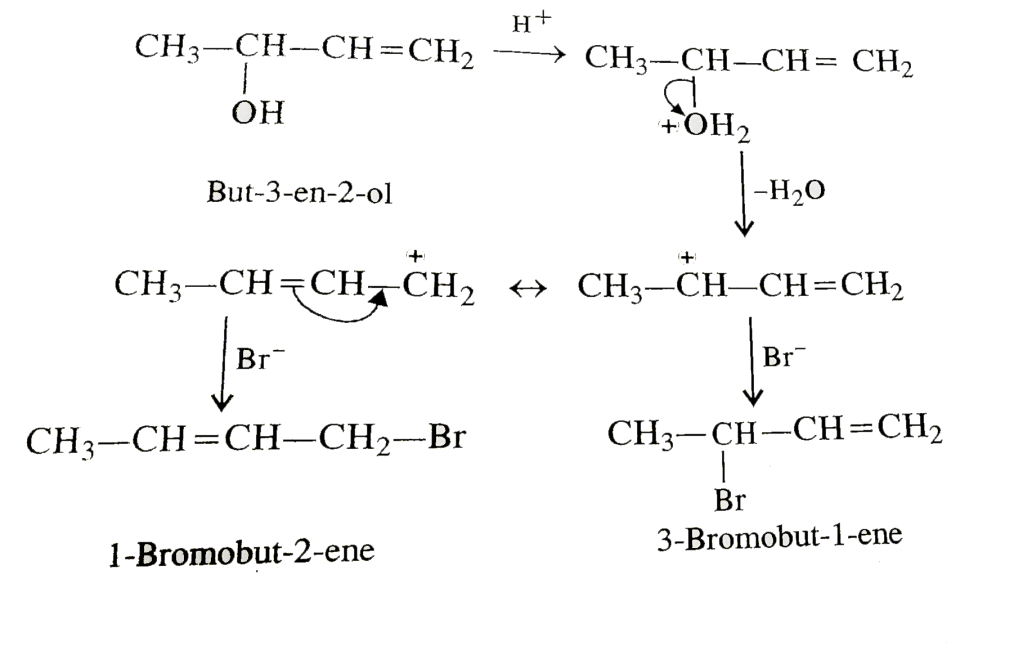
Major product: bromine replaces the –OH to give CH₃–CH(Br)–CH=CH₂ (IUPAC: 3-bromobut-1-ene) — with a minor product CH₃–CH=CH–CH₂Br (1-bromo-2-butene) possible.
Why (mechanism, stepwise):
Protonation of the alcohol. CH₃–CH(OH)–CH=CH₂ + H⁺ → CH₃–CH(OH₂⁺)–CH=CH₂
Loss of water → allylic carbocation (RDS). CH₃–CH(OH₂⁺)–CH=CH₂ → CH₃–C⁺H–CH=CH₂ (carbocation at C-2). This carbocation is allylic and is resonance stabilized: the + charge is delocalized between C-2 and the terminal C-4 (move the π electrons C3–C4 → C2–C3). Resonance forms:
A: CH₃–C⁺H–CH=CH₂ (positive at C2)
B: CH₃–CH=CH–CH₂⁺ (positive at terminal C4)
Nucleophilic attack by Br⁻. Bromide attacks the resonance-stabilized cation. Attack at C-2 (the more substituted resonance form) is favored, giving CH₃–CH(Br)–CH=CH₂ (major). Attack at the terminal C (resonance form B) gives CH₃–CH=CH–CH₂Br (minor).
Minor product is more stable alkene?
minor product can be the thermodynamically more stable alkene, but the reaction gives the major product for kinetic/reaction-path reasons. Here’s why, step-by-step, in plain language.
1) What the two products are (reminder)
Major product (fast): bromide ends up on the more substituted carbon (attack at C-2) → gives CH₃–CH(Br)–CH=CH₂ (formed quickly by attack on the resonance form with the positive charge at C-2).
Minor product (more stable alkene): bromide ends up at the terminal site (attack at C-4 resonance form) → gives CH₃–CH=CH–CH₂Br, which may correspond to the more substituted/thermodynamically more stable alkene after any isomerization.
2) Why the less stable alkene is the major product
After loss of water you form an allylic carbocation that is resonance-stabilized. The two resonance contributors are not equally important: the contributor with the positive charge on C-2 (the more substituted position) is a major contributor (it has greater carbocation stabilization by adjacent alkyl groups). That means Br⁻ encounters more positive character at C-2, so nucleophilic attack there is faster. The product from that fast attack is the observed major product — this is kinetic control.
The route that would give the thermodynamically more stable alkene requires attack on the resonance contributor with the charge at the terminal carbon (less favored contributor), so that pathway is slower → hence minor product.
3) Stability vs. kinetics
Thermodynamic stability (more substituted internal alkene) and kinetic accessibility (where Br⁻ attacks fastest) are two different things. The reaction pathway here is under kinetic control (fast capture of the carbocation by Br⁻), so the kinetically favored product predominates even if it’s not the most stable alkene.
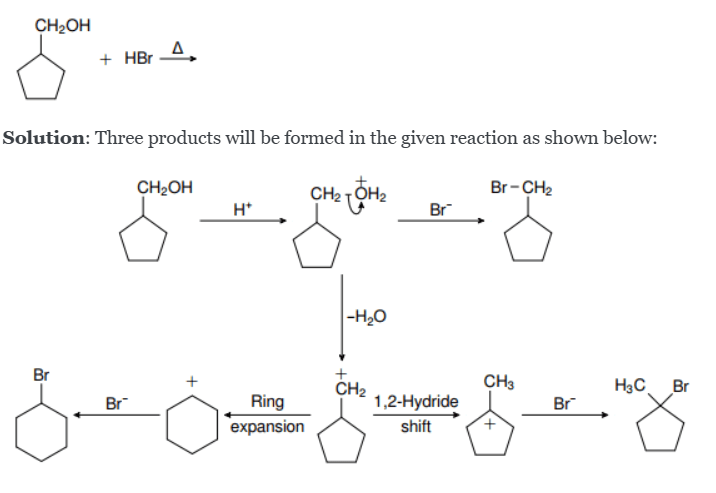
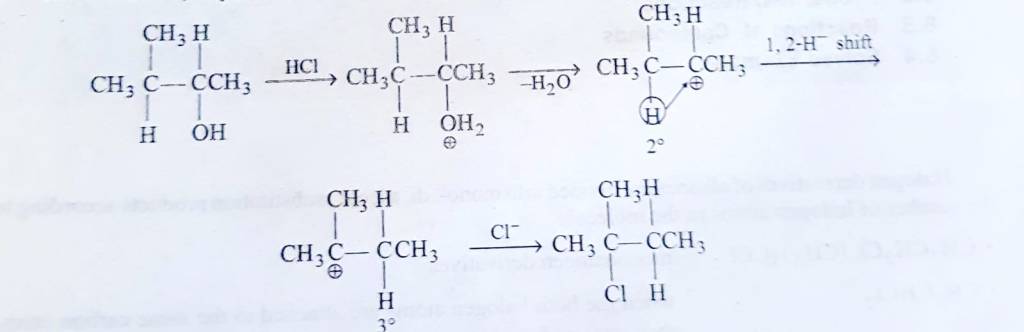
Ring expansion is a rearrangement reaction where a cyclic compound increases its ring size (e.g., 5-membered → 6-membered ring). It usually happens during carbocation rearrangements or nitrene/carbene insertions.
🔹 Why Does It Happen?
Rings expand mainly for stability reasons:
Carbocation stability – a less stable carbocation shifts to form a more stable one.
Ring strain relief – small rings (3, 4, 5-membered) are strained; expansion to 6-membered reduces strain.
Formation of more stable rings – 6-membered rings are especially stable due to minimal angle and torsional strain.
🔹 General Mechanism
Typical situation: a carbocation is adjacent to a ring.
A bond adjacent to the carbocation migrates (1,2-shift) into the positive center.
This migration enlarges the ring size by one carbon.
Stepwise:
Generate a carbocation (often via protonation, halonium ion, or leaving group loss).
Adjacent C–C bond migrates toward the carbocation center.
New carbocation forms inside the enlarged ring.
Do ring expansion always to cyclohexane?
Ring expansion does not always stop at cyclohexane, but cyclohexane is the most common and stable product when smaller rings expand, because:
Cyclohexane is strain-free (ideal bond angles ~109.5°, no angle strain).
Rings smaller than 6 (3-, 4-, 5-membered) often expand to reach 6.
Rings larger than 6 (like 7 or 8) may rearrange in different ways but they don’t necessarily “shrink” back to 6.
General trends:
Cyclopropane (3-membered) → expands to cyclobutane, cyclopentane, or cyclohexane (depending on the mechanism).
Cyclobutane (4-membered) → prefers expansion to cyclopentane or cyclohexane (to reduce strain).
Cyclopentane (5-membered) → expands most often to cyclohexane (since 6 is especially stable).
Cyclohexane (6-membered) → usually does not expand, because it’s already the most stable.
Cycloheptane or larger → can undergo rearrangements, but not necessarily to cyclohexane; instead, they may give different products depending on the reaction condition
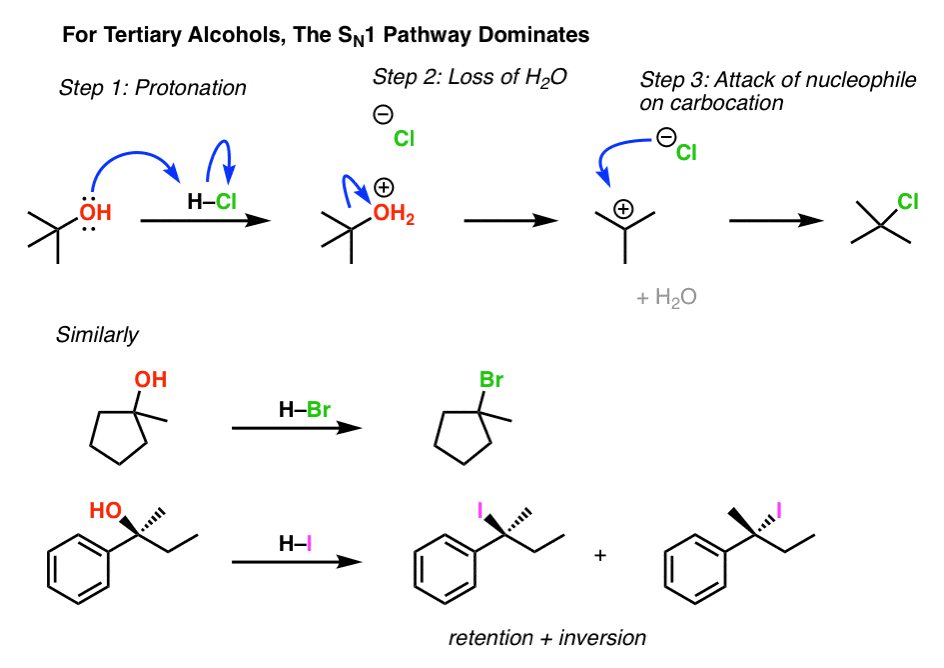
In SN1 (Substitution Nucleophilic Unimolecular) reactions involving alcohols (R-OH), the mechanism requires the departure of a leaving group to form a carbocation intermediate in the rate-determining step. The hydroxyl group (OH) in alcohols is a poor leaving group because it is a strong base (OH⁻) and holds onto the substrate too tightly, making ionization difficult.
To facilitate the reaction, the alcohol is first protonated under acidic conditions (e.g., using H₂SO₄ or HCl) to form an alkyloxonium ion (R-OH₂⁺). This protonation weakens the C-O bond and converts the leaving group to neutral water (H₂O), which is a much better leaving group due to its weaker basicity and greater stability. The water then departs, generating the carbocation (R⁺), which can be attacked by the nucleophile in the subsequent fast step.
Without this protonation, the SN1 pathway would be inefficient or impossible for alcohols, as the energy barrier for OH⁻ departure is too high. This is why SN1 reactions on alcohols are typically conducted in acidic media.
The order of reactivity of alcohols with hydrogen halides (HX, like HCl, HBr, HI) depends mainly on how easily the C–OH bond can be broken and replaced by halogen.
Key points:
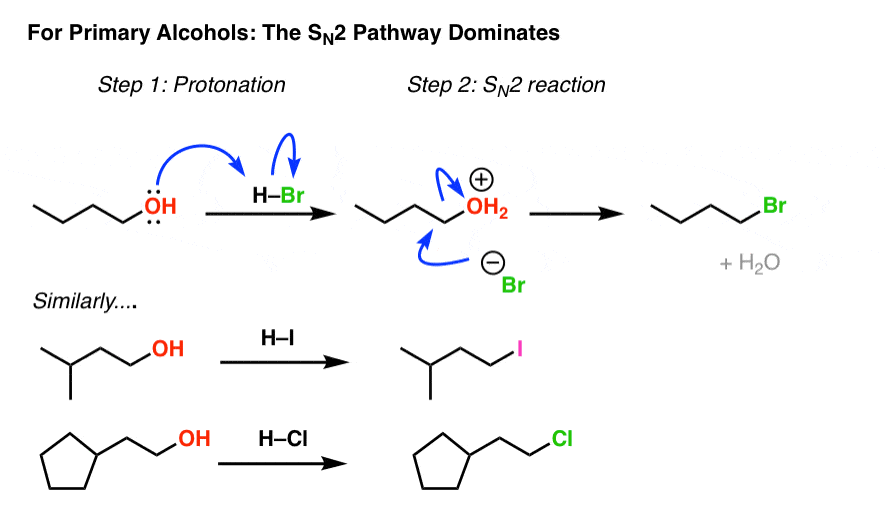
The reaction proceeds either via carbocation formation (SN1) or direct displacement (SN2) depending on the substrate.
Carbocation stability (tertiary > secondary > primary) governs the rate in SN1 cases.
Resonance-stabilized carbocations (benzylic, allylic) are even more reactive than tertiary.
Nucleophilicity is the ability of a species (usually an ion or molecule with a lone pair or π electrons) to attack an electrophilic center, such as a carbon atom in an alkyl halide.
While several factors affect nucleophilicity (like charge, solvent, and electronegativity), one major factor is steric hindrance — the crowding around the reactive site.
What Are Steric Effects?
Steric effects occur when bulky groups around the nucleophile block or hinder its approach toward the electrophilic atom.
Even if the nucleophile is strongly basic and has high electron density, its reactivity (nucleophilicity) decreases if it is physically hindered.
General Trend
Smaller, less hindered nucleophiles are more nucleophilic because they can easily reach and attack the electrophile.
Less steric hindrance → higher nucleophilicity
Example 1: Alkoxides
Let’s compare methoxide ion (CH₃O⁻) and tert-butoxide ion [(CH₃)₃CO⁻].
CH₃O⁻: small, unhindered → can easily attack → strong nucleophile
(CH₃)₃CO⁻: bulky tert-butyl group shields oxygen → difficult to attack → weak nucleophile
Result: CH₃O⁻ > (CH₃)₃CO⁻ in nucleophilicity But the reverse can be true for basicity, since tert-butoxide is a strong base.
Which is a better nucleophile in aqueous solution?
In water (a protic solvent), small, highly basic ions like RO⁻ are strongly solvated by hydrogen bonding.
Larger, less basic ions like RS⁻ are less solvated and therefore more available to attack electrophiles.
Answer:RS⁻ is the better nucleophile in aqueous solution.
Which is a better nucleophile in DMSO?
DMSO is a polar aprotic solvent — it does not strongly solvate anions.
Hence, nucleophilicity parallels basicity in aprotic solvents.
Since RO⁻ is the stronger base, it is also the stronger nucleophile in DMSO.
Answer:RO⁻ is the better nucleophile in DMSO.
a. Br⁻ or Cl⁻ in H₂O → Br⁻
In protic solvents larger, more polarizable anions are less strongly solvated and therefore better nucleophiles: I⁻ > Br⁻ > Cl⁻ > F⁻.
b. Br⁻ or Cl⁻ in DMSO → Cl⁻
In polar aprotic solvents nucleophilicity follows basicity (smaller, harder = better): Cl⁻ is a better nucleophile than Br⁻ in DMSO.
c. CH₃O⁻ or CH₃OH in H₂O → CH₃O⁻
The anion (methoxide) is far more nucleophilic than neutral methanol, even though it is somewhat solvated in water.
d. CH₃O⁻ or CH₃OH in DMSO → CH₃O⁻
In a polar aprotic solvent the anionic nucleophile is even more reactive (less solvated), so methoxide wins by a larger margin.
e. HO⁻ or ⁻NH₂ in H₂O → HO⁻
Practical point: ⁻NH₂ is so basic that it is protonated by water (it doesn’t exist appreciably in aqueous solution), so hydroxide is the available nucleophile.
f. HO⁻ or ⁻NH₂ in DMSO → ⁻NH₂
In an aprotic medium where ⁻NH₂ can exist, the stronger base (⁻NH₂) is the stronger nucleophile.
g. I⁻ or Br⁻ in H₂O → I⁻
Same protic-solvent rule: the larger, more polarizable I⁻ is less solvated and therefore the better nucleophile in water.
h. I⁻ or Br⁻ in DMSO → Br⁻
In polar aprotic solvents nucleophilicity follows basicity/charge density: the smaller Br⁻ is the stronger nucleophile than I⁻.
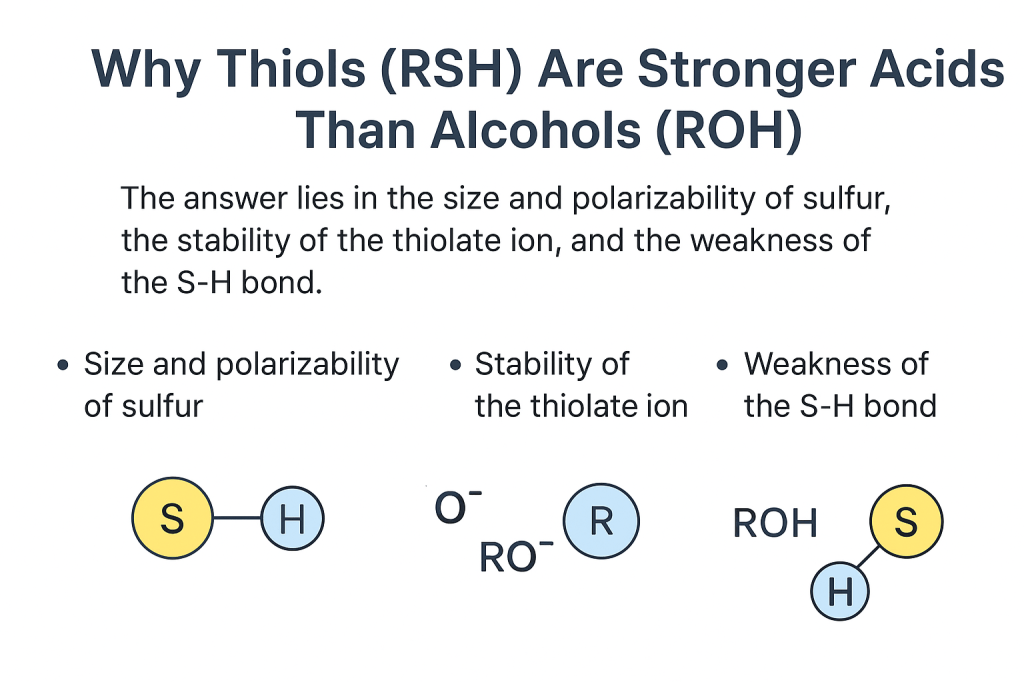
When you first look at alcohols (ROH) and thiols (RSH), they seem quite similar — both contain a hydrogen attached to a group 16 element (oxygen or sulfur). Yet, when it comes to acidity, thiols clearly win. In this post, we’ll explore why thiols (RSH) are stronger acids than alcohols (ROH) — step by step.
Step 1: Acid strength depends on conjugate base stability
The strength of an acid depends on how stable its conjugate base is after losing a proton (H⁺).
Alcohols (ROH) lose H⁺ to form alkoxide ions (RO⁻)
Thiols (RSH) lose H⁺ to form thiolate ions (RS⁻)
The more stable the conjugate base, the stronger the acid.
So, we must compare the stability of RO⁻ and RS⁻.
Step 2: The role of atom size and polarizability
Sulfur (S) is larger and more polarizable than oxygen (O). That means the negative charge on sulfur in RS⁻ is spread over a larger volume, making it more stable.
In contrast, oxygen is smaller and holds the negative charge tightly on a small area, creating stronger charge density and less stability.
Result: RS⁻ is more stable than RO⁻ → RSH is a stronger acid.
Step 3: Bond strength difference
The S–H bond is weaker than the O–H bond. It takes less energy to break the S–H bond and release a proton.
Weaker bond → easier H⁺ release → stronger acid
Step 4: Electronegativity vs Polarizability
Although oxygen is more electronegative than sulfur, electronegativity isn’t the main factor here. For acid strength, charge delocalization and bond strength dominate — and sulfur’s large, polarizable nature stabilizes the anion far better than oxygen.
tep 5: pKa values tell the story
Compound
Approx. pKa
Acid Strength
Methanol (CH₃OH)
~16
Weaker acid
Methanethiol (CH₃SH)
~10
Stronger acid
A lower pKa means a stronger acid — so thiols are clearly more acidic than alcohols.
✅ Final Summary
Factor
Alcohol (ROH)
Thiol (RSH)
Stronger Acid?
Atom size
Small (O)
Large (S)
✅ RSH
Charge delocalization
Less
More
✅ RSH
Bond strength
Strong O–H
Weak S–H
✅ RSH
pKa
~16
~10
✅ RSH
Conclusion
Thiols (RSH) are stronger acids than alcohols (ROH) because their conjugate bases (RS⁻) are more stable. Sulfur’s larger size and greater polarizability allow the negative charge to spread out, and the weaker S–H bond makes proton loss easier. So, while oxygen wins in electronegativity, sulfur wins in stability, making RSH the stronger acid overall.