
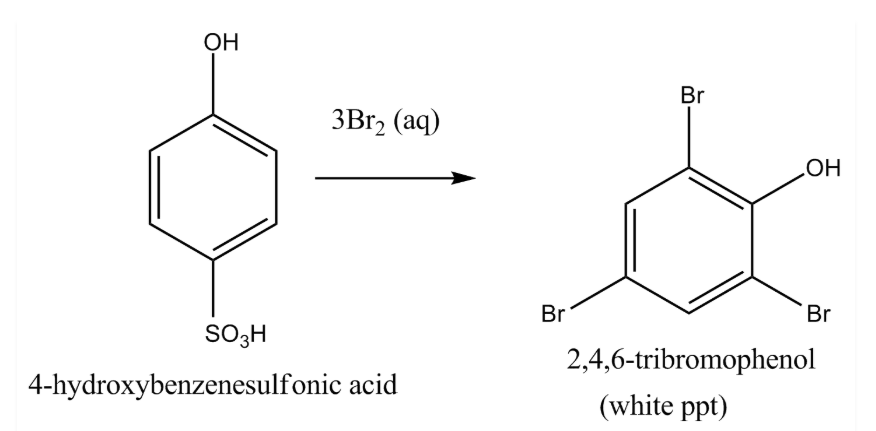
The key point is that –SO₃H acts as a temporary blocking group.
Step 1: Desulphonation
The starting compound is p-hydroxybenzenesulphonic acid:
On treatment with aqueous bromine, the strongly activating –OH group directs bromination to the ortho and para positions.
But the para position is occupied by –SO₃H.
Step 2: Bromination
Therefore, Br enters the two ortho positions:
The final product is:
Why does –SO₃H disappear?
Under the aqueous bromination conditions, desulphonation occurs, replacing SO3H by H. This allows bromination at the para position as well.
So the overall idea is:
Hence 3 Br atoms finally occupy the 2, 4 and 6 positions of phenol.

