
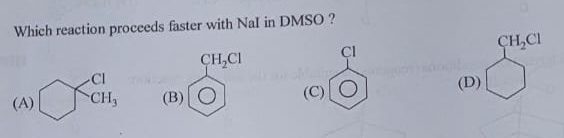
The answer is (B) benzyl chloride, C₆H₅–CH₂Cl.
The reagent is NaI in DMSO, which strongly favors an SN2 reaction.
Step 1: Compare the substrates
- A: tertiary alkyl chloride → highly hindered ❌
- B: benzyl chloride, C₆H₅–CH₂Cl → primary benzylic chloride ✅
- C: chlorobenzene, C₆H₅–Cl → aryl chloride, SN2 doesn’t occur ❌
- D: cyclohexylmethyl chloride → primary, but not benzylic
Step 2: Why is B exceptionally fast?
In benzyl chloride:
C₆H₅–CH₂–Cl
The carbon attacked by I⁻ is the CH₂ next to the benzene ring.
During SN2, the transition state has some electron deficiency at this carbon. The benzene ring can stabilize this transition state by resonance.
So:
benzyl chloride → very fast SN2
Also, DMSO is a polar aprotic solvent, which makes I⁻ a strong nucleophile and favors SN2.
Important order to remember
For SN2 reactivity:
benzyl/allyl halide > primary > secondary >> tertiary
And aryl/vinyl halides do not normally undergo SN2.

