
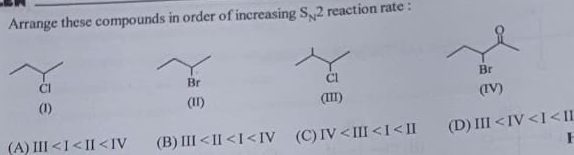
Answer: (A)
Reason:
- III → more steric hindrance → slowest
- I → secondary alkyl chloride
- II → secondary alkyl bromide; Br⁻ is a better leaving group than Cl⁻
- IV → -bromoketone; carbonyl group strongly activates the reaction → fastest
Correct option: (A) III < I < II < I
V is highest because it is an α-bromo ketone:
The key effect is the carbonyl group (C=O)
Why does increase rate?
The carbonyl group has a strong −I (electron-withdrawing) effect:
It pulls electron density away from the carbon bearing Br, making that carbon more electrophilic.


