
Fehling’s test is mainly used to detect aliphatic aldehydes.
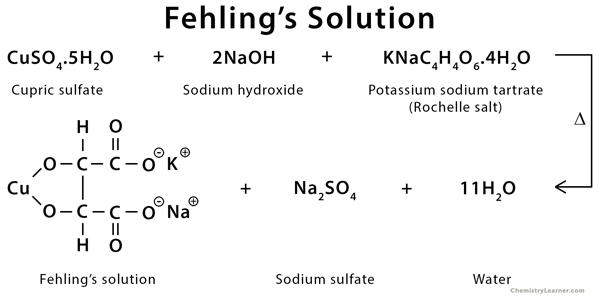
1. Fehling’s reagent
It consists of two solutions:
- Fehling A: solution
- Fehling B: alkaline sodium potassium tartrate (Rochelle salt) + NaOH
They are mixed freshly before the test.
2. Reaction with aldehyde
For an aliphatic aldehyde:
Observation:
Aldehyde is oxidised → carboxylate
is reduced →
3. Which compounds give Fehling’s test?
| Compound | Fehling test |
|---|---|
| Aliphatic aldehyde | ✅ Positive |
| Formaldehyde, HCHO | ✅ Positive |
| Acetaldehyde, CH₃CHO | ✅ Positive |
| Aromatic aldehyde, C₆H₅CHO | ❌ Generally negative |
| Ketones | ❌ Negative |
| Formic acid/formates | ✅ Can reduce Cu²⁺ |
| Reducing sugars | ✅ Positive |
Most important distinction
But both can give Tollens’ test:
JEE/NEET trap
Benzaldehyde (C6H5CHO)
- Tollens → ✅ Silver mirror
- Fehling → ❌ No brick-red precipitate
Acetaldehyde (CH3CHO)
- Tollens → ✅
- Fehling → ✅
Memory trick:
“Fehling likes aliphatic aldehydes, not aromatic aldehydes.”

