Rotate plane polarized light in opposite directions
(2) Diastereomers
Not mirror images
Different physical properties
Meso Compounds
Have chiral centers but optically inactive
Due to internal plane of symmetry
Optical Activity
d(+) → dextrorotatory
l(–) → levorotatory
Optical Activity of Diastereomers
Case 1: Optically Active
If molecule:
Has chiral center(s)
No plane of symmetry
✔ Then diastereomer rotates plane polarized light
Case 2: Optically Inactive
If molecule:
Has internal plane of symmetry (meso form)
✔ Then diastereomer is optically inactive
Example
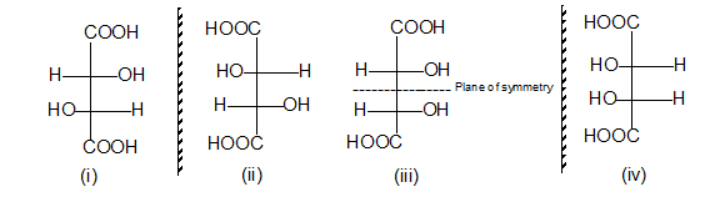
Tartaric acid:
(R,R) and (S,S) → Enantiomers → optically active
(R,S) → Meso form → optically inactive
here:
(R,R) vs (R,S) = Diastereomers
But:
(R,R) → active
(R,S) → inactive
Final Answer
Enantiomers:
(i) & (ii)
Meso:
(iii)
Diastereomers:
(i) & (iii)
(ii) & (iii)
(i) & (iv)
(ii) & (iv)
(iii) & (iv)
Key Recall
(i) & (ii) → enantiomers → both optically active
(iii) → meso → optically inactive
(iv) → optically active
Diastereomer Pairs Analysis
(i) & (iii)
(i) → active
(iii) → inactive (meso) Pair: one active + one inactive
(ii) & (iii)
(ii) → active
(iii) → inactive Pair: one active + one inactive
(iii) & (iv)
(iii) → inactive
(iv) → active Pair: one active + one inactive
(i) & (iv)
(i) → active
(iv) → active Pair: both optically active
(ii) & (iv)
(ii) → active
(iv) → active Pair: both optically active
3. Effect on number of stereoisomers
General:
With plane of symmetry:
Some structures become identical (meso)
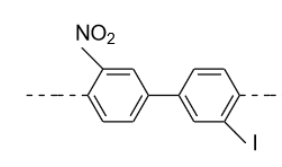
How to find the plane of symmetry in biphenyls and substituted cyclohexane?
Optical activity is shown by compounds in which plane of symmetry is not present, if plane of symmetry is present in any compound then they will never show optical activity.
Optical activity is a kind of property of any compound which rotates the plane polarized light to the right or left side from the direction of upcoming light. In biphenyls two benzene rings are present and if a plane of symmetry is present within the molecule then they don’t show optical activity.
This molecule does not have a plane of symmetry
Biphenyl rotation:
Structure: Biphenyl has two benzene rings connected by a single C–C bond.
So, in principle, it’s a single bond, which allows rotation.
Rotation limitation:
Each benzene ring is planar.
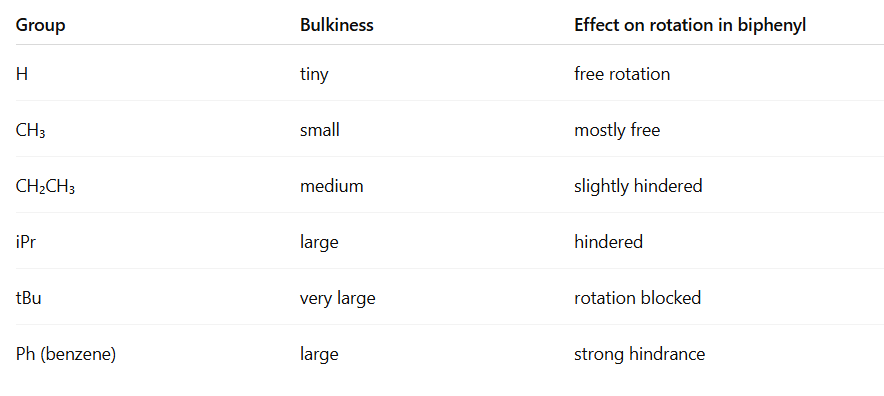
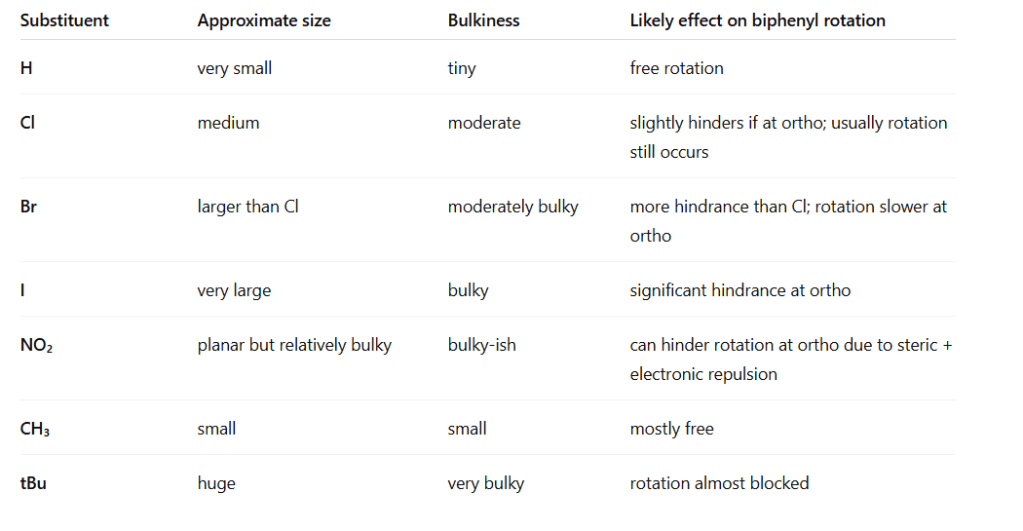
If there are no substituents at ortho positions, the two rings can rotate freely at room temperature.
If there are bulky groups at the ortho positions (next to the connecting bond), steric hindrance prevents free rotation, and the molecule may adopt a twisted conformation.
Extremely hindered biphenyls can even be atropisomers (stable enantiomers due to restricted rotation)
. It is chiral if the biphenyl can’t rotate freely (restricted rotation around the central C–C bond) and may exist as atropisomers.
Position matters most
Only ortho substituents (2,2’ positions on biphenyl) cause steric hindrance.

 Sarvan sir- Chemistry For All