
Experimental Arrangement for Study of Photoelectric Effect
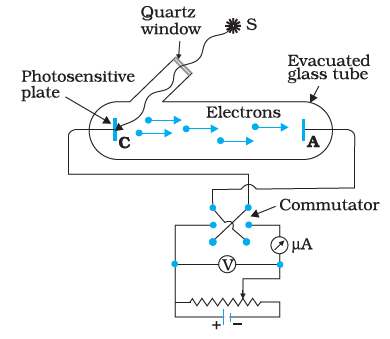
Figure 11.1 shows the experimental setup used to study the photoelectric effect. The arrangement consists of an evacuated glass or quartz tube containing two metal plates:
- Plate C → Photosensitive plate (Emitter)
- Plate A → Collector plate
A source of monochromatic light (S) sends light through a quartz window  onto the photosensitive plate (C).
Why is a quartz window used?
Quartz allows ultraviolet rays to pass through it, unlike ordinary glass. Since ultraviolet light is often needed to produce photoelectric emission, a quartz window is used.
Working of the Experiment
When light of sufficiently high frequency falls on the photosensitive plate (C):
- Electrons are emitted from the surface of plate (C).
- These emitted electrons are called photoelectrons.
A battery is connected between plates (A) and (C), creating an electric field.
- If collector plate (A) is kept positive with respect to emitter plate (C), the emitted electrons are attracted towards plate (A).
- Due to the movement of electrons, an electric current flows in the circuit. This current is called photoelectric current.
Measuring Instruments Used
- Voltmeter (V): Measures the potential difference between plates (A) and (C).
- Microammeter ((\mu A)): Measures the small photoelectric current flowing in the circuit.
Role of the Battery and Commutator
The battery maintains a variable potential difference between the two plates.
Using a commutator, the polarity of the plates can be reversed:
- Plate (A) can be made positive or negative with respect to plate (C).
- By changing the potential difference, the photoelectric current can be increased or decreased.
What Can Be Studied Using This Setup?
Using this arrangement, we can study how photocurrent depends on:
- Intensity of incident light
- Frequency of incident light
- Potential difference between plates (A) and (C)
- Nature of the photosensitive material
How Are Intensity and Frequency Varied?
(i) Changing Frequency
Different frequencies of light are obtained by using:
- Coloured filters
- Coloured glass plates
(ii) Changing Intensity
The intensity of light is changed by:
- Varying the distance between the light source and the emitter plate
Important Point
Photoelectric emission occurs only when the incident light has frequency greater than a certain minimum value called the threshold frequency of the material.

