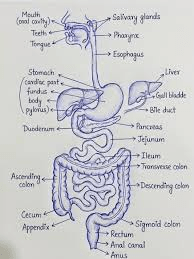
- The digestive system consists of the alimentary canal extending from mouth to anus.
- Different parts of the alimentary canal are specialised for different functions.
- Food is broken into small particles for easy digestion and absorption.
Mouth and Buccal Cavity
- Teeth crush and grind food.
- Saliva is secreted by salivary glands.
- Saliva contains the enzyme salivary amylase.
- Salivary amylase converts starch into simple sugars.
- The tongue mixes food with saliva and helps in swallowing.
- Food becomes soft and moist for smooth passage.
Oesophagus and Peristalsis
- Food passes from mouth to stomach through the oesophagus (food pipe).
- Rhythmic contraction and relaxation of muscles push food forward.
- These movements are called peristaltic movements.
Stomach
- The stomach is a muscular expandable organ.
- Gastric glands in the stomach wall secrete:
- Hydrochloric acid (HCl)
- Pepsin (protein-digesting enzyme)
- Mucus
- HCl creates an acidic medium for pepsin action.
- HCl also kills harmful germs present in food.
- Mucus protects the stomach lining from acid.
- Food is released slowly into the small intestine through a sphincter muscle.
Small Intestine
- The small intestine is the longest part of the alimentary canal.
- Complete digestion of carbohydrates, proteins, and fats occurs here.
- Herbivores have longer small intestines than carnivores.
Role of Liver
- The liver secretes bile juice.
- Bile:
- Makes acidic food alkaline.
- Breaks large fat globules into smaller droplets (emulsification).
Role of Pancreas
- The pancreas secretes pancreatic juice.
- Pancreatic enzymes include:
- Trypsin → digests proteins.
- Lipase → digests fats.
Intestinal Juice
- Intestinal glands secrete intestinal juice.
- Final digestion converts:
- Proteins → amino acids
- Carbohydrates → glucose
- Fats → fatty acids and glycerol
Absorption
- The inner lining of the small intestine has finger-like projections called villi.
- Villi increase surface area for absorption.
- Villi contain many blood vessels.
- Absorbed nutrients are transported to all body cells.
Large Intestine and Egestion
- Undigested food enters the large intestine.
- Water is absorbed from the remaining material.
- Waste is removed through the anus.
- The anal sphincter controls the exit of waste.