Order of reactivity of alcohols (Allyl, benzyl, primary, secondary and tertiary) with HX

The order of reactivity of alcohols with hydrogen halides (HX, like HCl, HBr, HI) depends mainly on how easily the C–OH bond can be broken and replaced by halogen.


Key points:

  • The reaction proceeds either via carbocation formation (SN1) or direct displacement (SN2) depending on the substrate.
  • Carbocation stability (tertiary > secondary > primary) governs the rate in SN1 cases.
  • Resonance-stabilized carbocations (benzylic, allylic) are even more reactive than tertiary.

Reactivity order:

Benzylic alcohol > Allylic alcohol > Tertiary alcohol > Secondary alcohol > Primary alcohol


Explanation:

  1. Benzylic alcohols → form benzylic carbocations stabilized by resonance with aromatic ring → very fast.
  2. Allylic alcohols → form allylic carbocations stabilized by resonance with adjacent double bond → also very fast.
  3. Tertiary alcohols → form stable 3° carbocations → faster than 2° or 1°.
  4. Secondary alcohols → less stable carbocation, slower.
  5. Primary alcohols → do not form stable carbocations easily, react only by SN2 mechanism with HX, so they are slowest.

Final order:
Benzyl > Allyl > 3° > 2° > 1°

Write IUPAC Name of ethylidene dibromide, Isopropylidene dichloride, ethylene dibromide, isobutene dibromide and tetramethylene dibromide

Ethylidene dibromide
Structure: CH₃–CHBr₂
IUPAC name: 1,1-dibromoethane

Isopropylidene dichloride
Structure: (CH₃)₂CCl₂
IUPAC name: 2,2-dichloropropane

Ethylene dibromide
Structure: Br–CH₂–CH₂–Br
IUPAC name: 1,2-dibromoethane

Isobutene dibromide (addition product of Br₂ across 2-methylprop-1-ene)
Structure: CH₂Br–CBr(CH₃)₂ (derived from CH₂=C(CH₃)₂ + Br₂)
IUPAC name: 1,2-dibromo-2-methylpropane

Tetramethylene dibromide
Structure: Br–(CH₂)₄–Br
IUPAC name: 1,4-dibromobutane

Nucleophilicity Of RO⁻ and RS⁻ in polar protic and polar aprotic solvent

Which is a better nucleophile in aqueous solution?

  • In water (a protic solvent), small, highly basic ions like RO⁻ are strongly solvated by hydrogen bonding.
  • Larger, less basic ions like RS⁻ are less solvated and therefore more available to attack electrophiles.

Answer: RS⁻ is the better nucleophile in aqueous solution.


Which is a better nucleophile in DMSO?

  • DMSO is a polar aprotic solvent — it does not strongly solvate anions.
  • Hence, nucleophilicity parallels basicity in aprotic solvents.
  • Since RO⁻ is the stronger base, it is also the stronger nucleophile in DMSO.

Answer: RO⁻ is the better nucleophile in DMSO.

a. Br⁻ or Cl⁻ in H₂O → Br⁻

  • In protic solvents larger, more polarizable anions are less strongly solvated and therefore better nucleophiles: I⁻ > Br⁻ > Cl⁻ > F⁻.

b. Br⁻ or Cl⁻ in DMSO → Cl⁻

  • In polar aprotic solvents nucleophilicity follows basicity (smaller, harder = better): Cl⁻ is a better nucleophile than Br⁻ in DMSO.

c. CH₃O⁻ or CH₃OH in H₂O → CH₃O⁻

  • The anion (methoxide) is far more nucleophilic than neutral methanol, even though it is somewhat solvated in water.

d. CH₃O⁻ or CH₃OH in DMSO → CH₃O⁻

  • In a polar aprotic solvent the anionic nucleophile is even more reactive (less solvated), so methoxide wins by a larger margin.

e. HO⁻ or ⁻NH₂ in H₂O → HO⁻

  • Practical point: ⁻NH₂ is so basic that it is protonated by water (it doesn’t exist appreciably in aqueous solution), so hydroxide is the available nucleophile.

f. HO⁻ or ⁻NH₂ in DMSO → ⁻NH₂

  • In an aprotic medium where ⁻NH₂ can exist, the stronger base (⁻NH₂) is the stronger nucleophile.

g. I⁻ or Br⁻ in H₂O → I⁻

  • Same protic-solvent rule: the larger, more polarizable I⁻ is less solvated and therefore the better nucleophile in water.

h. I⁻ or Br⁻ in DMSO → Br⁻

  • In polar aprotic solvents nucleophilicity follows basicity/charge density: the smaller Br⁻ is the stronger nucleophile than I⁻.

Why Thiols (RSH) Are Stronger Acids Than Alcohols (ROH)

When you first look at alcohols (ROH) and thiols (RSH), they seem quite similar — both contain a hydrogen attached to a group 16 element (oxygen or sulfur).
Yet, when it comes to acidity, thiols clearly win.
In this post, we’ll explore why thiols (RSH) are stronger acids than alcohols (ROH) — step by step.

Step 1: Acid strength depends on conjugate base stability

The strength of an acid depends on how stable its conjugate base is after losing a proton (H⁺).

  • Alcohols (ROH) lose H⁺ to form alkoxide ions (RO⁻)
  • Thiols (RSH) lose H⁺ to form thiolate ions (RS⁻)

The more stable the conjugate base, the stronger the acid.

So, we must compare the stability of RO⁻ and RS⁻.

Step 2: The role of atom size and polarizability

Sulfur (S) is larger and more polarizable than oxygen (O).
That means the negative charge on sulfur in RS⁻ is spread over a larger volume, making it more stable.

In contrast, oxygen is smaller and holds the negative charge tightly on a small area, creating stronger charge density and less stability.

Result: RS⁻ is more stable than RO⁻ → RSH is a stronger acid.

Step 3: Bond strength difference

The S–H bond is weaker than the O–H bond.
It takes less energy to break the S–H bond and release a proton.

Weaker bond → easier H⁺ release → stronger acid


Step 4: Electronegativity vs Polarizability

Although oxygen is more electronegative than sulfur, electronegativity isn’t the main factor here.
For acid strength, charge delocalization and bond strength dominate — and sulfur’s large, polarizable nature stabilizes the anion far better than oxygen.

tep 5: pKa values tell the story

CompoundApprox. pKaAcid Strength
Methanol (CH₃OH)~16Weaker acid
Methanethiol (CH₃SH)~10Stronger acid

A lower pKa means a stronger acid — so thiols are clearly more acidic than alcohols.


✅ Final Summary

FactorAlcohol (ROH)Thiol (RSH)Stronger Acid?
Atom sizeSmall (O)Large (S)✅ RSH
Charge delocalizationLessMore✅ RSH
Bond strengthStrong O–HWeak S–H✅ RSH
pKa~16~10✅ RSH

Conclusion

Thiols (RSH) are stronger acids than alcohols (ROH) because their conjugate bases (RS⁻) are more stable.
Sulfur’s larger size and greater polarizability allow the negative charge to spread out, and the weaker S–H bond makes proton loss easier.
So, while oxygen wins in electronegativity, sulfur wins in stability, making RSH the stronger acid overall.

What is oleum? Difference between oleum and H2SO4

Oleum, also known as fuming sulfuric acid, is a highly reactive compound consisting of dissolved sulfur trioxide gas (SO₃) in 100% sulfuric acid.

What do you mean by fuming?

When we say “fuming” (like fuming sulfuric acid = oleum), we mean:

  • The liquid gives off visible vapors (“fumes”) when exposed to air.
  • In the case of oleum, those vapors are actually SO₃ gas, which escapes easily because SO₃ is volatile.
  • When this SO₃ gas meets moisture in the air, it reacts immediately to form tiny droplets of H₂SO₄, which look like white, smoky fumes.

That’s why:

  • Concentrated H₂SO₄ does not “fume” much in air.
  • Oleum does, because of the escaping SO₃.

So fuming = releasing visible vapors (SO₃ + H₂SO₄ mist) into the air

Fumes of H2SO4 dangerous?

Yes ✅ the fumes of H₂SO₄ (sulfuric acid) are very dangerous.

Here’s why:

  • What the fumes are:
    Pure H₂SO₄ itself doesn’t evaporate much, but when it’s very concentrated (or as oleum) it releases SO₃ vapors.
    These vapors react with moisture in the air → form fine droplets of H₂SO₄ mist.
  • Effects on health:
    • Extremely corrosive to skin, eyes, and mucous membranes.
    • Causes severe burns on contact.
    • If inhaled, can damage the nose, throat, lungs (leading to breathing difficulty, pulmonary edema).
    • Even short exposure to strong fumes is harmful.

That’s why handling concentrated H₂SO₄ / oleum requires fume hoods, protective gloves, goggles, and masks.

H₂S₂O₇ is the chemical formula of oleum?

Oleum is also called fuming sulfuric acid.

It is not a single pure compound but rather a solution of SO₃ dissolved in H₂SO₄.

H₂S₂O₇ = pyrosulfuric acid, which represents one particular composition of oleum (when there is exactly one mole of SO₃ combined with one mole of H₂SO₄).

Oleum in general can have different amounts of SO₃, not just the 1:1 case.

If it is mixture, so why it is represented by molecular formula H2S2O7?

Oleum is really a mixture (H₂SO₄ + SO₃), but in chemistry we often like to represent it in a molecular way. That’s why one of its possible compositions is written as H₂S₂O₇ (pyrosulfuric acid).

Convenience in Representation

  • Writing H₂S₂O₇ makes it easier to handle in equations and discussions, instead of always writing “H₂SO₄·SO₃”.
  • For example, when balancing reactions in textbooks, H₂S₂O₇ is simpler to use.

But in Reality

  • Oleum is not just H₂S₂O₇ — it may have more (or less) SO₃ dissolved in H₂SO₄.
  • So H₂S₂O₇ is only one specific case of oleum.

Why Sulphonation of OF BENZENE IS Carried out with Oleum not pure Conc. H2SO4?

leum already contains a large amount of free SO₃ dissolved in H₂SO₄.

That SO₃ directly acts as the electrophile in the sulphonation of benzene.

The H₂SO₄ in oleum helps by protonating SO₃ to form the stronger electrophile

what is carbene? Singlet carbene and Triplet carbene

A carbene is a highly reactive organic species in which a carbon atom has only six valence electrons (instead of the usual eight) and is bonded to two substituents.

General Features:

  • General formula: R₂C:
  • Structure: Carbon in carbene is divalent (forms 2 bonds).
  • Electron deficiency: Only 6 valence electrons → makes carbenes very reactive.
  • Bond angle: Usually about 104–150°, depending on type.

Types of Carbenes:

  1. Singlet carbene
    • Both non-bonded electrons are paired in the same orbital.
    • Usually bent structure (~104° bond angle).
    • Electrophilic (electron-loving).
  2. Triplet carbene
    • The two non-bonded electrons occupy different orbitals with parallel spins.
    • Linear or nearly linear structure (~130–150° bond angle).
    • More stable than singlet.

Examples:

  • Methylene (:CH₂) → simplest carbene.
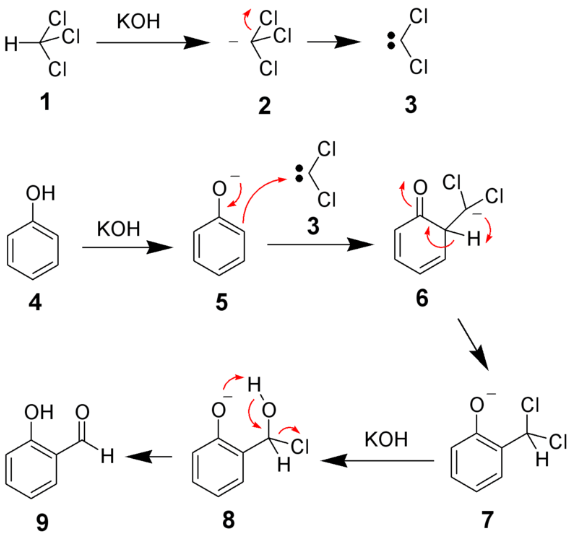
  • Dichlorocarbene (:CCl₂) → formed in Reimer–Tiemann reaction.

Preparation:

  • By photolysis or pyrolysis of diazo compounds (e.g., CH₂N₂ → :CH₂ + N₂).
  • By decomposition of haloforms (CHCl₃ + base → :CCl₂).

Reactivity:

  • Carbenes add to double bonds → form cyclopropanes.
  • Insert into C–H bonds.
  • Highly reactive intermediates in organic chemistr

Aakash NEET Question Paper 2025 With solution pdf

Aakash NEET‑UG 2025 Question Paper & Solutions – Code 45

The Aakash Institute has officially released the detailed question papers and solutions for the NEET‑UG 2025 examination held on May 4, 2025, in sets 45. This comprehensive PDFs include full-colour answer keys and step-by-step explanations, carefully prepared by subject-matter experts to help aspirants evaluate their performance and fine-tune their NEET preparation strategies

What’s inside the downloads?

  • Code-specific coverage: Available for Booklet Code 45 ensuring accuracy for your specific question set .
  • Physics, Chemistry & Biology: PDF contains all 180 MCQs along with fully worked-out solutions—including diagrams, formulas, and calculations.

Define catalyst give two examples

A catalyst is a substance that increases the rate of a chemical reaction by providing an alternative reaction pathway with a lower activation energy, without being consumed in the process. Catalysts work by facilitating the formation of the transition state, enabling the reaction to proceed more rapidly. They remain unchanged chemically and are not consumed during the reaction, allowing them to participate in multiple reaction cycles.

Two examples of catalysts are:

  1. Enzymes: Enzymes are biological catalysts that facilitate and regulate biochemical reactions in living organisms. They are typically proteins that act as catalysts by lowering the activation energy required for specific reactions. Enzymes play a crucial role in various biological processes such as digestion, metabolism, and DNA replication. For example, the enzyme amylase catalyzes the hydrolysis of starch into smaller sugar molecules.
  2. Platinum in Catalytic Converters: Platinum and other precious metals (such as palladium and rhodium) are commonly used as catalysts in catalytic converters of automobiles. They facilitate the conversion of harmful pollutants from exhaust gases into less harmful substances. For instance, platinum catalysts help to convert carbon monoxide (CO) into carbon dioxide (CO2) and nitrogen oxides (NOx) into nitrogen (N2) and oxygen (O2), reducing their environmental impact.

These examples demonstrate how catalysts can significantly enhance reaction rates and enable chemical transformations without being consumed in the process, making them crucial in various industrial, environmental, and biological applications.

Difference between adsorption and absorption

Adsorption and absorption are two distinct processes that involve the interaction of substances with a solid or liquid surface. Here are the key differences between adsorption and absorption:

  1. Nature of Interaction:
  • Adsorption: Adsorption refers to the adherence or accumulation of atoms, ions, or molecules from a gas or liquid phase onto the surface of a solid or liquid. It involves weak intermolecular forces of attraction between the adsorbate and the adsorbent. The adsorbate remains on the surface without penetrating or entering the interior of the adsorbent material.
  • Absorption: Absorption involves the penetration or uptake of a substance (liquid or gas) into the bulk of a solid or liquid material. The absorbed substance disperses within the absorbing material, entering its interior or matrix. Absorption can involve dissolution of the absorbed substance in the absorbing material.
  1. Surface Area:
  • Adsorption: Adsorption occurs specifically at the surface of the adsorbent material, taking place only on the exposed surface area. The concentration of the adsorbate is generally higher at the surface compared to the bulk.
  • Absorption: Absorption occurs throughout the bulk of the absorbing material, not limited to the surface area. The absorbed substance permeates or disperses within the absorbing material.
  1. Reversibility:
  • Adsorption: Adsorption is typically a reversible process, meaning that the adsorbate can be desorbed or removed from the surface under suitable conditions, such as changes in temperature or pressure.
  • Absorption: Absorption is not necessarily a reversible process. The absorbed substance may remain within the bulk of the absorbing material and might not be easily released.
  1. Energy Involved:
  • Adsorption: Adsorption generally involves weak intermolecular forces (such as van der Waals forces) between the adsorbate and the adsorbent. The energy associated with adsorption is lower than that of chemical bonds.
  • Absorption: Absorption often involves stronger interactions, such as chemical bonds or intermolecular forces, between the absorbed substance and the absorbing material. The energy associated with absorption is generally higher than that of adsorption.

In summary, adsorption refers to the adherence of substances onto a surface, occurring at the surface and involving weak intermolecular forces. Absorption, on the other hand, involves the penetration of substances into the bulk of a material, occurring throughout the material and often involving stronger interactions.

Define Adsorption Class 12

In chemistry, adsorption refers to the process by which atoms, ions, or molecules from a gas or liquid phase adhere to the surface of a solid or liquid substance. This phenomenon involves the accumulation of the adsorbate (the substance being adsorbed) at the interface between the adsorbent (the surface to which adsorption occurs) and the fluid phase.

Adsorption is a surface phenomenon and can occur due to various intermolecular forces, such as van der Waals forces, electrostatic interactions, and hydrogen bonding. The adsorption process is typically reversible, meaning that adsorbate molecules can detach from the surface under suitable conditions, such as changes in temperature or pressure.

Adsorption is classified into two main types based on the strength of the interaction between the adsorbate and the adsorbent:

  1. Physical Adsorption (Physisorption): Also known as van der Waals adsorption, physical adsorption involves the weak intermolecular forces of attraction between the adsorbate and the adsorbent. These forces include London dispersion forces, dipole-dipole interactions, and induced dipole interactions. Physisorption typically occurs at relatively low temperatures and can be reversed by altering the conditions, such as increasing temperature or reducing pressure.
  2. Chemical Adsorption (Chemisorption): Chemisorption involves the formation of chemical bonds between the adsorbate and the adsorbent surface. This type of adsorption is characterized by stronger interactions compared to physical adsorption. Chemisorption is specific and typically occurs at higher temperatures. The adsorption process involves the breaking of existing bonds on the adsorbate and the formation of new chemical bonds with the adsorbent surface. Chemisorption is generally not easily reversible.

Both physical and chemical adsorption play important roles in various chemical, biological, and industrial processes. Adsorption processes are utilized in applications such as gas separation, catalysis, purification, and wastewater treatment. Understanding adsorption is crucial in areas like surface science, materials science, and heterogeneous catalysis.