The SN2 Reaction and TheSN1 Reactions Concepts for JEE/NEET

SN2 stands for:

S → Substitution
N → Nucleophilic
2 → Bimolecular

So the full meaning is:

SN2 = Substitution Nucleophilic Bimolecular reaction
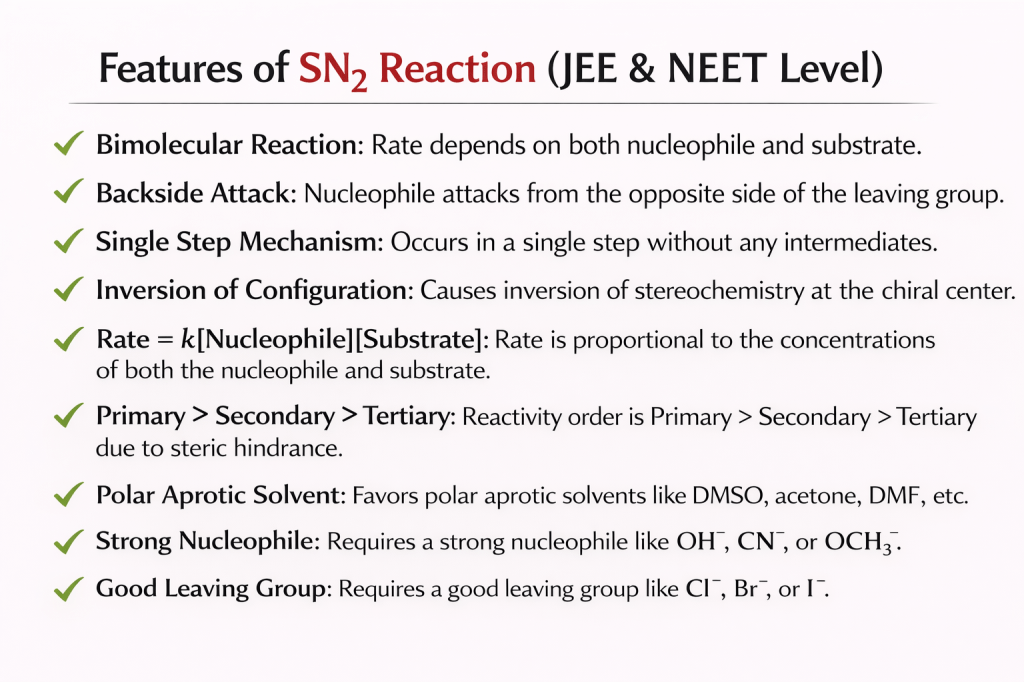
Key Features of SN2 Reaction

  1. Bimolecular Reaction
    • Rate depends on two species: substrate and nucleophile.
  2. Second-Order Kinetics
    • Rate law:
    Rate=k[R–X][Nu−]\text{Rate} = k[\text{R–X}][\text{Nu}^-]
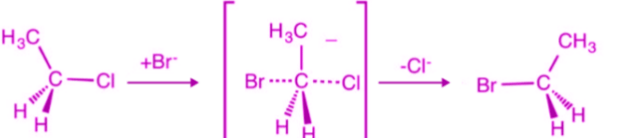
  3. One-Step Mechanism (Concerted Reaction)
    • Bond formation and bond breaking occur simultaneously.
    • No intermediate is formed.
  4. Backside Attack
    • Nucleophile attacks from the opposite side of the leaving group.
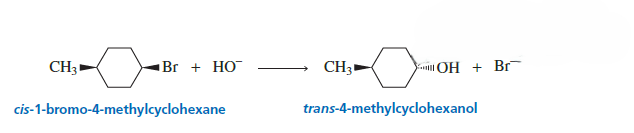
  5. Walden Inversion (Inversion of Configuration)
    • If the carbon is chiral, configuration inverts (like umbrella flipping).
  6. Transition State Formation
    • A pentacoordinate transition state is formed.
  7. Substrate Reactivity OrderCH3X>1∘>2∘>>3∘\text{CH}_3X > 1^\circ > 2^\circ >> 3^\circ
    • Tertiary halides do not undergo SN2 due to steric hindrance.
  8. Strong Nucleophile Required
    • Examples:
      OH⁻, CN⁻, I⁻, RS⁻
  9. Polar Aprotic Solvents Favor SN2
    • Examples: DMSO, DMF, acetone
    • They increase nucleophilicity.
  10. Good Leaving Group Needed
  • Order:

I−>Br−>Cl−>>F−I^- > Br^- > Cl^- >> F^-

  1. Steric Hindrance Slows Reaction
  • Bulky groups near the reacting carbon reduce SN2 rate.

Steric hindrance decreases the reaction rate

  • As the alkyl group becomes bulkier, the rate of SN2 decreases.
  • This happens because the nucleophile attacks from the backside, and bulky groups block this attack.
An example of inversion:
PROBLEM :
Which substitution reaction takes place more rapidly?
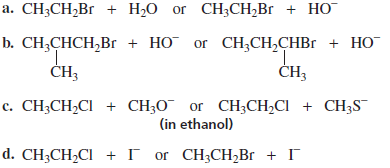
Use SN2 rules to compare the rates:

Key ideas for SN2 (JEE/NEET):

  • Stronger nucleophile → faster
  • Less steric hindrance → faster
  • Better leaving group → faster
  • Polar aprotic solvent increases nucleophilicity

Answers

(a)

CH₃CH₂Br + H₂O
or
CH₃CH₂Br + HO⁻

HO⁻ is a much stronger nucleophile than H₂O.

Faster:
CH₃CH₂Br + HO⁻


(b)

(CH₃)₂CHCH₂Br + HO⁻
or
(CH₃)₃CBr + HO⁻

First = primary bromide
Second = tertiary bromide

SN2 order:
Primary > Secondary >> Tertiary

Tertiary halides do not undergo SN2 easily.

Faster:
(CH₃)₂CHCH₂Br + HO⁻


(c)

CH₃CH₂Cl + CH₃O⁻ (in ethanol)
or
CH₃CH₂Cl + CH₃S⁻

Sulfur nucleophiles are stronger than oxygen nucleophiles because they are more polarizable.

Nucleophilicity:
RS⁻ > RO⁻

Faster:
CH₃CH₂Cl + CH₃S⁻


(d)

CH₃CH₂Cl + I⁻
or
CH₃CH₂Br + I⁻

Better leaving group → faster reaction.

Leaving group ability:
Br > Cl

Faster:
CH₃CH₂Br + I⁻


Final Answers

a) CH₃CH₂Br + HO⁻
b) (CH₃)₂CHCH₂Br + HO⁻
c) CH₃CH₂Cl + CH₃S⁻
d) CH₃CH₂Br + I⁻
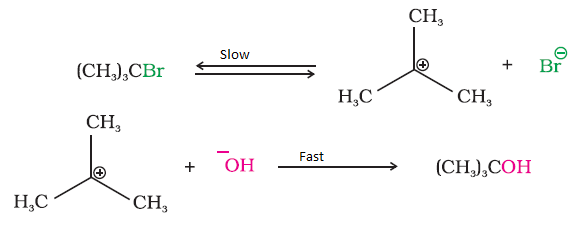
SN1 stands for:

S → Substitution
N → Nucleophilic
1 → Unimolecular

So the full meaning is:

SN1 = Substitution Nucleophilic Unimolecular reaction

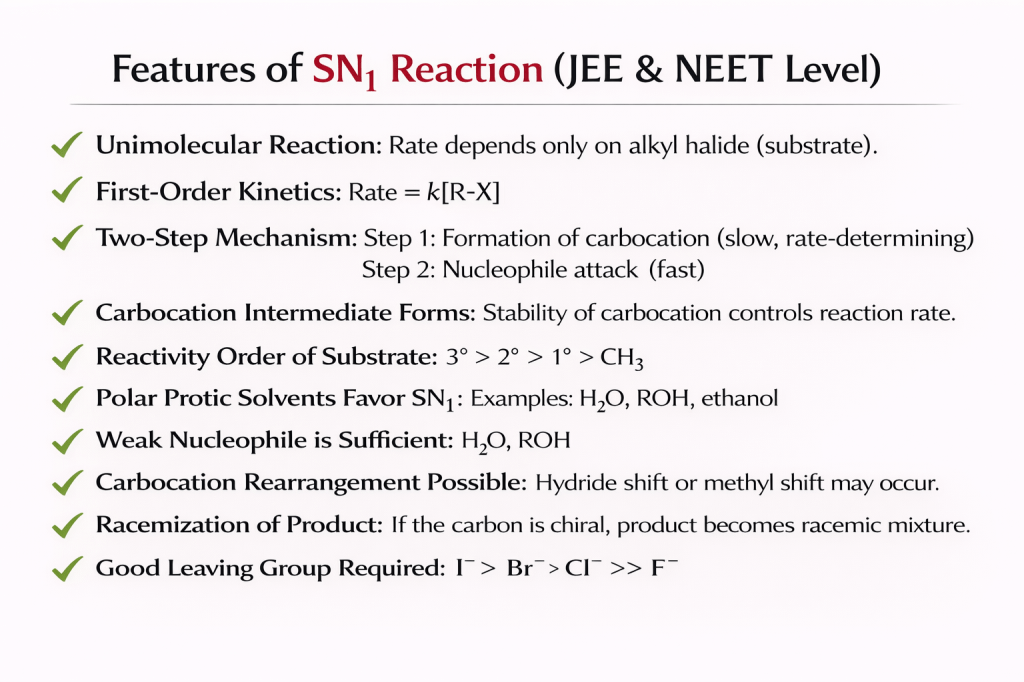
Features of SN1 Reaction (JEE / NEET level)

  1. Unimolecular Reaction
    • Rate depends only on alkyl halide (substrate).
  2. First-Order Kinetics Rate=k[R–X]\text{Rate} = k[\text{R–X}]
  3. Two-Step Mechanism
    • Step 1: Formation of carbocation (slow, rate-determining)
    • Step 2: Nucleophile attack (fast)
  4. Carbocation Intermediate Forms
    • Stability of carbocation controls reaction rate.
  5. Reactivity Order of Substrate

3∘>2∘>>1∘>CH33^\circ > 2^\circ >> 1^\circ > CH_3

  1. Polar Protic Solvents Favor SN1
    • Examples: H₂O, ROH, ethanol
  2. Weak Nucleophile is Sufficient
    • Examples: H₂O, ROH
  3. Carbocation Rearrangement Possible
    • Hydride shift or methyl shift may occur.
  4. Racemization of Product
    • If the carbon is chiral, product becomes racemic mixture.
  5. Good Leaving Group Required

I−>Br−>Cl−>>F−I^- > Br^- > Cl^- >> F^-

Most SN1 reactions give partial racemization.
In an SN1 reaction, a carbocation intermediate is formed, which is planar. Because of this planar structure, the nucleophile can attack from both sides, leading to formation of two stereoisomers.

However, in most cases the products are not formed in equal amounts. Usually, 50–70% of the product has inverted configuration, while the rest has retained configuration.

If equal amounts of both stereoisomers are produced, the reaction is called complete racemization.
When more of the inverted product is formed, the reaction is called partial racemization

Factors Affecting SN1 Reactions

The rate of an SN1 reaction is influenced mainly by the leaving group and the nucleophile.

Effect of Leaving Group in SN1 Reaction

In an SN1 reaction, the rate-determining step is the formation of a carbocation. Therefore, the reaction rate depends on two important factors:

  1. Ease of leaving group departure
    • The reaction is faster when the leaving group can easily dissociate from the substrate.
  2. Stability of the carbocation formed
    • The more stable the carbocation, the faster the SN1 reaction occurs.

Therefore, good leaving groups and stable carbocations increase the rate of SN1 reactions.
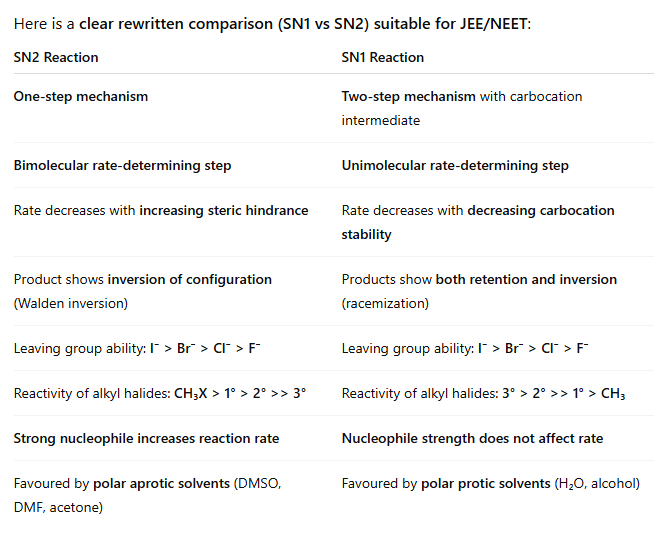
PROBLEM :
Which of the following reactions take place more rapidly when the concentration of the nucleophile is increased?
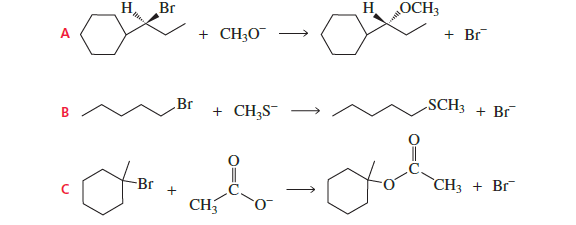
he question asks: Which reaction becomes faster when the nucleophile concentration increases?

Key concept:

  • SN2 reaction: Rate = k[R–X][Nu−]k[\text{R–X}][\text{Nu}^-]k[R–X][Nu−] → depends on nucleophile concentration
  • SN1 reaction: Rate = k[R–X]k[\text{R–X}]k[R–X] → independent of nucleophile concentration

So we must identify which reactions proceed by SN2.


Reaction A

Substrate: secondary alkyl bromide attached to cyclohexane

This structure favors SN1 (carbocation formation possible).

Therefore rate does NOT depend strongly on nucleophile concentration.

❌ Not the answer


Reaction B

Substrate: primary alkyl bromide

Primary halides undergo SN2 easily.

Rate depends on nucleophile concentration (CH₃S⁻).

Correct


Reaction C

Substrate: tertiary bromide on cyclohexane

Tertiary halides react by SN1.

Rate depends only on substrate, not nucleophile.

❌ Not the answer

Haloalkane and haloarenes JEE/NEET Concepts

Key Concepts to Arrange Basic Strength (NEET/JEE)

Key Concepts to Arrange Nucleophile Strength (NEET/JEE)

Haloalkane and haloarenes JEE/NEET Concepts

The SN2 Reaction and The SN1 Reactions Concepts for JEE/NEET

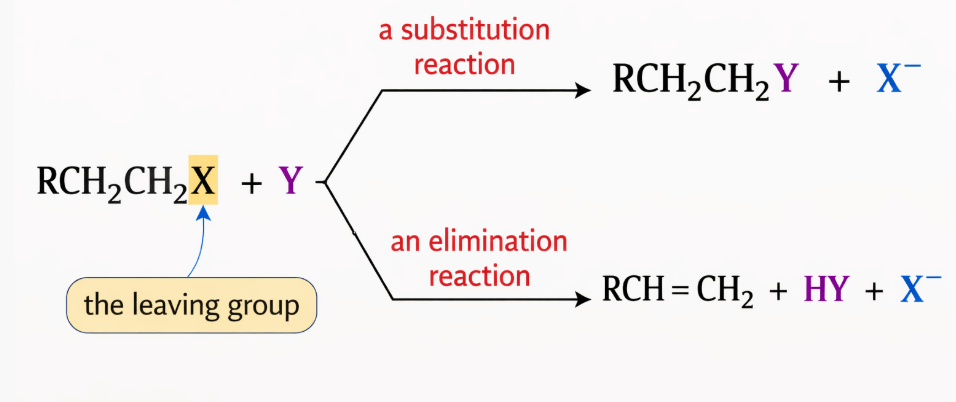
Elimination Reactions Of Alkyl Halides JEE/NEET

Ring expansion/ rearrangement during elimination/substitution reaction

Competition between E2 and E1 Reactions

Predicting the Products of the Reaction of an Alkyl Halide with a Nucleophile/Base

Leaving Group Ability Order

Key Concepts to Arrange Nucleophile Strength (NEET/JEE)

Nucleophilicity means the ability of a species to donate an electron pair to an electrophile and form a bond. In exams, students must quickly compare nucleophiles using a few core rules.

When we talk about atoms or molecules that have lone-pair electrons, sometimes we call them
bases and sometimes we call them nucleophiles (Table 9.1). What is the difference between a base
and a nucleophile?

Basicity tells us how easily a compound (base) can donate its lone pair of electrons to a proton (H⁺).
A strong base donates its electron pair more easily than a weak base.

Basicity is related to the acid dissociation constant (Ka) of its conjugate acid, which shows how easily that conjugate acid releases a proton. If the conjugate acid releases H⁺ easily, the base is weaker; if it does not release H⁺ easily, the base is stronger.

Nucleophilicity describes how easily a compound (nucleophile) can attack an electron-deficient atom and form a new bond.
It is measured by the rate constant (k), which indicates how fast the nucleophile reacts in a chemical reaction.

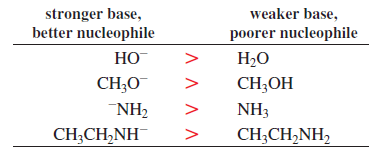
Note: Species with a negative charge is a stronger base and a better nucleophile than a
species that has the same attacking atom but is neutral

If the attacking atoms are the same size, stronger bases are better nucleophiles.

−NH2 > HO− > F−

If, however, the attacking atoms of the nucleophiles are very different in size, another factor
comes into play: the polarizability

Effect of Solvent on Nucleophilicity (Simple Point-wise) 🧪

  1. Aprotic Polar Solvent
    (Example: DMSO, DMF, Acetone)
  • Solvent molecules do not contain O–H or N–H bonds.
  • There is no strong hydrogen bonding with nucleophiles.
  • Therefore nucleophiles remain free and reactive.
  • Basicity and nucleophilicity follow the same order.
  • Stronger base → stronger nucleophile.

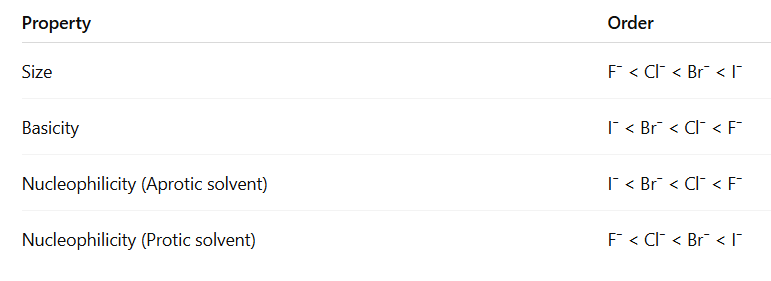
Example (Halide ions) :F−>Cl−>Br−>I−F^- > Cl^- > Br^- > I^-

  • Here I⁻ is the weakest base, so it is the poorest nucleophile in aprotic solvents.

2. Protic Polar Solvent
(Example: Water, Alcohol)

  • Solvent molecules contain O–H or N–H bonds.
  • They form hydrogen bonding with nucleophiles.
  • Small ions get strongly solvated (surrounded by solvent molecules).
  • This reduces their nucleophilicity.

Result:
Basicity and nucleophilicity order becomes opposite.

Example (Halide ions):I−>Br−>Cl−>F−I^- > Br^- > Cl^- > F^-

  • I⁻ is the best nucleophile in protic solvents because it is large and less solvated.

✅ Quick NEET/JEE Rule

  • Aprotic solvent: Basicity order = Nucleophilicity order
  • Protic solvent: Large atom = Better nucleophile

PROBLEM : Indicate whether each of the following solvents is protic or aprotic: a. chloroform (CHCl3) b. diethyl ether c. acetic acid d. hexane

To classify protic vs aprotic solvents, remember the rule:

Protic solvent: contains H bonded to O, N, or F → can form hydrogen bonding and donate H⁺.
Aprotic solvent: no H attached to O, N, or F.


(a) Chloroform

Structure: CHCl₃

  • Hydrogen is attached to carbon, not O/N/F.
  • Cannot donate hydrogen for hydrogen bonding.

Result: Aprotic solvent


(b) Diethyl ether

Structure: C₂H₅–O–C₂H₅

  • Oxygen is present, but no O–H bond.
  • Hydrogens are attached only to carbon.

Result: Aprotic solvent


(c) Acetic acid

Structure: CH₃–COOH

  • Contains O–H bond in the –COOH group.
  • Can donate proton and form hydrogen bonding.

Result: Protic solvent


(d) Hexane

Structure: alkane

  • Only C–H and C–C bonds.
  • No O–H, N–H, or F–H bonds.

Result: Aprotic solvent

Relative Nucleophilicity toward CH3l in Methanol

PROBLEM: Which is a stronger base: RO– or RS–?

b. Which is a better nucleophile in an aqueous solution?

c. Which is a better nucleophile in DMSO?

Let RO⁻ (alkoxide) and RS⁻ (thiolate) be compared.

Key idea: Basicity and nucleophilicity are not always the same, especially depending on the solvent.


(a) Which is a stronger base?

Compare conjugate acids:

  • RO⁻ → conjugate acid Alcohol (pKa ≈ 16)
  • RS⁻ → conjugate acid Thiol (pKa ≈ 10)

Lower pKa → stronger acid → weaker conjugate base.

Since thiols are more acidic than alcohols, their conjugate base RS⁻ is weaker.

Stronger base: RO⁻


(b) Better nucleophile in aqueous solution (polar protic solvent)

Water is a protic solvent, so small anions are strongly solvated by hydrogen bonding.

  • RO⁻ (O is smaller) → strongly solvated → nucleophilicity decreases
  • RS⁻ (S is larger, more polarizable) → less solvated → more reactive

Better nucleophile in water: RS⁻


(c) Better nucleophile in Dimethyl sulfoxide (polar aprotic solvent)

In polar aprotic solvents, anions are not strongly solvated, so nucleophilicity follows basicity.

Since:

RO⁻ is a stronger base than RS⁻

Better nucleophile in DMSO: RO⁻

Which is stronger nucleophile?

(a) Br⁻ or Cl⁻ in H₂O

Water strongly solvates smaller ions.

Br⁻ is larger → less solvated → more reactive.

Better nucleophile: Br⁻


b. CH₃O⁻ or CH₃OH in H₂O

Charged species are stronger nucleophiles than neutral molecules.

Methoxide ion vs Methanol

Better nucleophile: CH₃O⁻


c. CH₃O⁻ or CH₃OH in DMSO

Same logic: anion >> neutral molecule.

Better nucleophile: CH₃O⁻


(d) Br⁻ or Cl⁻ in DMSO

In aprotic solvent → nucleophilicity follows basicity.

Basicity order:
Cl⁻ > Br⁻

Better nucleophile: Cl⁻


(e) HO⁻ or NH₂⁻ in H₂O

Hydroxide ion vs Amide ion

NH₂⁻ is a much stronger base, but in water it reacts with the solvent:

NH₂⁻ + H₂O → NH₃ + HO⁻

So NH₂⁻ cannot exist effectively in water.

Better nucleophile: HO⁻


(f) I⁻ or Br⁻ in H₂O

In protic solvent → larger ion is better nucleophile.

I⁻ > Br⁻

Better nucleophile: I⁻


(g) I⁻ or Br⁻ in DMSO

Aprotic solvent → nucleophilicity follows basicity.

Basicity:
Br⁻ > I⁻

Better nucleophile: Br⁻


(h) HO⁻ or NH₂⁻ in DMSO

DMSO is aprotic → nucleophilicity follows basicity.

NH₂⁻ is stronger base.

Better nucleophile: NH₂⁻

Nucleophilicity Is Affected by Steric Effects

Basicity Comparison

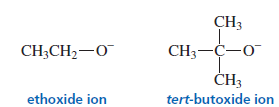
tert-Butoxide (t-BuO⁻) has three methyl groups pushing electron density toward oxygen.

This increases electron density, making it a stronger base.

Stronger base:(CH3)3CO−  >  CH3CH2O−(CH_3)_3CO^- \; > \; CH_3CH_2O^-


Nucleophilicity Comparison

Nucleophilicity depends strongly on steric hindrance.

  • tert-Butoxide ion is bulky because of three CH₃ groups.
  • This blocks approach to the electrophilic carbon in SN2 reactions.

Ethoxide is smaller, so it can attack carbon more easily.

PROBLEM :
Rank the following species from best nucleophile to poorest nucleophile in an aqueous solution:

Key Concepts to Arrange Basic Strength (NEET/JEE)

1.Charge on Species (Most Important First)

Species with negative charge are stronger bases than neutral ones.

ExampleOH−>H2OOH^- > H_2ONH2−>NH3NH_2^- > NH_3

Basicity is a measure of how well a compound (a base) shares its lone pair with a proton. The
stronger the base, the better it shares its electrons. Basicity is measured by an equilibrium constant
(the acid dissociation constant, Ka) that indicates the tendency of the conjugate acid of the base to
lose a proton

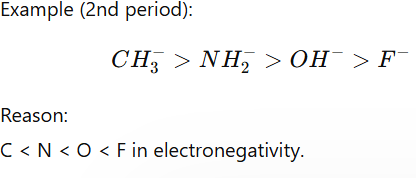
2. Electronegativity (Across a Period)

If atoms are in the same period, basicity decreases with electronegativity.

Less electronegative atom holds negative charge poorly → stronger base.

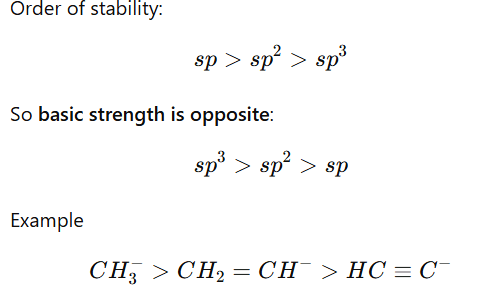
3.Hybridization Effect

More s-character stabilizes negative charge, making the base weaker.

4.Resonance

If negative charge is delocalized, the base becomes less basic.

Example:

Acetate ion vs Ethoxide

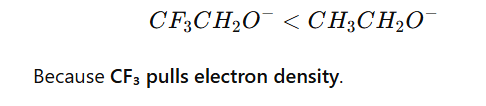
5.Inductive Effect

Electron-withdrawing groups (–I effect) decrease basicity.

Example

6. Aromaticity

If negative charge contributes to aromatic stabilization, the base becomes weaker.

Example
Cyclopentadienyl anion is stable → weak base.

Quick NEET/JEE Order (Decision Flow)

When comparing bases, check in this order:

1️⃣ Charge
2️⃣ Resonance
3️⃣ Electronegativity
4️⃣ Hybridization
5️⃣ Inductive effect
6️⃣ Aromaticity
7️⃣ Atom size

20 NEET / JEE MCQs – Basic Strength

1

Order of basicity:

CH₃⁻ , NH₂⁻ , OH⁻ , F⁻

A. CH₃⁻ > NH₂⁻ > OH⁻ > F⁻
B. NH₂⁻ > CH₃⁻ > OH⁻ > F⁻
C. OH⁻ > NH₂⁻ > CH₃⁻ > F⁻
D. F⁻ > OH⁻ > NH₂⁻ > CH₃⁻


2

Which is the strongest base?

A. NH₃
B. CH₃NH₂
C. (CH₃)₂NH
D. C₆H₅NH₂


3

Order of basicity:

NH₃ , CH₃NH₂ , (CH₃)₂NH , (CH₃)₃N (aqueous)

A. 2° > 1° > 3° > NH₃
B. 3° > 2° > 1° > NH₃
C. NH₃ > 1° > 2° > 3°
D. 1° > 2° > 3° > NH₃


4

Which is the weakest base?

A. Pyridine
B. Aniline
C. NH₃
D. CH₃NH₂


5

Correct order of basicity:

NH₂⁻ , OH⁻ , F⁻

A. NH₂⁻ > OH⁻ > F⁻
B. F⁻ > OH⁻ > NH₂⁻
C. OH⁻ > NH₂⁻ > F⁻
D. NH₂⁻ > F⁻ > OH⁻


6

Which is the strongest base?

A. HC≡C⁻
B. CH₂=CH⁻
C. CH₃⁻
D. C₆H₅⁻


7

Correct order of basicity:

CH₃NH₂ , C₆H₅NH₂ , NH₃

A. CH₃NH₂ > NH₃ > C₆H₅NH₂
B. NH₃ > CH₃NH₂ > C₆H₅NH₂
C. C₆H₅NH₂ > CH₃NH₂ > NH₃
D. NH₃ > C₆H₅NH₂ > CH₃NH₂


8

Which compound is most basic?

A. Pyrrole
B. Pyridine
C. Aniline
D. Ammonia


9

Which is strongest base?

A. CH₃O⁻
B. C₂H₅O⁻
C. OH⁻
D. F⁻


10

Order of basicity:

sp³ N , sp² N , sp N

A. sp³ > sp² > sp
B. sp > sp² > sp³
C. sp² > sp³ > sp
D. sp³ > sp > sp²


11

Which is least basic?

A. CH₃NH₂
B. NH₃
C. Aniline
D. (CH₃)₂NH


12

Which has maximum basicity?

A. NH₂⁻
B. OH⁻
C. H₂O
D. NH₃


13

Order of basicity:

Pyrrole , Pyridine , Piperidine

A. Piperidine > Pyridine > Pyrrole
B. Pyridine > Piperidine > Pyrrole
C. Pyrrole > Pyridine > Piperidine
D. Pyridine > Pyrrole > Piperidine


14

Which is stronger base?

A. CH₃NH₂
B. C₆H₅NH₂


15

Most basic compound:

A. NH₃
B. CH₃NH₂
C. C₂H₅NH₂
D. (CH₃)₂NH


16

Order of basicity:

NH₃ , PH₃ , AsH₃

A. NH₃ > PH₃ > AsH₃
B. AsH₃ > PH₃ > NH₃
C. PH₃ > NH₃ > AsH₃
D. NH₃ > AsH₃ > PH₃


17

Which is least basic?

A. Pyrrole
B. Pyridine
C. Piperidine
D. NH₃


18

Which is strongest base?

A. NH₂⁻
B. CH₃O⁻
C. OH⁻
D. NH₃


19

Order of basicity:

Aniline , p-methoxyaniline , p-nitroaniline

A. p-OCH₃ > aniline > p-NO₂
B. aniline > p-OCH₃ > p-NO₂
C. p-NO₂ > aniline > p-OCH₃
D. p-OCH₃ > p-NO₂ > aniline


20

Which is strongest base?

A. NH₃
B. CH₃NH₂
C. (CH₃)₂NH
D. (CH₃)₃N


Answer Key

  1. A
  2. C
  3. A
  4. B
  5. A
  6. C
  7. A
  8. B
  9. B
  10. A
  11. C
  12. A
  13. A
  14. A
  15. D
  16. A
  17. A
  18. A
  19. A
  20. C

Cracking of Alkanes — JEE Advanced Points

Cracking = breaking of C–C bonds of higher alkanes to give smaller alkanes + alkenes.

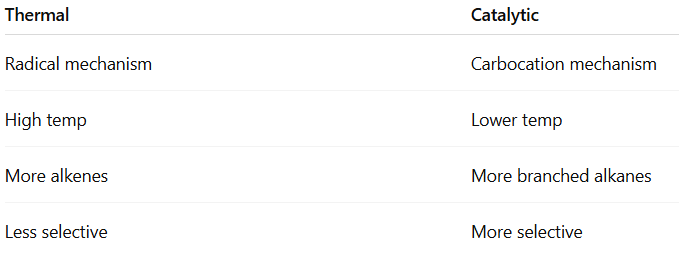
Types of Cracking

(A) Thermal Cracking

  • High temperature (700–900°C)
  • Free radical mechanism
  • Produces more alkenes
  • Less selective

(B) Catalytic Cracking

  • 450–550°C
  • Zeolite (acidic catalyst)
  • Carbocation mechanism
  • More branched alkanes
  • Higher octane number

Thermal Cracking Example (Free Radical)

Example 1:

n-Butane→800∘CEthene+Ethane\text{n-Butane} \xrightarrow{800^\circ C} \text{Ethene} + \text{Ethane}

Example 2:

n-Pentane→Propene+Ethane\text{n-Pentane} \rightarrow \text{Propene} + \text{Ethane}

Major product contains more substituted alkene due to radical stability

Example 3:

n-Decane→Pentane+Pentene\text{n-Decane} \rightarrow \text{Pentane} + \text{Pentene}

Catalytic Cracking Example (Carbocation Mechanism)

Occurs in presence of zeolite catalyst (acidic sites).

n-Hexane→Zeolite2-Methylpentane+Propene\text{n-Hexane} \xrightarrow{\text{Zeolite}} \text{2-Methylpentane} + \text{Propene}

✔ Rearrangement possible
✔ Branched products favored

Example 5:

n-Octane→Isobutane+Butene\text{n-Octane} \rightarrow \text{Isobutane} + \text{Butene}

More stable tertiary carbocation pathway preferred.

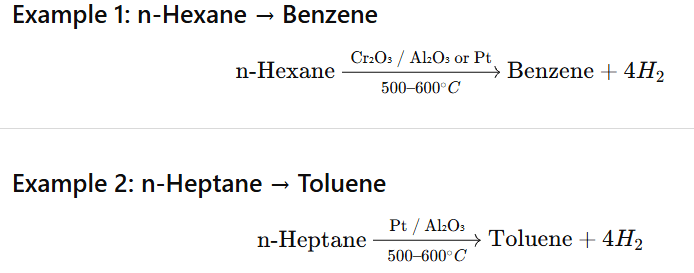
Aromatisation of Alkanes

Aromatisation is the conversion of higher alkanes (C₆ or more) into aromatic hydrocarbons (benzene and its derivatives) by dehydrogenation and cyclisation at high temperature in presence of catalysts.

n-Octane (C₈) → Xylene (or ethylbenzene)

Also possible under catalytic reforming conditions.

Theoretical Point of View

There is no fixed maximum carbon limit.
Any C₆ or higher straight-chain alkane (C₆⁺) can undergo aromatisation because at least six carbons are required to form a benzene ring.


🔹 Practical / Industrial Point of View

In petroleum refining (catalytic reforming):

✔ Most effective for C₆ to C₁₀ alkanes
✔ Above C₁₀–C₁₂, cracking and side reactions increase
✔ Very long chains prefer cracking rather than clean aromatisation

So practically:Industrially important range: C₆–C₁₀ (approx.)\boxed{\textbf{Industrially important range: C₆–C₁₀ (approx.)}}

Cyclohexane undergoes multiple dehydrogenations:

Cyclohexane→Cyclohexene→Cyclohexadiene→Benzene\text{Cyclohexane} \rightarrow \text{Cyclohexene} \rightarrow \text{Cyclohexadiene} \rightarrow \text{Benzene}

👉 Total 4 molecules of H₂ released.


🔹 Key Concept

✔ First dehydrogenation, then cyclisation, then aromatic stabilization
✔ Metal catalyst helps in removal of hydrogen
✔ Final product gains extra stability due to aromatic resonance

Mechanism of isomerisation of Alkane

Isomerisation of alkane is the process in which a straight-chain alkane (n-alkane) is converted into its branched-chain isomer without changing the molecular formula.

Conditions Required

  • Catalyst:
    • Anhydrous AlCl₃
    • HF
    • Pt/Al₂O₃
  • Temperature: 250–400°C (industrial process)
  • Occurs via carbocation mechanism

Mechanism (Simplified for JEE/NEET)

  1. Formation of carbocation
  2. Hydride shift or methyl shift
  3. Formation of more stable branched carbocation
  4. Deprotonation → Branched alkane

Industrial Importance

  • Used in petroleum refining
  • Improves octane number of petrol
  • Branched alkanes burn more smoothly (less knocking)

Example:
n-Pentane → Isopentane
n-Hexane → Isohexane

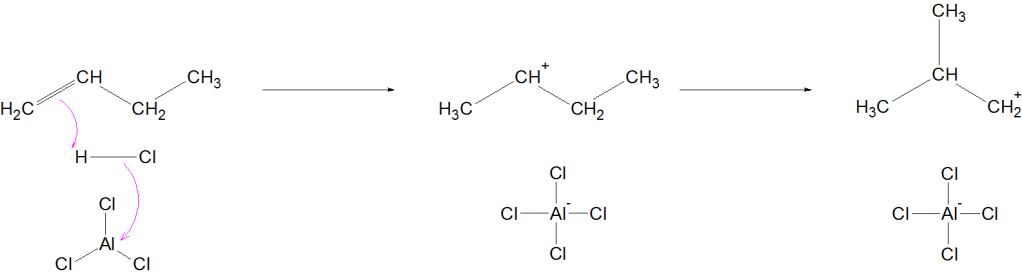
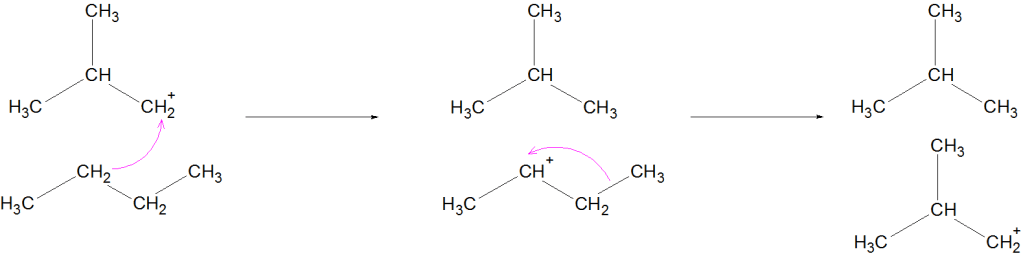
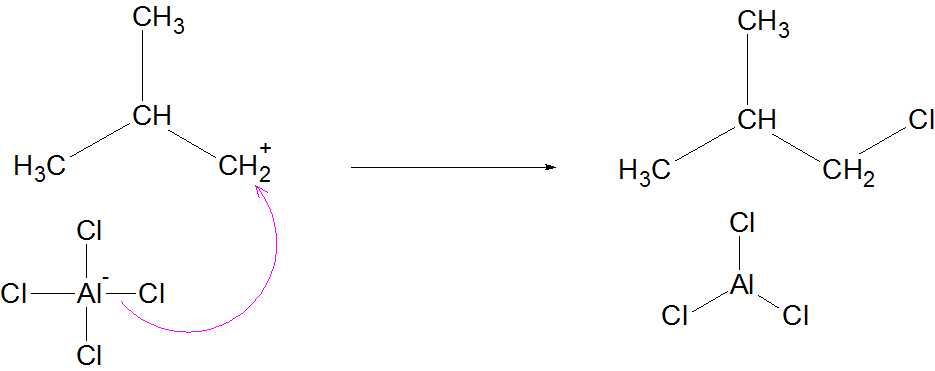
The mechanism for butane:

it probably begins by the protonation of butene impurities.

Step 1: Initiation

Propagation:

Termination:

Isomerisation of Pentane (C₅H₁₂)

During catalytic isomerisation of n-pentane (using AlCl₃/HCl or Pt/Al₂O₃), rearrangement proceeds via a carbocation intermediate.

🔹 Possible products:

2,2-Dimethylpropane (Neopentane)

2-Methylbutane (Isopentane)

Major Product → 2-Methylbutane (Isopentane)

✔ Why is it major?

  1. Formation occurs via secondary carbocation, which is reasonably stable.
  2. It requires only one methyl shift from n-pentane.
  3. Formation of neopentane requires further rearrangement and is less favored.
  4. Under equilibrium, moderately branched alkane forms in higher amount.

Isomerisation of n-Hexane — Major Product (Isohexane)

When n-hexane (C₆H₁₄) undergoes catalytic isomerisation (AlCl₃/HCl, Pt/Al₂O₃, zeolites), branched isomers are formed via carbocation rearrangement.

🔹 Possible Isohexanes (Structural Isomers)

1) 2-Methylpentane ✅ Major Product

2) 3-Methylpentane

3) 2,2-Dimethylbutane

4) 2,3-Dimethylbutane


✅ Major Isohexane → 2-Methylpentane

✔ Reason (JEE/NEET Concept):

  • Forms via secondary carbocation with minimal rearrangement.
  • Requires only one hydride/methyl shift.
  • Moderately branched alkane is favored kinetically.
  • Highly branched (like 2,2-dimethylbutane) needs further rearrangement → less formed.

Practically (Industrial Catalytic Isomerisation)

  • Commercially important for C₄ to C₇/C₈ alkanes
  • Used in petroleum refining to increase octane number.
  • Higher alkanes (> C₈) tend to undergo cracking along with isomerisation.

Corey–House Synthesis (Gilman Coupling)

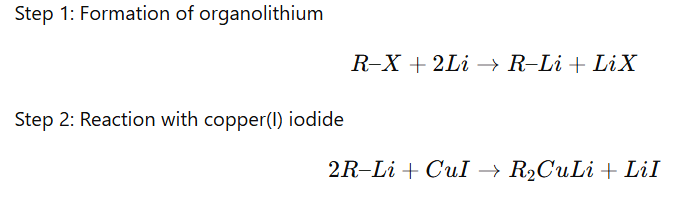
Corey–House synthesis is a method used to prepare higher alkanes by coupling an alkyl halide with a Gilman reagent (lithium dialkylcuprate, R₂CuLi).

Preparation of Gilman Reagent

Important JEE/NEET Points

✔ Best with primary alkyl halides
✔ Does not work well with tertiary halides (elimination dominates)
✔ Useful for forming unsymmetrical alkanes
✔ Milder and more selective than Wurtz reaction
✔ Works via substitution mechanism

Mechanistic Reason

  • Proceeds via substitution (SN2-like)
  • No free radical chain process
  • Controlled coupling

Rate of Hydrogenation of Alkene

Hydrogenation of alkene is the addition of H₂ across a C=C double bond in presence of a metal catalyst like Ni, Pd, or Pt, forming an alkane.

1. Based on Substitution of Double Bond

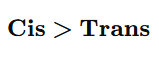
2.Cis vs Trans Alkenes

Reason:

  • Cis isomer is less stable (higher energy)
  • Therefore hydrogenates faster

3.Cyclic vs Acyclic

cyclopropane reacts faster due to ring strain.

4. Conjugated vs Isolated

Isolated double bond hydrogenates normally.

In conjugated systems, 1,4-addition may occur depending on conditions.

More stable alkene → Lower rate of hydrogenation why?

Hydrogenation is an exothermic reaction.

  • More stable alkene = lower potential energy
  • Therefore it releases less heat on hydrogenation
  • Lower energy difference → smaller driving force
  • Hence reacts more slowly

1. Which alkene hydrogenates fastest?

A) CH₃–CH=CH₂
B) CH₂=CH₂
C) (CH₃)₂C=CH₂
D) (CH₃)₂C=C(CH₃)₂

Answer: B


2. The rate of hydrogenation is inversely proportional to:

A) Heat of hydrogenation
B) Stability of alkene
C) Surface area of catalyst
D) Pressure of H₂

Answer: B


3. Which has lowest heat of hydrogenation?

A) 1-Butene
B) cis-2-Butene
C) trans-2-Butene
D) 2-Methyl-2-butene

Answer: D


4. Correct order of rate of hydrogenation:

A) Tetra > Tri > Di > Mono
B) Mono > Di > Tri > Tetra
C) Tri > Di > Mono > Tetra
D) Di > Mono > Tri > Tetra

Answer: B


5. Which reacts faster in hydrogenation?

A) trans-2-Butene
B) cis-2-Butene
C) Both equal
D) 2-Methyl-2-butene

Answer: B


6. Hydrogenation of alkene is:

A) Anti addition
B) Syn addition
C) Free radical reaction
D) Electrophilic addition

Answer: B


7. Which alkene is most stable?

A) CH₂=CH₂
B) CH₃–CH=CH₂
C) (CH₃)₂C=CH₂
D) (CH₃)₂C=C(CH₃)₂

Answer: D


8. Which will hydrogenate slowest?

A) 1-Butene
B) 2-Butene
C) 2-Methylpropene
D) 2,3-Dimethyl-2-butene

Answer: D


9. More stable alkene has:

A) Higher heat of hydrogenation
B) Lower heat of hydrogenation
C) Same heat of hydrogenation
D) Zero heat of hydrogenation

Answer: B


10. Strained cyclic alkene hydrogenates faster because:

A) It is more stable
B) It has lower energy
C) Relief of ring strain
D) It is more substituted

Answer: C

JEE/NEET Concept

Heat of hydrogenation order:Cyclopropene > Cyclobutene > Cyclopentene > Cyclohexene\text{Cyclopropene > Cyclobutene > Cyclopentene > Cyclohexene}

Higher heat release means less stable alkene → faster hydrogenation.

MCQs

1. Which cyclic alkene hydrogenates fastest?

A) Cyclohexene
B) Cyclopentene
C) Cyclobutene
D) Cyclopropene

Answer: D


2. The fastest hydrogenation is shown by the alkene having:

A) Maximum stability
B) Maximum ring strain
C) Maximum substitution
D) Minimum heat of hydrogenation

Answer: B


3. Arrange in increasing rate of hydrogenation:

A) Cyclohexene < Cyclopentene < Cyclobutene < Cyclopropene
B) Cyclopropene < Cyclobutene < Cyclopentene < Cyclohexene
C) Cyclobutene < Cyclopropene < Cyclohexene < Cyclopentene
D) Cyclopentene < Cyclohexene < Cyclobutene < Cyclopropene

Answer: A


4. Cyclohexene hydrogenates slower than cyclobutene because:

A) It is more substituted
B) It has less ring strain
C) It has higher energy
D) It forms unstable product

Answer: B


5. Heat of hydrogenation is maximum for:

A) Cyclohexene
B) Cyclopentene
C) Cyclobutene
D) Cyclopropene

Answer: D

Numerical-Type Concept Question

The heats of hydrogenation are:

  • Cyclohexene → −119 kJ/mol
  • Cyclopentene → −120 kJ/mol
  • Cyclobutene → −127 kJ/mol
  • Cyclopropene → −151 kJ/mol

Question:

Which is most stable? Which reacts fastest?

Solution:

✔ Most stable: Cyclohexene (least heat released)
✔ Fastest reaction: Cyclopropene (highest heat released)

“Hydrogenation rate of cyclic alkenes depends on ring strain. Smaller rings possess greater angle strain and hence higher heat of hydrogenation. Therefore, they react faster.”

JEE/NEET Important Order

Rate of hydrogenation:Isolated diene > Conjugated diene > Aromatic compound\textbf{Isolated diene > Conjugated diene > Aromatic compound}

Comparison Example (Very Important for Exams)

Compare:

  1. 1,3-Butadiene (conjugated)
  2. 1,4-Pentadiene (isolated)

Stability Order:

Conjugated > Isolated\textbf{Conjugated > Isolated}

Rate of Hydrogenation:

Isolated > Conjugated\textbf{Isolated > Conjugated}

JEE/NEET Important Order

Rate of hydrogenation:Isolated diene > Conjugated diene > Aromatic compound\textbf{Isolated diene > Conjugated diene > Aromatic compound}

(Benzene hydrogenates very slowly due to aromatic stability)

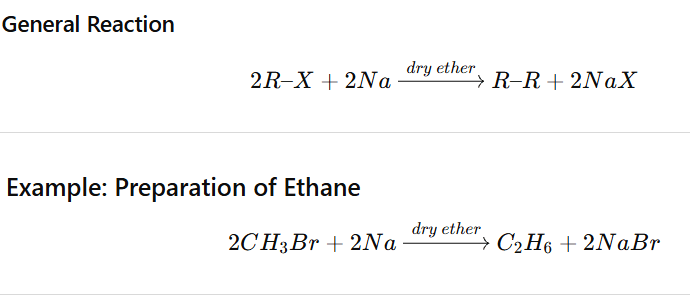
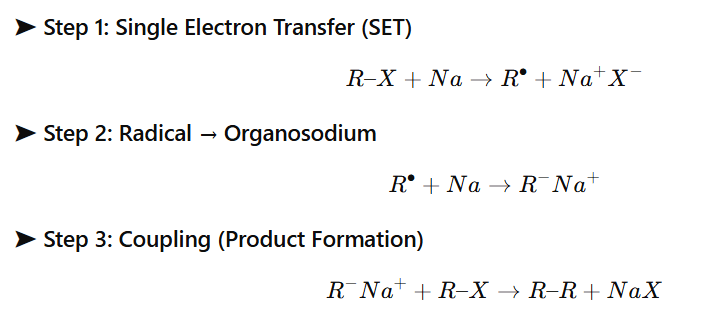
Mechanism Of Wurtz reaction (Free Radical / SET Mechanism) JEE/NEET

Mechanism (Free Radical / SET Mechanism)

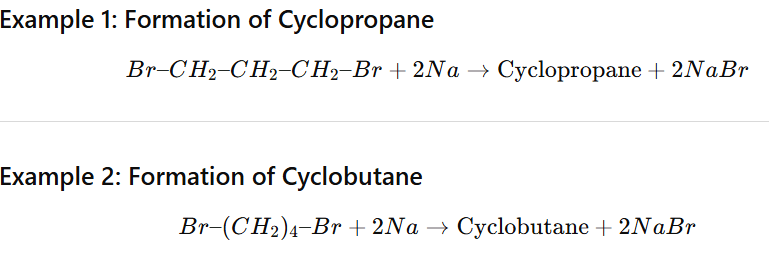
Intramolecular Wurtz Reaction (Cyclic Formation)

JEE / NEET Important Points

  1. Works best with primary alkyl halides
  2. Secondary & tertiary → elimination side reactions
  3. Dry ether is essential
  4. Same alkyl halide → symmetrical alkane
  5. Different alkyl halides → mixture of products
  6. Free radical intermediate
  7. SET (Single Electron Transfer) mechanism
  8. Even-numbered carbon chain formed
  9. Not suitable for unsymmetrical alkane synthesis
  10. Intramolecular reaction gives cyclic alkane

Important Concept

✔ Only alkali metals (Na, K, Li) give Wurtz-type coupling
✔ Sodium is preferred due to controlled reactivity
✔ Mg and Zn mainly form organometallic intermediates instead of direct alkane

Wurtz Reaction – Metals Other Than Sodium

Although sodium (Na) is the classical metal used in Wurtz reaction, some other metals can also promote coupling of alkyl halides

Potassium (K)

2R–X+2K→R–R+2KX2R–X + 2K \rightarrow R–R + 2KX

✔ More reactive than sodium
✔ Reaction is more vigorous
❌ Harder to control
📌 Rarely used in practice (safety issue)


Lithium (Li)

2R–X+2Li→R–R+2LiX2R–X + 2Li \rightarrow R–R + 2LiX

✔ Can participate in similar coupling
✔ Often forms organolithium intermediates
📌 Used more in organometallic synthesis than classical Wurtz


Silver (Ag)

R–X+Ag→R∙R–X + Ag \rightarrow R^\bullet

✔ Used mainly for radical formation studies
❌ Not common for alkane synthesis
📌 Often used in rearrangement or carbocation studies


Zinc (Zn)

Zinc does not give classical Wurtz coupling easily but forms:R–X+Zn→R–ZnXR–X + Zn \rightarrow R–ZnX

✔ Forms organozinc compounds
✔ Used in coupling reactions (e.g., Reformatsky type)


Magnesium (Mg)

R–X+Mg→R–MgX

✔ Forms Grignard reagent
❌ Does NOT directly give Wurtz alkane
📌 Very important alternative pathway

Cyclic Wurtz Reaction (Intramolecular Wurtz)

Cyclic Wurtz reaction is an intramolecular version of the Wurtz reaction in which a dihaloalkane reacts with sodium metal in dry ether to form a cycloalkane.

JEE / NEET Important Points

  1. Best for small rings (3–5 members).
  2. Large rings are difficult due to entropy factor.
  3. Competes with intermolecular Wurtz (polymerization possible).
  4. Primary dihalides give better yield.
  5. Dry ether is essential.
  6. Mechanism involves free radicals.

Product of Tertiary Alkyl Halide in Wurtz Reaction

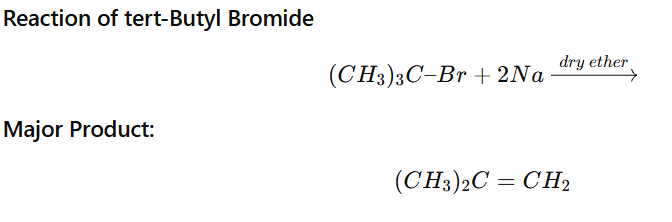
When a tertiary alkyl halide (3° RX) is treated with sodium (Na) in dry ether, it does not give Wurtz coupling product efficiently.

Major product = Alkene (Elimination product)
Coupling product is minor or negligible.


Example

Why Elimination Occurs?

✔ Tertiary halides easily form stable tertiary radicals / carbanions
✔ Strong base character of sodium promotes β-elimination
✔ Steric hindrance prevents effective coupling

Thus, E2-type elimination dominates over coupling.

JEE / NEET Important Points

  1. Primary RX → best for Wurtz coupling
  2. Secondary RX → mixture
  3. Tertiary RX → alkene (major)
  4. Elimination increases with substitution.
  5. Reaction follows radical pathway but elimination competes strongly.

Reactivity Order (Bond Strength Basis)

R–I>R–Br>R–Cl≫R–FR–I > R–Br > R–Cl \gg R–F

JEE / NEET Important Points

  1. Alkyl bromides are preferred.
  2. Primary halides give best results.
  3. Aryl halides do NOT undergo normal Wurtz (need Wurtz–Fittig).
  4. Fluorides are practically inactive.
  5. Dry ether is essential for the reaction.

Reasons for Using Dry Ether

1. Provides Anhydrous Medium

✔ Sodium reacts violently with water:2Na+2H2O→2NaOH+H2↑2Na + 2H_2O \rightarrow 2NaOH + H_2\uparrow

If moisture is present, sodium will react with water instead of alkyl halide.
Therefore, ether must be dry.

Why is solvent needed in Wurtz reaction?
Solvent used → Dry ether
1. Medium for Reaction
Sodium is solid
Alkyl halide is liquid
Reaction occurs at sodium surface
Ether provides:  Proper contact between reactant.

2. Uniform reaction medium

Without solvent → reaction is uncontrolled / incomplete.
3.  Stabilizes Reactive Intermediates
Wurtz reaction proceeds via:
Radical pathway
or Organosodium intermediate (R–Na)
Dry ether:

MCQ Questions for practice:

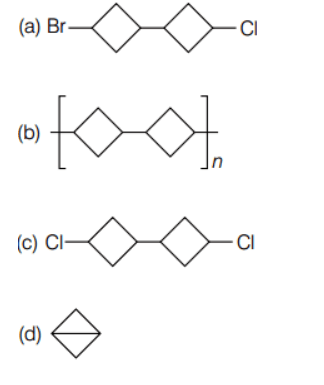
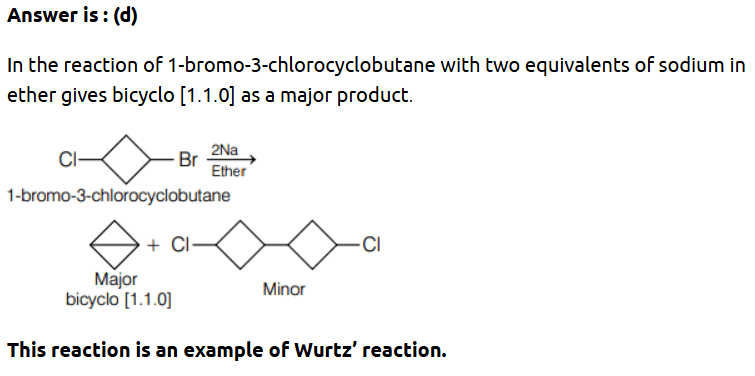
  1. In the reaction of 1-bromo-3-chlorocyclobutane with two equivalents of sodium in ether, the major product is