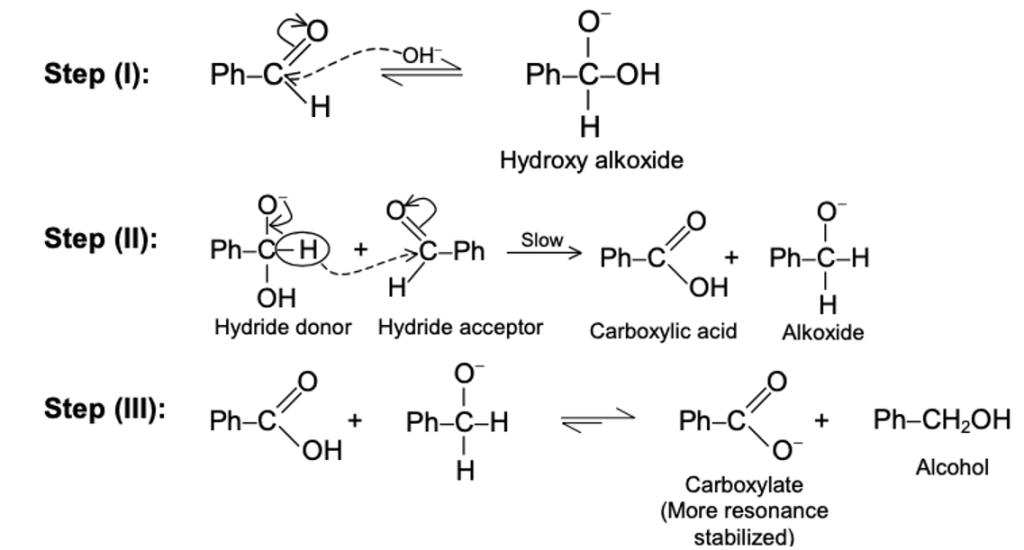
Definition: Cannizzaro reaction is a disproportionation reaction in which an aldehyde without α-hydrogen undergoes self oxidation–reduction in the presence of strong base (NaOH/KOH).
General Reaction
(One molecule is reduced → alcohol, other oxidized → carboxylate salt)
Key Conditions (VERY IMPORTANT for JEE)
Aldehyde must have NO α-H (alpha hydrogen)
Strong base: conc. NaOH or KOH
Usually occurs with:
Formaldehyde (HCHO)
Benzaldehyde (C₆H₅CHO)
Example
(Benzaldehyde → benzyl alcohol + sodium benzoate)
Mechanism (Conceptual Steps)
Nucleophilic attack of OH⁻ on aldehyde → alkoxide intermediate
Hydride transfer (H⁻ shift) from one molecule to another
Formation of:
Alcohol (reduction)
Carboxylate ion (oxidation)
Types of Cannizzaro Reaction
Self Cannizzaro Same aldehyde reacts Example: benzaldehyde
Cross Cannizzaro (Important!) Two different aldehydes
One should be formaldehyde (HCHO) (best reducing agent)
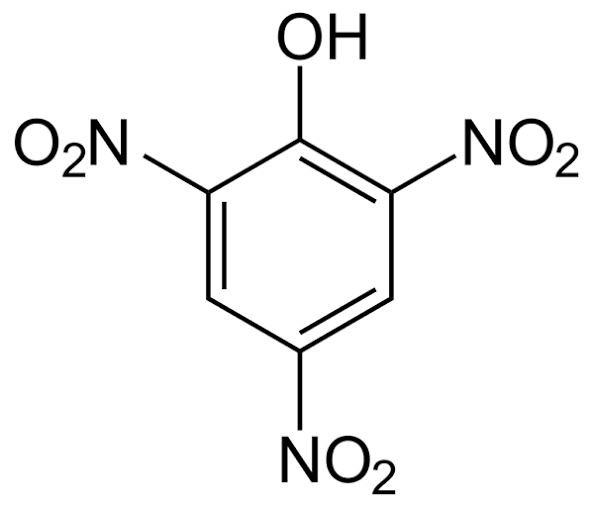
Picric acid has three –NO₂ groups which are strong electron-withdrawing groups.
These groups stabilize the conjugate base (picrate ion) by resonance and –I effect.
Formic acid has only one –COOH group, so its conjugate base is less stabilized.
Greater stabilization of conjugate base ⇒ higher acidity, so picric acid is stronger.
Picric Acid
HCOOH (Picric Acid)
Picric acid is soluble in NaHCO₃ solution?
Picric acid (2,4,6-trinitrophenol) is a strong acid due to the presence of three –NO₂ groups, which strongly withdraw electrons and stabilize the phenoxide ion. Because of this high acidity, it can react even with a weak base like NaHCO₃.