Sarvan Kumarhttp://sarvankumar.wordpress.comMy name is Sarvan Kumar, I am post graduate in chemistry (MSc). besides teaching chemistry at various schools and coaching centres I have been giving home tuitions to students for 10 years. I have helped students score good marks in chemistry not only in board examination but also JEE, NEET, SAT, IGCSE and IB examinations. Nearly 90% of my students have scored more than 95% in their CBSE board examination. Moreover they have also secured a seat in prestigious engineering and medical college.
Since every student is different hence my unique style of teach
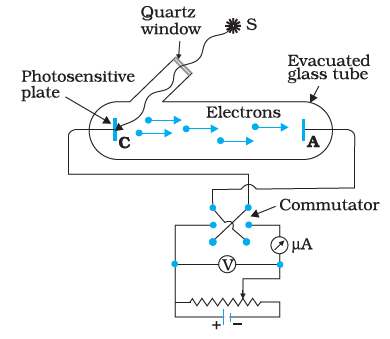
Experimental Arrangement for Study of Photoelectric Effect
Figure 11.1 shows the experimental setup used to study the photoelectric effect. The arrangement consists of an evacuated glass or quartz tube containing two metal plates:
Plate C → Photosensitive plate (Emitter)
Plate A → Collector plate
A source of monochromatic light (S) sends light through a quartz window onto the photosensitive plate (C).
Why is a quartz window used?
Quartz allows ultraviolet rays to pass through it, unlike ordinary glass. Since ultraviolet light is often needed to produce photoelectric emission, a quartz window is used.
Working of the Experiment
When light of sufficiently high frequency falls on the photosensitive plate (C):
Electrons are emitted from the surface of plate (C).
These emitted electrons are called photoelectrons.
A battery is connected between plates (A) and (C), creating an electric field.
If collector plate (A) is kept positive with respect to emitter plate (C), the emitted electrons are attracted towards plate (A).
Due to the movement of electrons, an electric current flows in the circuit. This current is called photoelectric current.
Measuring Instruments Used
Voltmeter (V): Measures the potential difference between plates (A) and (C).
Microammeter ((\mu A)): Measures the small photoelectric current flowing in the circuit.
Role of the Battery and Commutator
The battery maintains a variable potential difference between the two plates.
Using a commutator, the polarity of the plates can be reversed:
Plate (A) can be made positive or negative with respect to plate (C).
By changing the potential difference, the photoelectric current can be increased or decreased.
What Can Be Studied Using This Setup?
Using this arrangement, we can study how photocurrent depends on:
Intensity of incident light
Frequency of incident light
Potential difference between plates (A) and (C)
Nature of the photosensitive material
How Are Intensity and Frequency Varied?
(i) Changing Frequency
Different frequencies of light are obtained by using:
Coloured filters
Coloured glass plates
(ii) Changing Intensity
The intensity of light is changed by:
Varying the distance between the light source and the emitter plate
Important Point
Photoelectric emission occurs only when the incident light has frequency greater than a certain minimum value called the threshold frequency of the material.
Maxwell’s equations and the experiments of Heinrich Hertz in 1887 proved that light behaves as an electromagnetic wave.
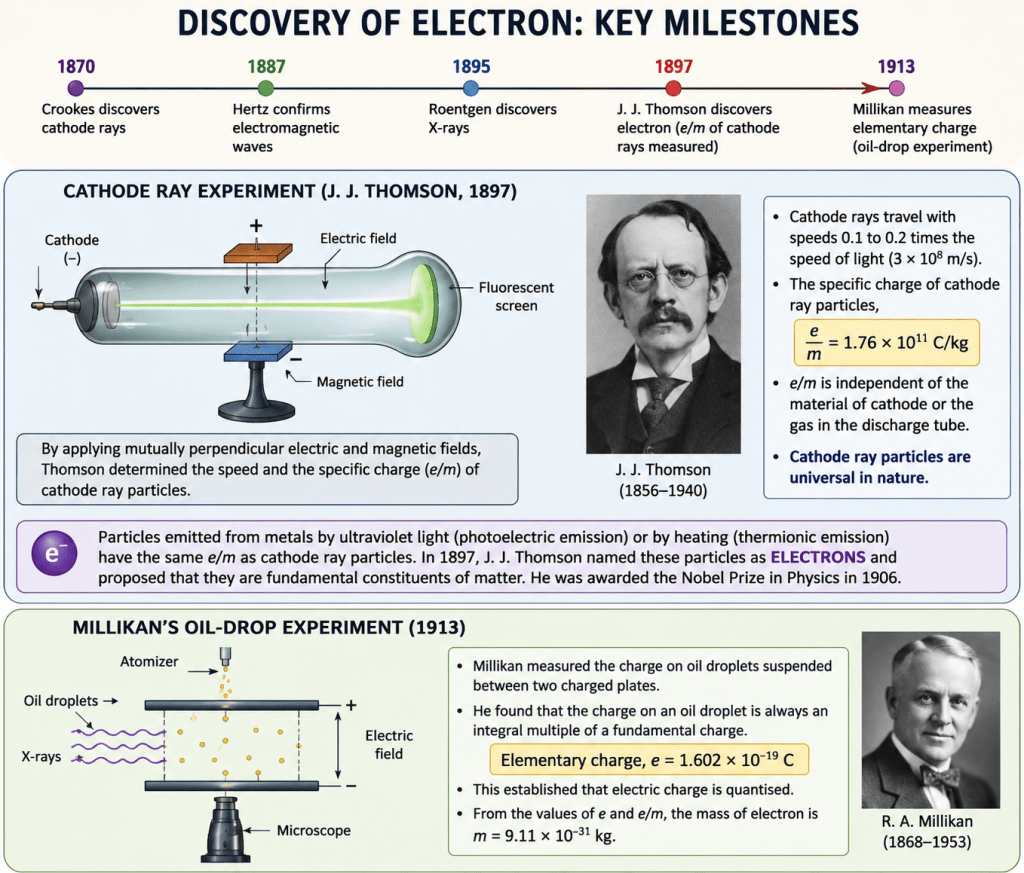
Experiments with electric discharge through gases at very low pressure helped scientists discover new particles and radiations.
Wilhelm Conrad Roentgen discovered X-rays in 1895.
J. J. Thomson discovered the electron in 1897.
In a discharge tube containing gas at very low pressure, applying a high electric field caused a discharge and produced a fluorescent glow on the glass wall opposite the cathode.
William Crookes discovered cathode rays in 1870 and proposed that they were streams of fast-moving negatively charged particles.
J. J. Thomson later confirmed this idea experimentally using electric and magnetic fields and measured the speed and charge-to-mass ratio of these particles, which were later called electrons.
This passage continues the story of the discovery of the electron and explains important experimental results.
Main points
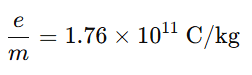
J. J. Thomson measured the specific charge of cathode ray particles:
The particles moved at speeds about .1C to .2C
where (c) is the speed of light.
The value of (e/m) was the same regardless of:
the metal used as the cathode,
or the gas inside the discharge tube.
This showed that cathode ray particles are universal and present in all matter.
Discovery of electrons from other experiments
Scientists also found that:
ultraviolet light falling on some metals caused emission of negative particles (photoelectric effect),
heated metals also emitted negative particles (thermionic emission).
The emitted particles had the same (e/m) ratio as cathode rays, proving they were identical.
Naming of the electron
In 1897, J. J. Thomson named these particles electrons and proposed that they are fundamental constituents of matter.
He received the Nobel Prize in Physics in 1906 for this work.
Millikan’s oil-drop experiment
In 1913, Robert Andrews Millikan measured the charge of the electron using the famous oil-drop experiment.
He found the elementary charge:
He also showed that electric charge is quantized, meaning charge always exists in whole-number multiples of this elementary charge.
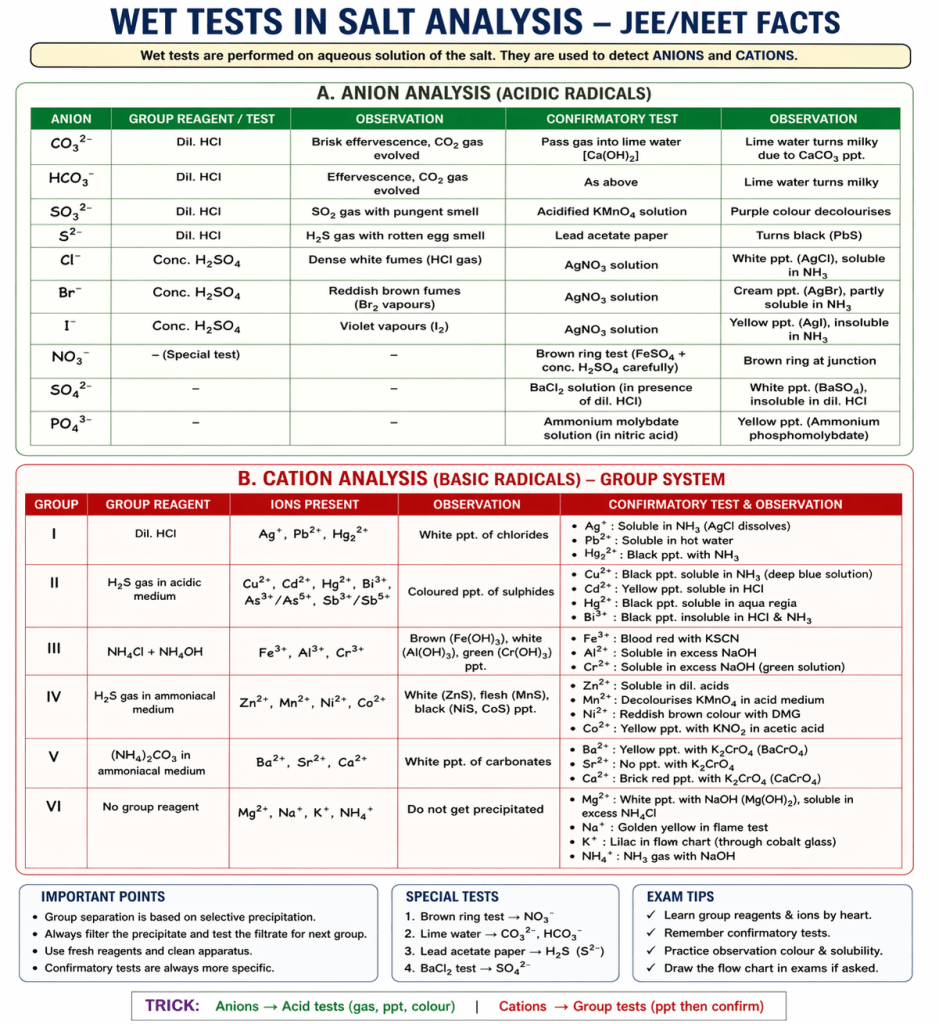
Salt analysis is a systematic method used to detect the cation and anion present in a given salt using dry and wet tests.
METHODS OF SALT ANALYSIS
1. Dry Tests
Flame test
Borax bead test
Charcoal cavity test
Cobalt nitrate test
Heating test
2. Wet Tests
Preliminary test (solubility test)
Anion analysis (acid radical tests)
Cation analysis (group analysis)
Confirmatory tests
3. Special Tests
Brown ring test
Lime water test
Chromyl chloride test
Lead acetate test
Nessler’s test
CATION GROUPS (Basic Radicals)
Group I (Dilute HCl group)
Ag⁺
Pb²⁺
Hg₂²⁺
Group II (H₂S in acidic medium)
Group II A (Copper group)
Cu²⁺
Cd²⁺
Hg²⁺
Pb²⁺
Bi³⁺
Group II B (Arsenic group)
As³⁺ / As⁵⁺
Sb³⁺ / Sb⁵⁺
Sn²⁺ / Sn⁴⁺
Group III (NH₄Cl + NH₄OH group)
Fe³⁺
Al³⁺
Cr³⁺
Group IV (H₂S in basic medium)
Zn²⁺
Mn²⁺
Ni²⁺
Co²⁺
Group V ((NH₄)₂CO₃ group)
Ba²⁺
Sr²⁺
Ca²⁺
Group VI (No group reagent)
Mg²⁺
Na⁺
K⁺
NH₄⁺
What is a Group Reagent?
A group reagent is a chemical reagent used in salt analysis to precipitate a specific group of cations together based on their similar properties.
Do anions have groups in salt analysis?
No, anions do not have a fixed “group system” like cations.
Why not?
Cations are grouped based on systematic precipitation using group reagents
Anions do not show such uniform precipitation behavior
Different anions require different specific tests
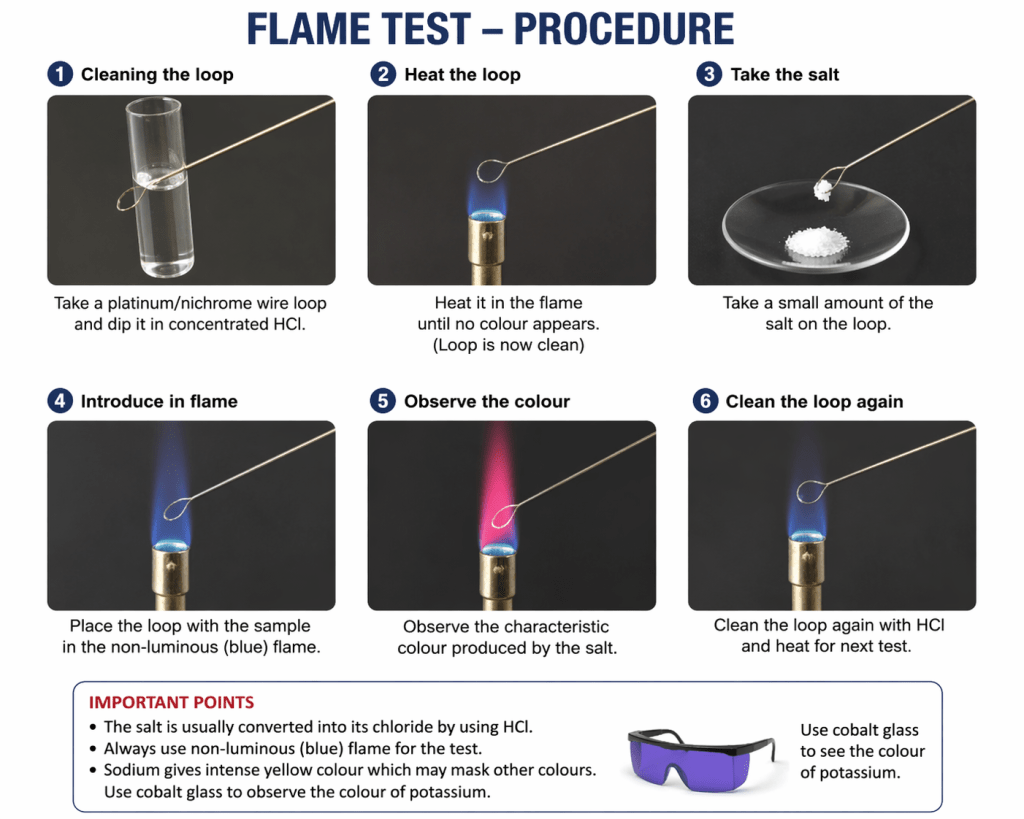
In qualitative analysis, dry tests are performed without dissolving the salt in solution. In a flame test, the salt (usually converted to its chloride) is directly heated in a flame, so it falls under dry tests. Flame test is done by heating a salt (on a clean wire loop with HCl) in a non-luminous flame and observing the characteristic color.
COMPLETE FLAME TEST LIST
1. Alkali Metals (Group 1) — Very important
Li⁺ (Lithium) → Crimson red
Na⁺ (Sodium) → Intense golden yellow
K⁺ (Potassium) → Lilac / pale violet (seen through cobalt glass)
Rb⁺ (Rubidium) → Red-violet
Cs⁺ (Caesium) → Blue-violet
2. Alkaline Earth Metals (Group 2)
Be²⁺ (Beryllium) → No colour
Mg²⁺ (Magnesium) → No colour
Ca²⁺ (Calcium) → Brick red (orange-red)
Sr²⁺ (Strontium) → Crimson red
Ba²⁺ (Barium) → Apple green
3. Transition & Post-Transition Metals
Cu⁺ / Cu²⁺ (Copper) → Bluish green
Pb²⁺ (Lead) → Bluish white (faint)
Tl⁺ (Thallium) → Bright green
Most others do NOT give a characteristic flame colour:
Fe²⁺ / Fe³⁺ → No colour
Co²⁺ → No colour
Ni²⁺ → No colour
Zn²⁺ → No colour
Mn²⁺ → No colour
Al³⁺ → No colour
4. Ions Showing NO Flame Colour (Important for elimination)
Be²⁺, Mg²⁺, Al³⁺
Zn²⁺, Fe²⁺/Fe³⁺, Co²⁺, Ni²⁺, Mn²⁺ Reason: emission not in visible region / weak excitation
IMPORTANT EXAM FACTS
1. Sodium Interference
Na⁺ gives very intense yellow
Masks all other colours
Solution: Use cobalt glass to detect K⁺
2. Why flame colour appears?
Due to electronic excitation and emission spectrum
3. Best observed for:
Volatile salts (usually chlorides)
What is a Wet Test?
A wet test is a method in salt analysis where the substance is first dissolved in a solvent (usually water or acid) and then tested using chemical reactions.
COLOURS OF CATION RADICALS
1. Coloured Ions (VERY IMPORTANT)
Cu²⁺ (Copper) → Blue solution
Fe²⁺ (Ferrous) → Pale green
Fe³⁺ (Ferric) → Yellow / brown
Ni²⁺ (Nickel) → Green
Co²⁺ (Cobalt) → Pink
Cr³⁺ (Chromium) → Green / violet
Mn²⁺ (Manganese) → Very pale pink
V³⁺ (Vanadium) → Green
Ti³⁺ (Titanium) → Purple
2. Colourless Ions (VERY COMMON MCQ)
Na⁺
K⁺
NH₄⁺
Mg²⁺
Ca²⁺
Ba²⁺
Sr²⁺
Al³⁺
Zn²⁺
3. Characteristic Precipitate Colours (IMPORTANT)
Ag⁺ → White ppt (AgCl)
Pb²⁺ → White ppt
Fe³⁺ → Reddish-brown ppt (Fe(OH)₃)
Fe²⁺ → Dirty green ppt (Fe(OH)₂)
Cu²⁺ → Blue ppt (Cu(OH)₂)
Ni²⁺ → Green ppt
Co²⁺ → Blue ppt (on heating)
Zn²⁺ → White ppt (Zn(OH)₂)
Al³⁺ → White gelatinous ppt
IMPORTANT EXAM POINTS
Colour is due to d–d transitions (transition metals)
d⁰ and d¹⁰ ions → colourless (Zn²⁺, Al³⁺ etc.)
Cu²⁺ always → blue solution (very important)
MOST ASKED
Blue solution → Cu²⁺
Green solution → Ni²⁺ / Fe²⁺ (trap!)
Pink → Co²⁺
Yellow/brown → Fe³⁺
SPECIAL REAGENTS – DETAILS
1. Nessler’s Reagent
Used for: Detection of NH₄⁺ (ammonium ion)
Composition
Alkaline solution of K₂HgI₄ (potassium mercuric iodide)
Observation
Brown colour / brown precipitate → NH₄⁺ present
Reaction idea
NH₃ (from NH₄⁺) reacts with Nessler’s reagent → coloured complex
One-line (viva)
Nessler’s reagent gives brown colour with ammonium ions.
2. FeSO₄ (Ferrous sulphate) – Brown Ring Test
Used for: Detection of NO₃⁻ (nitrate ion)
Reagents used
Fresh FeSO₄ solution
Concentrated H₂SO₄
Observation
Brown ring at junction of two layers
Key concept
Formation of nitrosyl complex
Important conditions
FeSO₄ must be fresh
H₂SO₄ added slowly along test tube wall
One-line (viva)
Brown ring test confirms presence of nitrate ion.
3. Copper Turnings Test
Used for: Detection of NO₃⁻ (nitrate ion)
Reagents used
Copper metal + conc. H₂SO₄
Observation
Brown fumes of NO₂ gas
Reaction idea
Nitrate gets reduced → NO₂ gas evolves
TEST FOR NICKEL (Ni²⁺) – KEY FACTS
1. Group Information
Group IV cation
Precipitated as NiS (black ppt) in basic medium (H₂S + NH₄OH)
2. Most Important Confirmatory Test
Dimethylglyoxime (DMG) Test
Reagent: Dimethylglyoxime (DMG) + NH₄OH
Observation:Bright red / rose-red precipitate
Compound formed: Nickel dimethylglyoxime complex
Very specific test for Ni²⁺
3. Reaction Idea
Ni²⁺ + DMG → Red complex (insoluble)
4. Other Supporting Facts
Ni²⁺ solution → Green colour
With NaOH → Green ppt (Ni(OH)₂)
With NH₄OH → forms complex (no ppt in excess)
What is Lake Test?
Lake test is used to detect Al³⁺ (aluminium ion) in salt analysis.
Principle
A lake is a coloured complex (dye + metal hydroxide) formed when a dye gets adsorbed on a gelatinous precipitate.
Procedure (short)
Add NH₄OH → forms Al(OH)₃ (white gelatinous ppt)
Add a dye (like alizarin / litmus)
Observation
Formation of a coloured “lake” (red/blue coloured ppt)
This confirms Al³⁺
Iodide of Millon’s base is involved in the Nessler’s reagent test.
In the test for NH4+ (ammonium ion), iodide of Millon’s base is involved in the Nessler’s reagent test.
Nessler’s Reagent (used for detection):
It contains alkaline solution of potassium tetraiodomercurate(II)
This is prepared using:
Mercury salts
Potassium iodide (KI)
KOH
During preparation, iodide of Millon’s base type species are formed.
Reaction with :
When ammonium ion is present:
Observation:
Brown precipitate forms This precipitate is called:
Iodide of Millon’s base
Charcoal Cavity Test (CCT)
The charcoal cavity test is a dry test in qualitative inorganic analysis used to detect certain metal ions (cations) by heating them in a small cavity made in charcoal.
Procedure:
A small cavity (hole) is made in a piece of charcoal
A pinch of the salt is placed in it
Heated strongly using a blowpipe flame
Sometimes mixed with sodium carbonate (Na₂CO₃)
Principle:
Charcoal acts as a reducing agent
On heating, metal compounds are reduced to metal or metal oxide
Different metals give characteristic residues / coatings
Observations (Important for exams):
Metal ion
Observation
Zn²⁺
Yellow when hot, white when cold (ZnO coating)
Pb²⁺
Yellow coating (PbO)
Cu²⁺
Red metallic bead (Cu)
Ag⁺
Shiny white metallic bead
Bi³⁺
Yellow coating
Borax Bead Test — Full Concept for JEE / NEET
This is one of the most important dry tests in qualitative analysis to identify transition metal ions.
What is Borax?
Borax = Sodium tetraborate
Principle (CORE CONCEPT)
On heating, borax decomposes to form boric anhydride which reacts with metal oxides:
Step 1: Heating borax
= boric anhydride (glassy mass)
Step 2: Reaction with metal oxide
Forms colored metaborate bead
Why color appears?
Due to transition metal ions
Caused by d–d electronic transitions
Flame Types (VERY IMPORTANT)
Flame type
Nature
Use
Oxidizing flame (O.F.)
Excess oxygen
Metal in higher oxidation state
Reducing flame (R.F.)
Less oxygen
Metal in lower oxidation state
Same metal → different color in OF & RF
Important Colors (JEE/NEET GOLD)
Metal ion
Oxidizing Flame
Reducing Flame
Cu²⁺
Blue-green
Red (Cu₂O / Cu)
Co²⁺
Deep blue
Deep blue
Cr³⁺
Green
Green
Fe³⁺
Yellow-brown
Bottle green
Mn²⁺
Amethyst (purple)
Colorless
Ni²⁺
Brown
Grey
V
Yellow
Green
Procedure (Short)
Take a platinum wire loop
Dip in borax → heat → forms colorless bead
Add salt → heat in O.F. & R.F.
Observe color
Key Points (Exam Focus)
Works mainly for transition metals
Bead = transparent glassy mass
Color depends on:
Metal ion
Oxidation state
Flame type
Cobalt always gives blue → very important MCQ
Common Mistakes Students Make
Ignoring reducing flame colors
Confusing Cu and Cr colors
Forgetting Mn becomes colorless in R.F.
Different Zones of Flame (very important for JEE/NEET)
1. Inner Zone (Dark Zone)
Location: Innermost part near burner
Color: Dark / almost invisible
Temperature: Lowest
Nature:Unburnt gases present (no combustion)
Contains mixture of fuel gas + air No practical use in tests

 onto the photosensitive plate (C).