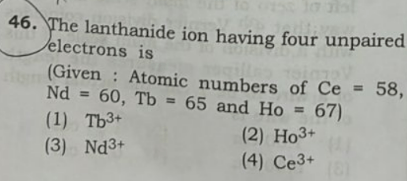
The lanthanide ion having four unpaired electrons is(Given : Atomic numbers of Ce = 58, Nd = 60, Tb = 65 and Ho = 67)

The Lanthanide Ion Having Four Unpaired Electrons

Question

The lanthanide ion having four unpaired electrons is:

  1. Tb³⁺
  2. Ho³⁺
  3. Nd³⁺
  4. Ce³⁺

Given: Atomic numbers
Ce = 58, Nd = 60, Tb = 65, Ho = 67


Step 1: Write the electronic configuration of Ln³⁺ ions

In lanthanides, the 6s electrons and one 5d electron (if present) are removed first to form the +3 ion.

Ce³⁺ (Z = 58)

Ce = [Xe] 4f¹5d¹6s²

Ce³⁺ = [Xe] 4f¹

Number of unpaired electrons = 1


Nd³⁺ (Z = 60)

Nd = [Xe] 4f⁴6s²

Nd³⁺ = [Xe] 4f³

Number of unpaired electrons = 3


Tb³⁺ (Z = 65)

Tb = [Xe] 4f⁹6s²

Tb³⁺ = [Xe] 4f⁸

For 4f⁸ configuration:

  • Seven f-orbitals are first singly occupied.
  • The eighth electron pairs up in one orbital.

Therefore, unpaired electrons = 6


Ho³⁺ (Z = 67)

Ho = [Xe] 4f¹¹6s²

Ho³⁺ = [Xe] 4f¹⁰

For 4f¹⁰ configuration:

  • Seven electrons occupy seven orbitals singly.
  • Three additional electrons pair up in three orbitals.

Therefore, unpaired electrons = 4


Step 2: Compare the number of unpaired electrons

IonConfigurationUnpaired Electrons
Ce³⁺4f¹1
Nd³⁺4f³3
Tb³⁺4f⁸6
Ho³⁺4f¹⁰4

Answer

Ho³⁺ has four unpaired electrons.

Correct Option: (2) Ho³⁺

Quick Trick: For an fⁿ configuration,

  • If n ≤ 7, unpaired electrons = n
  • If n > 7, unpaired electrons = 14 − n

For Ho³⁺: 4f¹⁰ → 14 − 10 = 4 unpaired electrons. ✔️

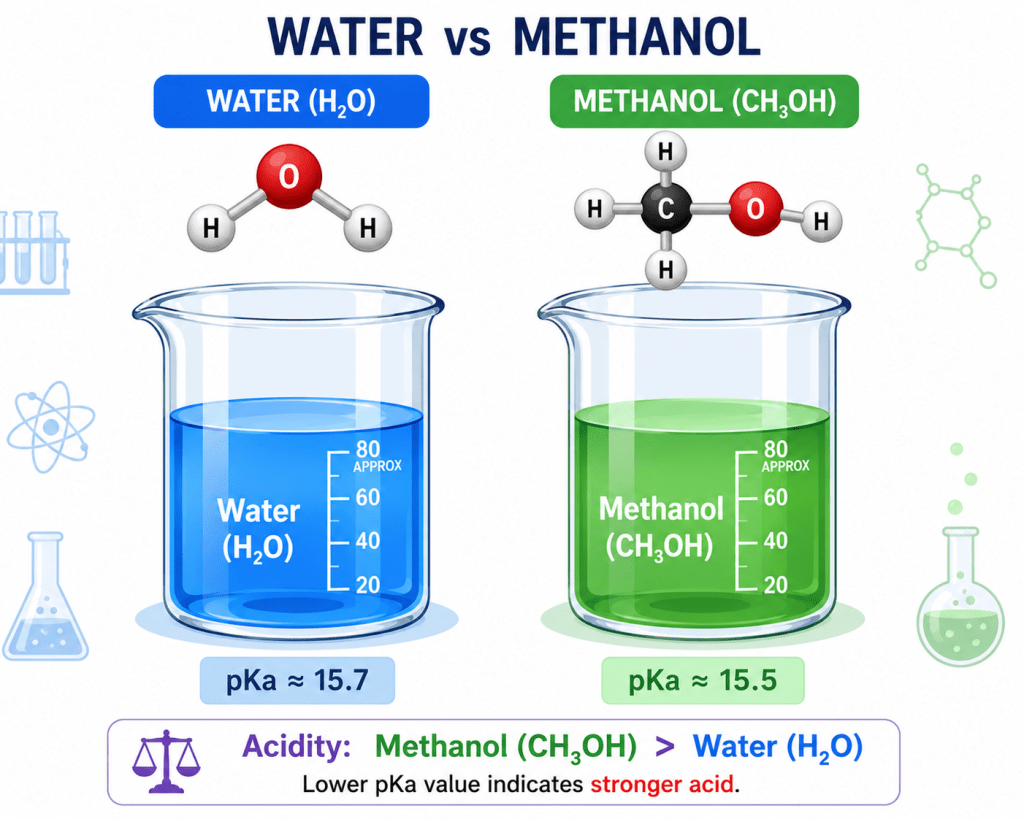
Determine whether methanol is more acidic than water ?

Methanol (CH₃OH) is actually slightly more acidic than water (H₂O), but the difference is relatively small.

The acidity of a substance is typically measured by its pKa value, which is a measure of the strength of an acid. A lower pKa value indicates a stronger acid. The pKa value of methanol is around 15.5, while the pKa value of water is around 15.7. This means that methanol is slightly more acidic than water, but the difference is relatively small.

The total number of isomers possible for the organic compounds JEE/NEET

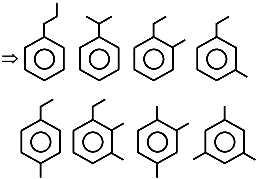
  1. The total number of structural isomers possible for the substituted benzene derivatives with the molecular formula C9 H12 is

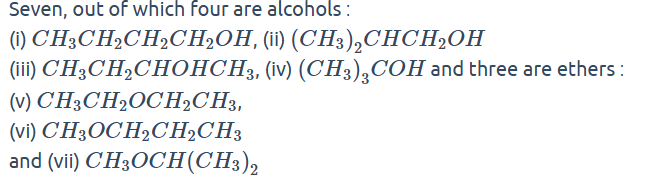
2. The total number of acyclic structural isomers possible for compound with molecular formula C4H10O is

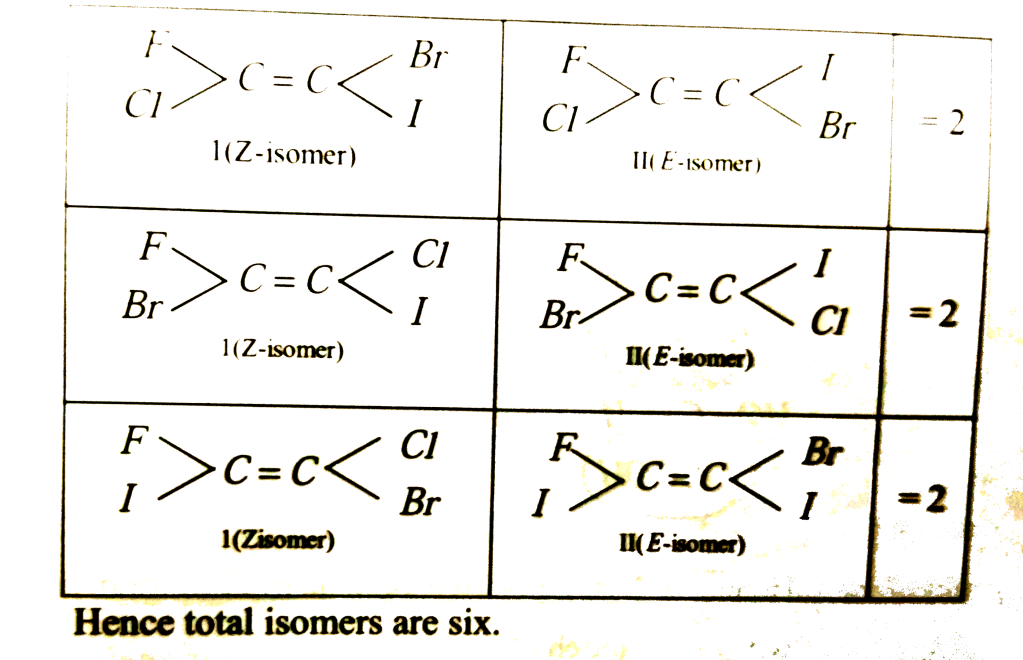
3. The number of isomers for the compound with molecular formula  is C2BrClFI

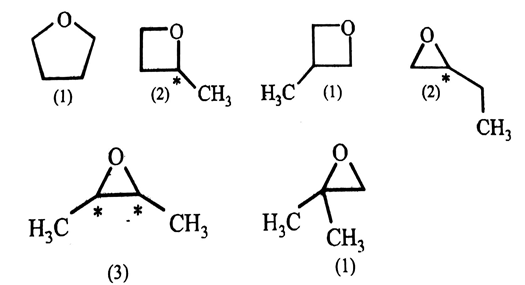
4. Total number of possible isomers (both structural as well as stereoisomers) of cyclic ethers of molecular formula  is :

The ether with 2 chiral carbons has a plane of symmetry in Cis-configuration. Therefore, it will have 3 stereo-isomers. Total isomers = 1+2+1+2+3+1=10

Actinoids (5f-Series) – Important Facts for JEE/NEET & NCERT

Structure & Physical Properties

  1. All actinoid metals are silvery in appearance.
  2. They show greater structural variability than lanthanoids.
  3. Their metallic radii vary irregularly, much more than in lanthanoids.
  4. They are generally dense metals with high melting points.

Chemical Reactivity

  1. Actinoids are highly reactive metals, especially in finely divided form.
  2. They react with boiling water to form a mixture of oxide and hydride.
  3. They combine readily with most non-metals at moderate temperatures.
  4. Hydrochloric acid (HCl) attacks all actinoid metals.
  5. Most actinoids are only slightly affected by nitric acid (HNO₃) due to formation of a protective oxide layer.
  6. Alkalies (NaOH, KOH) generally have no action on actinoids.

Magnetic Properties

  1. Magnetic properties of actinoids are more complex than those of lanthanoids.
  2. Magnetic susceptibility generally increases with the number of unpaired 5f electrons.
  3. For comparable electronic configurations, lanthanoids show higher magnetic susceptibility than actinoids.

Ionisation Enthalpy & Bonding

  1. Early actinoids have lower ionisation enthalpies than corresponding lanthanoids.
  2. 5f orbitals are less penetrating than 4f orbitals.
  3. 5f electrons are more effectively shielded from nuclear charge.
  4. Outer electrons are less firmly held and participate more readily in bonding.
  5. Therefore, actinoids show greater covalent character and variable oxidation states.

Comparison with Lanthanoids

  1. Early actinoids differ significantly from lanthanoids.
  2. Similarity with lanthanoids becomes more evident in the second half of the actinoid series.
  3. Like lanthanoids, actinoids show close similarities among themselves.
  4. Their properties change gradually across the series.

Actinoid Contraction

  1. Actinoids exhibit actinoid contraction (decrease in atomic/ionic radii across the series).
  2. Actinoid contraction affects the sizes and properties of succeeding elements.
  3. Similar to lanthanoid contraction, but its effects are less studied because heavier elements are less well known.
  4. Lanthanoid contraction is considered more important due to its greater impact on well-studied elements.

One-Line NCERT Facts

  • All actinoids are radioactive.
  • Actinoids show a wider range of oxidation states (+3 to +7) than lanthanoids.
  • Actinoids are more reactive than lanthanoids.
  • 5f electrons participate in bonding more readily than 4f electrons.
  • Actinoid contraction occurs due to poor shielding by 5f electrons

Aromaticity (JEE/NEET Quick Revision)

Aromaticity = extra stability shown by certain cyclic compounds due to delocalization of π-electrons.

4 Conditions for Aromaticity

A compound must be:

  1. Cyclic (ring structure)
  2. Planar (all atoms in one plane)
  3. Fully conjugated (continuous p-orbitals)
  4. Have (4n + 2) π electrons (Hückel Rule)

Hückel Rule

4n+2

Values of π electrons:

  • n = 0 → 2 π e⁻
  • n = 1 → 6 π e⁻
  • n = 2 → 10 π e⁻
  • n = 3 → 14 π e⁻

These are aromatic. (Chemistry LibreTexts)


Antiaromatic Compounds

Must be:

  • Cyclic
  • Planar
  • Fully conjugated
  • Have 4n π electrons

Examples:

  • Cyclobutadiene (4 π e⁻)
  • Cyclopentadienyl cation (4 π e⁻)

Very unstable.

Antiaromatic Rule

4n


Non-Aromatic Compounds

If any one condition fails:

  • Not planar OR
  • Not cyclic OR
  • Not fully conjugated

Examples:

  • Cyclooctatetraene (non-planar)
  • Cyclohexene

Non-aromatic compounds are neither specially stable nor specially unstable.


JEE/NEET Electron Counting Tricks

π-electrons contributed by:

Speciesπ electrons
Double bond2
Negative charge in p-orbital2
Positive charge0
Radical1
Pyrrole-type lone pair2
Pyridine-type lone pair0

Important Aromatic Species

✅ Benzene → 6 π e⁻

✅ Cyclopropenyl cation (C₃H₃⁺) → 2 π e⁻

✅ Cyclopentadienyl anion (C₅H₅⁻) → 6 π e⁻

✅ Tropylium ion (C₇H₇⁺) → 6 π e⁻

✅ Naphthalene → 10 π e⁻

✅ Pyridine, Pyrrole, Furan, Thiophene → Aromatic


Most Important JEE/NEET Shortcut

CAP + H Rule

Check in this order:

C = Cyclic
A = All atoms conjugated
P = Planar
H = Hückel (4n+2)

If all four satisfy → Aromatic

If CAP satisfies but H gives 4n → Antiaromatic

If CAP itself fails → Non-aromatic


Frequently Asked Examples

CompoundNature
BenzeneAromatic
CyclobutadieneAntiaromatic
CyclooctatetraeneNon-aromatic
Cyclopentadienyl anionAromatic
Cyclopentadienyl cationAntiaromatic
Tropylium ionAromatic

For JEE/NEET, remember this table:

CompoundLone pairs on heteroatomLone pairs involved in aromatic resonanceLone pairs NOT involved
Pyridine101
Pyrrole110
Furan211
Thiophene211

Why?

Pyridine

  • N is sp² hybridized.
  • Its lone pair lies in an sp² orbital (in the plane of the ring).
  • It does not participate in resonance.
  • Aromatic π-electrons = 6 from three double bonds only.

Pyrrole

  • N forms three σ bonds.
  • Its lone pair occupies a p-orbital perpendicular to the ring.
  • It participates in resonance.
  • Aromatic π-electrons = 4 (from two double bonds) + 2 (from lone pair) = 6.

Furan

  • O has two lone pairs.
  • One lone pair is in a p-orbital and participates in resonance.
  • The other is in an sp² orbital and does not participate.
  • Aromatic π-electrons = 4 + 2 = 6.

Thiophene

  • S has two lone pairs.
  • One lone pair participates in the aromatic π-system.
  • One lone pair remains localized.
  • Aromatic π-electrons = 4 + 2 = 6.

Quick Memory Trick

Pyridine → 0 LP involved
Pyrrole → 1 LP involved
Furan → 1 of 2 LPs involved
Thiophene → 1 of 2 LPs involved

So the answer is:

Pyridine = 0, Pyrrole = 1, Furan = 1, Thiophene = 1 lone pair involved in resonance.

CBSE Class 12 Biology – Population Interactions & Predation (Point-wise Notes)

Life History Variation

  • Populations evolve to maximize reproductive fitness (Darwinian fitness).
  • Darwinian fitness is associated with a high intrinsic rate of increase (r).
  • Organisms evolve reproductive strategies according to habitat conditions.
  • Some organisms breed once in a lifetime (Semelparity):
    • Pacific salmon fish
    • Bamboo
  • Some organisms breed many times in a lifetime (Iteroparity):
    • Most birds
    • Most mammals
  • Some produce many small offspring:
    • Oysters
    • Pelagic fishes
  • Some produce few large offspring:
    • Birds
    • Mammals
  • Life-history traits evolve due to biotic and abiotic constraints of the habitat.

Population Interactions

  • Interaction between populations of different species is called interspecific interaction.
  • Interactions may be:
    • Beneficial (+)
    • Harmful (−)
    • Neutral (0)

Types of Population Interactions

InteractionEffect
Mutualism(+,+)
Competition(−,−)
Predation(+,−)
Parasitism(+,−)
Commensalism(+,0)
Amensalism(−,0)

Predation

  • Predation is an interaction where:
    • Predator benefits (+)
    • Prey is harmed (−)
  • Predators transfer energy from lower to higher trophic levels.
  • Herbivores are also considered predators in a broad ecological sense.

Ecological Importance of Predators

  • Control prey population size.
  • Prevent ecosystem instability.
  • Maintain species diversity.
  • Reduce competition among prey species.
  • Used in biological control of pests.

NCERT Examples

Prickly Pear Cactus

  • Introduced into Australia.
  • Became invasive and spread rapidly.
  • Controlled by introducing a cactus-feeding moth.

Starfish (Pisaster)

  • Important predator in rocky intertidal communities.
  • Removal led to extinction of more than 10 invertebrate species due to competition.

Prey Adaptations Against Predation

Camouflage

  • Insects and frogs use cryptic colouration.
  • Helps avoid detection by predators.

Chemical Defence

  • Some animals are poisonous.
  • Predators avoid them.

Monarch Butterfly

  • Distasteful to birds.
  • Obtains toxic chemicals during caterpillar stage from poisonous weeds.

Plant Defences Against Herbivores

Morphological Defence

  • Thorns in:
    • Acacia
    • Cactus

Chemical Defence

  • Toxic chemicals:
    • Inhibit feeding
    • Inhibit digestion
    • Disrupt reproduction
    • May kill herbivores

Calotropis

  • Produces poisonous cardiac glycosides.
  • Avoided by cattle and goats.

Important Plant Defence Chemicals

  • Nicotine
  • Caffeine
  • Quinine
  • Strychnine
  • Opium

CBSE Exam One-Liners

  • Darwinian fitness = Reproductive success of an organism.
  • Predation = (+,−) interaction.
  • Mutualism = (+,+) interaction.
  • Competition = (−,−) interaction.
  • Commensalism = (+,0) interaction.
  • Amensalism = (−,0) interaction.
  • Pisaster is a keystone predator.
  • Monarch butterfly is protected by toxic chemicals.
  • Calotropis contains cardiac glycosides.
  • Prickly pear cactus in Australia was controlled by a cactus-feeding moth.

Logistic Growth chemistry class 12 notes

Logistic Growth (English Notes)

Key Terms

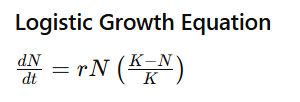
  • N = Population size (population density)
  • r = Intrinsic rate of natural increase
  • K = Carrying capacity (maximum population that a habitat can support)
  • dN/dt = Population growth rate

Characteristics of Logistic Growth

  1. Resources are limited.
  2. Individuals compete for food, water, space, etc.
  3. Population cannot grow indefinitely.
  4. Growth rate decreases as population approaches carrying capacity (K).
  5. Produces an S-shaped (Sigmoid) growth curve.
  6. Also called Verhulst–Pearl Logistic Growth.
  7. Considered a more realistic model than exponential growth.

Phases of Logistic Growth

  1. Lag Phase – Slow initial growth.
  2. Acceleration (Log/Exponential) Phase – Rapid increase in population.
  3. Deceleration Phase – Growth rate slows due to resource limitation.
  4. Stationary (Asymptote) Phase – Population reaches carrying capacity (K).


Important Conditions

  • N << K → Growth is nearly exponential.
  • N = K → Population growth rate = 0.
  • N > K → Population tends to decrease toward K.

NEET Important Points

  • Curve shape: Sigmoid (S-shaped)
  • Carrying capacity: K
  • Growth rate maximum at intermediate population size.
  • Most natural populations follow logistic growth.
  • Logistic growth occurs due to limited resources and competition.

JEE Advanced 2026 Results: Toppers Inspire the Next Generation of Engineers


By Sarvan Kumar (Chemistry Teacher)

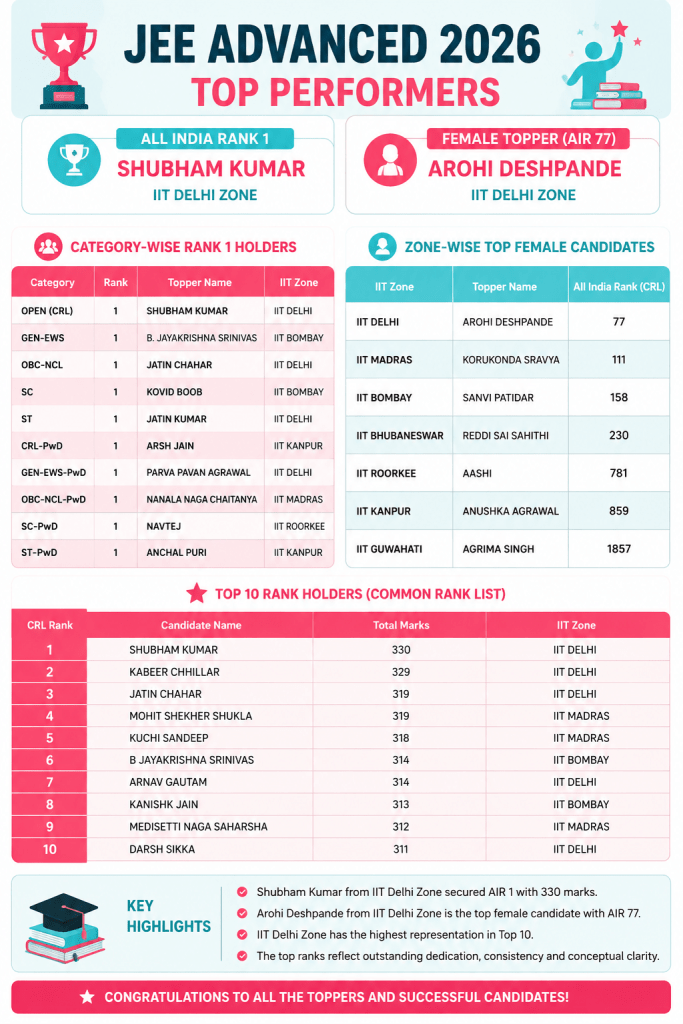
The JEE Advanced 2026 results have been declared by IIT Roorkee, bringing joy and motivation to lakhs of engineering aspirants across the country. This year witnessed outstanding performances from students across various IIT zones and categories, highlighting the importance of dedication, consistency, and conceptual clarity.

AIR 1: Shubham Kumar Tops JEE Advanced 2026

The prestigious All India Rank (AIR) 1 was secured by Shubham Kumar from the IIT Delhi Zone, making him the national topper of JEE Advanced 2026. His achievement stands as a testament to disciplined preparation and hard work.

Female Topper of JEE Advanced 2026

Among female candidates, Arohi Deshpande from the IIT Delhi Zone emerged as the highest-ranked girl candidate with an impressive AIR 77. Her success is an inspiration for countless young aspirants aiming for the IITs.

Category-Wise Rank 1 Holders

Category Rank 1 Candidate

Open (CRL) Shubham Kumar
GEN-EWS B. Jayakrishna Srinivas
OBC-NCL Jatin Chahar
SC Kovid Boob
ST Jatin Kumar
CRL-PwD Arsh Jain
GEN-EWS-PwD Parva Pavan Agrawal
OBC-NCL-PwD Nanala Naga Chaitanya
SC-PwD Navtej
ST-PwD Anchal Puri


—

Zone-Wise Top Female Candidates

The achievements of female candidates across different IIT zones deserve special recognition. Here are the top-ranked girls from various zones:

IIT Zone Top Female Candidate AIR (CRL)

IIT Delhi Arohi Deshpande 77
IIT Madras Korukonda Sravya 111
IIT Bombay Sanvi Patidar 158
IIT Bhubaneswar Reddi Sai Sahithi 230
IIT Roorkee Aashi 781
IIT Kanpur Anushka Agrawal 859
IIT Guwahati Agrima Singh 1857


Lessons for JEE Aspirants

Every topper’s journey teaches valuable lessons:

Build strong concepts rather than relying on rote learning.

Practice regularly and analyze mistakes.

Revise consistently throughout the year.

Maintain discipline and a positive mindset.

Focus on understanding rather than memorization.


As a chemistry teacher, I have observed that students who master the fundamentals of Physics, Chemistry, and Mathematics are better equipped to tackle the challenging questions asked in JEE Advanced.

Top 10 Rank Holders of JEE Advanced 2026


The competition at the top was extremely intense, with several candidates scoring above 310 marks. The top 10 candidates in the Common Rank List (CRL) are:

AIR Candidate Name Marks IIT Zone

1 Shubham Kumar 330 IIT Delhi
2 Kabeer Chhillar 329 IIT Delhi
3 Jatin Chahar 319 IIT Delhi
4 Mohit Shekher Shukla 319 IIT Madras
5 Kuchi Sandeep 318 IIT Madras
6 B. Jayakrishna Srinivas 314 IIT Bombay
7 Arnav Gautam 314 IIT Delhi
8 Kanishk Jain 313 IIT Bombay
9 Medisetti Naga Saharsha 312 IIT Madras
10 Darsh Sikka 311 IIT Delhi


Key Highlights

Shubham Kumar secured AIR 1 with an outstanding 330 marks.

The battle for the top ranks was extremely close, with only 1 mark separating AIR 1 and AIR 2.

IIT Delhi Zone dominated the top ranks, producing 5 candidates in the Top 10.

Candidates from IIT Madras and IIT Bombay Zones also delivered exceptional performances.

Four students scored 314 marks or higher, showcasing the high level of competition among the country’s best engineering aspirants.


Performance Analysis of Top 10 Candidates

A closer look at the Top 10 list reveals that excellence in JEE Advanced requires not only strong subject knowledge but also exceptional problem-solving skills and accuracy under pressure. The narrow mark differences among the leading candidates demonstrate how every single question can influence the final rank.

For future JEE aspirants, these results emphasize the importance of:

Strong conceptual understanding in Physics, Chemistry, and Mathematics.

Consistent revision and mock-test practice.

Effective time management during the examination.

Maintaining accuracy while attempting challenging questions.


As a Chemistry teacher, I believe that these remarkable achievements should motivate every serious JEE aspirant to stay focused on their goals and trust the preparation process.

Congratulations to all the toppers and successful candidates of JEE Advanced 2026!

— Sarvan Kumar
Chemistry Teacher | Mentor for JEE & NEET Aspirants

A Message to Future JEE Aspirants

The success stories of the JEE Advanced 2026 toppers prove that extraordinary results are achieved through consistent effort, smart study strategies, and perseverance. Whether your goal is IIT Delhi, Bombay, Madras, Kanpur, Roorkee, or any other premier institute, your preparation today will shape your future tomorrow.

Congratulations to all successful candidates and best wishes to every student preparing for JEE Advanced 2027 and beyond.

– Sarvan Kumar
Chemistry Teacher | Mentor for JEE & NEET Aspirants

JEE Advanced 2026 Results: Toppers Inspire the Next Generation of Engineers


By Sarvan Kumar (Chemistry Teacher)

The JEE Advanced 2026 results have been declared by IIT Roorkee, bringing joy and motivation to lakhs of engineering aspirants across the country. This year witnessed outstanding performances from students across various IIT zones and categories, highlighting the importance of dedication, consistency, and conceptual clarity.

AIR 1: Shubham Kumar Tops JEE Advanced 2026

The prestigious All India Rank (AIR) 1 was secured by Shubham Kumar from the IIT Delhi Zone, making him the national topper of JEE Advanced 2026. His achievement stands as a testament to disciplined preparation and hard work.

Female Topper of JEE Advanced 2026

Among female candidates, Arohi Deshpande from the IIT Delhi Zone emerged as the highest-ranked girl candidate with an impressive AIR 77. Her success is an inspiration for countless young aspirants aiming for the IITs.

Category-Wise Rank 1 Holders

Category Rank 1 Candidate

Open (CRL) Shubham Kumar
GEN-EWS B. Jayakrishna Srinivas
OBC-NCL Jatin Chahar
SC Kovid Boob
ST Jatin Kumar
CRL-PwD Arsh Jain
GEN-EWS-PwD Parva Pavan Agrawal
OBC-NCL-PwD Nanala Naga Chaitanya
SC-PwD Navtej
ST-PwD Anchal Puri


—

Zone-Wise Top Female Candidates

The achievements of female candidates across different IIT zones deserve special recognition. Here are the top-ranked girls from various zones:

IIT Zone Top Female Candidate AIR (CRL)

IIT Delhi Arohi Deshpande 77
IIT Madras Korukonda Sravya 111
IIT Bombay Sanvi Patidar 158
IIT Bhubaneswar Reddi Sai Sahithi 230
IIT Roorkee Aashi 781
IIT Kanpur Anushka Agrawal 859
IIT Guwahati Agrima Singh 1857


Lessons for JEE Aspirants

Every topper’s journey teaches valuable lessons:

Build strong concepts rather than relying on rote learning.

Practice regularly and analyze mistakes.

Revise consistently throughout the year.

Maintain discipline and a positive mindset.

Focus on understanding rather than memorization.


As a chemistry teacher, I have observed that students who master the fundamentals of Physics, Chemistry, and Mathematics are better equipped to tackle the challenging questions asked in JEE Advanced.

Top 10 Rank Holders of JEE Advanced 2026


The competition at the top was extremely intense, with several candidates scoring above 310 marks. The top 10 candidates in the Common Rank List (CRL) are:

AIR Candidate Name Marks IIT Zone

1 Shubham Kumar 330 IIT Delhi
2 Kabeer Chhillar 329 IIT Delhi
3 Jatin Chahar 319 IIT Delhi
4 Mohit Shekher Shukla 319 IIT Madras
5 Kuchi Sandeep 318 IIT Madras
6 B. Jayakrishna Srinivas 314 IIT Bombay
7 Arnav Gautam 314 IIT Delhi
8 Kanishk Jain 313 IIT Bombay
9 Medisetti Naga Saharsha 312 IIT Madras
10 Darsh Sikka 311 IIT Delhi


Key Highlights

Shubham Kumar secured AIR 1 with an outstanding 330 marks.

The battle for the top ranks was extremely close, with only 1 mark separating AIR 1 and AIR 2.

IIT Delhi Zone dominated the top ranks, producing 5 candidates in the Top 10.

Candidates from IIT Madras and IIT Bombay Zones also delivered exceptional performances.

Four students scored 314 marks or higher, showcasing the high level of competition among the country’s best engineering aspirants.


Performance Analysis of Top 10 Candidates

A closer look at the Top 10 list reveals that excellence in JEE Advanced requires not only strong subject knowledge but also exceptional problem-solving skills and accuracy under pressure. The narrow mark differences among the leading candidates demonstrate how every single question can influence the final rank.

For future JEE aspirants, these results emphasize the importance of:

Strong conceptual understanding in Physics, Chemistry, and Mathematics.

Consistent revision and mock-test practice.

Effective time management during the examination.

Maintaining accuracy while attempting challenging questions.


As a Chemistry teacher, I believe that these remarkable achievements should motivate every serious JEE aspirant to stay focused on their goals and trust the preparation process.

Congratulations to all the toppers and successful candidates of JEE Advanced 2026!

— Sarvan Kumar
Chemistry Teacher | Mentor for JEE & NEET Aspirants

A Message to Future JEE Aspirants

The success stories of the JEE Advanced 2026 toppers prove that extraordinary results are achieved through consistent effort, smart study strategies, and perseverance. Whether your goal is IIT Delhi, Bombay, Madras, Kanpur, Roorkee, or any other premier institute, your preparation today will shape your future tomorrow.

Congratulations to all successful candidates and best wishes to every student preparing for JEE Advanced 2027 and beyond.
– Sarvan Kumar
Chemistry Teacher | Mentor for JEE & NEET Aspirants