
Logistic Growth (English Notes)
Key Terms
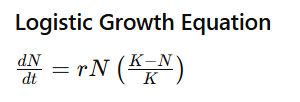
- N = Population size (population density)
- r = Intrinsic rate of natural increase
- K = Carrying capacity (maximum population that a habitat can support)
- dN/dt = Population growth rate
Characteristics of Logistic Growth
- Resources are limited.
- Individuals compete for food, water, space, etc.
- Population cannot grow indefinitely.
- Growth rate decreases as population approaches carrying capacity (K).
- Produces an S-shaped (Sigmoid) growth curve.
- Also called Verhulst–Pearl Logistic Growth.
- Considered a more realistic model than exponential growth.
Phases of Logistic Growth
- Lag Phase – Slow initial growth.
- Acceleration (Log/Exponential) Phase – Rapid increase in population.
- Deceleration Phase – Growth rate slows due to resource limitation.
- Stationary (Asymptote) Phase – Population reaches carrying capacity (K).
Important Conditions
- N << K → Growth is nearly exponential.
- N = K → Population growth rate = 0.
- N > K → Population tends to decrease toward K.
NEET Important Points
- Curve shape: Sigmoid (S-shaped)
- Carrying capacity: K
- Growth rate maximum at intermediate population size.
- Most natural populations follow logistic growth.
- Logistic growth occurs due to limited resources and competition.

