Radial Probability and Radial Probability Density
1. Radial Probability
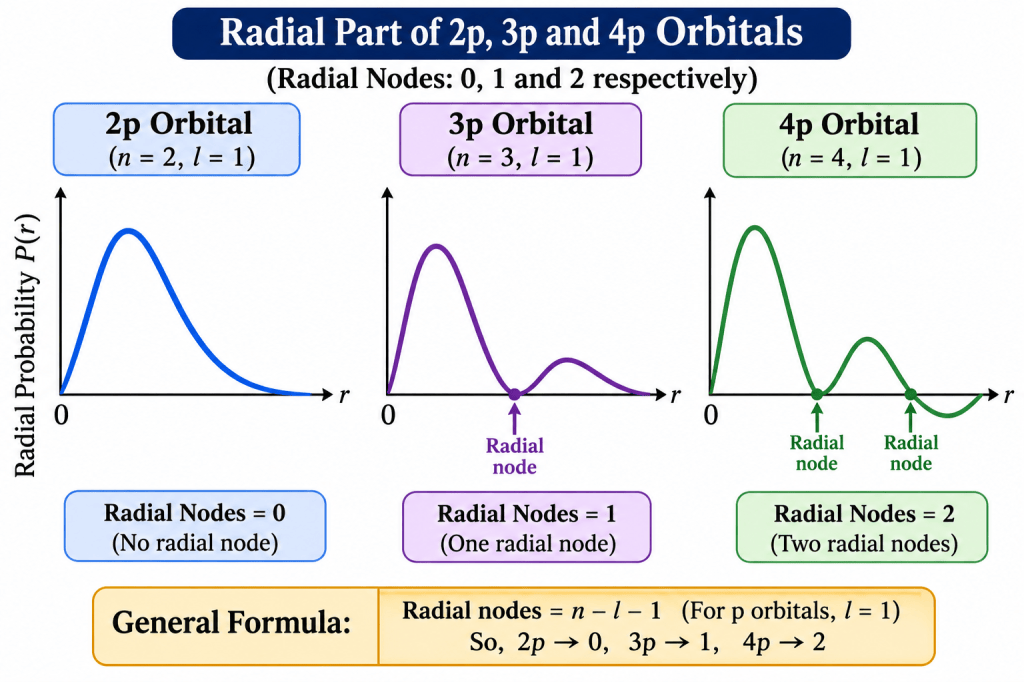
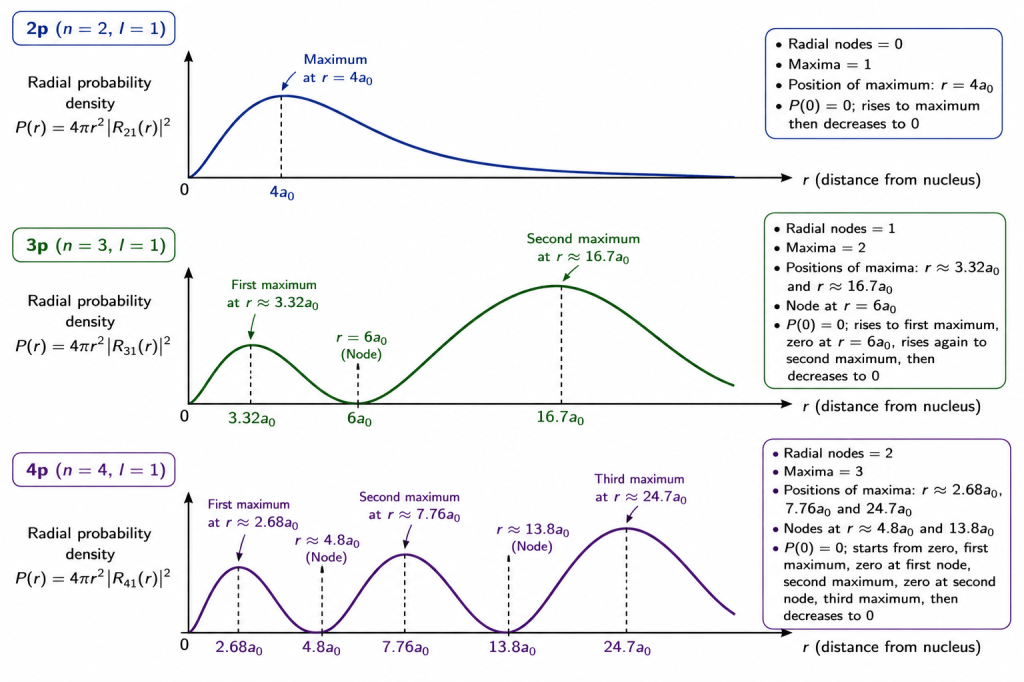
Radial probability refers to the probability of finding an electron within a spherical shell of radius r and thickness dr around the nucleus.
- It depends on the distance of the electron from the nucleus.
- It is represented by P(r).
- It is obtained by multiplying the probability density by the volume of the spherical shell.
- The radial probability is maximum at the most probable distance from the nucleus.
Formula:
P(r) dr = 4πr² |ψ|² dr
2. Radial Probability Density
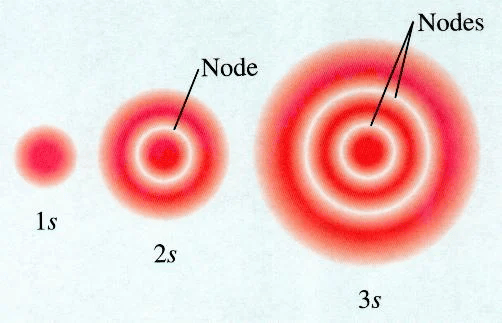
Radial probability density represents the probability of finding an electron per unit volume at a particular distance from the nucleus.
- It depends on the square of the radial wave function.
- It is represented by |ψ|² for a spherically symmetric orbital.
- It does not include the volume factor 4πr².
- It is maximum where the probability density is highest.
Formula:
Radial probability density = |ψ|²
Difference Between Radial Probability and Radial Probability Density
| Radial Probability | Radial Probability Density | ||
|---|---|---|---|
| Probability of finding an electron in a spherical shell of thickness dr. | Probability density at a particular point in space. | ||
| Includes the volume factor 4πr². | Does not include the volume factor 4πr². | ||
| Depends on both distance and wave function. | Depends on the square of the wave function. | ||
| Represented by P(r)dr. | Represented by | ψ | ² for spherically symmetric orbitals. |