
1. General facts
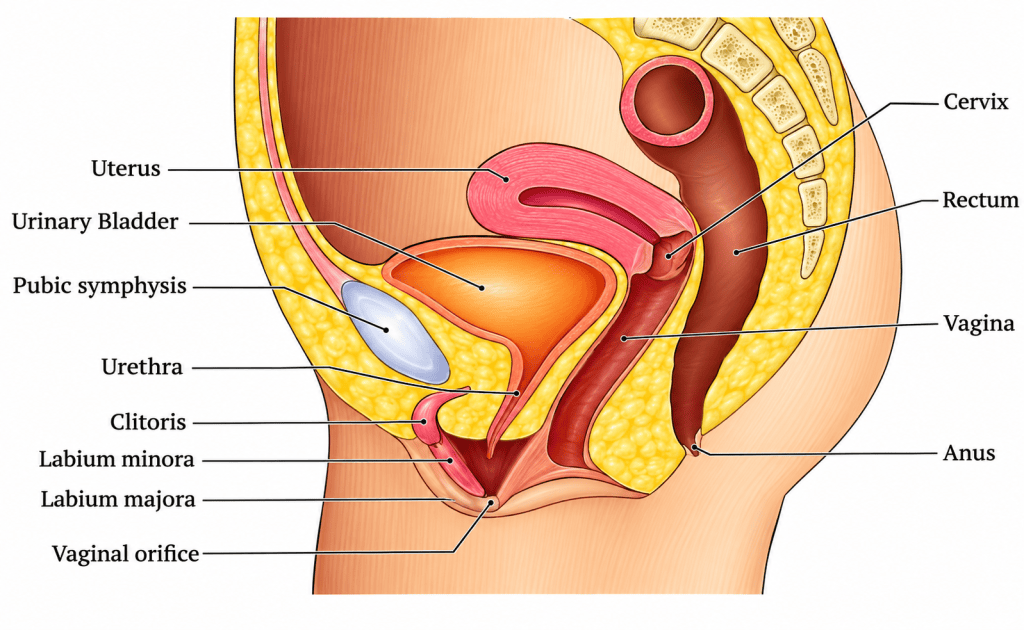
- Located in the pelvic region.
- Consists of a pair of ovaries, a pair of oviducts, uterus, cervix, vagina and external genitalia.
- Mammary glands support child care and lactation.
2. Ovaries
- Primary female sex organs.
- Produce ova (female gametes) and steroid hormones.
- One ovary is present on each side of the lower abdomen.
- Length: 2–4 cm.
- Connected to the pelvic wall and uterus by ligaments.
- Covered by thin epithelium.
- Ovarian stroma has two zones:
- Outer cortex
- Inner medulla
3. Oviducts (Fallopian tubes)
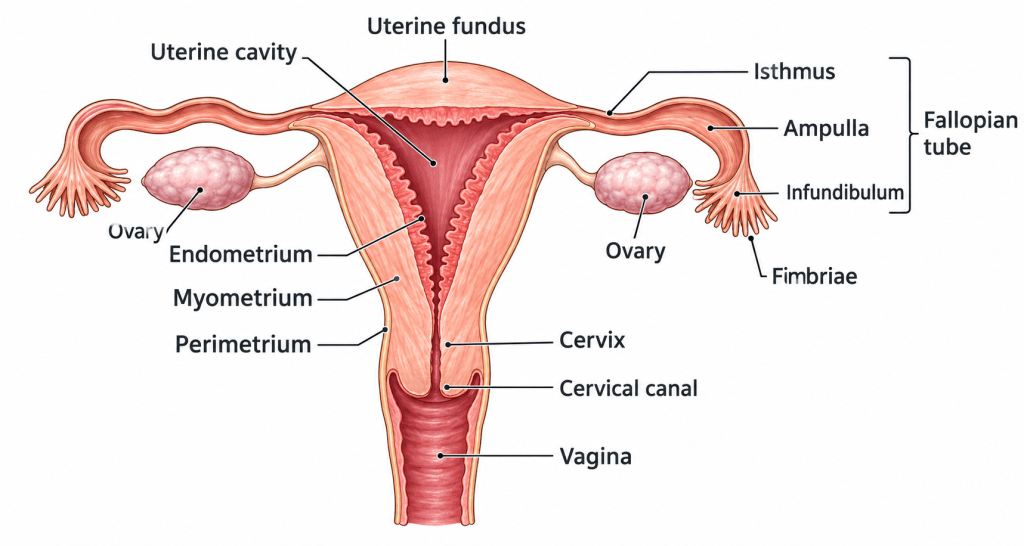
- Female accessory ducts include oviducts, uterus and vagina.
- Each oviduct is 10–12 cm long.
- Three parts:
- Infundibulum: Funnel-shaped; near the ovary.
- Ampulla: Wider part.
- Isthmus: Narrow lumen; joins the uterus.
- Fimbriae: Finger-like projections that help collect the ovum after ovulation.
4. Uterus
- Also called the womb.
- Single, inverted pear-shaped organ.
- Supported by ligaments attached to the pelvic wall.
- Opens into the vagina through the cervix.
- Cervical canal and vagina together form the birth canal.
Three layers of the uterine wall
| Layer | Important fact |
|---|---|
| Perimetrium | Outer, thin membranous layer |
| Myometrium | Middle, thick smooth-muscle layer |
| Endometrium | Inner, glandular layer lining the uterine cavity |
- Endometrium: Undergoes cyclical changes during the menstrual cycle.
- Myometrium: Exhibits strong contractions during childbirth.
5. Female external genitalia
- Mons pubis
- Labia majora
- Labia minora
- Hymen
- Clitoris
Important facts:
- Mons pubis: Fatty tissue covered by skin and pubic hair.
- Labia majora: Fleshy folds extending down from the mons pubis.
- Labia minora: Paired folds beneath the labia majora.
- Hymen: May partially cover the vaginal opening.
- Clitoris: Tiny, finger-like structure at the upper junction of the labia minora, above the urethral opening.
- The presence or absence of the hymen is not a reliable indicator of virginity or sexual experience.
6. Mammary glands
- Paired structures called breasts.
- Contain glandular tissue and variable amounts of fat.
- Each breast contains 15–20 mammary lobes.
- Each lobe contains clusters of cells called alveoli.
- Alveolar cells secrete milk.
- Milk is stored in the lumens of alveoli.
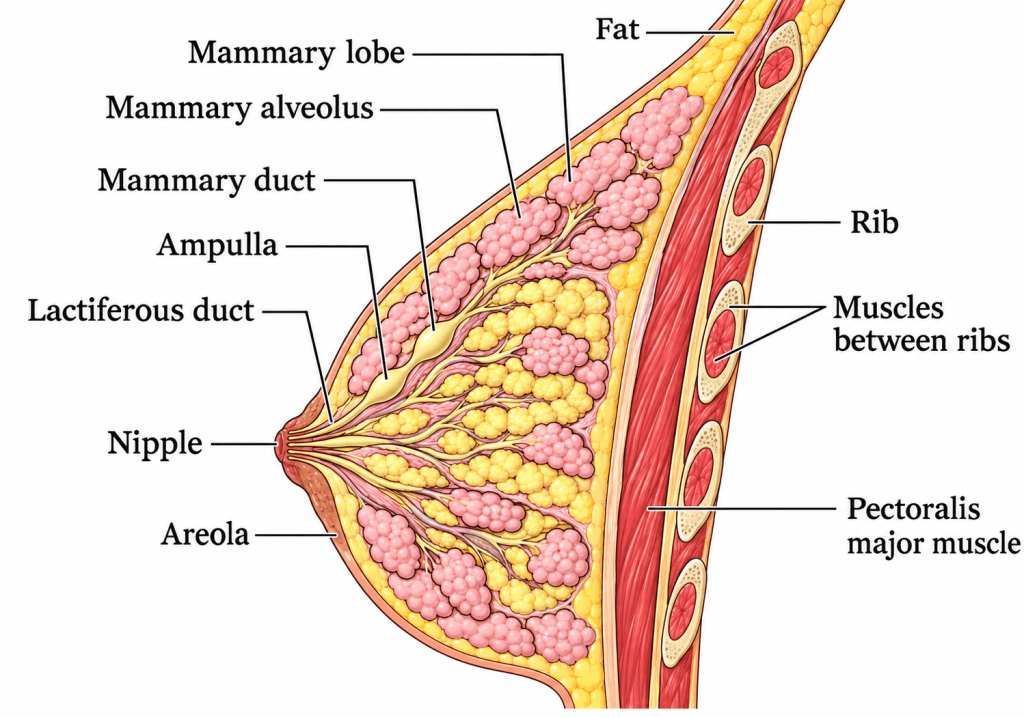
Milk passage pathway
Alveoli → Mammary tubules → Mammary ducts → Mammary ampulla → Lactiferous duct → Nipple
Quick revision: Numbers to remember
| Structure | Fact |
|---|---|
| Ovary | 2–4 cm long |
| Oviduct | 10–12 cm long |
| Mammary lobes per breast | 15–20 |
| Uterus | Inverted pear-shaped |
| Ovarian stroma | Cortex and medulla |
| Uterine wall | Perimetrium, myometrium, endometrium |
| Birth canal | Cervical canal + vagina |

