
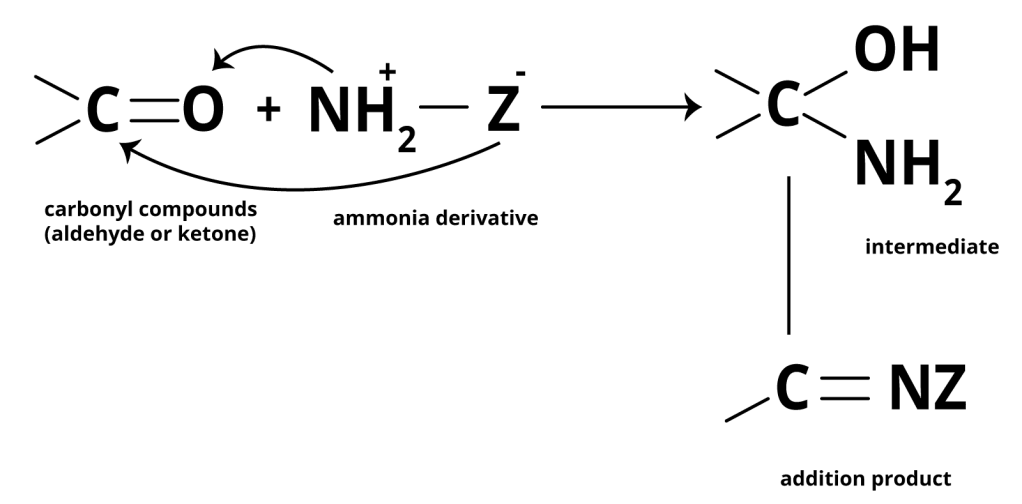
Why is pH 4–5 considered suitable?
The reaction involves nucleophilic attack by the nitrogen atom of the ammonia derivative on the carbonyl carbon, followed by proton-transfer steps and the elimination of water.
A mildly acidic medium (pH 4–5) provides suitable conditions for the reaction because:
- Activation of the carbonyl group: Mild acidity helps protonate the carbonyl oxygen, increasing the electrophilicity of the carbonyl carbon and facilitating nucleophilic attack.
- Maintaining nucleophilicity: The medium should not be too acidic. At very low pH, the nitrogen atom of the ammonia derivative becomes protonated, decreasing its nucleophilicity and making it less effective as a nucleophile.
- Facilitating dehydration: Acidic conditions assist the elimination of water during the formation of the final product.
Conclusion
A mildly acidic medium is preferred because it balances carbonyl-group activation, nucleophilic attack, and subsequent dehydration. Strongly acidic conditions suppress nucleophilicity, whereas insufficient acidity makes acid-catalysed steps less favourable.
NEET/JEE Tip: Remember that the reaction of carbonyl compounds with ammonia derivatives generally proceeds best under mildly acidic conditions, commonly around pH 4–5.

