
Some other points
- Photoelectric current
- Directly proportional to the intensity of incident light.
- More intensity → More emitted electrons.
- Saturation current
- Directly proportional to light intensity.
- Higher intensity gives higher saturation current.
- Stopping potential
- Depends on frequency.
- Does not depend on intensity.
- Intensity affects
- Number of emitted electrons.
- Photoelectric current.
- Saturation current.
- Intensity does NOT affect
- Maximum kinetic energy.
- Stopping potential.
- Frequency affects
- Maximum kinetic energy.
- Stopping potential.
- Whether emission occurs.
- Photoelectric emission is instantaneous.
- Time lag ≈ less.
- Emission occurs immediately even with very dim light, provided the frequency is above the threshold frequency.
- Different photosensitive materials have different sensitivities.
- Selenium is more sensitive than zinc or copper.
- The same material responds differently to different wavelengths.
- Example: Copper shows photoelectric effect with ultraviolet light but not with green or red light.
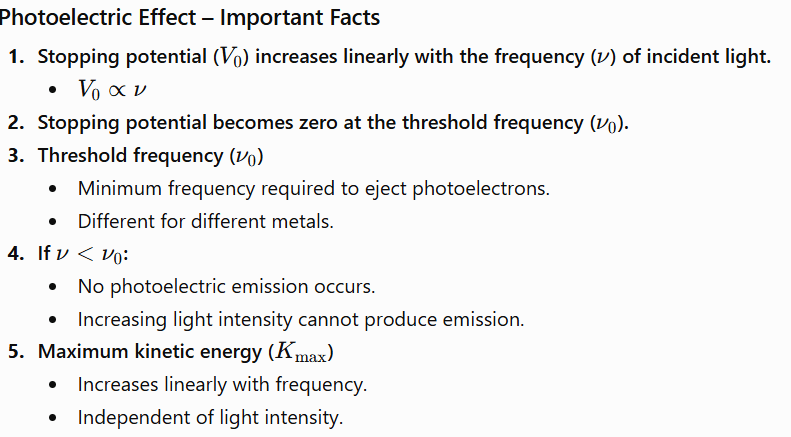
- Higher frequency → Higher stopping potential → Higher maximum kinetic energy.
- Below threshold frequency, no electrons are emitted regardless of light intensity.
- Above threshold frequency, increasing intensity increases only the number of photoelectrons, not their energy.
One-Line Revision
- Intensity → Number of electrons (Current)
- Frequency → Energy of electrons (Kinetic Energy & Stopping Potential)
- Threshold frequency → Minimum frequency required for emission
- Emission is instantaneous (≈ 10−910^{-9}10−9 s or less)

