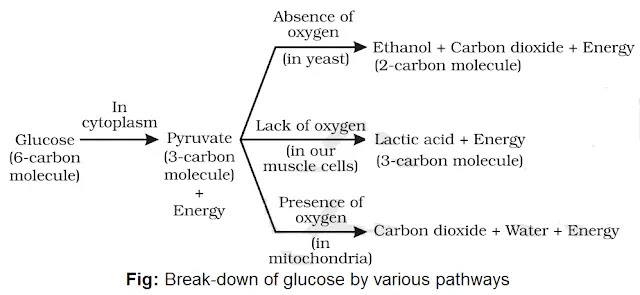
1. Breakdown of Glucose
- Food is used by cells to release energy.
- First step of respiration:
- Glucose (6-carbon compound) → Pyruvate (3-carbon compound)
- Occurs in the cytoplasm.
2. Fate of Pyruvate
(A) Aerobic Respiration (Presence of Oxygen)
- Occurs in mitochondria.
- Pyruvate → Carbon dioxide + Water + Large amount of energy.
- More energy is released than in anaerobic respiration.
(B) Anaerobic Respiration in Yeast
- Occurs in absence of oxygen.
- Pyruvate → Ethanol + Carbon dioxide + Energy.
- Process is called fermentation.
(C) Anaerobic Respiration in Muscles
- Occurs during oxygen deficiency.
- Pyruvate → Lactic acid + Energy.
- Accumulation of lactic acid causes muscle cramps.
3. Gas Exchange in Plants
- Takes place through stomata.
- Large intercellular spaces help diffusion of gases.
- Exchange occurs by diffusion.
At Night
- Photosynthesis stops.
- CO₂ release is the major activity.
During Day
- CO₂ produced in respiration is used in photosynthesis.
- Oxygen release becomes the major event.
4. Respiration in Animals
- Animals have specialized organs for gas exchange.
- Oxygen is taken in and carbon dioxide is removed.
5. Aquatic Animals
- Use oxygen dissolved in water.
- Dissolved oxygen is much less than atmospheric oxygen.
- Therefore, breathing rate is faster.
- Fishes take water through mouth and pass it over gills.
6. Terrestrial Animals
- Use atmospheric oxygen.
- Respiratory surfaces:
- Have large surface area.
- Are thin and delicate.
- Are kept inside the body for protection.
- Air passages carry air to respiratory surfaces.