What is oleum? Difference between oleum and H2SO4

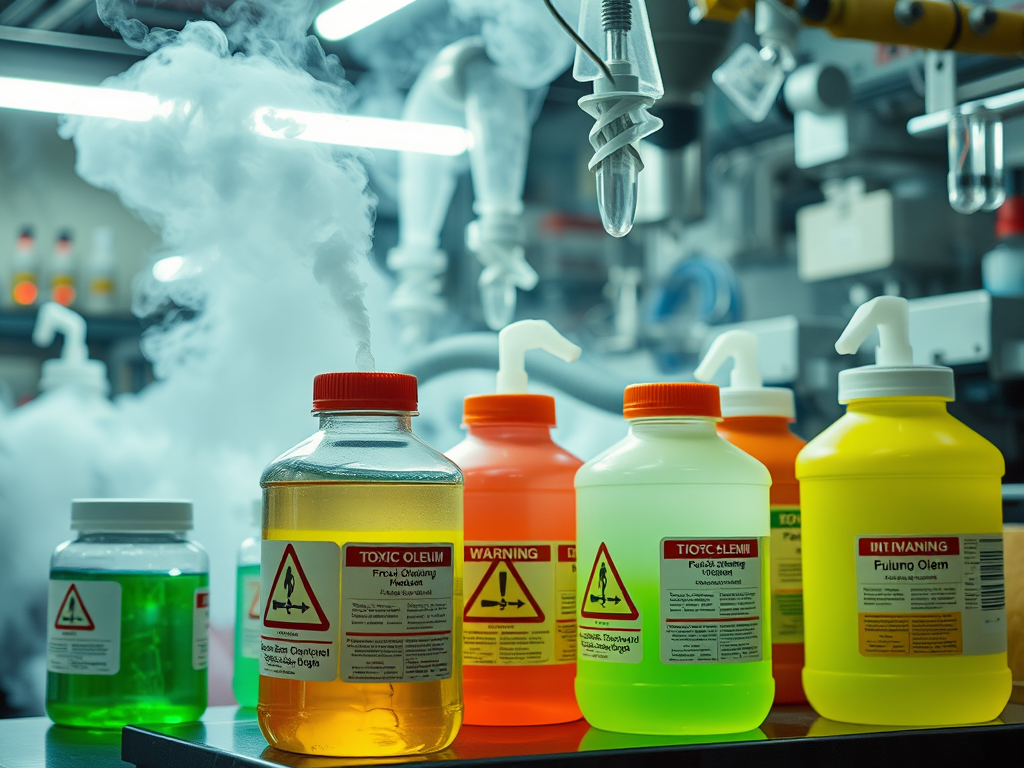
Oleum, also known as fuming sulfuric acid, is a highly reactive compound consisting of dissolved sulfur trioxide gas (SO₃) in 100% sulfuric acid.

What do you mean by fuming?

When we say “fuming” (like fuming sulfuric acid = oleum), we mean:

  • The liquid gives off visible vapors (“fumes”) when exposed to air.
  • In the case of oleum, those vapors are actually SO₃ gas, which escapes easily because SO₃ is volatile.
  • When this SO₃ gas meets moisture in the air, it reacts immediately to form tiny droplets of H₂SO₄, which look like white, smoky fumes.

That’s why:

  • Concentrated H₂SO₄ does not “fume” much in air.
  • Oleum does, because of the escaping SO₃.

So fuming = releasing visible vapors (SO₃ + H₂SO₄ mist) into the air

Fumes of H2SO4 dangerous?

Yes ✅ the fumes of H₂SO₄ (sulfuric acid) are very dangerous.

Here’s why:

  • What the fumes are:
    Pure H₂SO₄ itself doesn’t evaporate much, but when it’s very concentrated (or as oleum) it releases SO₃ vapors.
    These vapors react with moisture in the air → form fine droplets of H₂SO₄ mist.
  • Effects on health:
    • Extremely corrosive to skin, eyes, and mucous membranes.
    • Causes severe burns on contact.
    • If inhaled, can damage the nose, throat, lungs (leading to breathing difficulty, pulmonary edema).
    • Even short exposure to strong fumes is harmful.

That’s why handling concentrated H₂SO₄ / oleum requires fume hoods, protective gloves, goggles, and masks.

H₂S₂O₇ is the chemical formula of oleum?

Oleum is also called fuming sulfuric acid.

It is not a single pure compound but rather a solution of SO₃ dissolved in H₂SO₄.

H₂S₂O₇ = pyrosulfuric acid, which represents one particular composition of oleum (when there is exactly one mole of SO₃ combined with one mole of H₂SO₄).

Oleum in general can have different amounts of SO₃, not just the 1:1 case.

If it is mixture, so why it is represented by molecular formula H2S2O7?

Oleum is really a mixture (H₂SO₄ + SO₃), but in chemistry we often like to represent it in a molecular way. That’s why one of its possible compositions is written as H₂S₂O₇ (pyrosulfuric acid).

Convenience in Representation

  • Writing H₂S₂O₇ makes it easier to handle in equations and discussions, instead of always writing “H₂SO₄·SO₃”.
  • For example, when balancing reactions in textbooks, H₂S₂O₇ is simpler to use.

But in Reality
  • Oleum is not just H₂S₂O₇ — it may have more (or less) SO₃ dissolved in H₂SO₄.
  • So H₂S₂O₇ is only one specific case of oleum.

Why Sulphonation of OF BENZENE IS Carried out with Oleum not pure Conc. H2SO4?

leum already contains a large amount of free SO₃ dissolved in H₂SO₄.

That SO₃ directly acts as the electrophile in the sulphonation of benzene.

The H₂SO₄ in oleum helps by protonating SO₃ to form the stronger electrophile

MCQs Chemical Kinetics class 12

MCQs – Chemical Kinetics

1. The unit of rate constant for a first-order reaction is:
a) mol L⁻¹ s⁻¹
b) s⁻¹
c) L mol⁻¹ s⁻¹
d) mol² L⁻² s⁻¹


2. For a zero-order reaction, the rate depends on:
a) Concentration of reactants
b) Temperature only
c) Rate constant only
d) Both concentration and rate constant


3. If half-life of a first-order reaction is 20 minutes, the rate constant is:
a) 0.0347 min⁻¹
b) 0.693 min⁻¹
c) 0.020 min⁻¹
d) 0.050 min⁻¹


4. In the Arrhenius equation k=Ae−Ea/RTk = A e^{-Ea/RT}k=Ae−Ea/RT, the slope of ln⁡k\ln klnk vs 1T\frac{1}{T}T1​ is:
a) −Ea/R-Ea/R−Ea/R
b) Ea/REa/REa/R
c) R/EaR/EaR/Ea
d) −R/Ea-R/Ea−R/Ea


5. For a reaction A→BA \to BA→B, the rate of disappearance of A is 0.03 mol L⁻¹ s⁻¹. The rate of appearance of B is:
a) 0.03 mol L⁻¹ s⁻¹
b) 0.015 mol L⁻¹ s⁻¹
c) 0.06 mol L⁻¹ s⁻¹
d) Zero


6. Which order of reaction has half-life independent of initial concentration?
a) Zero order
b) First order
c) Second order
d) Third order


7. A reaction is first order in A and zero order in B. The rate law is:
a) Rate = k[A][B]
b) Rate = k[A]
c) Rate = k[B]
d) Rate = k[A][B]⁰


8. A plot of [A][A][A] vs time is linear for:
a) Zero order reaction
b) First order reaction
c) Second order reaction
d) Third order reaction


9. The activation energy of a reaction is 50 kJ mol⁻¹. If temperature increases, rate constant will:
a) Increase
b) Decrease
c) Remain constant
d) Become zero


10. The rate constant of a reaction doubles when temperature is increased by 10°C. This is known as:
a) Van’t Hoff’s rule
b) Arrhenius rule
c) Rate law
d) Lindemann rule


11. The half-life of a zero-order reaction is given by:
a) t1/2=0.693kt_{1/2} = \dfrac{0.693}{k}t1/2​=k0.693​
b) t1/2=[A]02kt_{1/2} = \dfrac{[A]_0}{2k}t1/2​=2k[A]0​​
c) t1/2=1k[A]0t_{1/2} = \dfrac{1}{k[A]_0}t1/2​=k[A]0​1​
d) t1/2=k[A]0t_{1/2} = k[A]_0t1/2​=k[A]0​


12. The order of a reaction can be determined by:
a) Molecularity
b) Balanced chemical equation
c) Experimental data only
d) Thermodynamics


13. In a chemical reaction, doubling the concentration of reactant doubles the rate. The order is:
a) Zero
b) One
c) Two
d) Three


14. The rate constant of a first-order reaction is 0.231 min⁻¹. The half-life is:
a) 3 min
b) 10 min
c) 30 min
d) 300 min


15. Molecularity of a reaction can be:
a) Zero
b) Fractional
c) Whole number only
d) Infinite


16. For a first-order reaction, the graph between ln⁡[A]\ln [A]ln[A] and time is:
a) Straight line, positive slope
b) Straight line, negative slope
c) Curve increasing
d) Curve decreasing


17. In a reaction, rate = k[A]²[B], the overall order is:
a) 1
b) 2
c) 3
d) 0


18. Temperature dependence of rate constant is expressed by:
a) Rate law
b) Arrhenius equation
c) Collision theory
d) Gibbs free energy


19. If the rate of reaction does not change with concentration, the order is:
a) Zero
b) First
c) Second
d) Infinite


20. In pseudo-first order reactions:
a) Both reactants are first order
b) Both are zero order
c) One reactant is in large excess
d) Reaction is always second order


Answer Key

  1. b
  2. c
  3. a
  4. a
  5. a
  6. b
  7. b (or d, since [B]⁰ = 1)
  8. a
  9. a
  10. a
  11. b
  12. c
  13. b
  14. b
  15. c
  16. b
  17. c
  18. b
  19. a
  20. c