what is carbene? Singlet carbene and Triplet carbene

A carbene is a highly reactive organic species in which a carbon atom has only six valence electrons (instead of the usual eight) and is bonded to two substituents.

General Features:

  • General formula: R₂C:
  • Structure: Carbon in carbene is divalent (forms 2 bonds).
  • Electron deficiency: Only 6 valence electrons → makes carbenes very reactive.
  • Bond angle: Usually about 104–150°, depending on type.

Types of Carbenes:

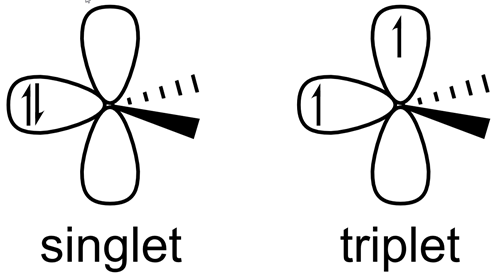
  1. Singlet carbene
    • Both non-bonded electrons are paired in the same orbital.
    • Usually bent structure (~104° bond angle).
    • Electrophilic (electron-loving).
  2. Triplet carbene
    • The two non-bonded electrons occupy different orbitals with parallel spins.
    • Linear or nearly linear structure (~130–150° bond angle).
    • More stable than singlet.

Examples:

  • Methylene (:CH₂) → simplest carbene.
  • Dichlorocarbene (:CCl₂) → formed in Reimer–Tiemann reaction.

Preparation:

  • By photolysis or pyrolysis of diazo compounds (e.g., CH₂N₂ → :CH₂ + N₂).
  • By decomposition of haloforms (CHCl₃ + base → :CCl₂).

Reactivity:

  • Carbenes add to double bonds → form cyclopropanes.
  • Insert into C–H bonds.
  • Highly reactive intermediates in organic chemistr
Aakash NEET Question Paper 2025 With solution pdf

Aakash NEET‑UG 2025 Question Paper & Solutions – Code 45

The Aakash Institute has officially released the detailed question papers and solutions for the NEET‑UG 2025 examination held on May 4, 2025, in sets 45. This comprehensive PDFs include full-colour answer keys and step-by-step explanations, carefully prepared by subject-matter experts to help aspirants evaluate their performance and fine-tune their NEET preparation strategies

What’s inside the downloads?

  • Code-specific coverage: Available for Booklet Code 45 ensuring accuracy for your specific question set .
  • Physics, Chemistry & Biology: PDF contains all 180 MCQs along with fully worked-out solutions—including diagrams, formulas, and calculations.

Define catalyst give two examples

A catalyst is a substance that increases the rate of a chemical reaction by providing an alternative reaction pathway with a lower activation energy, without being consumed in the process. Catalysts work by facilitating the formation of the transition state, enabling the reaction to proceed more rapidly. They remain unchanged chemically and are not consumed during the reaction, allowing them to participate in multiple reaction cycles.

Two examples of catalysts are:

  1. Enzymes: Enzymes are biological catalysts that facilitate and regulate biochemical reactions in living organisms. They are typically proteins that act as catalysts by lowering the activation energy required for specific reactions. Enzymes play a crucial role in various biological processes such as digestion, metabolism, and DNA replication. For example, the enzyme amylase catalyzes the hydrolysis of starch into smaller sugar molecules.
  2. Platinum in Catalytic Converters: Platinum and other precious metals (such as palladium and rhodium) are commonly used as catalysts in catalytic converters of automobiles. They facilitate the conversion of harmful pollutants from exhaust gases into less harmful substances. For instance, platinum catalysts help to convert carbon monoxide (CO) into carbon dioxide (CO2) and nitrogen oxides (NOx) into nitrogen (N2) and oxygen (O2), reducing their environmental impact.

These examples demonstrate how catalysts can significantly enhance reaction rates and enable chemical transformations without being consumed in the process, making them crucial in various industrial, environmental, and biological applications.

Difference between adsorption and absorption

Adsorption and absorption are two distinct processes that involve the interaction of substances with a solid or liquid surface. Here are the key differences between adsorption and absorption:

  1. Nature of Interaction:
  • Adsorption: Adsorption refers to the adherence or accumulation of atoms, ions, or molecules from a gas or liquid phase onto the surface of a solid or liquid. It involves weak intermolecular forces of attraction between the adsorbate and the adsorbent. The adsorbate remains on the surface without penetrating or entering the interior of the adsorbent material.
  • Absorption: Absorption involves the penetration or uptake of a substance (liquid or gas) into the bulk of a solid or liquid material. The absorbed substance disperses within the absorbing material, entering its interior or matrix. Absorption can involve dissolution of the absorbed substance in the absorbing material.
  1. Surface Area:
  • Adsorption: Adsorption occurs specifically at the surface of the adsorbent material, taking place only on the exposed surface area. The concentration of the adsorbate is generally higher at the surface compared to the bulk.
  • Absorption: Absorption occurs throughout the bulk of the absorbing material, not limited to the surface area. The absorbed substance permeates or disperses within the absorbing material.
  1. Reversibility:
  • Adsorption: Adsorption is typically a reversible process, meaning that the adsorbate can be desorbed or removed from the surface under suitable conditions, such as changes in temperature or pressure.
  • Absorption: Absorption is not necessarily a reversible process. The absorbed substance may remain within the bulk of the absorbing material and might not be easily released.
  1. Energy Involved:
  • Adsorption: Adsorption generally involves weak intermolecular forces (such as van der Waals forces) between the adsorbate and the adsorbent. The energy associated with adsorption is lower than that of chemical bonds.
  • Absorption: Absorption often involves stronger interactions, such as chemical bonds or intermolecular forces, between the absorbed substance and the absorbing material. The energy associated with absorption is generally higher than that of adsorption.

In summary, adsorption refers to the adherence of substances onto a surface, occurring at the surface and involving weak intermolecular forces. Absorption, on the other hand, involves the penetration of substances into the bulk of a material, occurring throughout the material and often involving stronger interactions.

Define Adsorption Class 12

In chemistry, adsorption refers to the process by which atoms, ions, or molecules from a gas or liquid phase adhere to the surface of a solid or liquid substance. This phenomenon involves the accumulation of the adsorbate (the substance being adsorbed) at the interface between the adsorbent (the surface to which adsorption occurs) and the fluid phase.

Adsorption is a surface phenomenon and can occur due to various intermolecular forces, such as van der Waals forces, electrostatic interactions, and hydrogen bonding. The adsorption process is typically reversible, meaning that adsorbate molecules can detach from the surface under suitable conditions, such as changes in temperature or pressure.

Adsorption is classified into two main types based on the strength of the interaction between the adsorbate and the adsorbent:

  1. Physical Adsorption (Physisorption): Also known as van der Waals adsorption, physical adsorption involves the weak intermolecular forces of attraction between the adsorbate and the adsorbent. These forces include London dispersion forces, dipole-dipole interactions, and induced dipole interactions. Physisorption typically occurs at relatively low temperatures and can be reversed by altering the conditions, such as increasing temperature or reducing pressure.
  2. Chemical Adsorption (Chemisorption): Chemisorption involves the formation of chemical bonds between the adsorbate and the adsorbent surface. This type of adsorption is characterized by stronger interactions compared to physical adsorption. Chemisorption is specific and typically occurs at higher temperatures. The adsorption process involves the breaking of existing bonds on the adsorbate and the formation of new chemical bonds with the adsorbent surface. Chemisorption is generally not easily reversible.

Both physical and chemical adsorption play important roles in various chemical, biological, and industrial processes. Adsorption processes are utilized in applications such as gas separation, catalysis, purification, and wastewater treatment. Understanding adsorption is crucial in areas like surface science, materials science, and heterogeneous catalysis.

Define activation energy how is it related to threshold energy

Activation energy is a concept in chemistry that represents the minimum amount of energy required for a chemical reaction to occur. It is the energy barrier that must be overcome for reactant molecules to transform into products.

In a chemical reaction, reactant molecules must collide with sufficient energy and proper orientation to break the existing bonds and form new ones. The activation energy corresponds to the energy difference between the energy level of the reactants and the transition state, which is an intermediate state during the reaction where the bonds are in the process of being broken and formed.

The activation energy determines the reaction rate. A higher activation energy means that the reaction is slower because a larger amount of energy is required for a sufficient number of reactant molecules to possess the necessary energy to overcome the barrier and proceed to the product state.

The relationship between activation energy and threshold energy depends on the context in which “threshold energy” is used. If “threshold energy” refers to the minimum energy required for a collision to result in a reaction, then it is similar to the activation energy concept. The threshold energy represents the minimum energy required for a successful collision that leads to a reaction, while the activation energy represents the minimum energy required for the overall reaction to occur.

However, if “threshold energy” is used to refer to the minimum energy required to break a specific bond in a reactant molecule, it is different from activation energy. The activation energy is the overall energy barrier for the reaction, which involves multiple bond-breaking and bond-forming events. In this case, the threshold energy would be specific to a particular bond within a reactant molecule, whereas the activation energy encompasses the energy requirements of the entire reaction.

Derive integrated rate law for first order reaction

To derive the integrated rate law for a first-order reaction, let’s consider a generic reaction:

A → Products

The rate of this reaction can be expressed as:

Rate = -d[A]/dt

Where [A] represents the concentration of A and t is time. The negative sign indicates that the concentration of A decreases over time.

We can rearrange the equation as follows:

-d[A] = k dt

Integrating both sides of the equation:

∫(-d[A]) = ∫k dt

The integration of the left side gives:

-[A] = kt + C

Where C is the constant of integration. At time t=0, the initial concentration of A is [A]0. Substituting these values into the equation:

-[A]0 = k(0) + C

C = -[A]0

Therefore, the integrated rate law for a first-order reaction is:

-ln([A]/[A]0) = kt

This can also be written as:

ln([A]0/[A]) = kt

Where [A]0 is the initial concentration of A, [A] is the concentration of A at time t, k is the rate constant of the reaction, and t is the reaction time.

The integrated rate law for a first-order reaction shows that the natural logarithm of the ratio of initial concentration to the concentration at a given time is directly proportional to the rate constant multiplied by time.

Integrated rate law for zero order reaction

For a zero-order reaction, the rate of the reaction is independent of the concentration of the reactant(s). The integrated rate law for a zero-order reaction can be expressed as:

[A]t = [A]0 – kt

where:

  • [A]t is the concentration of the reactant A at time t
  • [A]0 is the initial concentration of reactant A
  • k is the rate constant of the reaction
  • t is the reaction time

In this integrated rate law, the concentration of reactant A at any given time t is equal to the initial concentration [A]0 minus the product of the rate constant k and the reaction time t.

The unit of the rate constant (k) for a zero-order reaction is usually expressed as concentration/time (e.g., M/s).

What is pseudo order reaction in Chemistry

In chemistry, a pseudo-order reaction refers to a reaction that appears to follow a first-order rate equation, even though it is not truly a first-order reaction. This situation often arises when the concentration of one of the reactants is in excess compared to the other reactants, leading to the simplification of the rate equation.

Pseudo-order reactions are commonly encountered in cases where the concentration of a reactant is intentionally kept at a high, constant level. This can be achieved by using a large excess of one reactant or by maintaining a constant concentration through a continuous supply. By doing so, the concentration of the excess reactant remains essentially constant throughout the reaction, allowing the rate equation to be simplified.

For example, consider a reaction between a reactant A and a reactant B, where the concentration of B is in excess. The reaction may have an overall reaction order greater than one, but if the concentration of B remains constant, the rate equation can be simplified to a pseudo-first-order rate equation:

rate = k[A]

In this pseudo-first-order rate equation, the reaction appears to be first order with respect to reactant A, even though the true reaction order may be different. By monitoring the change in the concentration of reactant A over time, it is possible to determine the rate constant k for the pseudo-first-order reaction.

Pseudo-order reactions are particularly useful in cases where the reaction rate is too fast to accurately measure using conventional methods. By simplifying the rate equation, the reaction can be studied over a longer period of time, allowing for more accurate determination of the rate constant.

Define order of reaction and molecularity of reaction

In the context of chemical kinetics, the terms “order of reaction” and “molecularity of reaction” refer to different aspects of the rate equation that describes the rate at which a chemical reaction occurs.

  1. Order of Reaction: The order of reaction represents the mathematical relationship between the concentration of reactants and the rate of the reaction. It determines how the rate of a reaction is influenced by changes in the concentration of the reactants. The order of reaction is determined experimentally and can be an integer, fractional, or even zero.

For a generic chemical reaction: A + B → Products

The rate equation for this reaction can be expressed as: rate = k[A]m[B]n

In this equation, [A] and [B] represent the concentrations of the reactants A and B, respectively. The exponents ‘m’ and ‘n’ represent the orders of reaction with respect to A and B, respectively. The sum of the exponents (m + n) gives the overall order of the reaction.

  1. Molecularity of Reaction: The molecularity of a reaction refers to the number of reactant particles that are involved in the elementary step of a chemical reaction. It provides information about the complexity of the reaction and helps classify reactions based on the number of molecules colliding in a single step.

Molecularity can have three categories:

a) Unimolecular Reaction: A reaction in which a single reactant molecule undergoes a transformation in an elementary step. For example: A → Products

b) Bimolecular Reaction: A reaction involving the collision of two reactant molecules leading to a chemical transformation. For example: A + B → Products

c) Termolecular Reaction: A reaction involving the simultaneous collision of three reactant molecules leading to a chemical transformation. Termolecular reactions are relatively rare due to the low probability of three particles simultaneously colliding. For example: A + B + C → Products

It’s important to note that the molecularity of a reaction is a theoretical concept that describes the elementary steps of a reaction mechanism, while the order of reaction is determined experimentally and reflects the dependence of the reaction rate on the reactant concentrations.