Chemistry Notes the s-block elements

The s-block elements

Why are group 1 and group 2 elements  called s-block elements?

The last electron of these elements enters the outermost s-orbital that is why they are called s-block elements.

Group1 elements are collectively known as alkali metals why?

They form hydroxide in water,which are alkaline in nature ,that is why they are called alkali metals.

Group 2 elements are collectively known as alkaline earth metals why?

Because their oxides and hydroxides are alkaline in nature and these metal oxides are found in the earth’s crust.

What is general electronic configuration of s-block elements?

ns1-2

GROUP 1 ELEMENTS ( ALKALI METALS)

Li, Na, K,Rb,Cs,Fr

Q.1.Alkali metals are normally kept in kerosene oil why?

Ans.Alkali metals are highly reactive towards air and water hence they  are normally kept in kerosene oil.

Q.2.Alkali metals are never found free in nature why?

Ans. Due to very large size and presence of only one electron in outermost shell they easily lose their valence electron and from M+ ion.

Q.3.The atomic and ionic radii of alkali metals increase on moving down why?

Ans. As moving down the group  number of shell increases, that is why atomic and ionic radii of alkali metals increase top to bottom.

              Li<Na<K<Rb<Cs

Q.4.The ionization enthalpies of the alkali metals are considerably low and decrease down the group from Li to Cs.

Ans.Alkali metals are very large hence ionization enthalpies of these metals are very low. Since atomic size increases down the group thus ionization enthalpy decreases down the group.

Q.5.The hydration enthalpies of alkali metal ions decrease with increase in ionic sizes why?

Ans.Atomic size increases down the group hence hydration enthalpy decreases down the group.

                    Li+> Na+ > K+ > Rb+ > Cs+

Q.5. Li+ has maximum degree of hydration why?

                                          Or

Why are lithium salts commonly hydrated and those of the other alkali ions usually anhydrous?

Ans. Li+ is smallest in size thus lithium salts are mostly hydrated example LiCl.2H2O

Q.6.Alkali metals have very low density why?

Ans. Alkali metals are very large hence they have very low density.

Q.7.Why does density of alkali metals increases down the group Why ?

Ans. Because mass increases down the group.

Q.8.Potassium is lighter than sodium why ?

Ans. In case of K electron filling takes place in 4s without 3d thus volume increases so much and density decrease.

Q.9.The melting and boiling points of the alkali metals are low why?

Ans.Weak metallic bonding in alkali metal crystal  due to the presence of only a single valence electron in them.

Q.10.Alkali metals give flame test why?

Ans.Outermost orbital electron is excited to higher energy level .When the excited electron comes back to the ground state, there is emission of radiation in the visible region. Therefore they can be detected by the respective flame tests.

Q.11. Cs and K are used in photoelectric cell why?

Ans.The light energy absorbed by these metals and lose electron because outermost electron is loosely bonded with nucleus.

Q.12.Alkali metals are very reactive why?

Ans. Due to very large size and low ionization enthalpy alkali metals are highly reactive.

Q.13.Alkali metals tarnish in air why?

Ans. Alkali metals form oxide with air which further reacts with water and form hydroxide.

Q.14.What is the nature of oxide of alkali metals.

Ans. Lithium forms monoxide, sodium forms peroxide and K, Rb and Cs forms superoxide

    4 Li +O →2Li2O (oxide)

   2Na +O2 →Na2O2 (peroxide)

  M+O2 →MO2 (superoxide)

        (M = K, Rb, Cs)

Q.15.Lithium  reacts directly with nitrogen of air to form the nitride, Li3N why?

Ans.It is due to very small size of Li it shows anomalous behavior.

Q.16.What is the oxidation state of K in KO2?

Ans +1

Q.17.Li is least reactive with water but other elements react explosively with water why?

Ans. It is due to small size and very hydration energy of lithium it is least reactive with water.

Q.18.All the alkali metal hydrides have  high melting points why?

Ans. Alkali metals are ionic solid that is why they have high melting point.

Q.19.Lithium salts are mainly covalent why?

Ans. Li+ is small in size hence distortion of electron cloud(polarization power) is maximum hence its salt is covalent.

Q.20.In all lithium salts LiI is most covalent and why?

Ans. I having large size thus polarization power is maximum.

Q.21.Lithium is strongest reducing agent why?

Ans. EO value depends on the following factors.

M (s)  →        M(g) (Sublimation enthalpy)

M(g)   →       M(g)+ (Ionization enthalpy)

M+(g) + H2O →         M+(aq) Hydration enthalpy

Due to small size of lithium ,it has the highest hydration enthalpy resulting low negative Eo value and its high reducing power.

Q.22.Alkali metals give blue color in liquid ammonia.

                          or

 Alkali metals are paramagnetic in liquid ammonia why?

Ans. M +(x + y) NH3 →[M(NH3 )x ]+ + [e(NH3 )y ]

Due to presence of ammoniated electron alkali metals give blue color in liquid ammonia solution.

Q.23 Alkali metals in liquid ammonia liberate hydrogen on standing give reaction.

Ans. M+ (am) + e + NH3 (1)→MNH2(am) +½H2(g)

Q.24.What are the different uses of lithium alloys?

Ans. Li+Pb= ‘White metal’ bearings for motor engines,

       Li+Al = Aircraft parts

       Li+Mg= Armour plates which is used in thermonuclear reactions.

Q.25.What are the uses of other alkali metal.

Ans 1.Liquid sodium metal is used as a coolant in fast breeder nuclear reactors.

2. Na/Pb alloy needed to make PbEt4 and PbMe4 which is used as anti knock additives to  petrol earlier.

3. Potassium hydroxide is used in manufacturing of soft soap.

4. Potassium chloride is used as a fertilizer.

5. Cesium is used in photoelectric cells.

Q.26.What is the reason behind the increasing stability of the peroxide or superoxide, as the size of the metal ion increases ?

Ans.It is due to the stabilisation of large anions by larger cations through lattice energy effects.

Q.27. Why is KO2 paramagnetic?

Ans. An unpaired electron is present antibonding π*2p orbital of O2-

Q.28.The alkali metal halides, MX, (X=F,Cl,Br,I) are all high melting crystalline solids Why?

Ans. Alkali metals halides are ionic compound hence have very high melting point.

Q.29.The melting and boiling points of alkali metals decreases in following order  fluoride > chloride > bromide> iodide why?

Ans.Metallic  bond strength decreases as the size of halide ion increases.

Q.30. All alkali metal halides are soluble in water why.

Ans. Due to weak metallic bonding in alkali metal lattice enthalpy is lower than hydration enthalpy.

Q.31.Solubility of LiF in water is low why?

Ans.High lattice enthalpy of LiF due to small size of F.

Q.32.Solubility of CsI in water is low why?

Ans.Low hydration enthalpy of CsI due to large size of Cs.

Q.33.LiCl, LiBr,and LiI are not only soluble in water but also soluble in organic solvent like acetone,ethanol etc,but LiF is almost insoluble in water.

Ans Difference in lattice enthalpy and hydration enthalpy of other litium halides is higher than LiF, hence lithium halides are soluble in water. Due to larger size of Cl,Br and I their lithium halides have higher covalent character ,hence they are soluble in organic solvent also.

Q.34.The mobilities of the alkali metal ions in aqueous solution are Li+ < Na+ < K+ < Rb+ < Cs+

Ans.As the size of alkali metal ions increases hydration extent of these ions decreases thus mass of hydration ion decreases thus mobility increases.

Q.35.LiI is more soluble in KI in ethanol why?

Ans.LiI is more covalent than than KI due to high polarization power of Li  in compare with K.Thus LiI is more soluble in KI in ethanol.

Q.36.Sodium is found to be more useful than potassium why?

                                Or

What are the biological function of Na and K.

Ans.Na+ ions are found in the blood plasma and also in interstitial fluid which surrounds the cell thus help in variety of biological function.

1.Transmission of nerve signal.

2.Regulate the flow of water across cell membrane.

3.Transport sugar and amino acids into cell.

K+ ions are found inside cell and help in following biological functions.

1.They activate many enzymes

2.Participate in the  oxidation of glucose to produce ATP.

From above observation we can say that Sodium is found to be more useful than potassium.

Q.37.Alkali metals are prepared by electrolysis of their fused chlorides why?

Ans.In aq alkali metals chlorides  H+ ions are present along with alkali metals ions,and Eo value of H+ is higher than alkali metal ions hence H2 instead of the alkali metals produced at cathode.

Q.38.A solution of Na2CO3 is alkaline why ?

Ans. In aq solution forms NaOH which is strong base.

  CO32- + H2O →  HCO3 +OH     

Q.39.Define oxoacids.

Ans.Oxo-acids are those in which the acidic proton is on a hydroxyl group with an oxo group attached to the same atom e.g., carbonic acid.

Q.40.The stability of the carbonates and hydorgencarbonates of alkali metal increases from top to bottom in group why?

Ans.As the size of alkali metal ions increases the polarization power of these ions to CO32- and HCO3 decreases hence thermal stability increases.

Q.41.Lithium carbonate is not so stable to heat why?

                                    Or

Why is Li2CO3 decomposed at a lower temperature whereas Na2CO3 at higher

temperature?

Ans. smaller Li+ ions polarize CO32 most hence it decomposes into Li2O and CO2.

Q.42. Why does Li show  anomalous behavior?

Ans  It is due to

 (i) Exceptionally small size of its atom

(ii) High polarising power

(iii)High charge/radius ratio.

Q.43.List some anomalous behavior of Li.

Ans. (i) m.p. and b.p.of Li  are higher than the other alkali metals.

(ii) Lithium is least reactive but the strongest reducing agent among all the alkali metals.

(iii) Li forms monoxide, Li2O

(iv)Li forms nitride Li3N unlike other alkali metals.

(v) LiCl is more hydrated in compare with other alkali metals.

(vi) Solid Lithium hydrogencarbonate doesn’t exist while all other elements form solid hydrogencarbonates.

(vii) Lithium unlike other alkali metals forms covalent compound.

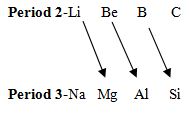
Q.44.What is the reason of diagonal relationship between Li and Mg.

Ans Due to similar charge/radius ratio they show similar behavior.

Q.45.What are the points of similarities between Li and Mg.

Ans (i)Both lithium and magnesium are harder than other elements in the respective groups.

(ii) Both Lithium and magnesium react slowly with water.

(iii) Both form nitride Li3N and Mg3N2, by direct combination with nitrogen.

(iv) Both form monoxide with oxygen Li2O and MgO.

(v) The carbonates of lithium and magnesium decompose easily on heating to form the oxides and CO2.

(vi) Solid hydrogencarbonates are not formed by lithium and magnesium.

(vii) Both LiCl and MgCl2 are soluble in ethanol.

(viii) Both LiCl and MgCl2 are deliquescent and crystallise from aqueous solution as hydrates, LiCl·2H2O and MgCl8H2O.

Q.46.Potassium carbonate cannot be manufactured by Solvay process why?

Ans.Potassium hydrogencarbonate is too soluble to be precipitated by the addition of ammonium hydrogencarbonate to a saturated solution of potassium chloride.

Q.47.What is the heating effect of washing soda (Na2CO3.10H2O)?

Q.48.What are the different uses of washing soda .

Ans.1 Water Softening,Laundring process.

       2 In paper ,Textiles and Paint industries.

       3 To manufacture soap,glass and borax.

Q.49. What are the uses of NaCl?

Ans.1Common salt for domestic purpose.

       2 To prepare Na2O2.MaOH etc.

Q.50.What are the uses of NaOH (Caustic Soda)?

Ans.  (i)   To manufacture soap paper, artificial silk etc

        (ii)  In petroleum refining

       (iii)  In the purification of bauxite,

        (iv) As a laboratory reagent.

Q.50.What are the uses of Sodium hydrogencarbonate (baking soda)

Ans (i) As antiseptic.

       (ii) It is used in fire extinguishers.

Q.51.What are the common physical and chemical properties of alkali metals?

           Ans.Physical properties.

          (i) Crystalline solid

          (ii) Silvery white, soft and light metals.

          (iii) Low density

          (iv) Low melting and boiling point

          (v) Give flame test

       Chemical  properties

            (i)  Very highly reactive

            (ii)+1 is common oxidation state

            (iii) Form monoxide ,peroxide ,super oxide with oxygen

            (iv) Form strong base on water

            (v) Form halides with halogen

            (vi) All are very strong reducing agent.

            (vii) Their ammonical solution is deep blue and paramagnetic

Q.52.What is the oxidation state of Na in Na2O2.

Ans . (+1) In peroxide oxidation state of oxygen is -1 hence

                    2(x) -2=0  thus x=1

Q.53.Sodium is less reactive than potassium why?

Ans.Lower ionization enthalpy of K makes it more reactive than sodium.

Q.54.Alkali and alkaline earth metals can not be obtained by chemical

reduction methods why?                                                                                 

Ans. Alkali and alkaline earth metals are themselves strong reducing agent due to low ionization enthalpies thus reducing agents better than alkali metals are not available.

Q.55.Why are K and Cs rather than Li used in photoelectric cell?

Ans.Atomic size of K and Cs is much larger than Li thus light can easily emits electron from K and Cs.

Q.56.Arrange thermal stability of carbonate and hydrogencarbonate of alkali metals in increasing  order.

Ans.Li­2CO3 <Na­2CO3< K­2CO3< Rb­2CO3< Cs2CO3

 Li­HCO3 <Na­HCO3< K­HCO3< Rb­HCO3< CsHCO3

GROUP 2 ELEMENTS ( ALKALINE EARTH METALS)

Be,Mg,Ca,Sr,Ba,Ra

Q.1.The atomic and ionic radii of alkaline earth metals increase on moving down why?

Ans As moving down the group number of shell increases, that is why atomic and ionic radii of alkaline earth metals increases top to bottom.

   Be<Mg<Ca<Sr<Ba

Q.2.The first ionization enthalpy of the alkali metals is lower than corresponding alkaline earth metal why?

Ans.Alkali metals are larger than alkaline earth metals hence ionization enthalpies of these metals are lower than corresponding alkaline earth metals.

Q.3.The 2nd  ionization enthalpy of the alkaline earth metals are lower than corresponding alkali metal why?

Ans.After removing of one electron from alkali metals they are converted into stable inert gas configuration hence removing of second electron becomes difficult.

Q.4.The hydration enthalpies of alkaline metal ions decrease with increase in ionic sizes why?

Ans.Atomic size increases down the group hence hydration enthalpy decreases down the group.

            Be2+> Mg2+ > Ca2+ > Sr2+ > Ba2+

Q.5.Hydration enthalpies of alkaline earth metal ions are larger than those of alkali metal ions.?

Ans. Ionic size of alkaline earth metals are lower than alkali metal ions hence the hydration enthalpies of alkaline earth metal ions are larger than those of alkali metal ions.

Q.6.The alkaline earth metals are harder than the alkali metals why?

                                             or

The melting and boiling points of these metals are higher than the corresponding alkali metals

Ans. Inter atom metallic bonding is stronger in case of alkaline earth metals due to their lower size.

Q.7.Strontium and barium impart characteristic colours to the flame why?

Ans. Flame excites electrons  to higher energy levels and when they come  back to the ground state, energy is emitted in the form of visible light.

Q.8.Beryllium and magnesium do not give flame test why?

Ans Electrons in beryllium and magnesium are too strongly bound to get excited by flame. Hence, these elements do not impart any colour to the flame.

Q.9.The alkaline earth metals are less reactive than the alkali metals?

Ans.Ionisation enthalpy of alkaline earth metals is higher than alkali metal hence alkaline earth metals are less reactive than the alkali metals.

Q.10.Beryllium and magnesium are kinetically inert to oxygen and water why?

Ans.Be and Mg form of an oxide film on their surface hence further reaction is not possible.

Q.11.Alkaline earth metals are strong reducing agents why?

Ans.It is due to large negative values of their reduction potentials.

Q.12.Reducing power of alkaline earth metal is less than those of their corresponding alkali metals why?

Ans.Alkali metals have larger –ve reduction potential due to their lower ionization enthalpies.

Q.13.The alkaline earth metals dissolve in liquid ammonia to give deep blue black solutions why?

Ans. Alkaline earth metals dissolve in liquid ammonia to give deep blue black solutions due to formation of ammoniated ions.

M +(x + y)NH3 →  [M(NH3 )x ]2+ + 2[e(NH3 )y ]

Q.14.What are the uses of different alkaline earth metals?

Ans.1.Cu +Be alloy is used in prepare high strength springs

       2. Metallic beryllium is used for making windows of X-ray tubes.

       3. Mg-Al alloys are used in air-craft construction

       4. Magnesium (powder and ribbon) is used in flash powders and bulbs, incendiary bombs and signals

       5. A suspension of magnesium hydroxide in water (called milk of magnesia) is used as antacid in medicine.

      6. Magnesium carbonate is an ingredient of toothpaste.

      7. Calcium is used in the extraction of metals from oxides which are difficult to reduce with carbon.

      8. Radium salts are used in radiotherapy, for example, in the treatment of cancer.

Q.15.Alkaline earth metals compounds are less ionic than the corresponding compounds of alkali metals.

Ans .It is due to increased nuclear charge and smaller size of alkaline earth metals they distort electron cloud higher than the alkali metals.

Q.16.The fluorides of alkaline earth metals are relatively less soluble than the chlorides why?

Ans.The fluorides of alkaline earth metals have higher lattice energy than the chlorides.

Q.17.The solubility of alkaline earth metal hydroxides in water increase down the group why?

Ans.Both lattice enthalpy and hydration enthalpy decreases down the group. OH is common hence size of the cation decides the lattice enthalpy. Since lattice enthalpy decreases much more than the hydration enthalpy with increasing ionic size, the solubility increases as we go down the group.

Q.18.Solubility of alkaline earth metal carbonates and sulphates in water decreases down the group Why?

Ans.The size of anions(CO32-and SO42-) are  much larger compared to cations, the lattice enthalpy will remain almost constant within a particular group. Since the hydration enthalpies decrease down the group, solubility will decrease as found for alkaline earth metal carbonates and sulphates.

Q.19.Arrange the thermal stability of carbonates and sulphates in decreasing order.

Ans.As the size of ion increase, ability to polarize the negative part decreases hence thermal stability increases.

Thus BeCO3 < MgCO3 < CaCO3 < SrCO3< BaCO3

        BeSO4 < MgSO4 < CaSO4 < SrSO4< BaSO4

Q.20.Beryllium carbonate is unstable and can be kept only in the atmosphere of CO2 why?

Ans. Being very small size it polarize CO32- most hence it is unstable and can be kept only in the atmosphere of CO2

Q.21.Arrange the thermal stability of alkaline earth  metal hydroxide in decreasing order.

Ans.Be(OH)2 < Mg(OH)2 <Ca(OH)2< Sr(OH)2 <Ba(OH)2

Q.22.Arrange the basic strength of alkaline earth  metal hydroxide in decreasing order.

Ans. Be(OH)2 < Mg(OH)2 <Ca(OH)2< Sr(OH)2 <Ba(OH)2

Q.23.Why are alkaline earth metal hydroxide are less basic, less stable and less soluble than alkali metal hydroxides?

Ans. Lower size, higher ionization enthalpy and higher lattice enthalpy of alkaline earth metals hydroxide are responsible for their less basic and less stable than alkali metal hydroxides?

Q.24.One of the alkaline earth metal hydroxide are amphoteric in nature name that hydroxide.

Ans.Be(OH)2 is amphoteric in nature because it reacts both with alkali and acid.

Q.25.Except Beryllium  halides all other halides of alkaline earth metals are ionic in nature why?

Ans.Be is small atom hence it distorts electron cloud towards it most hence it forms mainly covalent halides.

Q.26.Draw the structure of beryllium chlorides in solid state and in vapour state.

Ans. In solid state it exists in polymeric form with monomer BeCl2,and in vapour state it forms chloro-bridged dimer.
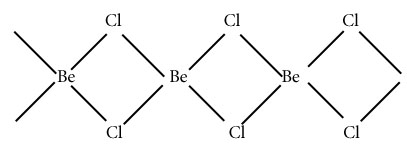
Solid State
Vapour state

Q.27.The tendency to form halide  hydrates gradually decreases (for example, MgCl2·8H2O, CaCl2·6H2O, SrCl2·6H2O and BaCl2·2H2O) down the group.

Ans.Since size of the alkaline earth metal decreases top to bottom hence hydration strength decreases down the group.

Q.28. List some anomalous behavior of Be.

Ans 1.Compunds of Be are mainly covalent.

       2.Be can show maximum coordination number 4 but other elements can show coordination number more than 4.

       3. The oxide and hydroxide of beryllium, the group, are amphoteric in nature.

Q.29.List some similar behavior of Be and Al.

Ans. Due to similar charge/radius ratio beryllium resembles aluminum in some ways.

(i) Both Be and Al are not readily attacked by acids.

(ii)Both Beryllium and aluminium hydroxide  dissolve in excess of alkali to give a beryllate ion, [Be(OH)4]2– just as aluminum hydroxide gives aluminates ion, [Al(OH)4].

(iii) in vapour state  the chlorides of both beryllium and aluminum  exist in bridged chloride structure

(iv)Both the chlorides are soluble in organic solvents and are strong Lewis acids.

Q.30.Define the process slaking of lime.

Ans.The addition of limited amount of water breaks the lump of lime. This process is known as slaking of lime.

Q.31.What are the uses of quick lime(CaO).

Ans.(i)Used in  manufacturing cement.

(ii) Used in  manufacturing sodium carbonate from caustic soda.

(iii) In the purification of sugar

(iv)In the manufacture of dye stuffs.

Q.32.What do you mean by lime water and milk of lime?

Ans.The aqueous solution of Ca(OH)2 is called lime water and a suspension of slaked lime in water is called milk of lime.

Q.33.When CO2 is passed through lime water turns milky why?

Ans Due to formation of calcium carbonate.

Q.34.What are the uses of Calcium hydroxide(slaked lime)?

Ans. (i) Used in the preparation of mortar.

(ii)Used in white wash due to its disinfectant nature.

(iii)Used in making glass and preparation of bleaching.

Q.35.What are the uses of CaCO3 ?

Ans.(i) As an antacid

(ii) Mi ld abrasive in tooth paste.

(iii) A constituent of chewing gum.

(iv) Filler in cosmetics.

(V) Used in the manufacture of high quality paper.

Q.36.What do you mean by ‘dead burnt plaster’.

Ans. It is anhydrous calcium sulphate having  no water of crystallisation formed after heating plaster (CaSO4 .1/2H2O ) of Paris above 393K.

Q.37.What are the uses of plaster of Paris(CaSO4 .1/2H2O)?

Ans. (i)In the building industry.

(ii) As  plasters.

(iii) In ornamental work.

(iv)For making casts of statues and busts.

Q.38.Cement is  is also called Portland why?

Ans. It resembles with the natural limestone in the Isle of Portland, England.

Q.39.What are the composition of cement.

Ans. The averagecomposition of Portland cement is : CaO, 50-60%; SiO2, 20-25%; Al2O3, 5-10%; MgO, 2-3%; Fe2O3, 1-2% and SO3, 1-2%.

Q.40.What do you mean by setting of cement?

Ans.When water is mixed with cement  it gives  give a hard mass, due to the hydration of the molecules of the constituents and their rearrangement.

Q.41.Why gypsum is added to cement?

Ans.Gypsum slow down the process of setting of the cement so that it gets sufficiently hardened.

Q.42.What are the biological use s of alkaline earth metals.

Ans (i)Chlorophyll  contains magnesium.

(ii)Ca is present in bones and teeth.

(iii) Ca plays important roles in neuromuscular function,interneuronal transmission, cell membrane integrity and blood coagulation.

Chemistry Notes Hydrogen

Hydrogen

Hydrogen is placed separately in the periodic table why?

Hydrogen resembles both with alkali metals and halogens .At same time it also differs in many ways with those elements. Hydrogen is extremely small and H+doest not exist freely hence hydrogen is placed separately in the periodic table.

Properties to which hydrogen resembles with alkali metals.

1.Like alkali metals hydrogen can  lose one electron to form unipositive ions.

2. Like alkali metals, hydrogen forms  sulphide, oxides and  halides.

3.Outermost electronic configuration of alkali metals(ns1) is similar to electronic configuration of hydrogen(1s1)

Properties to which hydrogen differs from alkali metals.

Ionisation enthalpy of hydrogen is very high unlike alkali metals which have low ionization enthalpies.

2. Hydrogen has not metallic properties.

Properties to which hydrogen resembles with halogens.

1.Like halogens hydrogen is also short by one electron to the corresponding noble gas configuration.

2. In term of ionization enthalpy, hydrogen is similar   with halogens.

3. Like halogens, hydrogen forms a diatomic molecule.

How many isotopes of hydrogen are known.

Which hydrogen is also known as heavy hydrogen.

Deuterium is also known as heavy hydrogen.

Are chemical properties of different isotopes are same? Explain in which property they differ from each other.

All isotopes of hydrogen have same electronic configuration hence they have almost the same chemical properties but their rates of reactions are different due to their different enthalpy of bond dissociation. Physical properties of these isotopes are different due their large mass differences.
What is water gas ?

The mixture of CO and H2 is called water gas.

What is syn gas?

Water gas (CO+ H2 ) is also known as synthesis gas (syn gas) because it is used for synthesis methanol and hydrocarbons.

What is ‘coal gasification’ ?

The process of producing ‘syn gas’ from coal is called ‘coal gasification’.

Hydrogen is inert at room temperature why or Atomic hydrogen is produced at a high temperature in an electric arc or under ultraviolet radiations.

The bond dissociation enthalpy of H-H is very high thus hydrogen gas is inert at room temperature.

Describe the different ways by which hydrogen combines with other element.

(i) Loss of an electron to give H +

 (ii) Gain of an electron to form H

(iii) Forms single covalent bond by sharing electrons.

Uses of Hydrogen?

(i) It is used as a rocket fuel.

 (ii) In preparation of organic compound like methanol etc.

(iii) In preparation of inorganic compound like NH3 ,metal hydrides etc.

(iv) In hydrogenation of vegetable oils into vanaspati.

(v) In metallurgical processes, to reduce heavy metal oxides to metals.

(vi) In fuel cells to generate electrical energy.

Three types of hydrides.

 (i) Ionic or saline or salt like hydrides.

(ii) Covalent or molecular hydrides.

(iii) Metallic or non-stoichiometric hydrides.

(i) Ionic or saline or saltlike hydrides.

These hydrides are formed with s block elements like Na ,K and Ca.

Exampes :NaH,KH,CaH2 etc.

 Properties.

(i) Mainly ionic but some covalents hydrides are also available.

(ii) Crystalline, non-volatile and non conducting in solid state.

(ii) Covalent or molecular hydrides.

These hydrides are formed with P block elements like C,N.F etc

CH4, NH3, H2O and HF

Properties

      (i) They are covalent  hydrides.

     (ii) Volatile compounds

(iii) Metallic or non-stoichiometric hydrides.

These are formed by many d-block and f-block elements. LaH2.87, YbH2.55, TiH1.5–1.

Properties.

                (i) Nonstoichiometric, being deficient in hydrogen.

  (ii) Crystalline, non-volatile and nonconducting in solid state.

Pd,Pt can use source of energy why?

These elements can accommodate large number of hydrogen thus they used as its

hydrogen storage and as a source of energy.

Different types of  molecular hydrides

(i)Electron-deficient

 (ii) Electron-precise

(iii) electron-rich

(i) Electron-deficient

Group 13 hydrides are electron-deficient compounds.like BH3.AlH3 etc.They all are electron acceptors that are Lewis acids.

(ii) Electron-precise

All elements of group 14 form such compounds example CH4 etc.

(iii) Electron-rich hydrides

Group 15-17 hydrides are electron-rich hydrides.Example: NH3 ,H2O, HF.They all are electron donors that are Lewis bases.

Water has high freezing point, high boiling point, high heat of vaporisation and high heat of fusion in comparison to H2S and H2Se why?

It is due to the presence of extensive hydrogen bonding between water molecules.

Which property of water is responsible for moderation of the climate and body temperature of living beings.

The high heat of vaporisation and heat capacity are responsible for moderation of the climate and body temperature of living beings.

What is the structure of ice?

Ice has crystalline structure in which each oxygen atom is surrounded tetrahedrally by four other oxygen.

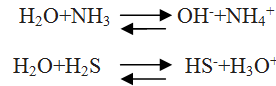
Water acts as Bronsted acid and base both give reactions to prove it.

What is hard water and soft water?

Water which contains hydrogencarbonate, chloride and sulphate of calcium and magnesium called hard water. Water free from soluble salts of calcium and magnesium is called soft water.Hard water does not give lather with soap. Soft water gives lather with soap easily.

Hard water is unsuitable for laundry also why?

Hard water forms scum/precipitate with soap hence unsuitable for laundry.

Hard water is harmful for boilers why?

On boiling there is deposition of salts in the form of scale. This reduces the efficiency of the boiler.

Types of hardness of water?

Hardness of water is of two types:

(i) Temporary hardness

Temporary hardness is due to the presence of magnesium and calcium hydrogen carbonates

(ii) Permanent hardness

Permanent hardness is due to the presence of magnesium and calcium chlorides and sulphates.

Methods to remove temporary hardness.

(i)Boiling

Mg(HCO3)2 ⎯⎯⎯⎯→Mg(OH)2 ↓ + 2CO2

Ca(HCO3)2 ⎯⎯⎯⎯→CaCO3 ↓ +H2O+ CO2

Mg (OH)and CaCO3 are  insoluble in water.

(ii)Clark’s Method

Mg(HCO3)2+ 2Ca(OH)2  ⎯⎯⎯⎯→ 2CaCO3↓ + Mg(OH)2 ↓ + 2H2O

Ca(HCO3)2+ Ca(OH)2  ⎯⎯⎯⎯→ 2CaCO3↓ + 2H2O

Mg (OH)and CaCO3 are insoluble in water.

Methods to remove permanent hardness.

(i)Treatment with washing soda

MCl2+Na2CO3⎯⎯⎯⎯→MCO3↓+2NaCl

MSO4 +Na2CO3⎯⎯⎯⎯→MCO3↓+Na2SO4

M=Mg and Ca

(ii) Calgon’s method

Na6P6O18   ⎯⎯⎯⎯→ 2Na++ Na4P6O182-

(M =Mg, Ca)

M2++ Na4P6O182-   ⎯⎯⎯⎯→2Na++ [M2P6O18]2-

M=Mg and Ca

What do you mean by 100 volume hydrogen peroxide?

30% solution of H2O2 is known as 100 volume hydrogen peroxide. It means 1 ml of 30 % H2O2 gives 100ml of oxygen at STP.

What are the uses  of H2O2?

(i) Used as a hair bleach and as a mild disinfectant.

(ii) Perhydrol is  H2Oused as antiseptic

(ii) In manufacturing sodium perborate and per-carbonate, which are used in high quality detergents.

(iii) In the synthesis of hydroquinone, tartaric acid, pharmaceuticals (cephalosporin) etc.

(iv)Used as a bleaching agent for textiles, paper pulp, leather, oils etc.

What is heavy water?

D2O, used as a moderator in nuclear reactors.

What are the advantage of using hydrogen as fuel?

(i)On a mass for mass basis dihydrogen can release more energy than other sources of fuel

        (ii) Pollutants in combustion of dihydrogen are less than other sources of fuel.

What are the disadvantages of using hydrogen as fuel cell?

1. Mass of a cylinder containing compressed dihydrogen of will be very high.

       2.Expensive insulated tanks will be used to convert hydrogen gas into liquid.

What will be only possible pollutants of fuel cell?

The only pollutants will be the oxides of dinitrogen.

What is the basic principle of hydrogen economy?

To transport and store of energy in the form of liquid or gaseous dihydrogen. Advantage of hydrogen economy is that energy is transmitted in the form of dihydrogen and not as electric power.

Chemistry Notes Redox Reactions

Redox Reactions

Define oxidation and reduction.

Definitions of Oxidation

Definition no 1: Addition of oxygen to an element or a compound called oxidation.

Definition:2 The removal of hydrogen from a substance called oxidation.

Definition 3 : Removal of electropositive element from substance is called oxidation.

Definition 4: Addition of electronegative element to a substance is called oxidation.

Definitions of Reduction.

Definition no1: Addition of hydrogen to an element or a compound is called reduction

Definition:2 The removal of oxygen from a substance is called reduction

Definition 3: Addition of electropositive element from substance is called reduction.

Definition 4: Removal   of electronegative element from substance is called reduction.

Define redox reactions.

When oxidation and reduction occur simultaneously that reaction is called redox reaction.

Define oxidation and reduction reactions in terms of electron transfer.

loss of electrons called oxidation and the gain of electrons is called reduction.

Define oxidizing agent and reducing agent.

Compound which oxidises other and reduces itself is called oxidizing agent.

Compound which reduces other and oxidises itself is called reducing agent.

Define Oxidation number.

Oxidation state of an element in a compound assuming there is a complete transfer of electron from a less electronegative atom to a more electonegative atom and determined by a set of rules.

Define oxidation,reduction,oxidizing agent ,reducing agent and redox reactions in terms of oxidation number.

Oxidation: Increase in oxidation number of the element in the given substance.

Reduction: Decrease in oxidation number of the element in the given substance.

Oxidising agent: A reagent which increases the oxidation number of an element in a given substance and decreases itself.

Reducing agent: A reagent which lowers the oxidation number of an element in a given substance and increases itself.

Redox reactions: Reactions in which there is increase in oxidation number of an element and also decrease in oxidation number takes place is called redox reduction.

What are the rules  for calculation of oxidation number?

1. The oxidation number of an atom in free elements is zero. Hydrogen in H2, sulphur in S8, phosphorus in P4 oxygen in O3 is zero.

2.Fluorine has oxidation number -1

3. Oxidation number of oxygen is -2 in all compounds except in peroxides, superoxides and oxygen fluorides. Oxidation number in peroxide is -1, in superoxides -1/2, in OF2 +2 and in O2F2 is +1.

4.The oxidation number of hydrogen is +1 in all of its compounds except metallic hydrides. In metallic hydrides it is +1.

5.The oxidation number of an ion is equal to the charge on it.

6.The oxidation number of group 1 elements(Li,Na,K,Rb,Cs) is +1 and the oxidation number of group 2 elements(Be,Mg,Ca,Sr,Ba) is +2.

7.For complex ions, the algebraic sum of oxidation numbers of all the atoms is equal to the net charge on the ion.

8.For neutral molecules the algebraic sum of oxidation numbers of all the atoms is equal o zero.

Balance the following equation by oxidation number method in acidic medium.

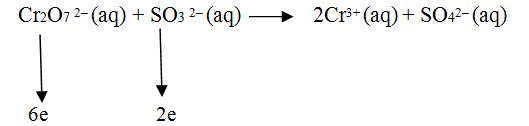
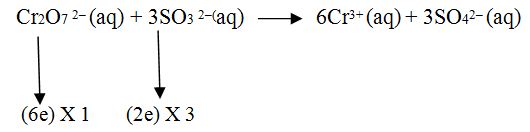
Step1.Calculate the oxidation number of each elements taking part in reaction.

Step 2. Balance the atoms which oxidation number changed during the reaction.

Step.3 Calculate the increase or decrease in the oxidation number per atom which oxidation number changed during the reaction.

Step.4 If these changes are not equal then multiply by suitable number so that these become equal.

Step.5 Balance oxygen if unbalance.

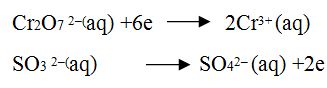
Balance the following equation by ion electron method method/half reaction method in acidic medium.

Step1.Calculate the oxidation number of each elements taking part in reaction.

Step 2. Write individual oxidation and reduction reaction.

Step 3 : Balance the atoms which oxidation number changed during the reaction.

Step 4: Calculate the increase or decrease in the oxidation number per atom which oxidation number changed during the reaction and add it in higher oxidation state side.

Step5. Add two reactions so that added electron must be cancelled.

\

Step6: Balance Oxygen atoms

Rule for balancing oxygen in acidic medium

Add H+ twice of the unbalance oxygen in that side in which higher number of oxygen is present and H2O equal number of unbalance oxygen in another side.

Rule for balancing oxygen in basic medium

Add H+ equal number of the unbalance oxygen in that side in which lower number of hydrogen is present.

Rule for balancing hydrogen in basic medium

Add OH equal number of the unbalance oxygen in that side in which lower number of oxygen is present and H2O equal number of unbalance hydrogen in another side.

Rule for balancing hydrogen in basic medium

Add OH equal number of the unbalance oxygen in that side in which higher number of oxygen is present and H2O equal number of unbalance hydrogen  in another side.

Define electrolytic cell.

The cell which convert electrical energy into chemical energy is called electrolytic cell.

Define Galvanic cell.

The cell which convert chemical energy into electrical energy is called electrolytic cell.

Define  electrode potential.

Potential of individual electrode is called electrode potential.

Dehine Standard Electrode Potential.        

At 298K when the concentration of each species taking part in the electrode reaction is unity reaction is carried out at 298K, then the potential of each electrode is said to be the   Standard Electrode Potential . 

Chemistry Notes Equilibrium

Equilibrium

Equilibrium in different physical process.

Solid-liquid equilibrium.

Rate of transfer of molecules from solid into liquid and of reverse transfer from liquid into solid is equal at normal melting point or normal freezing point of the substance.

Liquid -vapour equilibrium.

When rate of evaporation is equal to rate of condensation at normal boiling point of

the liquid.

Solid-vapour equilibrium.

Rate of transfer of molecules from solid into vapour and of reverse transfer from vapour into solid is equal.

Equilibrium involving dissolution of solid or gases in liquids.

For dissolution of solid in liquids.

The rate of dissolution of solid substance = rate of crystallization of solid substance.

For dissolution of solid in liquids.

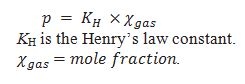
Define Henry’s Law.

The amount of solute that can be dissolved in given amount of solvent at given temperature  in mole fraction is directly proportional to the partial pressure of the gas.

Define equilibrium/Dyanamic equilibrium.

Actual reaction doesn’t stop but it proceeds from both sides with same speed that is rate of forward reaction is equal to rate of backward reaction.

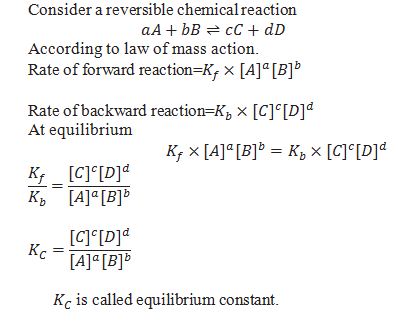
What is Law of mass action?

According to law of mass action rate of reaction is directly proportional to the concentration of reactants raised to the power equal to stochiometric coefficient.

Equilibrium constant (Kc)

What is KP.

KP is equilibrium constant for reactions involving gaseous reactants and products. In place of concentration partial pressures are used.

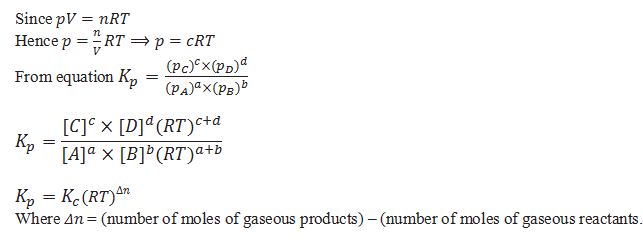
What is the relationship between and KP and KC.

Define heterogeneous equilibrium reaction.

Reaction in which equilibrium exists between reactants and products having more than one phase is called heterogeneous equilibrium.

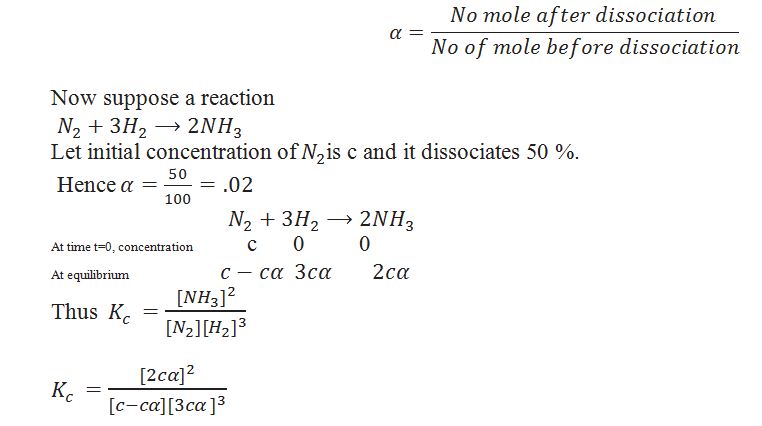
What is the significance of degree of dissociation while calculating equilibrium constant KC

Factors effecting equilibrium constant.

(i) Equilibrium constant is independent of initial concentrations of the reactants and products.

(ii) Equilibrium constant depends on temperature only.

How can we predict the extent of reaction by using equilibrium constant.

(i) If  value of Kc is very large that is greater than 103 than, the reaction is nearly to completion. The concentration of products is much larger than that of the reactants at equilibrium.

(ii) If  value of Kc is very small that is lesser than 10-3 than, the backward reaction is favored. Concentration of reactants is much larger than that of products that is the reaction proceeds to a very small extent in forward reaction

(iii) If  value of Kc is in between 103 and 10-3 than reaction proceeds toward equilibrium that is the reactants and products are comparable.

Define reaction quotient, Qc or Qp.

Reaction quotient is calculated similar as equilibrium constant but concentration of reactants and products are not necessarily equilibrium values.

How can we predict the direction of reaction by using reaction quotient.

(i) If Qc > Kc, the reaction is in reverse direction.

(ii) If Qc < Kc, the reaction is in forward direction

(iii) If Qc = Kc, the reaction mixture is at equilibrium.

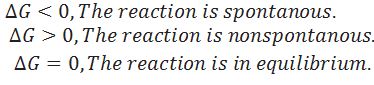
When the particular reaction is non spontaneous, spontaneous and equilibrium

Define Le Chatelier’s principle.

According to this principle when a chemical equilibrium is disturbed by a change of temperature,pressure, concentration or presence of catalyst equilibrium shifts in that direction in which these changes can be nullified.

(i)Effect of concentration.

(a)Addition of reactant shifts the equilibrium in forward direction

(b)Addition of products shifts the equilibrium in backward direction.

(c)Removal of reactant shifts the equilibrium in backward direction.

(d)Removal of products shifts the equilibrium in forward direction.

(ii)Effect of temperature:

(a)Increase the temperature to an exothermic reaction shifts the equilibrium on backward direction.

(b)Increase the temperature to an endothermic reaction shifts the equilibrium on forward direction.

(iii)Effect of pressure:

Increase the pressure shifts the equilibrium in that direction in which lower number of moles of gaseous reactants or products are present.

(iv) Effect of catalyst:

Catalyst does not affect the equilibrium but it helps the reaction to achieve equilibrium faster.

What is electrolyte?

Substances which dissociates into constitutes cation and anion in aq. solution is called electrolyte.

Define the types of electrolyte.

There are two types of electrolytes strong electrolyte and weak electrolyte.

Strong electrolyte:Types of electrolyte which dissociates  almost completely.

Examples: All salts(sodium chloride), Strong acids HCl,HNO3, H2SO4,H3PO4 ,HClO4,HBr,HI. Strong bases-Group 1 and group 2 elements hydroxides. Like NaOH,LiOH,KOH etc.

Weak electrolytes : Types of electrolyte which does not dissociates completely.

Examples:Weak acids like acetic acid,HNO2,HF etc. Weak bases like NH4OH.

Condition in which ionic equilibrium condition is established.

Ionic equilibrium condition is established in case of weak electrolyte, between dissociated ions and the unionized ions.

Define acids and bases according to Arrhenius theory.

Acids are substances which give H+( hydrogen ions) in water. and bases are substances that give OH( hydroxide ions) in water

What is the limitation of Arrhenius concept of acids and bases.

(i) Arrhenius concept is limited to only aq. Solution.

(ii) It does not explain the acidity and basicity of those compounds which do not contain hydrogen H+ and OH.

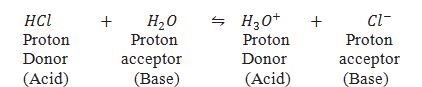
What are the Bronsted and Lowry concept of acids and bases.

Acids are the substance which donate proton(H+) and bases the substance which accept proton.

Define conjugate acid and base pairs.

The acid-base pair differs only by a proton(H+) is called a conjugate acid-base pair.

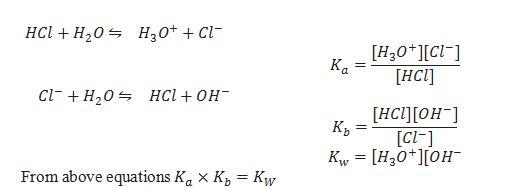
HCl and Cl are conjugate acid base pairs.Similarly H2O and H3O+ are another conjugate acid base pairs.

Lewis acids and bases

Species which accepts electron pair are called Lewis acids and which donates an electron pair are called Lewis bases. Strong acids have weak conjugate bases and vice versa.

Examples of Lewis acids.

(i) Some +ve charge species are Lewis acids.

Like H+,Fe3+ etc.

(ii) Electron deficient molecules are Lewis acids.

Like BF3,AlCl3 etc.

Examples of Lewis bases.

(i)-ve charge species are Lewis bases

Cl,OH etc.

(ii) Electron rich molecules are Lewis bases.

Like H2O,NH3 etc.

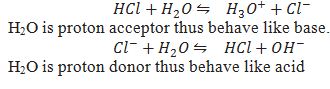
Give Two reactions to prove amphoteric nature of water.

Pure water also show amphoteric behaviour how?

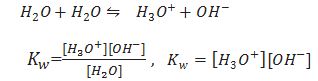
Ionic product of water.

Because concentration of water (55.55 M) is very high and doesn’t change during reaction

How can we determine the acidic, basic and neutral aq solution

  [H3O+] > [OH ]= Acidic

         [H3O+] = [OH ]= Neutral

         [H3O+] < [OH]= Basic

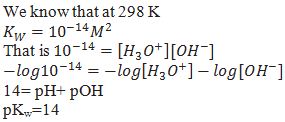
Define pH scale.

Prove  pH+ pOH= 14

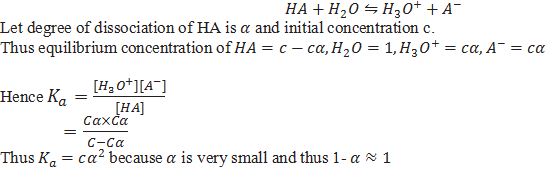
Ionization constant (Ka) for weak acid.

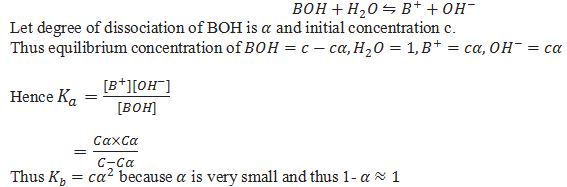
Ionization constant (Kb) for weak base

What is pKa and pKb.

pKa=-log[Ka] and pKb=-[log Kb]

Relation between Ka and Kb for conjugate acid base pair.

Determine the factors effecting acidic  strength.

(i)Larger the value of ionization constant Ka higher the acidic strength.

(ii) In a given group acidic strength increases as the bond length increases.

Example: HI>HBr>HCl>HF 

(iii) If the difference between electronegativity increases acidic strength increases.

Example: CH4 < NH3 < H2O < HF

What is common ion effect.

Common Ion effect is based on the Le Chatelier’s principle. If any common ion is added equilibrium shifts in that direction in which this increased concentration is consumed.

What is difference between hydration and hydrolysis of salt?

Salt is dissociated into constituent ions in aq.solution and remains as hydrated ions called hydration.

When ions interact with water to form corresponding acids or bases called hydrolysis.

Examples:

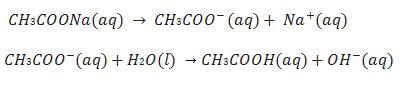
(i) Salts of weak acid and strong base e.g.CH3COONa.

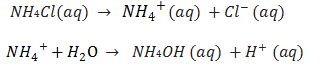
(ii) Salts of strong acid and weak base e.g. NH4Cl

(iii) salts of weak acid and weak base, e.g.CH3COONH4

What is the formula for determining pH of aq.solution containing salt of weak acid and weak base, e.g.CH3COONH4

pH = 7 + ½ (pKa – pKb)

Define Buffer Solutions.

The solutions which resist change in pH value on the addition of small amounts of acid or alkali are called Buffer Solutions.

What is solubility product Ksp.

Equilibrium is established between the undissolved sparingly soluble salt in water

and the ions in a saturated solution.

Chemistry Notes Thermodynamics

Thermodynamics

Define system and surrounding.

Substance which is taken under observation is called system , rest of the universe is called surrounding.

Explain the different types of system with example.  

There are three types of system.

(i)Open system.

The type of system in which both matter and energy is exchanged between system and surroundings.

Example: Substance in open container.

 (ii) Closed system.

Example: Substance in close container having thermoconducting wall.

The type of system in which only energy is exchanged between system and surroundings.

 (iii) Isolated system.

The type of system in which neither matter nor energy is exchanged between system and surroundings.

Example: Substance in insulated vessel (Thermos flask)

Define state function or state variables and path function.

Those properties of the system which depend only on the state of the system and not on how it is reached to that state are called state function.

Examples:Pressure,Temperature,Volume ,Internal energy,Enthalpy.etc.

Those properties of the system which depend on how the change is carried out are called path function.

Examples:Heat energy(q),Work done(w)

Define internal energy (U).

The total energy contained by the system is called internal energy.

                         U=Kinetic energy + Potential energy

Kinetic energy=translational energy + rotational +vibrational.

What is adiabatic system?

The types of the system in which there is no heat exchange between the system and surroundings through its boundary is called adiabatic system.

What is the difference between adiabatic system and isolated system.

Adiabatic system is a specified condition 

Mention the sign convention for different thermodynamics function.

Energy absorbed by the system ‘q’=+ve

Energy released by the system ‘q’ =-ve

Work done by the system ‘w’ = -ve

Work done on the system ‘w’ = +Ve

Define first Law of thermodynamics.

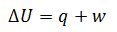
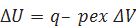
Internal energy change of the system is equal to the energy provide to the system and work done by the system.

Obtain a formula for mechanical work (pressure- volume work) against constant external pressure .

What do you mean by free expansion?

Expansion of a gas in vacuum when  is called free expansion.

No work during free expansion of an ideal gas whether the process is reversible or irreversible.

Define reversible and irreversible process.

The process which occur infinitely slowly such that system and surrounding are always in equilibrium with each other. The process  can be reversed at any moment by an infinitesimal change called reversible process. An irreversible process can be defined as a process in which the system and the surroundings do not return to their original condition once the process is initiated

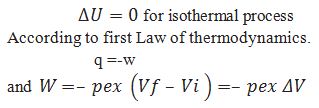
Change in internal energy of a system when

(i)Work done by the system or on the system and heat is absorbed by the system.

(ii)If a process is carried out at constant volume and heat is absorbed by the system.

(iii) For isothermal process.

(iv) For adiabatic system.

What is the equation for calculating work done for isothermal irreversible process.

Obtain equation for the work done for the isothermal reversible process.

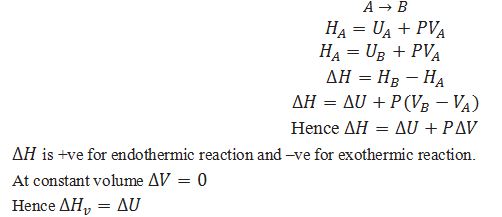
Define enthalpy.

A thermodynamic function, the enthalpy H is equal to H = U + pV .

U=Internal energy of the system

P=Pressure of the system.

V=Volume of the system.

What will be the change in enthalpy during the reaction  at constant pressure.

What is the equation for calculating change in enthalpy at constant pressure for a reaction involving gases.

What is extensive property and intensive properties of a system?

Those properties which depends on the amount of matter present in the system are called  extensive property.Example: Mass, volume, internal energy, enthalpy.

Those properties which do not depend on the amount of matter present in the system are known as intensive properties.Example:Temperature, density, pressure etc.

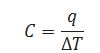
Define heat capacity.

Heat requires by the substance to increase the temperature by one 0C is called heat capacity.
Define specific heat capacity.

Heat requires by the unit mass of the substance to increase the temperature by one 0C is called specific heat capacity.

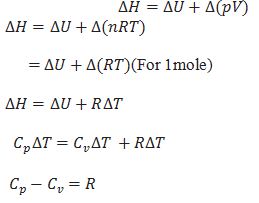
What is the relation between heat capacity at constant volume (Cv) and heat capacity at constant pressure Cp)?

What is bomb calorimeter?

A calorimeter in which the chemical reaction is carried out at constant volume. Hence there is no work done.

How can we calculate the enthalpy change for reaction?

Define standard enthalpy of reaction.

The standard enthalpy of reaction is the enthalpy change that occurs on a system when one mole of matter is transformed by a chemical reaction under standard condition.

Define standard  enthalpy of fusion

Enthalpy of fusion is the change in enthalpy when one mole of solid is melted in liquid.

Define standard enthalpy vaporization

Amount of heat required to vaporize one mole of liquid at constant temperature.

Define standard enthalpy of sublimation

The change in enthalpy when one mole of a solid substance is converted into vapour state at constant temperature.

Define standard enthalpy of formation

Enthalpy change during the formation of one mole of a compound from its constituent element in their standard state.

Define enthalpy of combustion

Enthalpy change during combustion of one mole of a substance when all the reactants and products are in standard state.

Define enthalpy of atomisation.

(i )Enthalpy change during breaking of one mole of bond of a compound completely into gaseous state.

(ii)Enthalpy of atomization is also called enthalpy of sublimation in case of solid element.

Define bond dissociation enthalpy.

The bond dissociation enthalpy is the change in enthalpy when one mole of covalent bond is broken to form product in gaseous state.

Define mean bond enthalpy.

For the polyatomic molecules mean bond enthalpy is defined as total bond dissociation enthalpies divided by number of bonds.

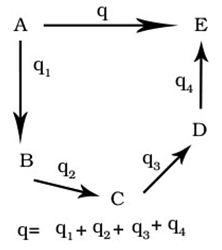
Define Hess’s Law of constant heat summation.

When a reaction takes place in several steps then its standard enthalpy is the sum of the standard enthalpies of the intermediate reactions.

Define enthalpy of solution

Enthalpy change when one mole of substance is dissolved in given amount of solvent.

Define  lattice enthalpy.

The enthalpy change when one mole of an ionic compound dissociates into it constituent ions in gaseous state.

Define enthalpy of hydration.

The energy released when new interacting are made between the gaseous ions and water molecules is called hydration enthalpy.

What is the relationship between enthalpy of solution,lattice enthalpy,hydration enthalpy.

What is Born -Haber cycle.

With the help of Born-Haber Cycle we determine the lattice enthalpy of the substance.              

Define spontaneous reaction.

The reaction which occurs itself without any external force is called spontaneous reaction.

Examples:Burning of carbon in oxygen.Cooling of hot water.

What do you mean by spontaneity of chemical reaction?

Spontaneity means feasibility of particular chemical reaction that is that reaction is possible or not.

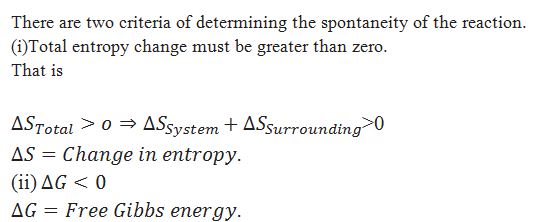
What is the criteria for spontaneous process?

Define entropy(s)

The degree of randomness or disorderness is called entropy.

How can we calculate the change in entropy of a reversible reaction?

Where q=enthalpy change during chemical reaction or heat released or absorbed by the system.

What is the relation between change in entropy of the system ,change in entropy of surrounding )?

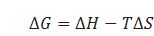
What is the relation between change in entropy of the system. change in enthalpy of system ) and Gibbs energy change ?

In that case in which randomness increases the change in entropy is taken as +ve and when  randomness decreases the change in entropy is taken as –ve.

What is the formula for calculating equilibrium constant Kc?

When the particular reaction is non spontaneous, spontaneous and equilibrium according to .

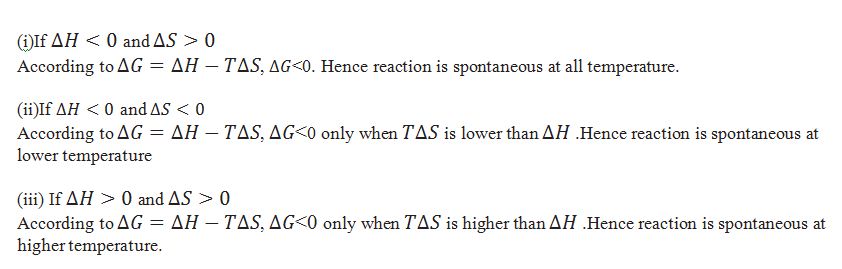
Predict whether the reaction may occur spontaneously or not in following cases.

Chemistry Notes States of Matter

States of matter

Intermolecular forces of attraction.

The forces of attraction and repulsion between constituent particles of matter a molecule or atom is called intermolecular force of attraction.

Different types of attractive intermolecular forces of attraction (van der Waals forces).

van der Waals forces  are of three types.

            (i)London forces/dispersion force-Between non polar molecules.

           (ii)Dipole-dipole forces- Between polar molecules.

           (iii)Dipole-induced dipole forces- Between non polar and polar molecules.

H-bonding-A particular type of dipole-dipole interaction acts between hydrogen of one molecule and F or O or N of other molecule.

What is thermal energy.

Energy of the substance arises due to motion of it constituent atoms or molecules.

Thermal energy of substance in their different physical states decreases in following order.

Gas>Liquid>Solid

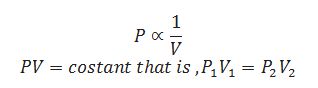
Define Boyle’s Law.

At constant temperature, the pressure of a given mass of gas is inversely proportional to its volume.

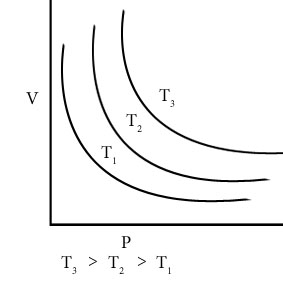
Define isotherm.

Each curve corresponds to a different constant temperature in pressure, p vs. Volume, v is called isotherm.

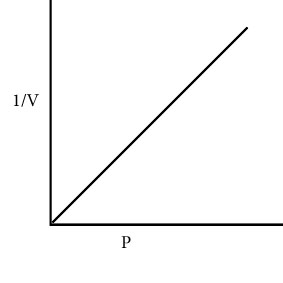
Draw Graph of pressure, p vs.1/V of a gas at different constant temperatures.

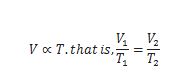
Define Charle’s law.

 At constant  pressure the volume of a given  mass of a gas is directly proportional to its absolute temperature.

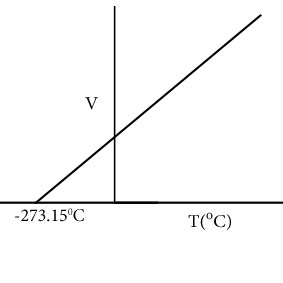
Draw Volume vs. Temperature   graph at constant pressure.

Define isobar.

Each line in  Volume vs Temperature graph at constant pressure is called isobar.

Define absolute zero.

Hypothetical  temperature at which volume of gases are considered  zero is called absolute zero.This temperature is -273.15oC.

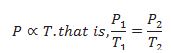
Explain Gay Lussac- Law.

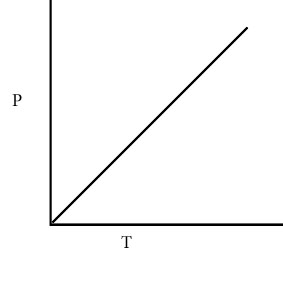
At constant volume, pressure of a given mass of a gas is directly proportional to the temperature.

Define isochore.

Each line in  Pressure  vs. Temperature   graph at constant volume is called isochore.

Define Avogadro Law.

Equal  volumes of all gases under the same temperature and pressure contain equal number of  molecules.

What do you mean by STP.

STP means standard temperature and pressure. Standard temperature is 273.15 K (0oC) and standard pressure is 1 bar .At STP molar volume of an ideal gas is 22.7 L mol–1.

Define ideal gas.

Gas which obeys all types of gas laws Boyle’s law, Charles’ law and Avogadro law strictly is called an ideal gas.

What is ideal gas equation.

Combination of four gas laws gives ideal gas equation.

Define partial pressure.

The pressure exerted by the individual gas in mixture of gases is called partial pressure.

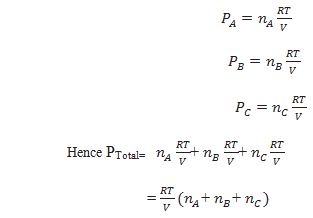
Define Dalton’s Law of partial pressure.

The total pressure exerted by the mixture of gases is equal to the sum of the partial

pressures of individual gases.

PTotal = PA+PB+PC……………

 Let at the temperature T, three gases A,B and C enclosed in the volume V, exert partial pressure pA, pB and pC respectively. then,

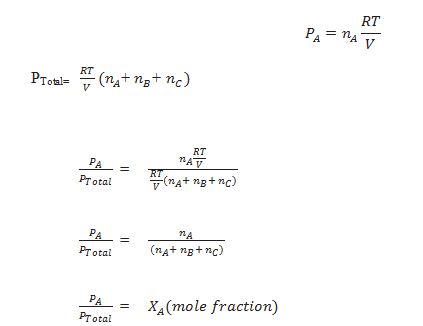
Waht is the relation between partial pressure mole fraction, total pressure and partial pressure.

Define aqueous tension.

Pressure exerted by saturated water vapour is called aqueous tension.

What is the different assumptions or postulates of the kinetic molecular theory of gases.

(i)The volume of the molecules is negligible in comparison to the empty space between them.

       (ii) There is no force of attraction between the particles of a gas at ordinary temperature and pressure.

       (iii) Particles of a gas are always in constant and random motion in straight lines

       (iv)Pressure exerted is due to collision of the particles with the walls of the container

       (v) Collisions of gas molecules are perfectly elastic thus the total energy of molecules before and after the collision remains constant.

       (vi)The average kinetic energy of the gas molecules is directly proportional to the absolute temperature.

Which assumption of kinetic theory explains the great compressibility of gases.

The volume of the molecules is negligible in comparison to the empty space between them.

Which assumption of kinetic theory explains that gases expand and occupy all the space available to them.

There is no force of attraction between the particles of a gas at ordinary temperature and pressure.

Why do gases deviate from the ideal behaviour?

It is due to following reasons.

         (i) The volume of the molecules is negligible in comparison to the empty space between them.

         (ii) There is no force of attraction between the particles of a gas at ordinary temperature and pressure.

What are the conditions under which gases deviate from ideality?

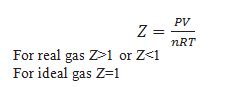
Gases deviate from ideal behaviour when compressibility factor Z>1or Z<1.This is possible at high pressure and low temperature when molecules of gases are very close to each other and intermolecular forces become significant.

What are the conditions under which gases follow ideal gas equation and very close to ideality?

Gases behave as ideal gas when compressibility factor Z=1.This is possible at very low pressure and high temperature when molecules of gases are very far to each other and intermolecular forces are negligible.

What are the real gas/van der Waals  equation.

What is the significance of  ‘a’ and ‘ b’ in real gas equation.?

’a’ is measure of magnitude of attractive forces between the molecules .Higher  the value of ‘a ‘easier’  the liquefaction.  ‘b’ is effective size of molecules, higher the value of  ‘b’ smaller is the compressible volume.

What is the unit of van der Waals ‘a’ and ‘b’.

Unit of a=L2 mol-2atm.

       Unit of b=Lmol-1

What is compressibility factor Z.

Z determine the deviation of gas from ideal behaviour.

Define  Boyle  point/ Boyle temperature.

The temperature at which a real gas obeys ideal gas law over an appreciable range of pressure is called Boyle temperature or Boyle point.

How can compressibility factor is determined id VReal and VIdeal are  given.

Define critical temperature(Tc) critical pressure(Pc) ,critical volume(Vc).

Critical temperature(Tc)-  Highest  temperature at which gases can be liquefied by increasing pressure  above this temperature gases can’t  be liquefied.

Critical pressure(Pc)– Pressure  of one mole of gas  at critical temperature is called critical pressure (pC).

Critical volume (VC) -Volume of one mole of the gas at critical temperature is called critical volume (VC).

What do you mean by permanent gases.?

Gases which has Z>1 that is show continuous positive deviation in Z(compressibility factor) value are permanent  gases. These gases have lower value of critical temperature and can’t be liquefied easily.Examples:H2.He.N2 etc.

Give the examples of easily liquefiable gases.

CO2,NH3,H2O etc. are easily liquefiable gases which has having high critical temperature. These gases first show decrease in Z value with increasing pressure, which reaches a minimum value. On further increase in pressure, the value of Z increases continuously.

Which of these gases will liquefy first when we start cooling from 700 K to their critical temperature ? CO2,NH3,H2O, H2.He,N2,O2

H2O> NH3 >CO2> O2 >N2 >H2 >He. Higher the value of critical temperature easier is liquefaction.

Define vapour pressure.

In closed container when rate of evaporation is equal to the rate of condensation  (equilibrium condition) the pressure exerted by the vapour of the liquid to the walls of the container is called vapour pressure.

What the boiling terms represent for liquid?

The condition of free vaporization throughout the liquid is called boiling.

Define boiling point?

The temperature at which vapour pressure of liquid is equal to the external pressure is called boiling point at that pressure.

What is normal boiling point.

The temperature at which vapour pressure of liquid is equal to the 1atm is called normal boiling point.

What is standard boiling point.

The temperature at which vapour pressure of liquid is equal to the 1 bar is called standard boiling point

Standard boiling point(99oC) of the liquid is slightly lower than the normal boiling point(100oC) why?

Since 1 bar pressure is slightly less than 1 atm pressure hence standard boiling point of the liquid is slightly lower than the normal boiling point.

The pressure cooker is used for cooking food on hills.

Since atmospheric pressure at high altitude is lower than sea level hence liquid boil at lower temperature on high altitude.Thus pressure cooker is used for cooking food on hills

Define Surface tension.

Surface tension is the force acting per unit length perpendicular to the line drawn on the surface of liquid.

What is the S.I unit of surface tension.

Nm-1

What is the cause of surface tension?

In the bulk of liquid, each molecule is pulled equally in every direction due to presence of similar molecules in all directions, resulting in a net force of zero.The molecules at the surface do not have other molecules on all sides, thus net attractive force is towards the interior of the liquid.

Liquid droplets are perfectly spherical in the gravity free environments why?

Surface tension is responsible for the shape of liquid droplets. It is the surface tension due to which liquids tend to have minimum surface area.

Why do liquid tends to rise (or fall) in the capillary.?

Surface tension gives stretching property to the surface of liquid hence liquid  tends to rise (or fall) in the capillary.

Why do particles of soil at the bottom of river remain separated but they stick together when taken out?

It is due to surface tension which reduces surface area of thin film of water on particles of soil.

Heating makes sharp glass edges smooth why?

On heating, the glass melts and the surface of the liquid tends to take the rounded shape at the edges due to surface tension which makes the edges smooth.

Define viscosity.

Internal friction between layers of fluid which resist the flow if liquid is called viscosity.

Define laminar flow.

The flow of a viscous liquid on which particles of the fluid move in parallel layers and there is  regular gradation of velocity in passing from one layer to the next layer is called laminar flow.

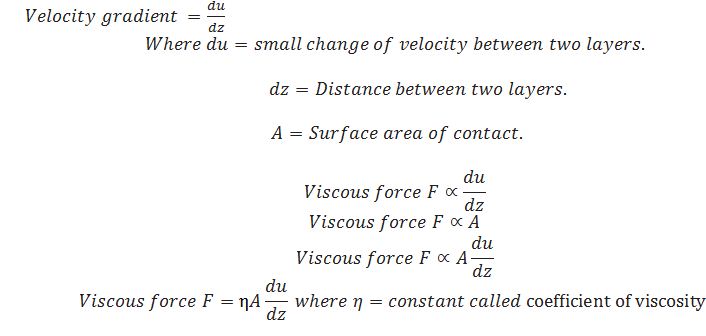
Obtain a formula for determining viscous force between two layers

Define coefficient of viscosity.

Viscosity coefficient is the viscous force when velocity gradient is unity and the area of contact is also unity.

Describe factors effecting viscosity.

(i)Temperature-higher the temperature lesser the viscosity ,this slower the motion.

(ii) Intermolecular force of attraction.- Hydrogen bonding and van der Waals forces are responsible for viscosity.

Windowpanes of old buildings are thicker at the bottom than at the top why?

It is due to property of flow of liquid.

Chemistry Notes Chemical bonding and molecular structure

Chemical bonding and molecular structure

Define chemical bond.

The attractive force of attraction which holds the atoms together in a molecule called chemical bond.

What is octet rule?

Atoms can combine either by transfer of valance electrons from one atom to another or by sharing of valance electrons in order to have an octet in their valance shell.

How does ionic bond form explain with example?

Ionic bond forms by transfer of valance electron from one atom to another.

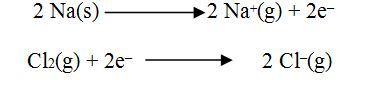
Example:Formation of NaCl

(i)Loss of an electron by Na metal and formation of cations.

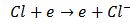
(ii) Gain of an electron by Cl nonmetal and formation of anions

(iii)The negative anion and  positive cation forms NaCl by electrostatic force of attraction.

Define electrovalent bond.

The electrostatic  force of attraction between cation and anion which holds the ion together in a molecule is called electrovalent bond.

Define electrovalency.

The number of electrons loss or gain by elements in particular ionic compound is called electrovalency.

Example:NaCl

Electrovalencey of Na =1

Electrovalencey of Cl =1

Explain formation of covalent bond with example.

Covalent bond forms by sharing of electrons between two atoms.

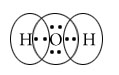
Example formation of H2O.

formation of covalent bonds

Define covalency.

Number of electrons an atom can share with other atoms is called covalency.

Example: In H2O Covalency of H=1,and covalency of oxygen is 2

The drawback of octet theory.

(i) Octet rule is based upon the chemical interest of noble gases .However some noble gases also form some compound.

(ii)Octet rule does not explain the shape of the molecules.

(iii) It does not explain the relative stability of the molecules.

Describe the factors for formation of ionic compound.

(i) Metals which form cation must have low ionization enthalpy.

(ii)Non metals which form anion must have high electron gain enthalpy.

(iii)Lattice enthalpy of ionic compound should be high.

Define lattice enthalpy.

Energy require to separate one mole of a solid ionic compound into gaseous constituent ions is called lattice enthalpy.

Define bond order.

Number of bonds between two atoms in a molecule is called bond order.

Define bond length.

Bond length is defined as the equilibrium distance between the nuclei of two bonded atoms in a molecule.

Define covalent radius.

The covalent radius is half of the distance between two similar atoms joined by a covalent bond in a same molecule.

Define van der Waals radius.

Half of the distance between two similar atoms in a separate molecule.

Define bond angle.

Angle between the orbitals containing bonding electron pairs around the central atom in molecule.

Define Bond enthalpy.

Energy required  to break one mole of bonds of a particular type between two atoms in a gaseous state.

Define average bond enthalpy.

Average bond enthalpy in a polyatomic molecule can be obtained by dividing total bond dissociation enthalpy by number of bonds broken.

Explain formal charge.

Formal charge =[Total number of valence electrons in the free atom]-[Total number of nonbonding  electrons( lone pair  electrons)]-1/2[Total number of bonding (shared electrons) electrons]

What are the limitations of octet rule?

(i)The incomplete octet of the central atom.

incomplete octet
Incomplete octet

 (ii )Odd –electron molecules.

Odd –electron molecules.

(iii)The expanded octet

The expanded octet
The expanded octet

Draw Lewis dot structure of following compound.

C2H4

Lewis dot structure of ethene

N2

Lewis dot structure of Nitroogen

H2

Lewis dot structure of Hydrogen

O2

Lewis dot structure of oxygen

O3

Lewis dot structure of ozone

NF3

Lewis dot structure of NF3

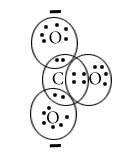
CO32-

Lewis dot structure of carbonate ion

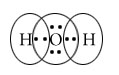
H2O

Lewis dot structure of water

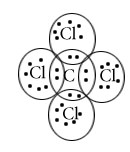
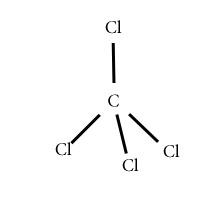
CCl4

Lewis dot structure of carbon tetrachloride
 

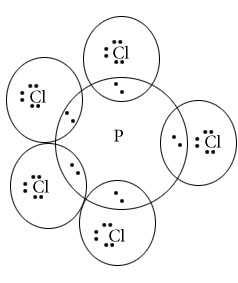
PCl5

Lewis dot structure of phosphorus pentachloride

SF6


Lewis dot structure of sulphur hexachloride

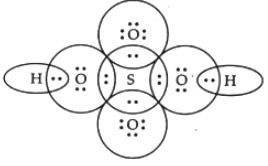
H2SO4

Lewis dot structure of sulphuric acid

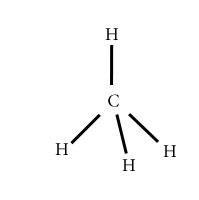
CH4

Lewis dot structure of methane

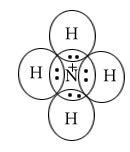
NH4+

Lewis dot structure of ammonium ion

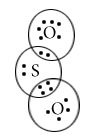
SO2

Lewis dot structure of sulphur dioxide

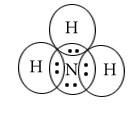
NH3

Lewis dot structure of Ammonia

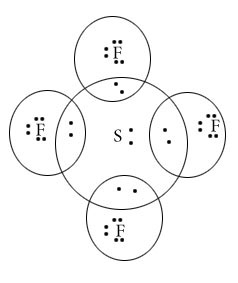
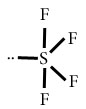
SF4


Lewis dot structure of sulphur tetrafluooride

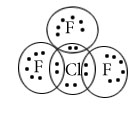
ClF3

Lewis dot structure of ClF3

BrF5

Lewis dot structure of BrF5

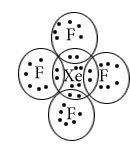
XeF4

Lewis dot structure of XeF4

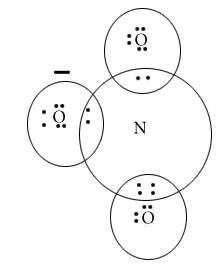
NO3

Lewis dot structure of Nitrate ion

What is Fajan’s Rule?

The partial covalent character of ionic bond was discussed by Fajan’s,by following rules.

(i)The smaller the size of cation and the larger the size of anion the greater the covalent character of particular ionic bond.

(ii)The greater the charge on the cation the greater the covalent character if the ionic bond.

Explain VBT with example.

(i)Covalent  bond between two atom forms by overlapping of atomic orbitals.

(ii)Only valence shell orbitals can take part in bonding and must have opposite spin.

(iii)Greater the overlap the stronger is the bond formed between two atoms.

Example : Formation of H2 molecule.

H2

Electronic configuration of one H atom 1s1


Shape of s orbital

Overlapping

Thus H-H  forms, having one  bond

Explain the formation of following molecules on the basis of VBT.

N2

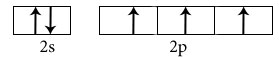
Electronic configuration of one N atom 1s2,2s2,2p3


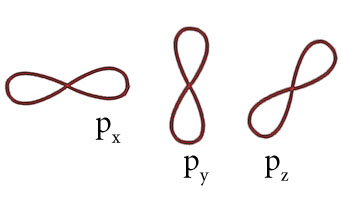
Shape of three p orbitals

Overlapping

O2

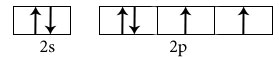
Electronic configuration of one O atom 1s2,2s2,2p4


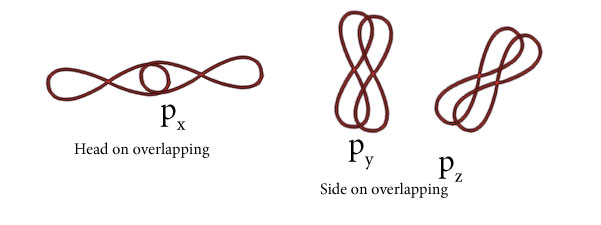
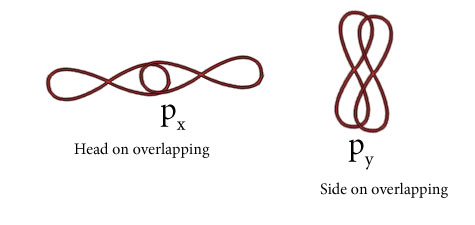
Shape of two p orbitals

Overlapping

Thus O=O forms having one sigma and one pi bond.

Mention two types of overlapping and nature of covalent bond.

There are two types of bond formed during overlapping of atomic orbitals.

(i)Sigma bond( Covalent bond which forms by head on overlapping along the intermolecular axis.

Following types of overlapping can form sigma bond

(i)s-s overlapping.

(ii)s-p overlapping.

(iii)p-p overlapping.

(iii )Pi Bond( Covalent bond forms by side on overlapping .

Following types of overlapping can form pi bond.

(iii)p-p overlapping.

Which bond is stronger in sigma  and Pi bond?

Sigma bond is stronger bond than Pi bond because in case of sigma bond the overlapping of orbitals takes place to a larger extent.

What are the main postulates of VSEPR theory.

(i) Electron pair Geometry of the molecule is decided by both bond pair and lone pair orbitals ,but Molecular geometry of the molecules is decided by only bond pair orbitals.

(iii)The repulsive interaction of electrons pair decreases in the following order.

Lone pair(lp)-lone pair(lp) > Lone pair(lp)-bond pair(bp) > bond pair(bp)-bond pair(bp) 

What are the steps to find shape of the molecules according to VSEPR theory.

Example: NH3

Step (i)Write Lewis dot structure of NH3.

Step(ii)Chose central atom here it is N

Step(iii)Find bond pair orbitals and lone pair orbitals

bp=3,lp=1

Step(iv)Find the sum of lp and bp

Here lp+bp=4

Now structure is determined by following table.

lp+bp Structure (Electron pair Geometry)
2 Linear
3 Trigonal planer
4 Tetrahedral
5 Triangular bipyrmidal
6 Square bipyramidal
7 Pentagonal bipyarnidal
VSEPR Theory

Determine the shape of following molecules.

NH3

Central atom=N

l.p=1

b.p=3

l.p+b.p =4

Electron pair Geometry=Tetrahedral

Shape of NH3
Shape of NH3

Molecular Geometry= Pyramidal

H2O

Central atom=O

l.p=2

b.p=2

l.p+b.p =4

Electron pair Geometry=Tetrahedral

shape of water
shape of water

Molecular Geometry=Bent/Angular

CCl4

Central atom=c

l.p=0

b.p=4

l.p+b.p =4

Electron pair Geometry/Molecular Geometry =Tetrahedral

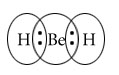
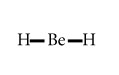
BeH2

Central atom=Be

l.p=0

b.p=2

l.p+b.p =2

Electron pair Geometry /Molecular Geometry=Linear

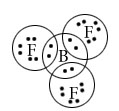
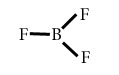
BF3

Central atom=B

l.p=0

b.p=3

l.p+b.p =3

Electron pair Geometry/Molecular geometry=Trigonal planer

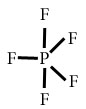
PF5

Central atom=P

l.p=O

b.p=5

l.p+b.p =5

Electron pair Geometry/Molecular geometry=Trigonal bipyramidal

SF6

Central atom=S

l.p=0

b.p=6

l.p+b.p =6

Electron pair Geometry/Molecular geometry=Square bipyramidal

CH4

Central atom=C

l.p=O

b.p=4

l.p+b.p =4

Electron pair Geometry/Molecular geometry=Tetrahedral

SF4

Central atom=S

l.p=1

b.p=4

l.p+b.p =5

Electron pair Geometry=Trigonal bipyramidal

Molecular geometry=See-Saw

ClF3

Central atom=Cl

l.p=2

b.p=3

l.p+b.p =5

Electron pair geometry=Trigonal bipyramidal

Molecular Geometry=T shape

XeF4

Central atom=Xe

l.p=2

b.p=4

l.p+b.p =6

Structure=Square bipyramidal

Shape-Square Planar

Define Dipole moment.

The Product of the magnitude of charge and the distance between the centers of the two positive and negative and nonpolar covalent co charge is called dipole moment.

What is Debye(D)

Debye is unit of dipole moment.

What is polar covalent compound and nonpolar covalent compound?

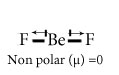
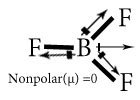
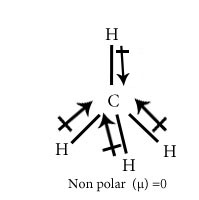
Polar covalent Compound-Compounds having net dipole moment not equal to zero are polar covalent compound.

Non polar covalent Compound-Compounds having net dipole moment  equal to zero are nonpolar covalent compound

Chose the polar and nonpolar compound in following compounds.

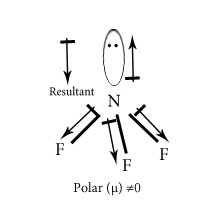
NF3

Dipole moment of NF3

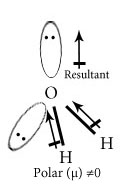
H2O

Dipole moment of H2O

BeF2

Dipole moment of BeF2

BF3

CH4

Dipole moment of CH4

NH3

Dipole moment of NH3

In NH3 and NF3 which has higher dipole moment?

Dipole moment of NH3 is higher than that of NF3. In NH3 the orbital dipole due to lone pair is in same direction as the resultant dipole moment of N-H bonds ,whereas in NF3 the orbital dipole is in the direction opposite to the resultant dipole moment of three N-F bonds.

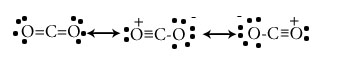
Explain the term resonance in a covalent compound.

When a particular compound can be draw in more than two Lewis dot structure in which atomic positions are remain constant and differ on only arrangement of electrons.

Draw the resonating structure of following compounds.

CO2

Resonance Of CO2

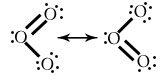
 O3

Resonance of Ozone
Resonance of Ozone

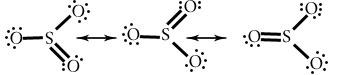
 SO3

Resonance of carbonate ion SO3

NO3

Resonance of nitrate ion

CO32-

Resonance of carbonate ion

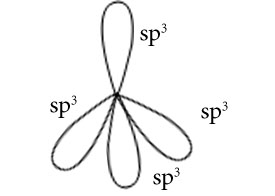
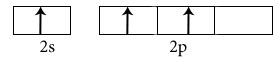
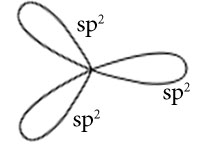
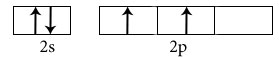
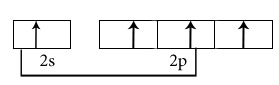
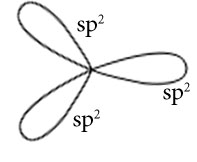
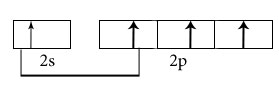
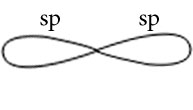
Define hybridisation.

The process of intermixing of the orbitals having slightly different energies and formation of new type of orbitals called hybrid orbitals of equivalent energies and shape.

What are the different types of hybridization and their structures.

Hybridisation Structure
sp Linear
Sp2 Triagonal planer
Sp3 Tetrahedreal
Sp3d Triangular bipyramidal
Sp3d2 Square bipyramidal

Using hybridization theory show the formation of following molecules.

H2O

Central atom is Oxygen

Electronic configuration in ground state

Hybridisation among 2s and 2p orbitals

Hybridisation is sp3

Orientation of four sp3 hybrid orbitals in space

Overlapping between hybrid orbital and s orbital of hydrogen and formation of two bonds.

Hybridisation of H2O

BCl3

Central atom is B

Electronic configuration in ground state

Electronic configuration in excited state

Hybridisation among 2s and 2p orbitals

Hybridisation is sp2

Orientation of three sp2 hybrid orbitals in space

Overlapping between hybrid orbital and p orbital of Chlorine and formation of three bonds.

Hybridisationn of BCl3

PCl5

Central atom is P

Electronic configuration in ground state

Electronic configuration in excited state

Hybridisation among 3s ,3p and 3d orbitals

Orientation of five  sp3d  hybrid orbitals in space

Overlapping between hybrid orbital and p orbitals of chlorine and formation of five bonds.

Hybridisationn of PCl5

SF6

Central atom is S

Electronic configuration in ground state

Electronic configuration in excited state

Hybridisation among 3s ,3p and 3d orbitals

Orientation of five  sp3d2  hybrid orbitals in space

Overlapping between hybrid orbital and p orbitals of fluorine and formation of six bonds.

Hybridisation of SF6

CH4

Central atom is Carbon

Electronic configuration in ground state

Electronic configuration in excited state

Hybridisation among 2s and 2p orbitals

Hybridisation is sp3

Orientation of four sp3 hybrid orbitals in space

Overlapping between hybrid orbital and s orbitals of hydrogen and formation of four bonds.

Hybridisation of CH4

NH3

Central atom is N

Electronic configuration in ground state

Hybridisation among 2s and 2p orbitals

Hybridisation is sp3

Orientation of four sp3 hybrid orbitals in space

Overlapping between hybrid orbital and s orbitals of hydrogen and formation of three bonds.

Hybridisation Of NH3

C2H4

Central atoms are two carbon atoms.

Electronic configuration in ground state

Electronic configuration in excited state

Hybridisation among 2s and 2p orbitals

Hybridisation is sp2

Orientation of three sp2  hybrid orbitals in space

Similarly of other carbon atoms

Overlapping

Hybridisation of ethene

C2H2

Central atoms are two carbon atoms.

Electronic configuration in ground state

Electronic configuration in excited state

Hybridisation among 2s and 2p orbitals

Hybridisation is sp

Orientation of two sp hybrid orbitals in space

Similarly of other carbon atoms

Overlapping

What are the main features of molecular orbital theory?

(i)Like atoms are present in the atomic orbitals ,electrons in a molecule are present in a molecular orbitals.

(ii)The atomic orbitals of proper orientation combine to form molecular orbitals.

(iii)Like electron in a atomic orbitals are influenced by one nucleus ,in molecular orbital it is influenced by two or more nuclei.

(iv)The number of molecular orbitals formed are equal to the number of combining orbitals half are called bonding orbitals and another half are called antibonding orbitals.

(v)Bonding molecular orbitals have greater stability because they have lower energy than that of antibonding orbitals.

(vi)Molecualr orbitals are filled according to the aufbau principle,Pauli’s ,Hund’s rule.

What is LACO theory.?

LCAO-linear combination of atomic orbitals.

Let a molecule contain two atoms A and B .Formation of molecular orbitals are due to linear combination of atomic orbitals that can take place by addition and by subtraction of wave functions. 

LCAO

What is the sequence of energy levels of molecular orbitals.

Define bond order.

Bond order is defined as half of the difference between the number of electrons present in bonding and antibonding orbitals.  

Explain stability of compound using bond order.

Stable molecule-Nb>Na

Unstable molecule- Nb<Na, Nb=Na

When is compound diamagnetic and paramagnetic?

(i)If all the molecular orbitals in a molecule are doubly occupied the substance is diamagnetic and repelled by magnetic field.

(ii) If one or more molecular orbitals are singly occupied the substance is paramagnetic and attracted by magnetic field.

Discuss the bonding of H2, He2, Li2, C2, O2 O2+,O2 on MOT

Draw molecular orbital diagram of ,H2,He2,O2.

H2

Molecular orbital diagram of H2,

He2

Molecular orbital diagram of He2,

O2

Molecular orbital diagram of O2

Define H-bonding.

The attractive force which binds hydrogen atom of one molecule with the F,O,N of another molecule.

Define the two types of H-bonding.

(a)Intermolecular H-bonding.

(b)Intramolecular H-bonding.

(a)Intermolecular H-bonding.

It forms between two different molecules of the same or different compounds.

Example:H-F.H2O etc

(b)Intramolecular H-bonding.

It forms when H-atom and F,O,N is present on the same molecule.

Example :O-nItrophenol.

Chemistry Notes Classification of elements and periodicity in properties

Classification of elements and periodicity in properties

Why do you need to classify elements?

It is very difficult to study chemistry of all elements individually ,because number of elements are very large.

Explain Dobereiner ‘s triads rule.

Dobereiner arranged three elements in increasing order of their atomic weight called triads ,He observed that the middle elements of each triads had an atomic weight equal to the arithmetic mean of the other two.

Example.Li(7) ,Na(23),K(39)

What was the major drawback of Dobereiner ‘s triads rule?

The triads rule valid for limited number of elements.

Explain Newlands Law of octaves.

He arranged the elements in increasing order of their atomic weights and noticed that every eight element have properties similar to the  first element.

What was the major drawback of Newland’s octave rule?

The Law was true only for elements up to Ca.

Explain Mendeleev periodic law.

The properties of the elements are periodic function of their atomic weight.

What was the major drawback of Mendeleev  periodic table?

Iodine with lower atomic weight than that of tellurium was placed in group VII along with F,Cl.Br.I.

Give special property of Mendeleev periodic table which makes it very special.

He proposed that some of the elements were still discovered and left the several gaps in the table. For example both Galium and Germaimum were unknown at the time  Mendeleev published his periodic table. He left the gap under Al and Si and called these elements Eka Aluminium and Eka silicon.

What do you mean by Eka Aluminium and Eka silicon?

He left the gap under Al and Si and called these elements Eka Aluminium(Galium) and Eka silicon(Germanium).

What is modern periodic law?

The properties of the elements are periodic function of their atomic number.

What do you  mean by periods and groups in long form of periodic table.

The Horizontal rows are called periods and vertical columns are called groups.

How many groups and periods are in long form of periodic table?

There are eighteen groups (1,2,3,4,5,6,7,8,9,10,11,12,13,14,15,16,17,18) and seven periods (1,2,3,4,5,6,7)

What is the IUPAC name of elements having atomic number 101 and 102?

101-Unnilunbium.

102-unnilnium.

4f and 5f inner transition series of elements are placed in the separately in the periodic table why?

To maintain the structure and preserve the principle of classification by keeping elements with similar properties in a single column.

Why the elements of same group exhibit similar chemical behavior?

Because these elements have the same distribution of electrons in their outermost shell.

Long form of periodic table is classified into four blocks name that groups.

1.S-block elements.

2.p-block elements.

3.d-block elements.

4.f-block elements.

What is the general electronic configuration of the last shell of

1.S-block elements  2.p-block elements 3.d-block elements 4.f-block elements.

1.S-block elements-[ns1-2]

2.p-block elements-[ns1-2np1-6]

3.d-block elements[(n-1)d1-10ns0-2]

4.f-block elements[(n-2)f1-14(n-1)d0-1ns2]

Define following terms.

1.Alkali metals.2.Alakaline earth metals.3.Representative elements or Main group elements.4.Noble gases.5.Halogens.6.Chalogens.7.Transition elements.8.inner transition elements.

1.Alkali metals.-Group 1 elements.

2.Alakaline earth metals. Group 2 metals.

3.Representative elements or Main group elements.-S-block elements and p-block elements.

4.Noble gases.Group 18 elements.

5.Halogens-Group 17 elements.

6.Chalogens-Group 16 elements.

7.Transition elements-d-block elements.

8.inner transition elements-f-block elements.

Why are group 1 elements called alkali metals?

When alkali metals are dissolved in water they form hydroxide which are basic in nature.

Why are group 2 elements called alkaline earth  metals.

Hydroxide and oxide of group 2 elements are basic in nature and they are found in earth crust.

Group 18 elements are called Noble gases why?

All the orbitals in the valence shell of the Noble gases are completely filled by electrons and it is very difficult to remove electrons.

d-block elements are called Transition metals why?

d-block elements forma bridge between the chemically active metals of s-block elements and less reactive elements of group 13 and group 14.

What are Lanthanoids and Actinoids.

Lanthanoids-14 elements after La are called Lanthanoids.Last electron goes into 4f orbital.

Electronic configuration is 4f1-145d0-16s2.

Actinoids. 14 elements after Ac  are called Actinoids.Last electron goes into 5f orbital.

Electronic configuration is 5f1-146d0-17s2.

What are transuranium elements?

The elements  after Uranium are called transuranium elements.

Properties of s-block elements.

1.s-block elements are metals.

2.They  are high reactive metals.

3.They have low ionization energy.

4.They lose the outermost electrons readily to form +1 ions(Group 1 elements)+and +2 ion (group2 elements.)

5.The compounds of the s-block elements are ionic except Li and Be.

Properties of the p-block elements.

1.p-block elements contain both metals and non metals.

2.Group 17 and group 16 elements are mainly nonmetals.

3.Group 17 and and Group 16 elements have very high negative electron gain enthalpy.

4.Group 18 elements are noble gases.

Properties of d-block elements.

1.They all are metals.

2.They form colored ions .

3.They have variable oxidation  states.

4.They are paramagnetic.

5.They are good catalyst.

Zn,Hg,Cd do not show most of the properties of transition metals due to completely filled d –orbitals.

Properties of f-block elements.

1.They all are metals.

2.With in each series properties of the elements are quite similar.

3.The chemistry of actinoids are more complicated than the corresponding lanthanoids.

4.Actionoids are radioactive elements.

How many types of elements are in periodic table.

There are two types of elements.

1. Metals-78% of all elements are metals. They are located in left side of periodic table.

2. Non metals. They are located in at the top right side of the periodic table.

What are the properties of metals?

1.Metals are usually solid at room temperature.

2.They are good conductors.

3.They have high melting and boiling point.

4.They are malleable and ductile.

What are the properties of non metals?

1.Usually solids or gas at room temperature.

2.Low melting point and boiling point.

Boron and carbons are exceptions.

3.They are poor conductors of heat and electricity.

4.Brittle and are neither malleable and ductile.

5.Metallic character increases top to bottom and decreases left to right.

6.Non metallic decreases top to bottom and increases left to right.

What are semi metals and metalloids?

Elements which show properties of both metals and non metals.

eg. Silicon ,Germanium,Arsenic ,Antimony and Tellurium.

What do you mean by covalent radius and metallic radius.

Covalent radius-It gives the size of an atom of non metal. It is the half of the distance between two atoms when they are bound together by a single bond.

Metallic radius-Half of the distance between two adjacent kernels present at the lattice site in crystal.

Atomic size of elements increases top to bottom why?

As we go down the group number of shell per period increases thus size increases.

Atomic size of elements decreases from left to right in period why?

As we go from left to right in period shell number remains constant and electrons are added to same shell thus attraction between nucleus and outermost electron increases thus size decreases.

The size of anion is larger than its parent atom why?

It is due to addition of one or more electron would result in increased repulsion  among  the electrons and decrease in effective nuclear charge.

The size of cation  is smaller  than its parent atom why?

It is due to removal of one or more electron would result in decreased repulsion among the electrons and increases  in effective nuclear charge.

The cation with the greater positive charge will have a smaller radius why?

It is due to greater attraction of the electron to the nucleus.

The anion with the greater –ve charge will have large radius why?

It is due to the net repulsion of the electron will more outweigh the nuclear charge and the will expand in size.

Define ionization enthalpy.

The energy required to the remove an electron from an isolated gaseous atom.

Define first Ionization enthalpy and second ionization enthalpy.

The first ionization enthalpy for an element X is the enthalpy change for the reaction.

The second  ionization enthalpy for an elements X is the enthalpy change for the reaction.

Why Ionization enthalpies are always positive?

Because energy is always required to remove electron from an atom.

Why second ionization is always higher than the first ionization enthalpy.

It is more difficult to remove an electron from an positively charged ion than from neutral atom.

What is shielding effect or screening effect?

The effective nuclear charge experienced by an valance electron in an atom will be less than the actual charge on nucleus because of the repulsion between the core electrons and valance electrons.

Why 1st ionization enthalpy of elements decreases top to bottom in group why?

It is due to atomic size increases top to bottom in group.

Ionization enthalpy of elements increases in period from left to right why?

Atomic size of elements decreases  from left  to right in period.

The first ionization enthalpy of boron(B) is slightly higher than Beryllium(Be) why?

In Be electron is removed from  fully filled (stable) 2s orbital and in boron the electron is removed from partially filled(less stable) 2p orbital.

The 1st ionization enthalpy of oxygen (o) is lower than that of Nitrogen(N) why?

It is easier to remove a electron from partially filled (2p4)orbital  in case of oxygen than that of half orbital (2p3) orbital in case of nitrogen.

What are isoelectronic species?

Atoms and ions which contain the same number of electron is called isoelectronic dpecies.

e.g.O2- =10 electron.F=10 electron.

Elctron gain enthalpy  increases from left to right up to group 17 why?

It is due to the size of atom decreases from  left to right in period.

Why negative electron gain enthalpy  decreases from top to bottom  in group why?

It is due to the size of atom increases from top to bottom in group.      

Which oxidation state is shown by group 1 and group 2 elements?

Group 1 elements have only one valance electron hence they show  +1 oxidation state  Group 2 elements have two  valance electron hence they show  +2 oxidation state .

Periods 2 elements (top elements from group 13-17) show anomalous behavior why?

I t is due to small size ,high electronegativity  and  unavailability of d orbitals.

What do you mean by diagonal relationship?

Properties of 2 elements are similar with properties of period 3 elements diagonally.

The 1st member of group 13-17 show anomalous behavior why?

1st member of group has only four valance orbitals one 2s and three 2p orbitals ,whereas the other members have d orbitals hence they can expand their covalency.

B can only form BF4 whereas Al Can form AlF63- why?

It has due to B has only four valance orbitals but Al has d-orbitals thus it can expand its covalency.

The first member of p-block elements display greater ability to form  multiple bonds to itself and to the other elements (like C=C,C=N,N=O) but other elements not why?

It is due to first member of p-block element has following properties.

1.Small size.

2.large charge/radius ratio.

3.High electronegativity.

Group 1 elements  and halogens are highly reactive why?

Group1 elements have only one valance electron on their last shell hence they can lose electron easily and thus can form cation easily.

Halogens are seven electron on their last shell hence they need only on electron to complete their octet thus can form anion easily.

Chemistry Notes of Structure of Atom

Chemistry Notes of Structure of Atom

Cathode ray discharge tube experiment/Discovery Of Electron.

Cathode ray discharge tube experiment

When high voltage is applied to discharge tube at very low pressure ,current starts flowing through a stream of particles moving in the tube from –ve electrode(Cathode) to the +ve electrode(anode).These were called cathode rays particle latter these particles were called electrons.

What are the properties of cathode rays?

1.The cathode rays move towards anode from cathode.

 2.They travel in straight line.

 3.Deviations of cathode rays in electric field and magnetic field are similar to that the cathode rays consists of –vely charged particles.

4.Properties of cathode rays(such as e/m ratio) do not depend upon the materials of electrode and the nature of the gas present in the cathode ray tube.

How protons were discovered? What are canal rays?

Goldstein used a gas discharge tube which had a perforated cathode.When a high electrical potential  is applied between the cathode and anode,”rays” are seen extending from the holes in the back of the cathode. These rays are beams of particles moving in a direction opposite to the cathode rays which are streams of electrons which move toward the anode. “channel rays” or “canal rays”, because they were produced by the holes or channels in the cathode. The lightest +ve ions, formed when there was some hydrogen gas in the tube .They were called protons.

What are the properties of anode rays?

1.Properties of anode rays (e/m ratio etc,) depend upon the gas present in the discharge tube.

2.Anode rays are +vely charged gaseous ions.

3.Properties of anode rays in electrical and magnetic field are opposite to the properties of cathode rays.

How neutrons were discovered?

Chadwick bombarded a thin sheet of Be by α-particles, new types were emitted.He named these particles neutrons.Neutrons have mass slightly greater than of protons and have no charge.

Thomson model of atom or plum pudding or watermelon model of atom.


Thomson model of atom

1.Atom has spherical shape.

2.Positive charge is uniformly distributed throughout  the atom.

3.The electrons are embedded into it in such a way which gives the most stable electrostatic arrangement.

4.Atom has no charge.

Explain Rutherford Model of atom.


Rutherford Model of atom

The thin foil of gold was bombarded by α-particle, the following observations were made:

(i) Most of the fast moving α- particles passed straight through the gold foil.

(ii) Some of the α- particles were deflected by the foil by small angles.

(iii) Surprisingly one out of every 12000 particles appeared to rebound.

Rutherford concluded from the α particles scattering experiment that–

(i) Most of the space inside the atom is empty because most of the α-particles passed through the gold foil without getting deflected.

(ii) Very few particles were deflected from their path, indicating that the positive charge of the atom occupies very little space.

(iii) A very small fraction of α-particles were deflected by 180o, indicating that all the positive charge and mass of the gold atom were concentrated in a very small volume within the atom.

On the basis of his experiment, Rutherford put forward the nuclear model of an atom, which had the following features:

(i) There is a positively charged center in an atom called the nucleus. Nearly all the mass of an atom resides in the nucleus.

(ii) The electrons revolve around the nucleus in well-defined orbits.

(iii) The size of the nucleus is very small as compared to the size of the atom.

What is was the drawback of Rutherford atomic model of atom?

The orbital revolution of the electron is not expected to be stable. Any particle in a circular orbit would undergo acceleration. During acceleration, charged particles would radiate energy. Thus, the revolving electron would lose energy and finally fall into the nucleus. If this were so, the atom should be highly unstable and hence matter would not exist in the form that we know. We know that atoms are quite stable.

Atomic number and Mass number.

ATOMIC NUMBER- The number of protons in the nucleus of an atom determines an element’s atomic number.

MASS NUMBER-Number of protons + number of neutrons is called mass number.

Define Isotopes and isobars with examples.

ISOBARS-Atoms with same mass number but different atomic numbers are called mass numbers.

Define electromagnetic waves or electromagnetic radiation.

When electrically charged particle move under acceleration, alternating electrical and magnetic fields are produced and transmitted in the form of waves called electromagnetic wave or electromagnetic radiation.

What are the properties of electromagnetic wave?

1.Oscillating electric and magnetic fields are perpendicular to each other and both are perpendicular to the direction of propagation of the wave.

2.They do not require medium and can move in vacuum.

3.There are many types of electromagnetic wave.

How is the frequency(٧) wavelength(λ), and the velocity(C) of light are related among each other?

Define wave number.

It is defined as the number of wavelength per unit length.

Arrange different types of electromagnetic waves in increasing order of their frequency.

What is black body? What is black body radiation?

The ideal body which emits and absorbs all frequencies is called black body and the radiation emitted by such a body is called black body radiation.

What is the relation between intensity and wavelength for a black body radiation.


Wien’s Displacement Law

At given temp ,intensity of radiation emitted increases with decreases of wavelength ,reaches at maximum value and the start decreasing with further decrease of wavelength.

Which properties of electromagnetic wave that is not explained by wave properties.

1.Black body radiation.

 2. Photoelectric effect.

What is Planck’s quantum theory ?

1.The radiant energy which is emitted or absorbed by the black body is not continuous but discontinuous in the form of small discrete packets of energy, each such packet of energy is called a ‘quantum‘. In case of light, the quantum of energy is called a ‘photon‘.

2.The energy E of the quantum is related to the frequency  .The quantity h, is Planck constant, is a universal constant with the value of 6.626 X 10⁻³⁴ Js.
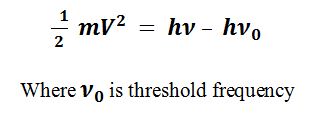
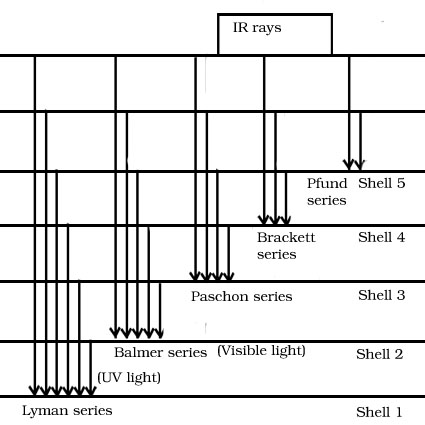
What is photoelectric effect?

When certain metals (K.Rb.Cs etc) are exposed by a beam of light electrons are ejected from metals, the phenomena is called photoelectric effect.

Which observation of photoelectric effect explains the particle nature of light?

Ejection of electron depends on the frequency of light and it does not depend on the intensity of light.

Define Work function.

Minimum  energy that can eject electron from metal surface.

Define threshold frequency

Minimum frequency below which photoelectric effect is not observed.

Give the relation between energy of photon, work function and kinetic energy during photoelectric effect.

On which factor no. of ejection of electrons depends.

The number of photoelectrons ejected is proportional to the intensity of incident radiation.

How can we say that electromagnetic radiations have dual behavior?

Interference and diffraction phenomena can explain by wave nature.

Photoelectric effect and blackbody radiation can explain by particle nature.

Define spectrum of white light

A ray of white light spread into series of bands called spectrum .Angle deviation is inversely proportional to the wavelength if the wave. Red color deviated the least while violet is deviated the most.

What is continuous spectrum?

A spectrum having no apparent gap or breaks throughout its entire spectrum.

Define emission spectra.

The emission spectra are produced by thin gases in which the atoms do not experience many collisions .The emission lines corresponds the photon of discrete energies that are emitted when excited atomic states in the gas back to the lower states.

Define absorption spectrum.

An absorption spectrum occurs when white light passes through a cold, dilute gas and atoms in the gas absorbs at characteristic frequencies, thus give rise to dark lines in the spectrum.

Define line spectra.

Atoms emit light only a specific wavelength with dark space between them called spectra.

Explain line spectrum of Hydrogen

line spectrum of Hydrogen

When an electric discharge is passed through gaseous Hydrogen excited Hydrogen atoms produced emit electromagnetic radiation.

Types of different transition in spectrum of Hydrogen.

1.Lyman series-It involves transition which end with  the ground state of Hydrogen(n=1)

2.Balmer series-It involves transition which end with shell n=2.

3.Paschon series-It involves transition which end with shell n=3

4.Brackett series-It involves transition which end with shell (n=4)

5..Pfund series-It involves transition which end with  the shell (n=5)

The postulates of Bohr’s atomic model.

1.Electrons move around the nucleus in a circular path of fixed radius and energy fixed paths are called orbit.

2.The energy of an electron in the orbit does not change with time.

3.Energy is absorbed when electron move from a lower stationary to a higher stationary state to and energy is emitted when electrons move from higher stationary state to lower state.

4.The frequency of radiation absorb or emitted is equal to

5.Electrons can move only in those orbit for which its angular momentum is integral multiple of h/2π.

What are the advantages of Bohr’s Model.

1.The radii of the stationary are expressed as rn=52.9 n2/Z pm

2.Energy of stationary state

                                  En  = -2.18×10⁻¹⁸ Z2 (1/n2) J.

                                  Z=atomic number

3.Bohr’s theory can also be applied to the ions containing 1 electron example-He+.Li2+,Be3+   

4..Velocity of electron moving in orbit can also be calculated.

Formula for calculating energy, frequency released or absorbed in line spectrum of Hydrogen.


What are the limitation of Bohr’s model?

1.It fails to account for the finer detail of the Hydrogen spectrum.

2.Unable to explain the spectrum of atoms other than Hydrogen atom.

3.This model is unable to explain the splitting of spectral lines in presence of magnetic field(Zeeman effect) or an electric field(stark effect).

4.Could not explain the ability of atoms to form molecule.

What is the reason for the failure of the Bohr’s model?

Bohr model of Hydrogen atom not only ignores dual behavior of matter but also contradicts Heisenberg uncertainty principle.

What is quantum mechanics?

The branch of science deals with the dual behavior of matter.

Write the Schrodinger wave equation for a system whose energy does not change with time.

H^=Eψ where H^ is a mathematical operator called Hamiltonian operator.

What do you mean by ψ and ψ2.

Schrodinger equation gives the possible energy levels the electron can occupy and corresponding wave function (ψ).The wave function ψ denotes an atomic orbital for an electron in an atom.Ψ2 is probability density where finding an electron is maximum.

Plot a graph for orbital wave function ψ(r) and the variation of probability density ψ2(r) as a function of distance r of the electron from the nucleus for 1s and 2s orbital.

For 1s orbital the probability density is maximum at the nucleus and it decreases sharply as we move away from it.

For 2s orbital the  probability density first decreases sharply to zero and again starts increasing after reaching a small maxima .it decreases again approaches zero as the value of r increases further.

Define nodal surfaces or nodal plane

The region where the probability function reduces to zero is called nodal surfaces.

Give the formula for for determining number of nodes for ns orbital and np orbital.

Ans. For ns orbital number of nodes =(n-1)

       For np orbital number of nodes =(n-2)

Give the formula for determining the total number of nodes.

Total number of nodes =angular nodes + radial nodes

                                        =l+(n-l-1)                                      

                                        =n-1

What do you mean by degenerate orbitals?

The orbitals having the same energy are called degenerate orbital.

Explain the de-Broglie theory.

According to de-Broglie theory matter like radiation has both particle and wave like properties.

             λ=h/mv=h/P

                     m=mass of the particle.

                      V=velocity

                      P=momentum

Explain the limitations of de-Broglie theory.

de-Broglie theory is not applicable for ordinary objects due to short wavelength is associated with because of large mass of ordinary objects.The wavelengths associated with electrons and other subatomic particles can be detected experimentally.

What is Heisenberg Uncertainty principle.

It is impossible to determine simultaneously the exact momentum and exact position of electron.   

What is the significance of Heisenberg uncertainty principle?

The effect of Heisenberg Uncertainty principle is significant only for motion of microscopic object and is negligible for macroscopic objects.

                      Let there is a ball have mass 10-6 Kg.

What are Quantum numbers?

Each electron has a set of four quantum numbers called quantum numbers that specify it completely.

Describe the four quantum numbers.

1.Principal quantum numbers-The principal quantum number has the symbol ‘n’where n=1,2,3,4……..it tells which energy level an electron is in .Size and the energy of an orbit can also be determined after the finding the value of n.

2.Azimuthal quantum numbers or subsidiary quantum numbers-The Azimuthal quamtum number determines the orbital angular momentum of an atomic orbital and describes the shape of the orbital.

Value of l depends on n. l can have n value ranging from 0 to (n-1)

The various orbitals related to different values of l are sometimes called subshell.

symbolMaximum electronshapeName
0s2spheresharp
1p6Two dumbellsprincipal
2d104 dumbellsdiffuse
3f148 dumbellsfundamental

3.Magnetic quantum numbers(m)-It describe the orientation in space of a particular orbital.

Value of m depends on value of l. For any possible value of l the values of m are -l to +l

Total value of m= 2l+1

SubshelllmPossible orientation
s00Only one way in which a sphere can be oriented in a space
p1-1,0,+1Px,  py, pz
d2-2,-1,0,1,2dxy,dyz,dzx,dx2,dy2,dz2

4.Spin quantum number.

An electron spin around its own axis. The two orientation can be describe by spin quantum number and take the values of +1/2 and -1/2.

Draw the shape of s orbital.

Draw the shape of p orbitals.


shape of p orbitals

Draw the shape of d orbitals.


shape of d orbitals

What do you mean by valance electron and core electron?

Valence  electron-The electrons present in the last shell of atom are called valence electrons.

Core electron-The electron present in completely filled shells are called core electrons.

What is Aufbau principle?

I.Electrons are filled in a orbital in order of their increasing energies.

II.The lower the value (n+l )the lower will be energy of that orbital.

  III.If the two orbitals  having same (n+l ) the lower the value of n the lower will be energy of that orbitals.

Thus 1s<2s<2p<3s<3p<4s<3d<4p<5s<4d<5p<4f<5d<6p<7s.

What is Pauli exclusion principle?

No two electrons in an atom can have the same set of four quantum numbers.

Which quantum number differentiate the behavior of two electrons?

Two electrons have the same value of n,l,m but must have the opposite  spin quantum numbers.

Which rule explain that the maximum number of electrons in the shell with quantum number n is equal  to 2n2 ?

Pauli exclusion principle

Explain Hund’s rule

The pairing of electrons in the orbitals belonging to same subshell does not take place until each orbital belonging to that subshell has got one electron.

Write the electronic configuration of Cr.and Cu.

24Cr-1s22s22p63s23p64s13d5.

 29Cu-1s22s22p63s23p64s13d10.

Why Cr and Cu adopt d5 and d10 electronic configuration?

Because half filled and fully filled orbitals are more stable.

Important Question and Answers

1.What is atoms in chemistry?

    Chemistry Notes Some Basic Concept Of Chemistry

    Chemistry Notes Some Basic Concept Of Chemistry

    Dalton’s atomic theory.
    I.Matters are made up of invisible atoms.
    II.When atoms of different elements combine with each other they form compound.
    III.Atoms of same element have identical properties.
    IV.Chemical reaction involve reorganization of atoms .These are neither created nor destroyed in chemical reaction.

    What do you mean by precision and accuracy of quantity?
    Precision refers to the closeness of various measurements for the same quantity.Accuracy is the agreement of particular value to the true value of results.

    Explain the term scientific notation.
    Exponential notation in which any number can be represented in the form of N x 10n where n is an
    exponent having +ve or –ve value and N is equal to 1-10.Example-scientific notation of 232.508 is 2.32508 X10².

    What is significant figure of a number.
    Significant figures are meaningful digits which are known with certainty.
    Rule 1.All non zeros digits are significant.
    Example
    325 m has 3 significant figures.
    .2584 has 4 significant figures.
    Rule 2. Zeros preceding to first non zeros digits are not significant.
    Example
    .05 m has 1 significant figure.
    .0063 has 2 significant figures.
    .2584 has 4 significant figures.
    Rule 3.Zeros between two non Zeros digits are significant.
    Example: 3.008 has 4 significant figures.
    Rule 4. Zeros at the end or right of a number are significant provided they are on the right side of decimal point.
    Example: .3000 has 4 significant figures.
    Rule 5.Terminal Zeros are not significant if there is no decimal point.
    Example : 200 has 1 significant figure.
    Example 300.0 has 4 significant figures.
    Rule 6.Counting number of objects have infinite significant figures.
    Example 2 pens have infinite significant figures.

    Explain the law of conservation of mass.
    According to Lavoisier matter can neither be created nor be destroyed.
    Explain the law of definite proportion.
    A given compound always contains exactly the same proportion of elements by weight.

    Explain the law of multiple proportions.
    If two elements can combine to form more than one compound, the masses of one element that combine with a fixed mass of the other element are in the ratio of small whole number.

    Example: 𝐻2 + 1/2𝑂2 → 𝐻2𝑂
    2𝑔 16𝑔 18𝑔
    𝐻2 + 𝑂2 → 𝐻2𝑂2
    2𝑔 32𝑔 34𝑔
    Fixed mass of Hydrogen (2g) combine with the 16 g and 32g of oxygen which is a simple ratio(16:32 or 1:2).

    What is Gay Lussac’s law of gaseous volume?
    Gases combined or produced in a chemical reaction in simple ratio at same temperature and pressure.
    What is Avogadro’s Law?
    Equal volume of gases at the same temperature and pressure contain equal no. of molecules.
    Define one mole.
    One mole is the amount of a substance that contain as many as entities as there are in 12g of carbon
    12𝐂 isotope.1 mole of any substance =6.023 x 10²³ particles.

    What is molar mass?
    The mass of one mole of a substance in gram is called its molar mass.
    Example=Molar mass of water =18g.
    What is mole concept?
    (i) When atomic mass is expressed in gram, it gives mass of one mole of that element.
    Example: Mass of one mole of sodium atoms =23 gram.
    (ii) When molecular mass is expressed into gram it gives mass of one mole of that compound.
    Example: Mass of one mole of water (H2O) =18 gram.
    (ii) When molecular mass is expressed into u/amu it gives mass of one molecule of that compound.
    Example: Mass of one molecule of water (H2O) =18 u.
    (iv) When atomic mass is expressed into umu it gives mass of one atom of that element.
    Example: Mass of one atom of sodium atom =23 u
    (v) Volume of one mole of gas at STP=22.4 liter.
    Define amu/u.
    One atomic mass unit is defined as a mass exactly equal to one-twelfth of the mass of one carbon atom. 1amu =1.66 x 10⁻²⁴ g.
    What is average atomic mass?
    Many naturally occurring elements exist as more than one isotopes. Hence average atomic mass is
    calculated.

    Average atomic mass

    Define Molecular mass.
    Molecular mass is the sum of atomic masses of the elements present in a molecule.
    What is formula mass?
    Some substance do not exist as a single entity, for these substances instead of molecular mass formula mass is calculated, it denote ratio of two atoms in a given sample of compound.
    What do you mean by % composition?
    Percentage of particular element in a particular compound is called %composition of that element.

    What is empirical formula and molecular formula?
    An empirical formula represents the simplest whole number ratio of various atoms present in a compound whereas the molecular formula show the exact number of different atoms present in a molecule.

    Explain Stoichiometry concept.

    Consider following reaction.
    𝐶𝐻4(𝑔) + 2O2(𝑔) → 𝐶O2(𝑔) + 2𝐻2O(𝑔)
    The following stoichiometry concepts are.

    1.One mole of CH4 reacts with  two moles of O2  gas to give one mole of CO2  and two moles of 𝐻2O(𝑔

    2. One molecule of CH4 reacts with  two molecules of O2  to give one molecule of CO2  and two molecules of H2O.

    3. 22.4 of CH4 (g) reacts with  44.8 L of O2 (g)as to give 22.4 L of CO2 (g)  and 44.8 L of H2O(g)

    4.16g of CH4 reacts with  64g of O2 to give 44g  of CO2  and 36 g of H2O.
    What is limiting reagent?
    The reactant which gets consumed, limits the amount of product formed and is, therefore called the limiting reagent;
    Explain the following concentration terms.
    a.Mole fraction
    b.Mass %
    C.Molarity.
    d.Molality.

    1.Mole fraction:

    The ratio of number of moles of a particular component to the total number of moles of solution is called mole fraction of that component.

    let ‘A’ dissolves in substance ‘B’ and their number of moles of 𝑛𝐴 and 𝑛𝐵
    respectively, then the mole fraction of A and B are given as-
    Mole fraction of A= 𝑛𝐴 ⁄ (𝑛𝐴 + 𝑛𝐵)
    Mole fraction of B= 𝑛𝐵 ⁄ (𝑛𝐴 + 𝑛𝐵)