45 NEET-level MCQs covering Solutions, Classification, d-block elements, and Coordination Compounds

SECTION 1: SOLUTIONS (10 MCQs)

  1. Which of the following is an ideal solution?
    A) Acetone + Chloroform
    B) Benzene + Toluene
    C) Ethanol + Water
    D) Water + HCl
  2. Raoult’s law is applicable to:
    A) Non-volatile solutes
    B) Electrolytes
    C) Ideal solutions
    D) Strong acids
  3. Mass of glucose (C6H12O6) required to be dissolved to prepare one litre of its solution which is isotonic with 15 g L1 solution of urea (NH2CONH2) is(Given: Molar mass in g mol1 C : 12, H : 1, O : 16, N : 14)
    A) 55g
    B) 30g
    C) 15g
    D) 45g
  4. The Henry’s law constant (KH) values of three gases (A, B, C) in water are 145, 2 × 10⁻⁵ and 35 kbar, respectively. The solubility of these gases in water follow the order:
    A) B > A > C (B) B > C > A (C) A > C > B (D) A > B > C
  5. The plot of osmotic pressure ( ∏ ) vs concentration ( mol− 1 ) for a solution gives a straight line with slope 25.73 L bar mol−1 . The temperature at which the osmotic pressure measurement is done is (Use R = 0.083 L bar mol−1 K −1 )
    A) 1
    B) 2
    C) 3
    D) 0
  6. Osmotic pressure is given by:

π=iCRT\pi = iCRT

A) Boyle’s law
B) Ideal gas equation
C) van’t Hoff equation
D) Dalton’s law

  1. Maximum boiling azeotrope shows:
    A) Positive deviation
    B) Negative deviation
    C) No deviation
    D) Infinite deviation
  2. Which increases boiling point?
    A) Adding volatile solute
    B) Adding non-volatile solute
    C) Decreasing pressure
    D) Increasing solvent
  3. Henry’s law relates:
    A) Pressure and solubility
    B) Volume and temperature
    C) Mass and density
    D) Temperature and pressure
  4. Which amongst the following aqueous solution of electrolytes will have minimum elevation in boiling point? Choose the correct option :-
    A) 0.05 M NaCl
    B) 0.1 M KCl
    C) 0.1MgSO4
    D) 1M NaCl

SECTION 2: CLASSIFICATION OF ELEMENTS (10 MCQs)

  1. Which of the following statements are true?
    A)  Unlike Ga that has a very high melting point, Cs has a very low melting point.
    B) On Pauling scale, the electronegativity values of N and Cl are not the same
    C) A r , K + , C l , C a 2 + , and S 2 − are all isoelectronic species.
    D) The correct order of the first ionization enthalpies of N a , M g , A l and Si is S i > A l > M g > Na
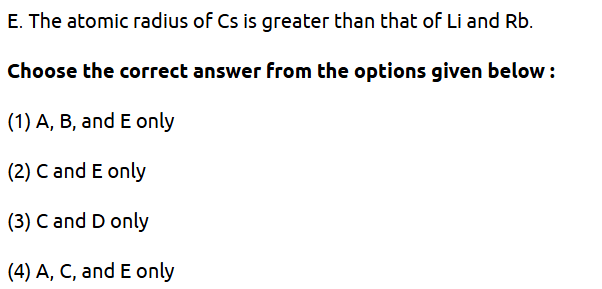
12. Which among the following electronic configurations belong to main group elements?
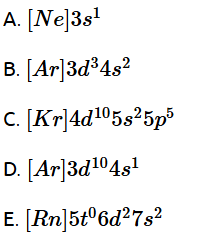
Choose the correct answer from the option given below :

(1) B and E only

(2) A and C only

(3) D and E only

(4) A, C and D

13.The correct decreasing order of atomic radii (pm) of Li, Be, B and C is

(1) Be > Li > B > C

(2) Li > Be > B > C

(3) C > B > Be > Li

(4) Li > C > Be > B

14.Match List-I with List-II :
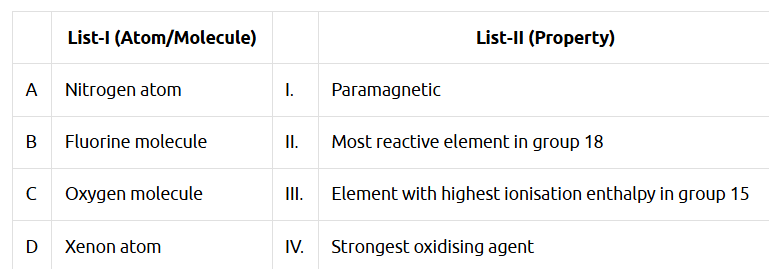
Identify the correct answer from the options given below :

(1) A-III, B-I, C-IV, D-II

(2) A-I, B-IV, C-III, D-II

(3) A-II, B-IV, C-I, D-III

(4) A-III, B-IV, C-I, D-II

15.Arrange the following elements in increasing order of first ionization enthalpy: Li, Be, B, C, N

Choose the correct answer from the options given below:

(1) Li < Be < B < C < N

(2) Li < B < Be < C < N

(3) Li < Be < C < B < N
(4) Li < Be < N < B < CR

16. Arrange the following elements in increasing order of electronegativity:

N, O, F, C, Si

Choose the correct answer from the options given below :

Choose the correct answer from the options given below:

(1) Si < C < N < O < F

(2) Si < C < O < N < F

(3) O < F < N < C < Si

(4) F < O < N < C < Si

17 Which of the following is correctly matched?
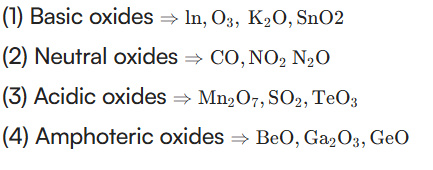
18. The correct sequence given below containing neutral, acidic, basic and amphoteric oxide each, respectively, is

Options: A. NO, ZnO, CO₂, CaO

B. ZnO, NO, CaO, CO₂

C. NO, CO₂, ZnO, CaO

D. NO, CO₂, CaO, ZnO

19. For elements B, C, N, Li, Be, O and F the correct order of first ionization enthalpy is

(1) Li < Be < B < C < N < O < F

(2) B > Li > Be > C > N > O > F

(3) Li < B < Be < C < O < N < F

(4) Li < Be < B < C < O < N < F

20. Decrease in size from left to right in actinoid series is greater and gradual than that in lanthanoid series due to

1.4f orbitals are second to last

2. 4f orbitals have greater shielding effect

3. 5f orbitals have poor shielding effect

4.5f orbitals have greater shielding effect


    SECTION 3: d-BLOCK ELEMENTS (10 MCQs)

    1. Transition elements have:
      A) Completely filled d-orbitals
      B) Partially filled d-orbitals
      C) No d-orbitals
      D) Only s-orbitals
    2. General configuration:
      A) (n-1)d¹–¹⁰ ns¹–²
      B) ns² np⁶
      C) ns¹
      D) np⁵
    3. Highest oxidation state of Mn:
      A) +2
      B) +4
      C) +7
      D) +6
    4. Color in transition metals due to:
      A) s-electrons
      B) d-d transition
      C) p-electrons
      D) nuclear charge
    5. Which is not transition element?
      A) Zn
      B) Fe
      C) Cu
      D) Cr
    6. Catalytic property due to:
      A) Low density
      B) Variable oxidation states
      C) High melting point
      D) Atomic size
    7. Magnetic behavior depends on:
      A) paired electrons
      B) unpaired electrons
      C) protons
      D) neutrons
    8. Which is diamagnetic?
      A) Fe²⁺
      B) Mn²⁺
      C) Zn²⁺
      D) Cu²⁺
    9. Alloy of Cu and Zn:
      A) Bronze
      B) Brass
      C) Steel
      D) Solder
    10. Highest melting point:
      A) Hg
      B) Fe
      C) W
      D) Cu

    SECTION 4: COORDINATION COMPOUNDS (15 MCQs)

    1. Coordination number of central atom is:
      A) number of ligands
      B) number of bonds
      C) number of donor atoms
      D) oxidation state
    2. Ligand donating one pair:
      A) Bidentate
      B) Monodentate
      C) Tridentate
      D) Polydentate
    3. Example of bidentate ligand:
      A) NH₃
      B) H₂O
      C) en
      D) Cl⁻
    4. IUPAC name of [Cu(NH₃)₄]²⁺:
      A) Copper tetraammine
      B) Tetraammine copper(II)
      C) Ammine copper
      D) Copper ammonia
    5. Oxidation state of Fe in [Fe(CN)₆]³⁻:
      A) +2
      B) +3
      C) +6
      D) −3
    6. Coordination compounds show isomerism:
      A) Yes
      B) No
      C) Rarely
      D) Only optical
    7. Geometrical isomerism in:
      A) tetrahedral
      B) square planar
      C) linear
      D) trigonal
    8. Strong field ligand:
      A) Cl⁻
      B) H₂O
      C) CN⁻
      D) Br⁻
    9. Crystal field splitting occurs in:
      A) s-orbitals
      B) p-orbitals
      C) d-orbitals
      D) f-orbitals
    10. High spin complex has:
      A) pairing
      B) maximum unpaired electrons
      C) no electrons
      D) stable structure
    11. Hybridization of [Ni(CN)₄]²⁻:
      A) sp³
      B) dsp²
      C) sp²
      D) d²sp³
    12. Werner theory explains:
      A) valency
      B) bonding
      C) structure of complexes
      D) reactivity
    13. Chelate effect increases:
      A) instability
      B) stability
      C) reactivity
      D) acidity
    14. [Co(NH₃)₆]³⁺ is:
      A) paramagnetic
      B) diamagnetic
      C) ferromagnetic
      D) antiferromagnetic
    15. Which shows optical isomerism?
      A) [Co(en)₃]³⁺
      B) [NiCl₄]²⁻
      C) [PtCl₄]²⁻
      D) [Zn(NH₃)₄]²⁺
    Organic chemistry – Some Basic Principles and techniques JEE/NEET Concepts

    Methods of Purification of Organic Compounds

    Basic Idea of Wedge–Dash Notation

    R and S Configuration (JEE/NEET Concept – Easy Explanation)

    Conformations of Propane (JEE/NEET Concepts)

    Stereoisomerism organic chemistry JEE/NEET Concepts

    Key Concepts to Arrange Nucleophile Strength (NEET/JEE)

    Key Concepts to Arrange Basic Strength (NEET/JEE)

    Degree of Unsaturation (DU) formula for organic compound

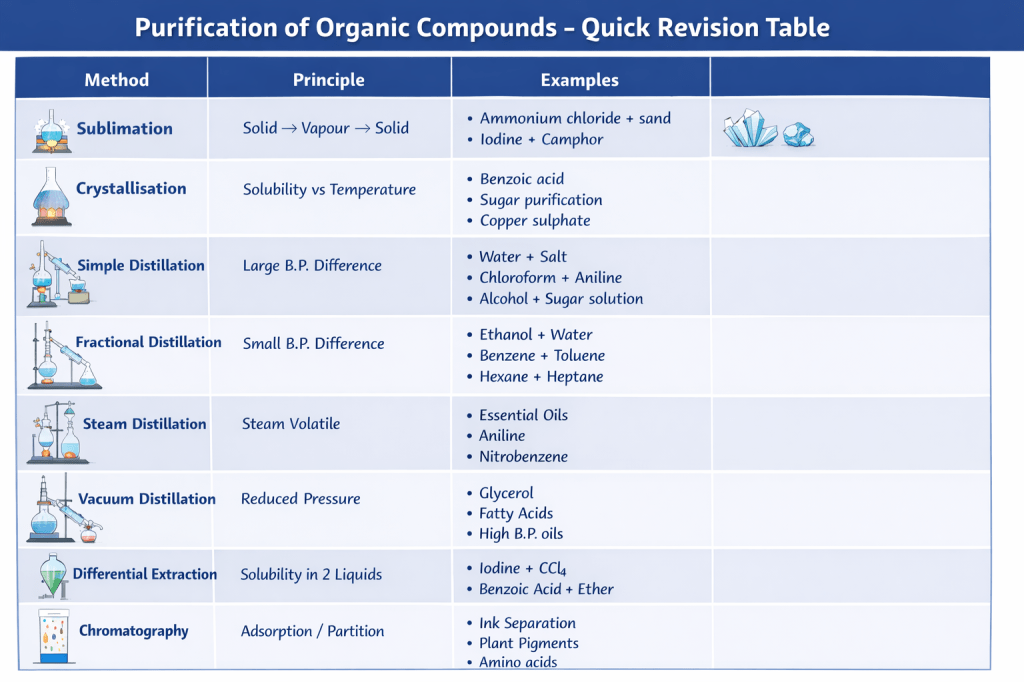
    Methods of Purification of Organic Compounds

    Sublimation

    What is Sublimation?

    Sublimation is the process in which a solid directly changes into vapour without becoming liquid.

    Example:

    • Ammonium chloride
    • Iodine
    • Camphor
    • Naphthalene

    Why does it happen?

    Some solids have:

    • Weak intermolecular forces
    • High vapour pressure even at lower temperatures

    So, when heated, they directly escape into vapour form.


    Sublimation as a Separation Technique

    It is used to purify substances:

    Sublimable substance → turns into vapour
    Non-sublimable impurities → remain as solid

    Then vapour is cooled → forms pure solid again.


    Simple Setup

    1. Heat the mixture
    2. Sublimable substance vaporizes
    3. Vapour condenses on a cold surface
    4. Pure solid is collected

    Example Use

    Separating:

    • Ammonium chloride + sand

    Ammonium chloride sublimates, sand stays behind.

    Crystallisation

    What is Crystallisation?

    A purification technique used to purify solid organic compounds based on difference in solubility.


    Principle

    • Substance is less soluble at low temperature
    • Substance is more soluble at high temperature

    So:

    • Dissolve at high temp
    • Cool → pure crystals form

    Steps

    1. Dissolve impure solid in hot solvent
    2. Make a saturated solution
    3. Filter (if needed, remove insoluble impurities)
    4. Cool the solution
    5. Pure crystals separate out
    6. Filter and dry crystals

    Important Terms

    • Mother liquor → remaining liquid after crystallisation
    • Activated charcoal → removes colored impurities

    🔹 Examples

    Example 1: Benzoic Acid purification

    • Impure benzoic acid dissolved in hot water
    • On cooling → pure crystals of benzoic acid form

    When repeated crystallisation is needed?

    When

    Simple Distillation (large boiling point difference)

    When used:

    • Difference in b.p. > 25–30°C
    • Or liquid + non-volatile impurity

    Examples:

    Example 1:

    • Water + salt
      Water distils, salt remains

    Example 2:

    • Chloroform (334 K) + Aniline (457 K)
      Easily separated

    Example 3:

    • Alcohol + sugar solution
      Alcohol vaporises, sugar stays

    Example 4:

    • Acetone + water
      Acetone (low b.p.) comes first

    Fractional Distillation (close boiling points)

    When used:

    • Difference in b.p. < 25°C

    Examples:

    Example 1:

    • Ethanol (78°C) + Water (100°C)
      Cannot separate by simple distillation

    Example 2:

    • Benzene (80°C) + Toluene (110°C)
      Need fractionating column

    Example 3:

    • Hexane + Heptane
      Very close boiling points

    Example 4 (Industrial):

    • Crude oil refining
      Petrol, diesel, kerosene separated

    3. Steam Distillation (heat-sensitive substances)

    When used:

    • Substance:
      • Immiscible with water
      • Volatile with steam
      • Decomposes at high temperature

    Examples:

    Example 1:

    • Extraction of essential oils
      From plants (e.g., clove oil, eucalyptus oil)

    Example 2:

    • Aniline purification
      High b.p. but steam volatile

    Example 3:

    • Nitrobenzene
      Separated using steam

    Example 4:

    • Rose oil extraction (attar)
      Used in perfumes


    Quick Comparison (Very Important)

    MethodConditionExample
    Simple DistillationLarge b.p. differenceWater + salt
    Fractional DistillationSmall b.p. differenceEthanol + water
    Steam DistillationHeat-sensitive, steam volatileEssential oils


    Distillation Under Reduced Pressure (Vacuum Distillation)

    Statement:

    Distillation under reduced pressure → Glycerol + spent-lye


    Why this method is used?

    Some liquids:

    • Have very high boiling points
    • Decompose before boiling

    Example: Glycerol


    Principle

    When pressure is reduced:
    Boiling point decreases

    So, substance can distil at lower temperature without decomposition


    Application in given case

    Mixture:

    • Glycerol (high b.p., heat sensitive)
    • Spent-lye (impurities)

    What happens?

    • Pressure ↓
    • Glycerol boils at lower temp
    • Vapours collected → pure glycerol
    • Impurities remain

    Why not simple distillation?

    ❌ Glycerol decomposes at high temperature
    ✔ So vacuum distillation is required


    🔹 More Examples

    Example 1:

    • Glycerol purification (most common)

    Example 2:

    • High boiling oils
    • Example 3:
    • Fatty acids

    Example 4:

    • Petroleum residues

    Quick Summary

    MethodUsed for
    Simple distillationLow b.p. liquids
    Fractional distillationClose b.p. liquids
    Steam distillationHeat-sensitive, steam volatile
    Reduced pressure distillationHigh b.p., decomposing liquids

    Differential Extraction

    When an organic compound is present in an aqueous medium, it is separated by shaking it with an organic solvent in which it is more soluble than in water. The organic solvent and aqueous solution should be immiscible so that they form two distinct layers which can be separated using a separating funnel. The organic solvent is later removed by distillation or evaporation to obtain the compound.

    Concept: Differential (Liquid–Liquid) Extraction

    Principle

    Based on difference in solubility of a compound in two immiscible liquids

    Usually:

    • Water (aqueous layer)
    • Organic solvent (like ether, benzene)

    Key Conditions

    ✔ Two liquids must be immiscible
    ✔ Compound should be more soluble in organic solvent

    Process (Separating Funnel)

    1. Take mixture in separating funnel
    2. Add organic solvent
    3. Shake well
    4. Allow layers to separate

    Two layers form:

    • Upper layer (usually organic solvent)
    • Lower layer (water)
    1. Separate layers
    2. Evaporate solvent → get pure compound

    Example

    Example 1:

    • Iodine in water + carbon tetrachloride (CCl₄)
      → Iodine moves to organic layer

    Example 2:

    • Benzoic acid from water using ether

    Continuous Extraction

    When used?

    • When compound is slightly soluble in solvent

    Why?

    • Single extraction inefficient
    • Repeated extraction increases yield

    Same solvent reused again and again


    Advantages

    • Efficient separation
    • Better recovery of compound
    • Widely used in organic chemistry labs

    Chromatography

    What is Chromatography?

    A separation technique where components of a mixture are separated based on their different affinities between two phases.


    Principle

    Based on distribution of components between two phases:

    1. Stationary phase → fixed (solid or liquid)
    2. Mobile phase → moving (liquid or gas)

    Different substances move at different speeds → separation occurs


    Types of Chromatography

    1. Paper Chromatography

    • Stationary phase → paper
    • Mobile phase → solvent

    Used for:

    • Ink separation
    • Plant pigments

    2. Thin Layer Chromatography (TLC)

    • Stationary phase → silica gel layer
    • Faster and more accurate than paper chromatography

    3. Column Chromatography

    • Column filled with adsorbent (silica/alumina)
    • Used for larger scale separation

    4. Gas Chromatography (GC)

    • Mobile phase → gas
    • Used for volatile compounds

    How Separation Happens?

    • Component with more attraction to stationary phase → moves slowly
    • Component with more attraction to mobile phase → moves faster

    Example

    Ink Separation

    Black ink → separates into different colors on paper


    Plant Pigments

    Chlorophyll, carotene separated using chromatography


    Important Term: Rf Value

    Rf=Distance travelled by substanceDistance travelled by solventRf = \frac{\text{Distance travelled by substance}}{\text{Distance travelled by solvent}}

    Uses

    ✔ Separation of mixtures
    ✔ Purification
    ✔ Checking purity
    ✔ Drug testing
    ✔ Food analysis

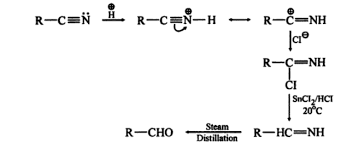
    Stephen Reaction (Stephen Aldehyde Synthesis)

    tephen Reaction (Stephen Aldehyde Synthesis) – Mechanism (JEE/NEET Concept)

    Definition:
    Conversion of nitriles (R–C≡N) into aldehydes (R–CHO) using SnCl₂/HCl, followed by hydrolysis.


    Overall Reaction

    RCNHClSnCl2RCH=NHHClH2ORCHOR-C \equiv N \xrightarrow[\text{HCl}]{\text{SnCl}_2} R-CH=NH \cdot HCl \xrightarrow{\text{H}_2O} R-CHO


    Stepwise Mechanism

    Step 1: Formation of Iminium Salt (Reduction Step)

    • SnCl₂ (mild reducing agent) donates electrons.
    • Nitrile gets partially reduced.
    • Formation of iminium chloride salt:

    RCNSnCl2/HClRCH=NHHClR-C \equiv N \xrightarrow{\text{SnCl}_2/HCl} R-CH=NH \cdot HCl

    Key point:

    • Triple bond (C≡N) → double bond (C=NH)
    • Controlled reduction (not all the way to amine)

    Step 2: Hydrolysis of Iminium Salt

    • Iminium salt reacts with water.
    • Produces aldehyde + ammonium salt

    RCH=NHHCl+H2ORCHO+NH4ClR-CH=NH \cdot HCl + H_2O \rightarrow R-CHO + NH_4ClR−CH=NH⋅HCl+H2​O→R−CHO+NH4​Cl


    Important Points (Exam-Oriented)

    • Works best for alkyl nitriles (aryl nitriles give poor yield).
    • Stops at aldehyde stage (unlike strong reduction → amine).
    • SnCl₂/HCl = selective mild reducing system
    • Intermediate = iminium salt (not imine directly)

    Shortcut Trick (Memory Tip)

    “Nitrile + Mild Reduction = Aldehyde”
    Think: Stephen = Stops Early (Aldehyde, not amine)


    Example

    CH3CNSnCl2/HClCH3CHOCH_3CN \xrightarrow{\text{SnCl}_2/HCl} CH_3CHO

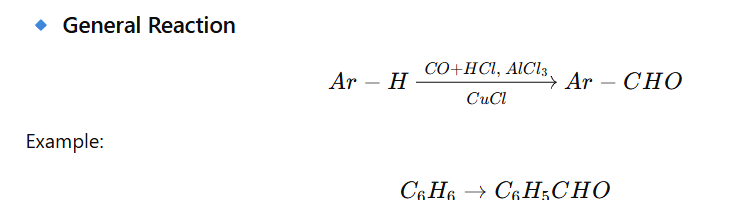
    Gattermann–Koch Reaction (JEE/NEET Must-Know)

    What is it?

    Introduction of a formyl group (–CHO) into an aromatic ring using:

    CO + HCl in presence of Aluminium chloride and Cuprous chloride


    Mechanism (Stepwise)

    Formation of Electrophile

    • CO + HCl react in presence of AlCl₃/CuCl
    • Generate formyl cation

    CO+HClHCO+ (electrophile)CO + HCl \rightarrow HCO^+ \ (\text{electrophile})


    Electrophilic Attack (EAS Step)

    • Benzene ring attacks HCO⁺
    • Forms sigma complex (arenium ion)

    Deprotonation

    • Loss of H⁺ restores aromaticity
    • Forms benzaldehyde complex

    Hydrolysis

    • Final hydrolysis gives aldehyde (–CHO)

    Key Points for Exams

    ✔ Type of Reaction

    Electrophilic Aromatic Substitution (EAS)


    ✔ Important Conditions

    • CO must be dry
    • Presence of both AlCl₃ and CuCl is essential

    ❌ Limitations

    • Does NOT work with strongly deactivated rings
      (e.g., nitrobenzene ❌)

    🔁 Comparison Trick

    ReactionReagentProduct
    Gattermann–KochCO + HCl–CHO
    Friedel–CraftsR–Cl / RCOCl–R / –COR

    🔹 One-Line Revision

    Gattermann–Koch introduces –CHO on benzene via formyl cation (HCO⁺) using CO + HCl / AlCl₃–CuCl

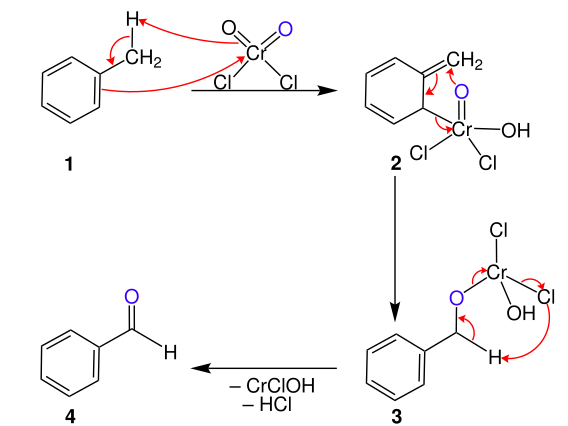
    Etard reaction mechanism

    Oxidation of a benzylic methyl group (–CH₃ attached to benzene) to an aldehyde (–CHO) using
    Chromyl chloride in a non-aqueous solvent (like CCl₄).

    Mechanism (Stepwise)

    Formation of Etard Complex

    • Chromyl chloride attacks benzylic hydrogen
    • Forms a brown complex (Etard complex)

    ArCH3ArCH(OCrOCl2)2Ar-CH_3 \rightarrow Ar-CH(OCrOCl_2)_2


    Hydrolysis of Complex

    • On hydrolysis (H₂O), the complex breaks
    • Gives aldehyde

    ArCH(OCrOCl2)2H2OArCHOAr-CH(OCrOCl_2)_2 \xrightarrow{H_2O} Ar-CHO

    The unsaturated ether on acidic hydrolysis produces carbonyl compounds

    Key Idea

    Unsaturated ethers (enol ethers) on acidic hydrolysis give carbonyl compounds (aldehydes/ketones).


    Why does this happen?

    Unsaturated ethers are basically enol forms of carbonyl compounds.

    General structure:RCH=CHORR – CH = CH – OR’

    Under acidic conditions:

    1. Protonation of ether oxygen
    2. Formation of unstable enol
    3. Tautomerism (enol → carbonyl)

    🔹 Important Reaction

    Example:CH2=CHOCH3H+,H2OCH3CHO+CH3OHCH_2 = CH – OCH_3 \xrightarrow{H^+, H_2O} CH_3CHO + CH_3OH

    Product:

    • Aldehyde/Ketone (carbonyl compound)
    • Alcohol

    🔹 Mechanism Shortcut (Exam Trick ⚡)

    • Break C–O bond
    • Form enol
    • Enol → carbonyl (keto form)

    One-line Concept (for revision)

    Unsaturated ether + acidic hydrolysis → enol → carbonyl compound


    Important for Exams

    • Only vinyl / allyl ethers show this behavior
    • Due to keto-enol tautomerism
    • Very common in mechanism-based questions

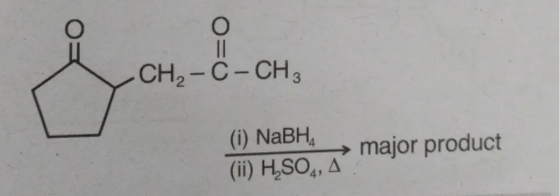
    Some Questions from Aldehydes, Ketone and carboxylic acids.

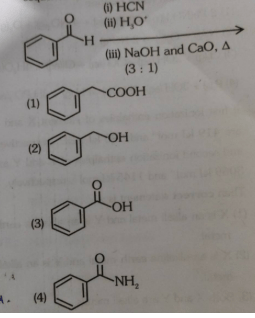
    1. The major product formed in the following conversion is

    2.The product formed from the following reaction sequence is

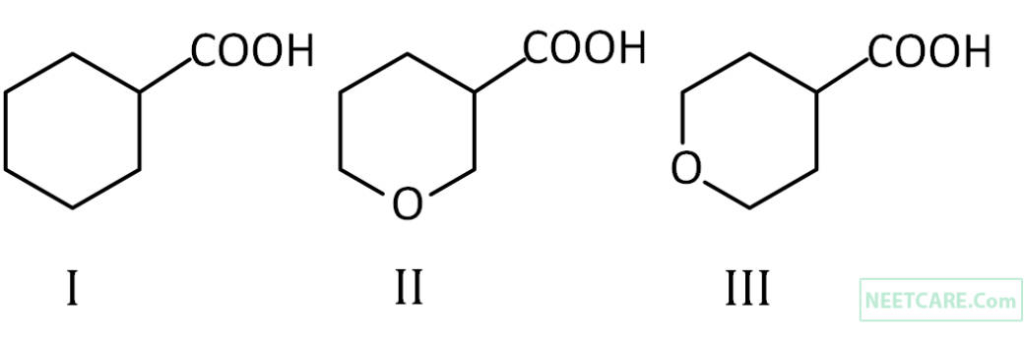
    3.The correct order of strengths of the carboxylic acids

    Q 4.Given below are two statements :

    Statement I : Cross aldol condensation between two different aldehydes will always produce four different products.

    Statement II : When semicarbazide reacts with a mixture of benzaldehyde and acetophenone under optimum pH , it forms a condensation product with acetophenone only.

    Q.5

    In the light of the above statements, choose the correct answer from the options given below

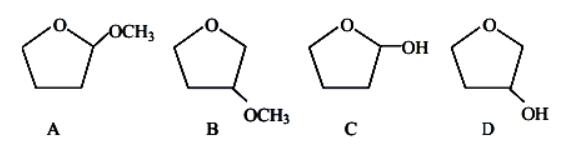
    A student is given one compound among the following compounds that gives positive test with Tollen’s reagent

    Cannizzaro Reaction (JEE/NEET Concepts)

    Cannizzaro Reaction (JEE/NEET Concepts)

    Definition:
    Cannizzaro reaction is a disproportionation reaction in which an aldehyde without α-hydrogen undergoes self oxidation–reduction in the presence of strong base (NaOH/KOH).


    General Reaction

    2RCHO+OHRCH2OH+RCOO2RCHO + OH^- \rightarrow RCH_2OH + RCOO^-

    (One molecule is reduced → alcohol, other oxidized → carboxylate salt)


    • Key Conditions (VERY IMPORTANT for JEE)
    • Aldehyde must have NO α-H (alpha hydrogen)
    • Strong base: conc. NaOH or KOH
    • Usually occurs with:
      • Formaldehyde (HCHO)
      • Benzaldehyde (C₆H₅CHO)

    Example

    2C6H5CHO+NaOHC6H5CH2OH+C6H5COONa2C_6H_5CHO + NaOH \rightarrow C_6H_5CH_2OH + C_6H_5COONa

    (Benzaldehyde → benzyl alcohol + sodium benzoate)


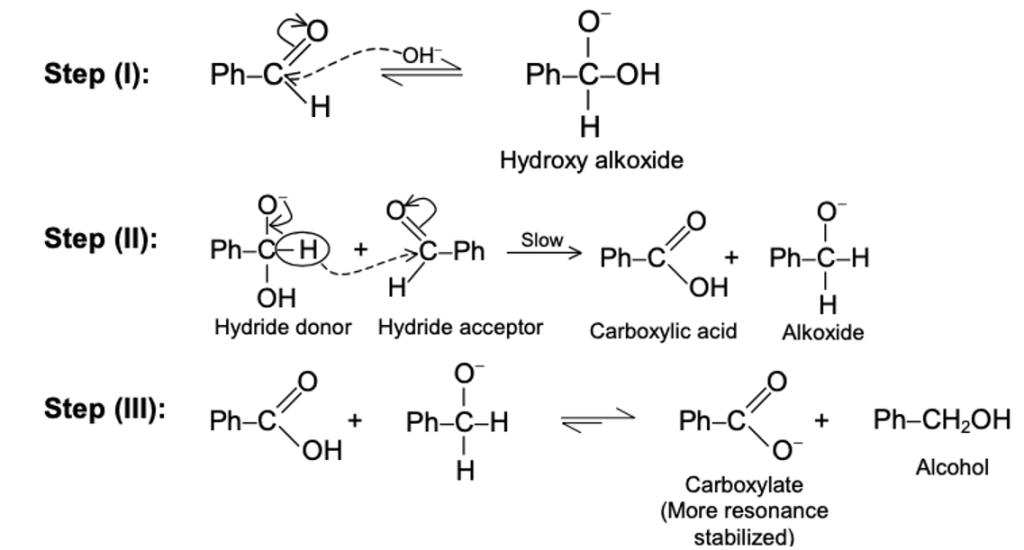
    Mechanism (Conceptual Steps)

    1. Nucleophilic attack of OH⁻ on aldehyde → alkoxide intermediate
    2. Hydride transfer (H⁻ shift) from one molecule to another
    3. Formation of:
      • Alcohol (reduction)
      • Carboxylate ion (oxidation)

    Types of Cannizzaro Reaction

    1. Self Cannizzaro
      Same aldehyde reacts
      Example: benzaldehyde
    2. Cross Cannizzaro (Important!)
      Two different aldehydes
      • One should be formaldehyde (HCHO) (best reducing agent)

    HCHO+C6H5CHO+NaOHC6H5CH2OH+HCOONaHCHO + C_6H_5CHO + NaOH \rightarrow C_6H_5CH_2OH + HCOONa

    (Formaldehyde gets oxidized, other gets reduced)


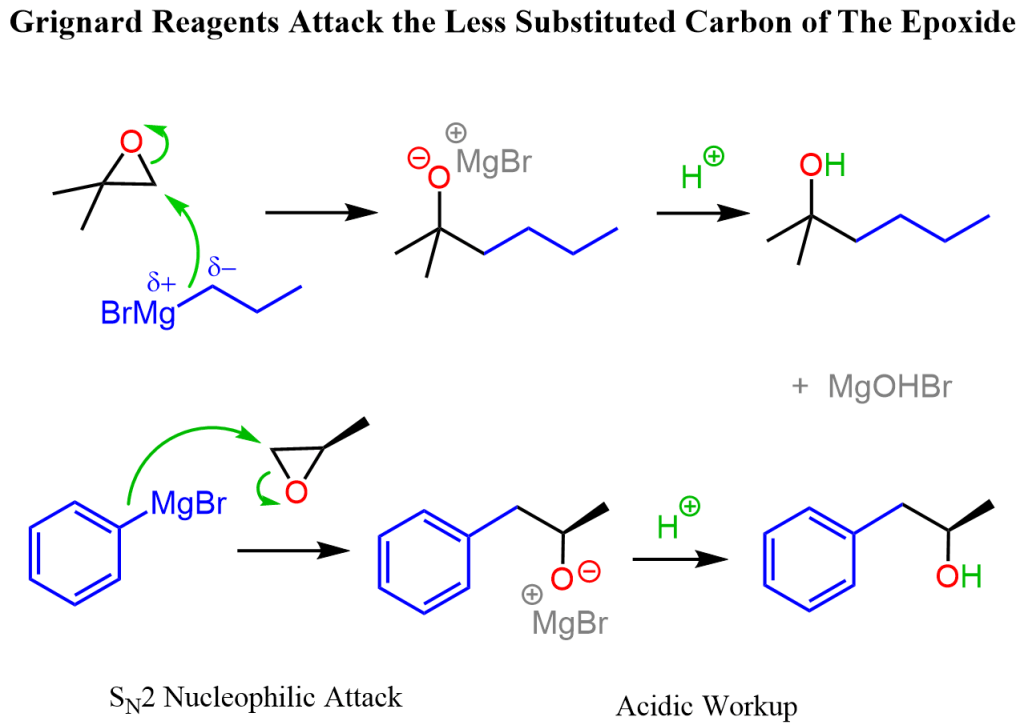
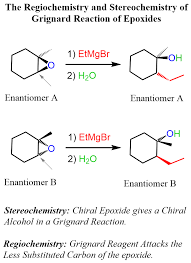
    Epoxide + Grignard Reagent (Complete JEE/NEET Concept)

    This is a high-weightage concept from alcohols + organometallics.


    General Reaction:

    Epoxide+RMgXdry etheralkoxideH3O+alcohol\text{Epoxide} + RMgX \xrightarrow{\text{dry ether}} \text{alkoxide} \xrightarrow{H_3O^+} \text{alcohol}


    Core Mechanism:

    • Grignard reagent (RMgX) behaves like R⁻ (strong nucleophile)
    • Attacks epoxide → ring opening (SN2 type)
    • Final step: acidic hydrolysis → alcohol

    Golden Rules (VERY IMPORTANT):

    Attack Position:

    ✔ Always attacks LESS substituted carbon (SN2 mechanism)


    Product Type:

    Alcohol is formed at the carbon where O⁻ was present
    ✔ Nature depends on epoxide structure:

    • Ethylene oxide → Primary alcohol
    • Substituted epoxide → Secondary / tertiary alcohol

    Chain Extension Trick:

    ✔ Adds +2 carbons (only with ethylene oxide clearly)
    ✔ With other epoxides → chain increases but depends on structure


    Important Cases:

    1. Ethylene Oxide:

    RMgXRCH2CH2OHRMgX \rightarrow R-CH_2-CH_2-OH

    Always primary alcohol
    +2 carbon extension (fixed)


    2. Unsymmetrical Epoxide (e.g., Propylene oxide):

    RMgXRCH2CH(R)OHRMgX \rightarrow R-CH_2-CH(R’)-OH

    Attack at less hindered carbon
    Usually secondary alcohol


    • JEE/NEET Quick Summary:

    ✔ RMgX = nucleophile (R⁻)
    ✔ Epoxide opening = SN2 reaction
    ✔ Attack = less substituted carbon
    ✔ Product = alcohol after H₃O⁺